India Turmeric Market Top 5 Importing Countries and Market Competition (HHI) Analysis
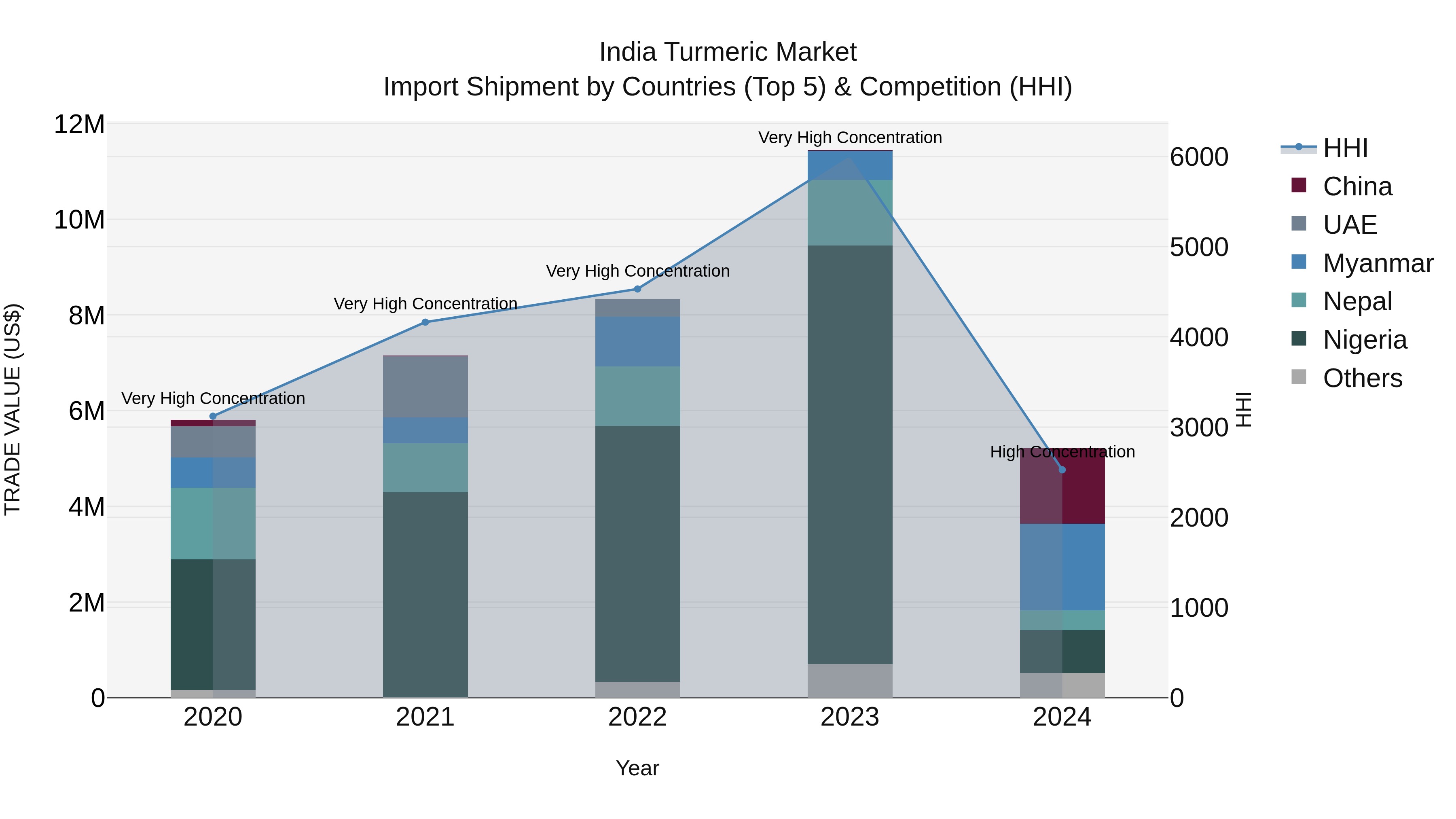
India`s turmeric import shipments in 2024 were dominated by top exporting countries including Myanmar, China, Nigeria, Nepal, and Vietnam. The Herfindahl-Hirschman Index (HHI) indicated a shift from very high concentration in 2023 to high concentration in 2024. Despite a negative Compound Annual Growth Rate (CAGR) of -2.65% from 2020 to 2024, the growth rate in 2024 saw a significant decline of -54.4% compared to the previous year. This suggests a challenging landscape for turmeric imports in India, with potential implications for the market dynamics and supply chains in the coming years.
India Turmeric Market Overview
The India Turmeric Market is one of the largest in the world, driven by both domestic consumption and export demand. Turmeric is a staple spice in Indian cuisine and is also widely used in traditional medicine and skincare products. The market is characterized by a diverse range of products, including raw turmeric, turmeric powder, and value-added products like turmeric supplements and extracts. India is the largest producer and exporter of turmeric globally, with regions like Andhra Pradesh, Telangana, and Tamil Nadu being major cultivation hubs. Factors such as increasing awareness about the health benefits of turmeric, growing demand for organic products, and expanding applications in the food and cosmetic industries are driving market growth. However, challenges such as price volatility, quality control issues, and competition from other turmeric-producing countries pose potential hurdles for market players.
India Turmeric Market Trends
The India Turmeric Market is currently experiencing a surge in demand due to its various health benefits and culinary uses. The market is witnessing a growing preference for organic turmeric as consumers are becoming more health-conscious and environmentally aware. There is also a rising demand for value-added turmeric products such as turmeric extracts and supplements, driven by the increasing awareness of turmeric`s anti-inflammatory and antioxidant properties. Additionally, the Indian turmeric market is benefitting from growing exports to countries like the US and the Middle East, where turmeric is gaining popularity for its medicinal properties. Overall, the market is expected to continue its growth trajectory in the coming years, supported by increasing consumer awareness and the expanding application of turmeric in various industries.
India Turmeric Market Challenges
In the India Turmeric Market, some key challenges include price volatility due to fluctuations in supply and demand, weather conditions affecting crop yields, quality control issues leading to inconsistent product quality, and competition from other turmeric-producing countries. Additionally, inadequate infrastructure and storage facilities can result in post-harvest losses, impacting both farmers and traders. Regulatory challenges such as changing export policies and quality standards also pose hurdles in the market. Furthermore, the presence of counterfeit products and adulteration practices can undermine consumer trust and market integrity. Overall, addressing these challenges requires a coordinated effort from stakeholders across the turmeric supply chain to ensure sustainable growth and competitiveness in the Indian turmeric market.
India Turmeric Market Investment Opportunities
The India Turmeric Market presents several investment opportunities due to the growing demand for turmeric both domestically and internationally. Investors can consider investing in turmeric farming operations to capitalize on the increasing demand for this popular spice. Additionally, there is potential for investment in turmeric processing facilities to cater to the demand for turmeric powder, extracts, and supplements. The health and wellness trend driving the demand for turmeric products further enhances the investment prospects in this market. Furthermore, with the Indian government`s focus on promoting agriculture and exports, there are opportunities for investors to participate in the turmeric export market. Overall, the India Turmeric Market offers diverse investment avenues for those looking to capitalize on the growing demand for this versatile spice.
India Turmeric Market Government Policy
The Indian government has implemented various policies to support and regulate the turmeric market. The Minimum Support Price (MSP) scheme ensures that farmers receive a fair price for their turmeric, protecting them from market fluctuations. The government also provides subsidies for inputs such as seeds, fertilizers, and irrigation to promote higher yields and quality. In addition, export promotion schemes incentivize turmeric traders to explore international markets and increase foreign exchange earnings. To ensure quality standards, the government has set regulations for packaging, labeling, and certification. Overall, these policies aim to stabilize the turmeric market, support farmers, promote exports, and maintain quality standards in the industry.
India Turmeric Market Future Outlook
The future outlook for the India Turmeric Market appears promising due to growing consumer awareness of the health benefits associated with turmeric consumption. As a key ingredient in traditional Indian cuisine and an increasingly popular supplement in the health and wellness sector, turmeric demand is expected to rise. Additionally, the rising popularity of turmeric in the global market, driven by its anti-inflammatory and antioxidant properties, is likely to increase export opportunities for Indian producers. However, challenges such as fluctuating weather patterns affecting crop yields and price volatility may impact market growth. Overall, the India Turmeric Market is anticipated to expand steadily, driven by increasing consumer demand and expanding export opportunities.
Key Highlights of the Report:
- India Turmeric Market Outlook
- Market Size of India Turmeric Market,2024
- Forecast of India Turmeric Market, 2031
- Historical Data and Forecast of India Turmeric Revenues & Volume for the Period 2021-2031
- India Turmeric Market Trend Evolution
- India Turmeric Market Drivers and Challenges
- India Turmeric Price Trends
- India Turmeric Porter's Five Forces
- India Turmeric Industry Life Cycle
- Historical Data and Forecast of India Turmeric Market Revenues & Volume By Type for the Period 2021-2031
- Historical Data and Forecast of India Turmeric Market Revenues & Volume By Organic for the Period 2021-2031
- Historical Data and Forecast of India Turmeric Market Revenues & Volume By Conventional for the Period 2021-2031
- Historical Data and Forecast of India Turmeric Market Revenues & Volume By Processed for the Period 2021-2031
- Historical Data and Forecast of India Turmeric Market Revenues & Volume By Infused for the Period 2021-2031
- Historical Data and Forecast of India Turmeric Market Revenues & Volume By Others for the Period 2021 - 2029
- Historical Data and Forecast of India Turmeric Market Revenues & Volume By Form for the Period 2021-2031
- Historical Data and Forecast of India Turmeric Market Revenues & Volume By Powder for the Period 2021-2031
- Historical Data and Forecast of India Turmeric Market Revenues & Volume By Whole for the Period 2021-2031
- Historical Data and Forecast of India Turmeric Market Revenues & Volume By Extracts for the Period 2021-2031
- Historical Data and Forecast of India Turmeric Market Revenues & Volume By Capsules for the Period 2021-2031
- Historical Data and Forecast of India Turmeric Market Revenues & Volume By Application for the Period 2021-2031
- Historical Data and Forecast of India Turmeric Market Revenues & Volume By Culinary Use for the Period 2021-2031
- Historical Data and Forecast of India Turmeric Market Revenues & Volume By Medicinal Use for the Period 2021-2031
- Historical Data and Forecast of India Turmeric Market Revenues & Volume By Skincare for the Period 2021-2031
- Historical Data and Forecast of India Turmeric Market Revenues & Volume By Herbal Therapy for the Period 2021-2031
- Historical Data and Forecast of India Turmeric Market Revenues & Volume By Nutritional Supplements for the Period 2021 - 2029
- Historical Data and Forecast of India Turmeric Market Revenues & Volume By End Use for the Period 2021-2031
- Historical Data and Forecast of India Turmeric Market Revenues & Volume By Households for the Period 2021-2031
- Historical Data and Forecast of India Turmeric Market Revenues & Volume By Pharmaceuticals for the Period 2021-2031
- Historical Data and Forecast of India Turmeric Market Revenues & Volume By Personal Care for the Period 2021-2031
- Historical Data and Forecast of India Turmeric Market Revenues & Volume By Alternative Medicine for the Period 2021-2031
- Historical Data and Forecast of India Turmeric Market Revenues & Volume By Nutraceuticals for the Period 2021 - 2029
- Historical Data and Forecast of India Turmeric Market Revenues & Volume By End Use for the Period 2021-2031
- Historical Data and Forecast of India Turmeric Market Revenues & Volume By Professional Tattooing for the Period 2021-2031
- Historical Data and Forecast of India Turmeric Market Revenues & Volume By Tattoo Studios for the Period 2021-2031
- India Turmeric Import Export Trade Statistics
- Market Opportunity Assessment By Type
- Market Opportunity Assessment By Form
- Market Opportunity Assessment By Application
- Market Opportunity Assessment By End Use
- Market Opportunity Assessment By End Use
- India Turmeric Top Companies Market Share
- India Turmeric Competitive Benchmarking By Technical and Operational Parameters
- India Turmeric Company Profiles
- India Turmeric Key Strategic Recommendations






































