India Virtual Router Market Size & Growth Rate (2026-2032)
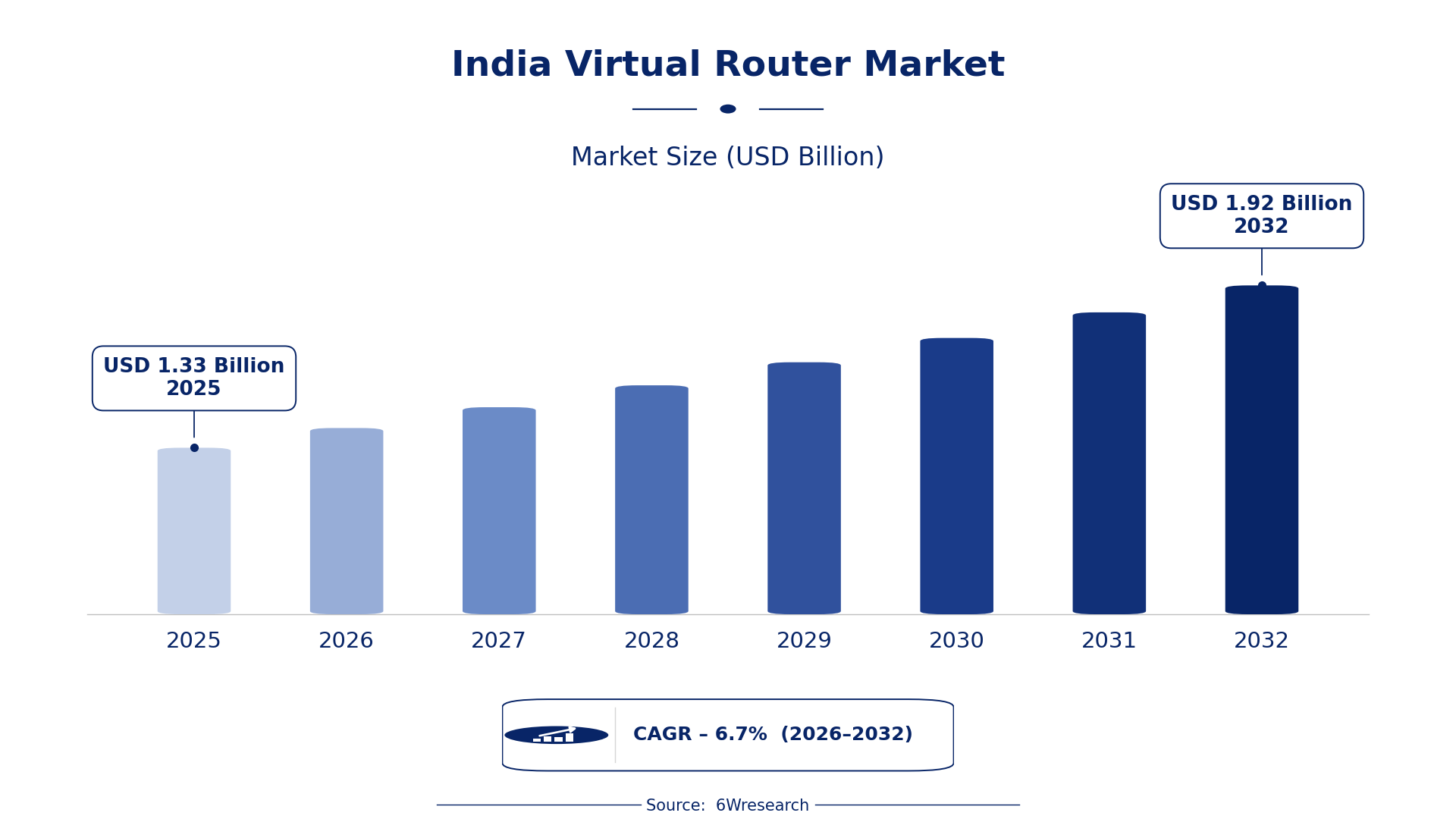
The India Virtual Router Market was estimated at USD 1333 Million in 2025 and is projected to reach USD 1918 Million by 2032, growing at a CAGR of 6.7% from 2026 to 2032.
India Virtual Router Market Synopsis
The rise of software-defined networking (SDN) is the most significant force currently driving the India Virtual Router Market. Organizations are increasingly adopting SDN to streamline network management, enabling flexibility and customization that traditional hardware cannot match.
As businesses undergo digital transformation, the demand for scalable and cost-effective networking solutions has surged. Virtual routers are emerging as a preferred option, as they reduce reliance on physical infrastructure, allowing companies to respond swiftly to changing market needs.
India Virtual Router Market Year-wise Growth Rate and Key Drivers
This graph illustrates the annual growth rates of the India Virtual Router Market from 2021 to 2032, highlighting a steady upward trajectory and projected expansion over the forecast period.
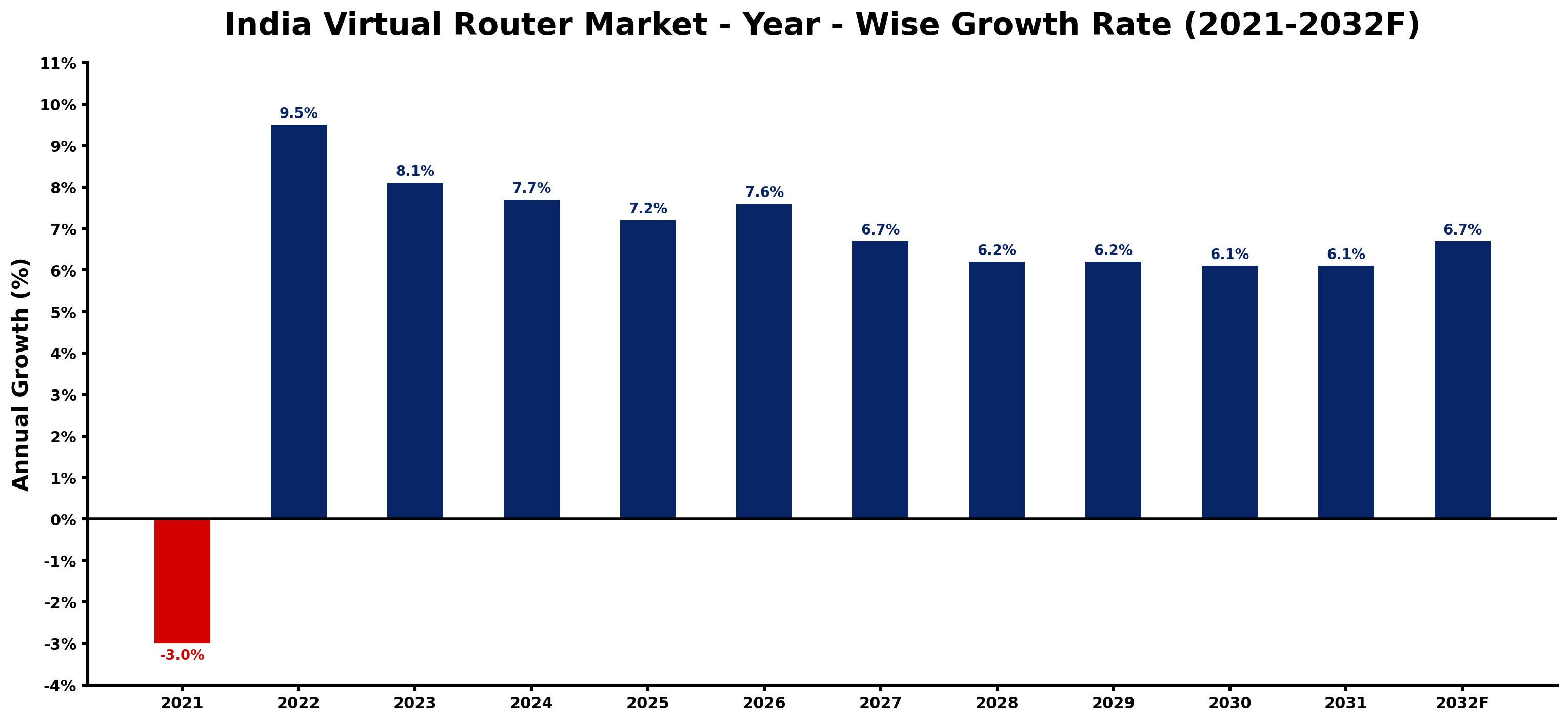
The table below presents the year‑wise growth rates along with the key drivers influencing the market
| Year | Growth Rate | Major Drivers |
| 2021 | -3.0% | Telecom Regulatory Authority of India limited new spectrum allocation. |
| 2022 | 9.5% | Government's Digital India initiative boosting internet infrastructure growth |
| 2023 | 8.1% | Rise in remote work increasing need for reliable connectivity |
| 2024 | 7.7% | Telecom sector investments in 5G enhancing virtual router demand |
| 2025 | 7.2% | Emerging startups requiring scalable virtual networking solutions |
| 2026 | 7.6% | Regulatory push for improved cybersecurity measures in networking |
| 2027 | 6.7% | Increased online education spurring demand for robust routers |
| 2028 | 6.2% | E-commerce growth driving demand for high-performance networking |
| 2029 | 6.2% | Smart city projects necessitating advanced routing technologies |
| 2030 | 6.1% | Digital transformation in small businesses driving router adoption |
| 2031 | 6.1% | Rising use of IoT devices requiring enhanced virtual networking |
| 2032 | 6.7% | Government's push for digitalization encouraging virtual router usage |
Note: Market size estimations and growth projections presented in this report are based on 6Wresearch's proprietary forecasting methodology, utilizing the latest available industry data, government publications, and primary research inputs.
India Virtual Router Market Key Takeaways
Below are some of the specific key takeaways from the market, including:
- The market is being significantly influenced by the shift towards cloud-based services.
- Growing adoption of network function virtualization (NFV) is enhancing operational efficiency.
- Increased online activities during the pandemic have underscored the importance of virtual routers.
- Major companies are investing in innovations to offer advanced routing solutions.
- The focus on regulatory compliance is shaping the deployment of virtual router technologies.
Evaluation of Restraints in India Virtual Router Market
Despite the market's growth, several factors are limiting its full potential. Key among these is the challenge of managing and securing a wide array of end-user devices. Organizations must find a balance between user mobility and data security, often resulting in complex strategies. Additionally, maintaining a consistent user experience across diverse platforms poses significant difficulties. Regulatory compliance and data privacy concerns are also complicating the decision-making process for businesses looking to adopt virtual router solutions.
India Virtual Router Market Trends
The demand for virtual routers is increasingly shaped by trends such as the integration of AI and machine learning for enhanced network management. Companies are leveraging these technologies to automate processes and improve decision-making. on top of that, the growing trend of remote work is propelling the need for agile networking solutions that can adapt to fluctuating user demands. This evolution is driving the development of more sophisticated virtual routing capabilities.
India Virtual Router Market Opportunities
The landscape is rife with growth opportunities, particularly for businesses willing to invest in innovative networking solutions. As more organizations transition to hybrid cloud environments, the demand for virtual routers that can seamlessly integrate with existing infrastructure will only increase. Additionally, the ongoing push for digitalization across sectors presents a ripe environment for companies specializing in virtual routing technologies to expand their offerings.
Government Initiatives in the India Virtual Router Market
Government policies are playing an essential role in shaping the direction of the India Virtual Router Market. With a focus on enhancing digital infrastructure, public policy is increasingly supportive of innovations that promote efficient networking solutions. This regulatory environment is crucial for businesses looking to adopt virtual routing technologies and aligns with broader objectives of economic growth and technological advancement.
- A national digital infrastructure upgrade programme was recently completed, enhancing connectivity across urban and rural areas.
- Current initiatives are underway to promote public-private partnerships aimed at expanding telecom infrastructure access.
- Upcoming regulations are expected to mandate improved billing transparency for network services, impacting virtual router deployment.
- A framework introduced in 2025 aims to support the integration of SDN technologies within government sectors.
- Future policies are being planned to provide incentives for companies adopting virtualization technologies, encouraging innovation.
Future Insights of the India Virtual Router Market
Looking ahead to 2026-2032, the India Virtual Router Market is set to expand considerably as digital transformation accelerates. Organizations will increasingly rely on virtual routers to enhance their network agility and operational efficiency. The continued rise of cloud computing and the integration of advanced technologies will further fuel market growth. As businesses seek to modernize their infrastructure, the demand for innovative routing solutions will remain strong.
India Virtual Router Market Latest Developments
Recent activity in the India Virtual Router Market reflects a growing emphasis on innovation and efficiency. Companies are focusing on developing advanced solutions that can meet the increasing demands of a digital-first world. As the market evolves, strategic partnerships and technological advancements are becoming more common, highlighting a competitive drive for leadership.
- A major technology vendor launched a new virtual routing solution in early 2025, aimed at enhancing network efficiency for enterprise clients.
- Ongoing collaboration between telecom operators and software providers is enhancing service delivery and reducing operational costs.
- An upcoming rollout planned for late 2026 aims to integrate AI-driven analytics into virtual routing functionalities.
- A recent partnership established between regional operators focuses on sharing best practices for network virtualization, currently underway.
- A new service upgrade expected by mid-2026 will enhance security features in virtual routers, addressing emerging cyber threats.
India Virtual Router Market - Key Attractiveness of the Report
- 10 Years of Market Numbers
- Historical Data Starting from 2022 to 2025
- Base Year: 2025
- Forecast Data until 2032
- Key Performance Indicators Impacting the Market
- Major Upcoming Developments and Projects
Key Highlights of the Report:
- India Virtual Router Market Outlook
- Market Size of India Virtual Router Market, 2025
- Forecast of India Virtual Router Market, 2032
- Historical Data and Forecast of India Virtual Router Revenues & Volume for the Period 2022-2032F
- India Virtual Router Market Trend Evolution
- India Virtual Router Market Drivers and Challenges
- India Virtual Router Price Trends
- India Virtual Router Porter's Five Forces
- India Virtual Router Industry Life Cycle
- Historical Data and Forecast of India Virtual Router Market Revenues & Volume By Component for the Period 2022-2032F
- Historical Data and Forecast of India Virtual Router Market Revenues & Volume By Solution for the Period 2022-2032F
- Historical Data and Forecast of India Virtual Router Market Revenues & Volume By Service for the Period 2022-2032F
- Historical Data and Forecast of India Virtual Router Market Revenues & Volume By Type for the Period 2022-2032F
- Historical Data and Forecast of India Virtual Router Market Revenues & Volume By Pre-defined for the Period 2022-2032F
- Historical Data and Forecast of India Virtual Router Market Revenues & Volume By Custom for the Period 2022-2032F
- Historical Data and Forecast of India Virtual Router Market Revenues & Volume By End-User for the Period 2022-2032F
- Historical Data and Forecast of India Virtual Router Market Revenues & Volume By Service Provider for the Period 2022-2032F
- Historical Data and Forecast of India Virtual Router Market Revenues & Volume By Enterprises for the Period 2022-2032F
- India Virtual Router Import Export Trade Statistics
- Market Opportunity Assessment By Component
- Market Opportunity Assessment By Type
- Market Opportunity Assessment By End-User
- India Virtual Router Top Companies Market Share
- India Virtual Router Competitive Benchmarking By Technical and Operational Parameters
- India Virtual Router Company Profiles
- India Virtual Router Key Strategic Recommendations






































