India Workforce Management Market Size & Growth Rate (2026-2032)
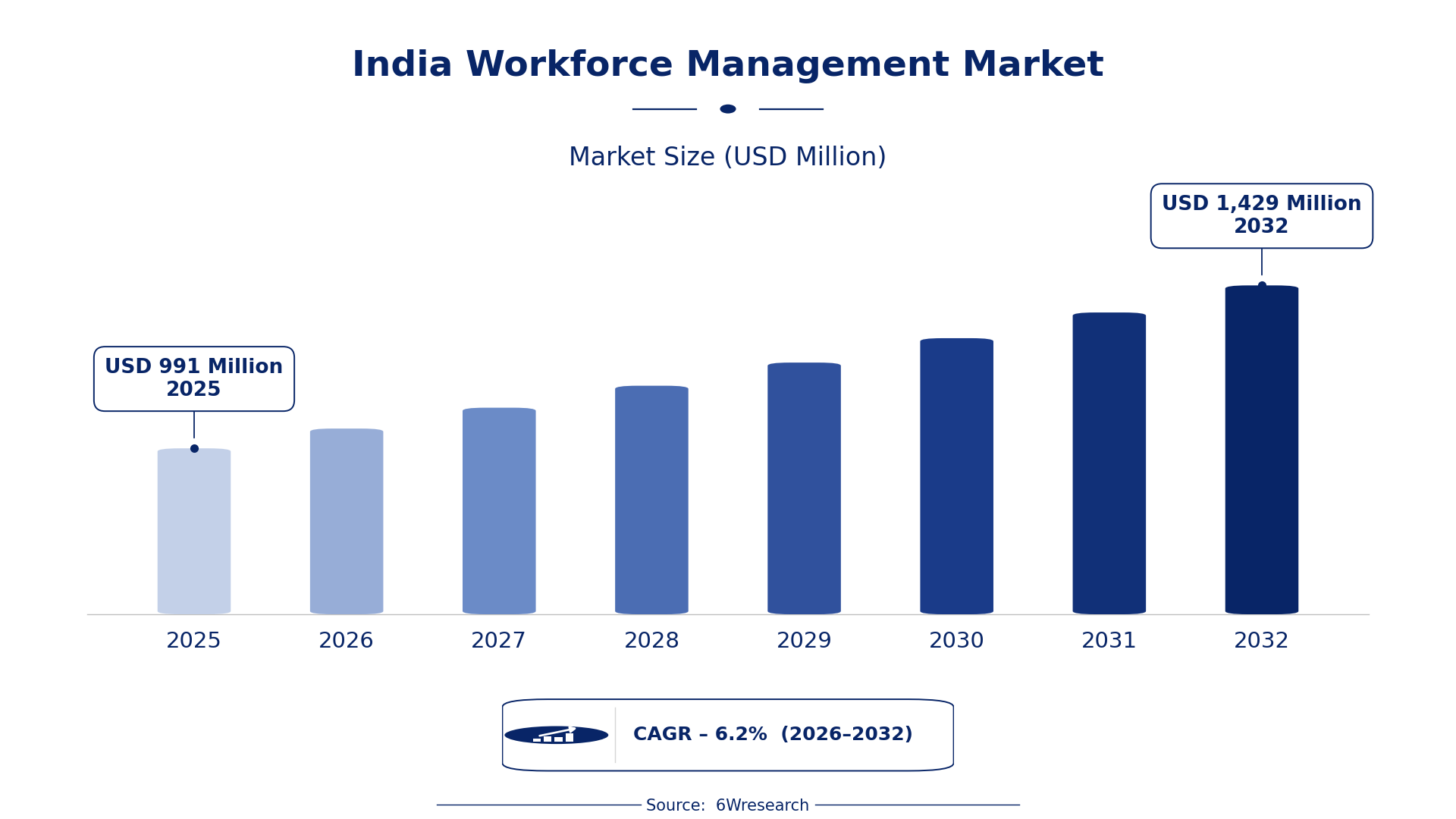
The India Workforce Management Market was estimated at USD 991 Million in 2025 and is projected to reach USD 1429 Million by 2032, growing at a CAGR of 6.2% from 2026 to 2032.
India Workforce Management Market Synopsis
As organizations in India increasingly shift towards flexible work arrangements, the demand for advanced workforce management solutions is surging. Companies are investing in tools that enhance employee scheduling, time tracking, and analytics to maintain productivity and compliance.
The post-pandemic environment has only intensified this need, as remote work has become a standard practice. Businesses are now tasked with re-evaluating their workforce management strategies to meet these new demands, paving the way for innovative solutions tailored to diverse workforce scenarios.
India Workforce Management Market Year-wise Growth Rate and Key Drivers
This graph illustrates the annual growth rates of the India Workforce Management Market from 2021 to 2032, highlighting a steady upward trajectory and projected expansion over the forecast period.
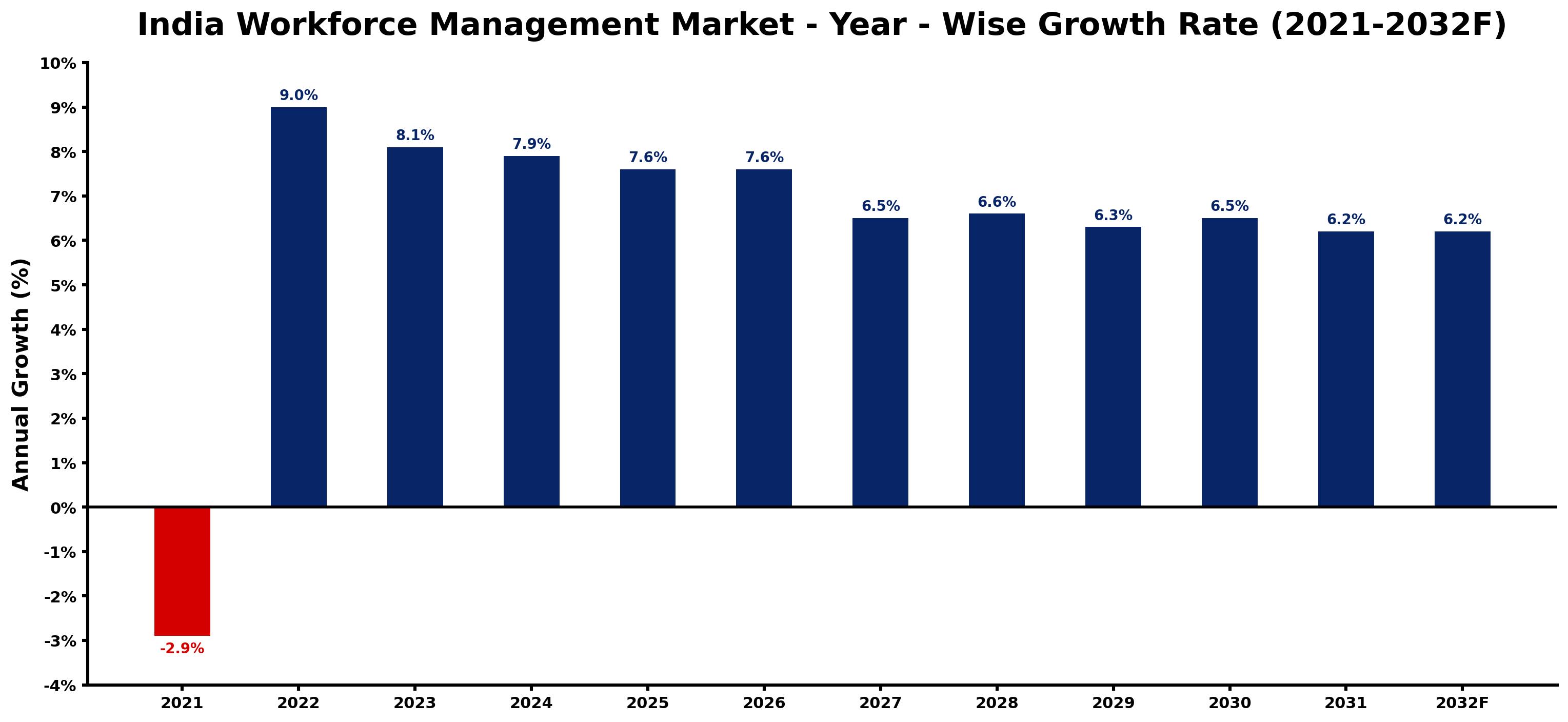
The table below presents the year‑wise growth rates along with the key drivers influencing the market
| Year | Growth Rate | Major Drivers |
| 2021 | -2.9% | Implementation delays of new labor laws by government |
| 2022 | 9.0% | Increased gig economy participation among tech-savvy youth. |
| 2023 | 8.1% | Government's Skill India initiative enhancing workforce productivity. |
| 2024 | 7.9% | Emergence of AI-driven HR solutions in urban sectors. |
| 2025 | 7.6% | Startup culture driving workplace automation adoption. |
| 2026 | 7.6% | Evolving labor laws promoting remote workforce management. |
| 2027 | 6.5% | High mobile penetration facilitating real-time workforce tracking. |
| 2028 | 6.6% | Focus on employee engagement due to attrition rates. |
| 2029 | 6.3% | Adoption of analytics tools for workforce insights. |
| 2030 | 6.5% | Demand for upskilling amid rapid technological advancements. |
| 2031 | 6.2% | Growth of hybrid work models after pandemic effects. |
| 2032 | 6.2% | Local startups pushing innovation in employee management tools. |
Note: Market size estimations and growth projections presented in this report are based on 6Wresearch's proprietary forecasting methodology, utilizing the latest available industry data, government publications, and primary research inputs.
India Workforce Management Market Key Takeaways
Below are some of the specific key takeaways from the market, including:
- The market is experiencing a surge in demand due to the complexities of managing hybrid workforces.
- Technological advancements are driving innovations in workforce management tools across various sectors.
- Compliance with labor regulations is becoming increasingly critical, influencing software development.
- Real-time analytics and reporting capabilities are top priorities for organizations investing in these solutions.
- The integration of artificial intelligence is expected to reshape workforce management practices significantly.
Evaluation of Restraints in India Workforce Management Market
Despite the growth trajectory, the India Workforce Management Market faces several restraints. One major limitation is the varying compliance requirements across different states, which complicates the implementation of standardized solutions. Additionally, many companies are still hesitant to fully embrace technology due to concerns over data security and employee privacy. These factors create a challenging environment for vendors seeking to penetrate the market effectively.
India Workforce Management Market Trends
Several trends are currently shaping the India Workforce Management Market. The rise of AI-driven analytics is transforming how companies forecast labor needs and assess employee performance. Another notable trend is the increasing adoption of mobile applications, allowing managers to oversee workforce operations remotely. on top of that, a focus on employee well-being and engagement is driving organizations to seek solutions that foster a positive workplace culture.
India Workforce Management Market Opportunities
Opportunities abound for businesses looking to invest in workforce management solutions. The ongoing digital transformation across industries presents a ripe landscape for innovative software that enhances operational efficiency. Additionally, as more organizations adopt hybrid work models, there is a growing need for tailored solutions that address the unique challenges of managing a dispersed workforce. Investments in training and development tools also represent a significant opportunity for growth.
Government Initiatives in the India Workforce Management Market
Government initiatives are increasingly influencing the India Workforce Management Market. With a focus on enhancing labor market efficiency, recent policy developments are aimed at promoting compliance with labor regulations and encouraging the adoption of technology in workforce management. The regulatory landscape is evolving to support businesses in managing their human resources effectively.
- A regulatory framework introduced in 2025 mandating transparency in employee scheduling and payroll practices.
- Current initiatives focused on digital infrastructure upgrades to enhance connectivity for remote workforce solutions.
- A planned public-private partnership expected to foster innovation in workforce management software by 2027.
- Recently launched training programs aimed at equipping HR professionals with the skills needed for effective workforce management.
Future Insights of the India Workforce Management Market
Looking ahead, the India Workforce Management Market is set to witness transformative changes driven by technological advancements and evolving workforce needs. As organizations continue to adopt flexible work models, the demand for integrated workforce management solutions will grow. The emphasis on real-time data analytics, employee engagement, and compliance will shape product offerings, leading to a more dynamic and responsive market environment.
India Workforce Management Market Latest Developments
Recent developments within the India Workforce Management Market highlight the industry's quick adaptation to changing demands and technologies. Over the past year, companies have been actively innovating and launching new solutions aimed at streamlining workforce operations and enhancing productivity.
- A major technology vendor launched a new AI-driven workforce analytics platform in early 2025, aimed at improving operational efficiency.
- A leading regional operator is currently expanding its mobile workforce management application, with updates expected by mid-2026.
- An initiative that began in late 2025 focuses on integrating compliance management tools into existing HR systems.
- A planned rollout of a cloud-based workforce management solution is set to begin in Q3 2026, targeting small to mid-sized enterprises.
India Workforce Management Market - Key Attractiveness of the Report
- 10 Years of Market Numbers
- Historical Data Starting from 2022 to 2025
- Base Year: 2025
- Forecast Data until 2032
- Key Performance Indicators Impacting the Market
- Major Upcoming Developments and Projects
Key Highlights of the Report:
- India Workforce Management Market Outlook
- Market Size of India Workforce Management Market, 2025
- Forecast of India Workforce Management Market, 2032
- Historical Data and Forecast of India Workforce Management Revenues & Volume for the Period 2022-2032F
- India Workforce Management Market Trend Evolution
- India Workforce Management Market Drivers and Challenges
- India Workforce Management Price Trends
- India Workforce Management Porter's Five Forces
- India Workforce Management Industry Life Cycle
- Historical Data and Forecast of India Workforce Management Market Revenues & Volume By Solution for the Period 2022-2032F
- Historical Data and Forecast of India Workforce Management Market Revenues & Volume By Time and Attendance Management for the Period 2022-2032F
- Historical Data and Forecast of India Workforce Management Market Revenues & Volume By Leave and Absence Management for the Period 2022-2032F
- Historical Data and Forecast of India Workforce Management Market Revenues & Volume By Workforce Scheduling for the Period 2022-2032F
- Historical Data and Forecast of India Workforce Management Market Revenues & Volume By Workforce Analytics for the Period 2022-2032F
- Historical Data and Forecast of India Workforce Management Market Revenues & Volume By Others for the Period 2022-2032F
- Historical Data and Forecast of India Workforce Management Market Revenues & Volume By Component for the Period 2022-2032F
- Historical Data and Forecast of India Workforce Management Market Revenues & Volume By Solutions for the Period 2022-2032F
- Historical Data and Forecast of India Workforce Management Market Revenues & Volume By Services for the Period 2022-2032F
- Historical Data and Forecast of India Workforce Management Market Revenues & Volume By Service for the Period 2022-2032F
- Historical Data and Forecast of India Workforce Management Market Revenues & Volume By Consulting for the Period 2022-2032F
- Historical Data and Forecast of India Workforce Management Market Revenues & Volume By Implementation for the Period 2022-2032F
- Historical Data and Forecast of India Workforce Management Market Revenues & Volume By Training, Support and Maintenance for the Period 2022-2032F
- Historical Data and Forecast of India Workforce Management Market Revenues & Volume By Deployment Type for the Period 2022-2032F
- Historical Data and Forecast of India Workforce Management Market Revenues & Volume By On-Premises for the Period 2022-2032F
- Historical Data and Forecast of India Workforce Management Market Revenues & Volume By Cloud for the Period 2022-2032F
- Historical Data and Forecast of India Workforce Management Market Revenues & Volume By Organization Size for the Period 2022-2032F
- Historical Data and Forecast of India Workforce Management Market Revenues & Volume By Large Enterprises for the Period 2022-2032F
- Historical Data and Forecast of India Workforce Management Market Revenues & Volume By Small and Medium-sized Enterprises (SMEs) for the Period 2022-2032F
- Historical Data and Forecast of India Workforce Management Market Revenues & Volume By Vertical for the Period 2022-2032F
- Historical Data and Forecast of India Workforce Management Market Revenues & Volume By Banking, Financial Services and Insurance (BFSI) for the Period 2022-2032F
- Historical Data and Forecast of India Workforce Management Market Revenues & Volume By Telecom for the Period 2022-2032F
- Historical Data and Forecast of India Workforce Management Market Revenues & Volume By Government for the Period 2022-2032F
- Historical Data and Forecast of India Workforce Management Market Revenues & Volume By Consumer Goods and Retail for the Period 2022-2032F
- Historical Data and Forecast of India Workforce Management Market Revenues & Volume By Manufacturing for the Period 2022-2032F
- Historical Data and Forecast of India Workforce Management Market Revenues & Volume By Energy and Utilities for the Period 2022-2032F
- Historical Data and Forecast of India Workforce Management Market Revenues & Volume By Transportation and Logistics for the Period 2022-2032F
- Historical Data and Forecast of India Workforce Management Market Revenues & Volume By Healthcare and Life Sciences for the Period 2022-2032F
- India Workforce Management Import Export Trade Statistics
- Market Opportunity Assessment By Solution
- Market Opportunity Assessment By Component
- Market Opportunity Assessment By Service
- Market Opportunity Assessment By Deployment Type
- Market Opportunity Assessment By Organization Size
- Market Opportunity Assessment By Vertical
- India Workforce Management Top Companies Market Share
- India Workforce Management Competitive Benchmarking By Technical and Operational Parameters
- India Workforce Management Company Profiles
- India Workforce Management Key Strategic Recommendations






































