India Zinc Market Top 5 Importing Countries and Market Competition (HHI) Analysis
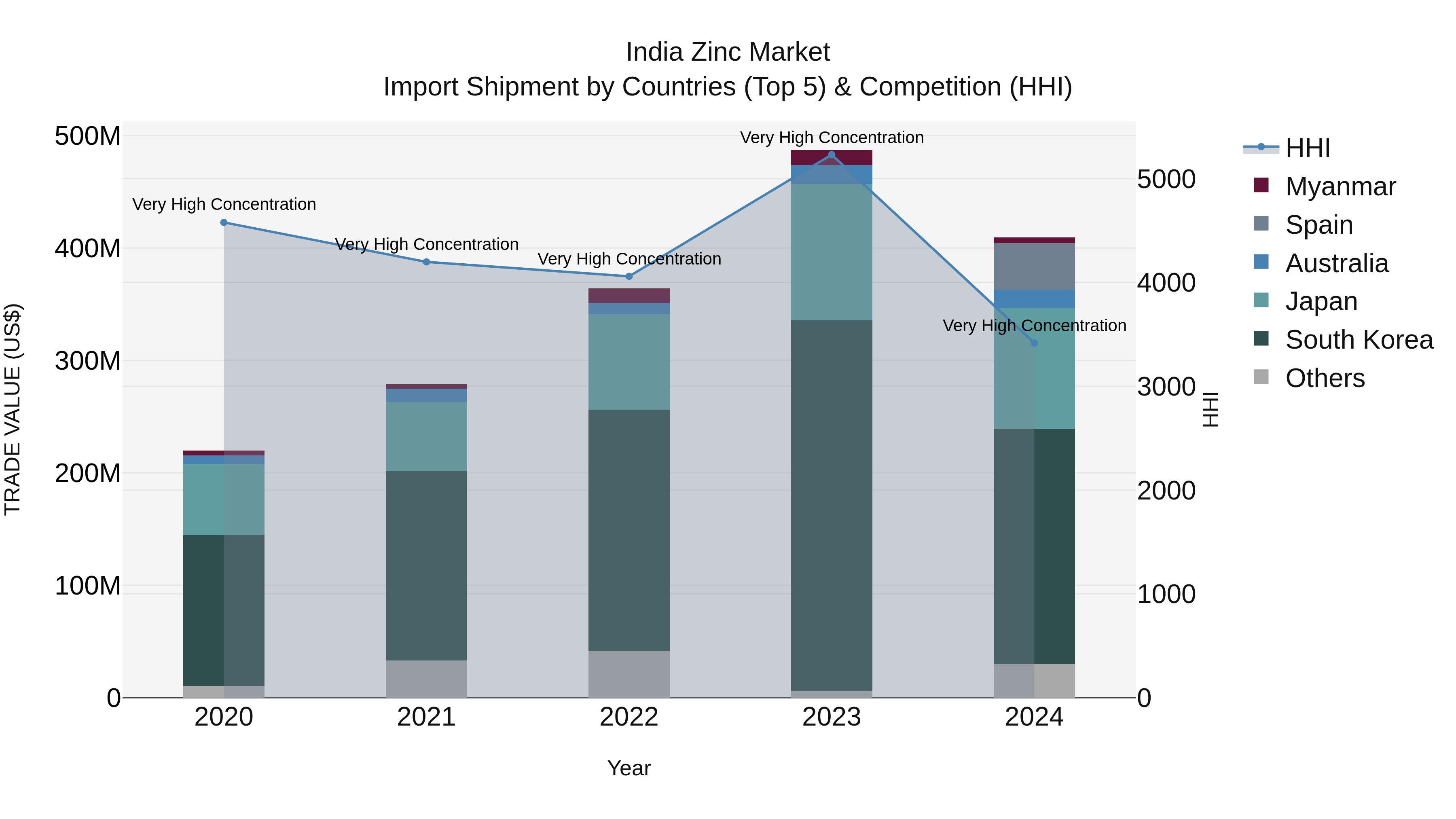
India`s zinc import shipments in 2024 continued to showcase a high level of concentration, with South Korea, Japan, Spain, Australia, and even domestic sources being the top exporters to India. Despite the impressive compound annual growth rate (CAGR) of 16.83% from 2020 to 2024, a slight decline was observed in the growth rate from 2023 to 2024 at -15.9%. This data suggests a dynamic market landscape for zinc imports in India, with key players maintaining their dominance while facing fluctuations in growth rates.
India Zinc Market Growth Rate
According to 6Wresearch internal database and industry insights, the India Zinc Market is projected to grow at a compound annual growth rate (CAGR) of 5.9% during the forecast period (2026-2032).
Topics Covered in the India Zinc Market Report
The India Zinc Market report thoroughly covers the market by product type and applications. The market report provides an unbiased and detailed analysis of ongoing market trends, opportunities/high growth areas, and market drivers, which help stakeholders devise and align their market strategies according to the current and future market dynamics.
India Zinc Market Highlights
| Report Name | India Zinc Market |
| Forecast period | 2026-2032 |
| CAGR | 5.9% |
| Growing Sector | Galvanizing Segment |
India Zinc Market Synopsis
India Zinc Market is anticipated to record notable growth due to the growing demand in the construction, infrastructure, and automotive sectors. Zinc is indispensable in the process of galvanizing steel, as it improves the resistance of metal products to corrosion and increases their durability, thus being vital for extensive infrastructure projects. Moreover, the increased investment in the production of renewable energy sources, such as solar panels and wind turbines, has positively impacted the market dynamics by increasing the demand for zinc. The development of manufacturing industries and policies encouraging domestic production have also driven the market forward.
Evaluation of Growth Drivers in the India Zinc Market
Below mentioned are some prominent drivers and their influence on the market dynamics:
| Drivers | Primary Segments Affected | Why it Matters (Evidence) |
| Infrastructure Development | Galvanizing; Construction | Large projects increase demand for corrosion-resistant steel. |
| Growth in Automotive Industry | Die Casting; Transportation | Zinc is widely used in automotive components manufacturing. |
| Expansion of Renewable Energy | Galvanizing; Energy Sector | Zinc coatings protect structures in solar and wind installations. |
| Rising Industrial Manufacturing | Brass & Bronze; Consumer Goods | Industrial growth boosts zinc consumption across applications. |
| Government Support for Mining | All Applications; Industry | Policies promote domestic production and reduce import dependence. |
India Zinc Market is expected to grow at the CAGR of 5.9% during the forecast period of 2026-2032. The key drivers of growth in this industry include increasing investments in infrastructure construction, rising automotive applications, and high demand for galvanized steel. Moreover, there are increasing investments being made in renewable energy projects that use materials which are corrosion-resistant and durable. There are also some favorable government policies regarding mining and metals production within the country. Growth in industrial activity and urbanization is also leading to higher usage of zinc in India.
Evaluation of Restraints in the India Zinc Market
Below mentioned are some major restraints and their influence on the market dynamics:
| Restraints | Primary Segments Affected | What This Means (Evidence) |
| Fluctuating Raw Material Prices | All Applications; Manufacturing | Price volatility impacts production costs and profitability. |
| Environmental Regulations | Mining; Industry | Strict norms increase compliance costs for producers. |
| Energy Consumption Is High | Smelting; Manufacturing | Energy-hungry processes increase costs. |
| Imports of Technology Are Dependable | All Applications; Manufacturing | Prevents the enhancement of efficiency of production processes. |
| Disruptions In the Supply Chain | All Applications; Distribution | Time delays impact the delivery process. |
India Zinc Industry Challenges
Despite steady growth, the India Zinc Industry faces several challenges that affect its overall performance. In addition to those challenges, there is the threat of prices in the market for raw materials being unpredictable, leaving manufacturers unsure about their bottom line. Another challenge with producing zinc is that it involves the use of lots of energy, leading to increased production costs. In addition, there are regulations that compel manufacturers to invest in technology for better environmental sustainability. Supply chain problems and dependence on foreign technology also hinder efficiency improvements.
India Zinc Market Trends
Emerging trends in the India Zinc Market Growth are:
- Growing Demand for Galvanized Steel: Galvanized steel is becoming more popular in construction projects due to its resistance to corrosion. This will lead to an increase in the demand for zinc in major projects.
- Increased Investment in Renewable Energy: Zinc is finding more applications in the construction of photovoltaic cells and wind turbines. This development will contribute to increasing zinc usage in the future.
- Advances in Smelting Technologies: Manufacturers are embracing new technologies that help increase efficiency and decrease pollution levels. These advancements boost production capabilities.
- Growing Usage in Vehicle Parts: Zinc is extensively employed in die casting for vehicle components due to its hardness and sturdiness.
Investment Opportunities in the India Zinc Market
Some best investment opportunities in the India Zinc Market Share include:
- Increased Scope of Mining Activities – Investing in mining activities within the country increases zinc output potential. This lessens reliance on external sources.
- Adoption of Innovative Smelting Techniques – Organizations can invest in environmentally friendly smelting techniques that conserve energy. This leads to cost savings.
- Investment in Infrastructure Development – Investment in infrastructure leads to increased demand for galvanized steel, thereby creating business opportunities for zinc producers.
Top 5 Leading Players in the India Zinc Market
Some leading players operating in the India Zinc Market include:
1. Hindustan Zinc Limited
| Company Name | Hindustan Zinc LimitedA |
| Established Year | 1966 |
| Headquarters | Udaipur, India |
| Official Website | Click Here |
Hindustan Zinc Limited is India’s largest zinc producer, offering high-quality zinc and lead products. The company focuses on sustainable mining practices and advanced production technologies, supporting various industries such as construction, automotive, and infrastructure development.
2. Vedanta Limited
| Company Name | Vedanta Limited |
| Established Year | 1976 |
| Headquarters | Mumbai, India |
| Official Website | Click Here |
Vedanta Limited is a major player in the zinc market, providing integrated mining and metal production solutions. The company emphasizes efficiency and sustainability in its operations.
3. Glencore plc
| Company Name | Glencore plc |
| Established Year | 1974 |
| Headquarters | Baar, Switzerland |
| Official Website | Click Here |
Glencore is a global commodities company involved in zinc production and trading. It supplies zinc to various industries worldwide and focuses on responsible sourcing practices.
4. Teck Resources Limited
| Company Name | Teck Resources Limited |
| Established Year | 1913 |
| Headquarters | Vancouver, Canada |
| Official Website | Click Here |
Teck Resources is a leading producer of zinc concentrate and refined zinc. The company supports industrial applications and focuses on sustainable mining operations.
5. Boliden AB
| Company Name | Boliden AB |
| Established Year | 1924 |
| Headquarters | Stockholm, Sweden |
| Official Website | Click Here |
Boliden specializes in mining and smelting of metals including zinc. The company focuses on innovation and sustainability in metal production processes.
Government Regulations Introduced in the India Zinc Market
According to India’s Government Data, several programs are helping in the development of the zinc market. Firstly, there is the national mineral policy that focuses on sustainable mining operations and ensures participation of the private sector in mineral exploration. Secondly, the Make in India campaign facilitates metal production within India and minimizes reliance on imported metals. There are also environmental laws that ensure that mining and smelting processes are conducted responsibly. Furthermore, there are infrastructure programs that indirectly help zinc by enhancing galvanized steel demand.
Future Insights of the India Zinc Market
India Zinc Market is expected to witness steady growth driven by increasing infrastructure development and industrial expansion. The increased demand for anticorrosive products in the construction and transportation industries will contribute to the growth of the market. The development of various renewable energy sources will further contribute to an increase in demand for zinc in the market. Various innovations in mining and smelting operations will contribute towards higher efficiency and sustainability. The government support for local production will open up new avenues for growth for the market.
Market Segmentation Analysis
The report offers a comprehensive study of the subsequent market segments and their leading categories.
Galvanizing Segment to Dominate the Market – By Applications
According to Mohit, Senior Research Analyst, 6Wresearch, the Galvanizing segment dominates the India Zinc Market due to its extensive use in protecting steel from corrosion. The application finds wide acceptance across construction, infrastructure, and industrial sectors.
Construction Segment Leads Demand – By End-user
The Construction Segment is dominant owing to growing infrastructure construction and urbanization. Zinc is needed for the galvanization process that is used in steel construction. The market growth is backed by government investments in infrastructure projects.
Key Attractiveness of the Report
- 10 Years of Market Numbers.
- Historical Data Starting from 2022 to 2025.
- Base Year: 2025.
- Forecast Data until 2032.
- Key Performance Indicators Impacting the Market.
- Major Upcoming Developments and Projects.
Key Highlights of the Report:
- India Zinc Market Outlook
- Market Size of India Zinc Market, 2025
- Forecast of India Zinc Market, 2032
- Historical Data and Forecast of India Zinc Revenues & Volume for the Period 2022-2032
- India Zinc Market Trend Evolution
- India Zinc Market Drivers and Challenges
- India Zinc Price Trends
- India Zinc Porter's Five Forces
- India Zinc Industry Life Cycle
- Historical Data and Forecast of India Zinc Market Revenues & Volume By Applications for the Period 2022-2032
- Historical Data and Forecast of India Zinc Market Revenues & Volume By Galvanizing for the Period 2022-2032
- Historical Data and Forecast of India Zinc Market Revenues & Volume By Die casting for the Period 2022-2032
- Historical Data and Forecast of India Zinc Market Revenues & Volume By Brass and bronze for the Period 2022-2032
- Historical Data and Forecast of India Zinc Market Revenues & Volume By Others for the Period 2022-2032
- Historical Data and Forecast of India Zinc Market Revenues & Volume By End-users for the Period 2022-2032
- Historical Data and Forecast of India Zinc Market Revenues & Volume By Construction for the Period 2022-2032
- Historical Data and Forecast of India Zinc Market Revenues & Volume By Transportation for the Period 2022-2032
- Historical Data and Forecast of India Zinc Market Revenues & Volume By Consumer goods for the Period 2022-2032
- Historical Data and Forecast of India Zinc Market Revenues & Volume By Others for the Period 2022-2032
- India Zinc Import Export Trade Statistics
- Market Opportunity Assessment By Applications
- Market Opportunity Assessment By End-users
- India Zinc Top Companies Market Share
- India Zinc Competitive Benchmarking By Technical and Operational Parameters
- India Zinc Company Profiles
- India Zinc Key Strategic Recommendations
Market Covered
The report offers a comprehensive study of the subsequent market segments:
By Applications
- Galvanizing
- Die casting
- Brass and bronze
- Others
By End-users
- Construction
- Transportation
- Consumer goods
- Others






































