Indonesia Aromatic Compounds Market Size, Share & Growth Rate
The Indonesia Aromatic Compounds Market was estimated at USD 208 Million in 2025 and is projected to reach USD 274 Million by 2032, growing at a CAGR of 4.0% from 2026 to 2032. This anticipated growth is primarily fueled by the robust demand from the chemical and petrochemical sectors, which rely on aromatic compounds as key raw materials. As global trends shift toward more sustainable practices, Indonesia's strategic positioning as a producer of these essential chemicals will be critical for capturing international market share.
Indonesia Aromatic Compounds Market Year-wise Growth Rate and Key Drivers
This graph highlights how the Indonesia Aromatic Compounds Market has steadily grown over the years, supported by major growth factors.
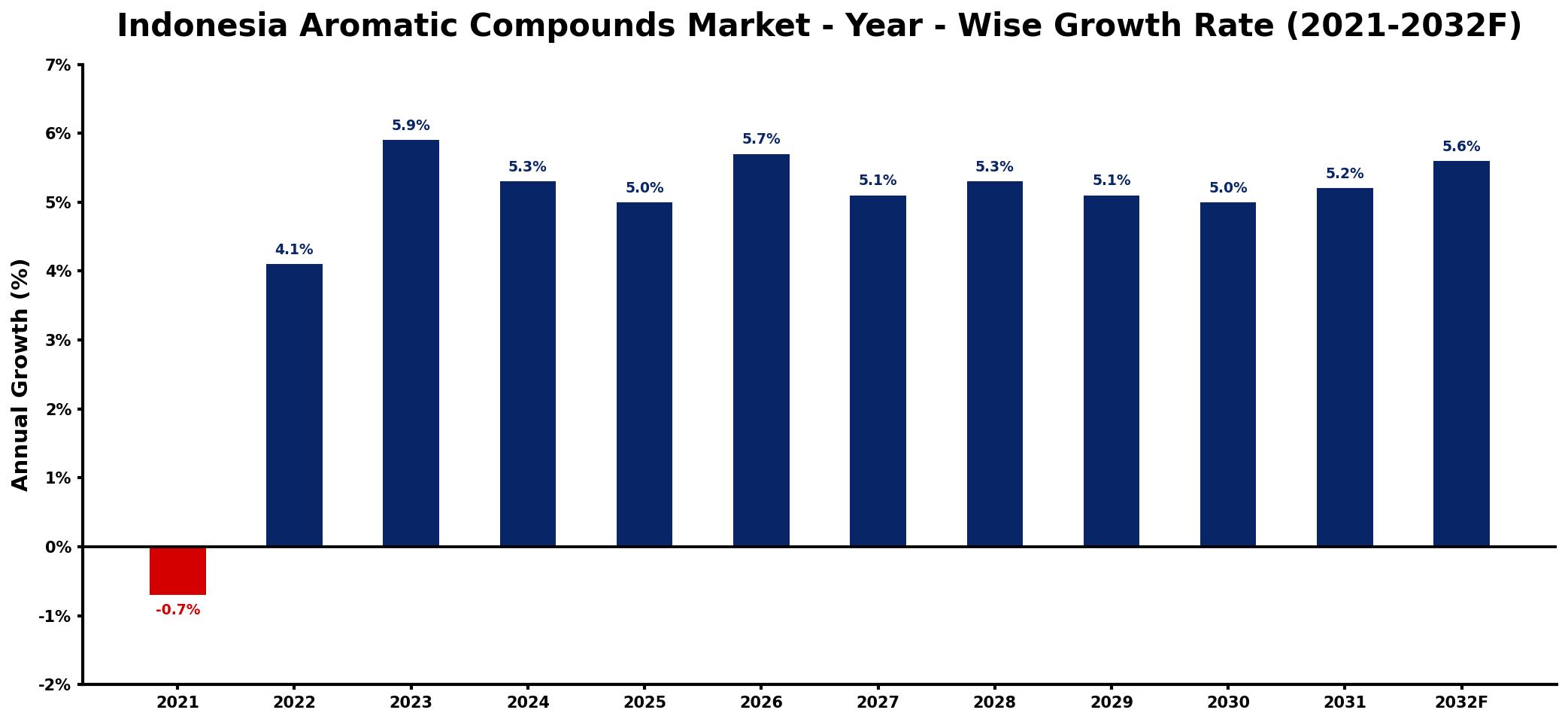
The table below presents the year‑wise growth rates along with the key drivers influencing the market
| Year | Growth Rate | Major Drivers |
| 2021 | -0.7% | decreased consumer spending patterns |
| 2022 | 4.1% | increased demand from fragrance industry |
| 2023 | 5.9% | expansion of personal care sector |
| 2024 | 5.3% | growth in food flavoring applications |
| 2025 | 5.0% | rising investments in manufacturing |
| 2026 | 5.7% | surge in online retail channels |
| 2027 | 5.1% | enhanced distribution network efficiency |
| 2028 | 5.3% | growing popularity of natural ingredients |
| 2029 | 5.1% | boost in export opportunities globally |
| 2030 | 5.0% | development of sustainable sourcing practices |
| 2031 | 5.2% | emergence of innovative product formulations |
| 2032 | 5.6% | expansion into emerging market segments |
Note: Market size estimations and growth projections presented in this report are based on 6Wresearch's proprietary forecasting methodology, utilizing the latest available industry data, government publications, and primary research inputs.
Indonesia Aromatic Compounds Market Synopsis
Indonesia's aromatic compounds market is currently undergoing significant changes, with increasing production capabilities and export potential reflecting the nation's position in the global petrochemical landscape. The sector is experiencing a surge in demand, driven by various industries such as plastics and pharmaceuticals, as these compounds are integral to their manufacturing processes.
Moreover, technological advancements in production techniques are enhancing operational efficiencies, enabling local producers to meet both domestic needs and international demands more effectively. However, the market remains sensitive to fluctuations in global demand and regulatory environments, which could influence future growth trajectories.
Indonesia Aromatic Compounds Market Key Takeaways
- The market is poised for steady growth due to escalating demand in chemical and petrochemical sectors.
- Technological innovations are enhancing production processes and product quality.
- Sourcing raw materials presents ongoing challenges amidst shifting global supply chains.
- Regulatory compliance is becoming increasingly vital for maintaining competitive advantage.
- The pandemic highlighted vulnerabilities but also opportunities for market adaptation and resilience.
Evaluation of Restraints in Indonesia Aromatic Compounds Market
Despite the market's growth potential, several factors impose significant constraints. Sourcing quality raw materials can be challenging, especially as global demands fluctuate and supply chains remain volatile. Additionally, compliance with stringent environmental and safety regulations requires substantial investment from producers, affecting their profit margins and operational capabilities. The need for maintaining high product quality standards further complicates production processes, necessitating advanced technologies and skilled labor, which can be a constraint for some companies.
Indonesia Aromatic Compounds Market Trends
Current trends in the Indonesia aromatic compounds market reveal a strong shift toward sustainability and eco-friendly practices. As consumer awareness regarding environmental impacts increases, producers are exploring greener production methodologies. Additionally, the integration of digital technologies in manufacturing processes is becoming more prevalent, leading to improved efficiencies and reduced waste. Furthermore, the rise of bio-based aromatic compounds presents a new frontier, reflecting a growing preference for sustainable alternatives in various applications.
Indonesia Aromatic Compounds Market Opportunities
The Indonesian aromatic compounds market offers significant growth and investment opportunities. As countries worldwide seek to reduce their carbon footprints, the demand for sustainable and bio-based aromatic chemicals is on the rise. This trend presents an opportunity for Indonesia to leverage its agricultural resources in producing renewable feedstocks. Furthermore, expanding into high-demand markets such as specialty chemicals and advanced materials can provide local manufacturers with additional revenue streams, fostering greater market resilience and competitiveness.
Government Initiatives in the Indonesia Aromatic Compounds Market
The Indonesian government is actively promoting the growth of the aromatic compounds market through various initiatives aimed at enhancing the petrochemical sector's competitiveness. Policies encouraging investment in technological advancements and sustainable practices are being implemented. Additionally, the government is facilitating partnerships between local and international firms to boost production capabilities and integrate into global supply chains. Public spending on infrastructure improvements and research and development further supports the market's potential for long-term growth.
Future Insights of the Indonesia Aromatic Compounds Market
Looking ahead to 2026-2032, the Indonesia aromatic compounds market is expected to experience significant evolution driven by innovation and changing consumer preferences. As global demand for sustainable petrochemical products continues to rise, local producers will need to adapt their strategies to align with these trends. Investments in advanced production technologies and sustainable practices will likely differentiate successful companies from their competitors. Additionally, fostering international partnerships can enhance market access and facilitate knowledge transfer, positioning Indonesia as a key player in the global aromatic compounds landscape.
Indonesia Aromatic Compounds Market Latest Developments (2025 - 2026)
Recent developments in the Indonesia aromatic compounds market indicate a focus on increasing production capacities while integrating sustainable practices. Several initiatives have emerged aimed at enhancing operational efficiencies and reducing environmental impacts. Companies are exploring collaborations to leverage advanced technologies in production, showcasing a commitment to adapting to global market demands. Additionally, there is a notable shift toward exploring bio-based alternatives, as industry stakeholders aim to meet consumer expectations for eco-friendly products.
Indonesia Aromatic Compounds Market - Key Attractiveness of the Report
- 10 Years of Market Numbers
- Historical Data Starting from 2022 to 2025
- Base Year: 2025
- Forecast Data until 2032
- Key Performance Indicators Impacting the Market
- Major Upcoming Developments and Projects
Key Highlights of the Report:
- Indonesia Aromatic Compounds Market Outlook
- Market Size of Indonesia Aromatic Compounds Market, 2025
- Forecast of Indonesia Aromatic Compounds Market, 2032
- Historical Data and Forecast of Indonesia Aromatic Compounds Revenues & Volume for the Period 2022-2032F
- Indonesia Aromatic Compounds Market Trend Evolution
- Indonesia Aromatic Compounds Market Drivers and Challenges
- Indonesia Aromatic Compounds Price Trends
- Indonesia Aromatic Compounds Porter's Five Forces
- Indonesia Aromatic Compounds Industry Life Cycle
- Historical Data and Forecast of Indonesia Aromatic Compounds Market Revenues & Volume By Type for the Period 2022-2032F
- Historical Data and Forecast of Indonesia Aromatic Compounds Market Revenues & Volume By Benzene for the Period 2022-2032F
- Historical Data and Forecast of Indonesia Aromatic Compounds Market Revenues & Volume By Xylene for the Period 2022-2032F
- Historical Data and Forecast of Indonesia Aromatic Compounds Market Revenues & Volume By Toluene for the Period 2022-2032F
- Historical Data and Forecast of Indonesia Aromatic Compounds Market Revenues & Volume By Application for the Period 2022-2032F
- Historical Data and Forecast of Indonesia Aromatic Compounds Market Revenues & Volume By Solvent for the Period 2022-2032F
- Historical Data and Forecast of Indonesia Aromatic Compounds Market Revenues & Volume By Additive for the Period 2022-2032F
- Historical Data and Forecast of Indonesia Aromatic Compounds Market Revenues & Volume By End-use for the Period 2022-2032F
- Historical Data and Forecast of Indonesia Aromatic Compounds Market Revenues & Volume By Packaging for the Period 2022-2032F
- Historical Data and Forecast of Indonesia Aromatic Compounds Market Revenues & Volume By Detergent And Dyes for the Period 2022-2032F
- Historical Data and Forecast of Indonesia Aromatic Compounds Market Revenues & Volume By Automobile for the Period 2022-2032F
- Historical Data and Forecast of Indonesia Aromatic Compounds Market Revenues & Volume By Electronic Devices for the Period 2022-2032F
- Historical Data and Forecast of Indonesia Aromatic Compounds Market Revenues & Volume By Medical Devices for the Period 2022-2032F
- Historical Data and Forecast of Indonesia Aromatic Compounds Market Revenues & Volume By Pharmaceuticals for the Period 2022-2032F
- Historical Data and Forecast of Indonesia Aromatic Compounds Market Revenues & Volume By Gasoline for the Period 2022-2032F
- Historical Data and Forecast of Indonesia Aromatic Compounds Market Revenues & Volume By Tire for the Period 2022-2032F
- Indonesia Aromatic Compounds Import Export Trade Statistics
- Market Opportunity Assessment By Type
- Market Opportunity Assessment By Application
- Market Opportunity Assessment By End-use
- Indonesia Aromatic Compounds Top Companies Market Share
- Indonesia Aromatic Compounds Competitive Benchmarking By Technical and Operational Parameters
- Indonesia Aromatic Compounds Company Profiles
- Indonesia Aromatic Compounds Key Strategic Recommendations






































