Indonesia Decentralized Identity Market Size & Growth Rate (2026-2032)
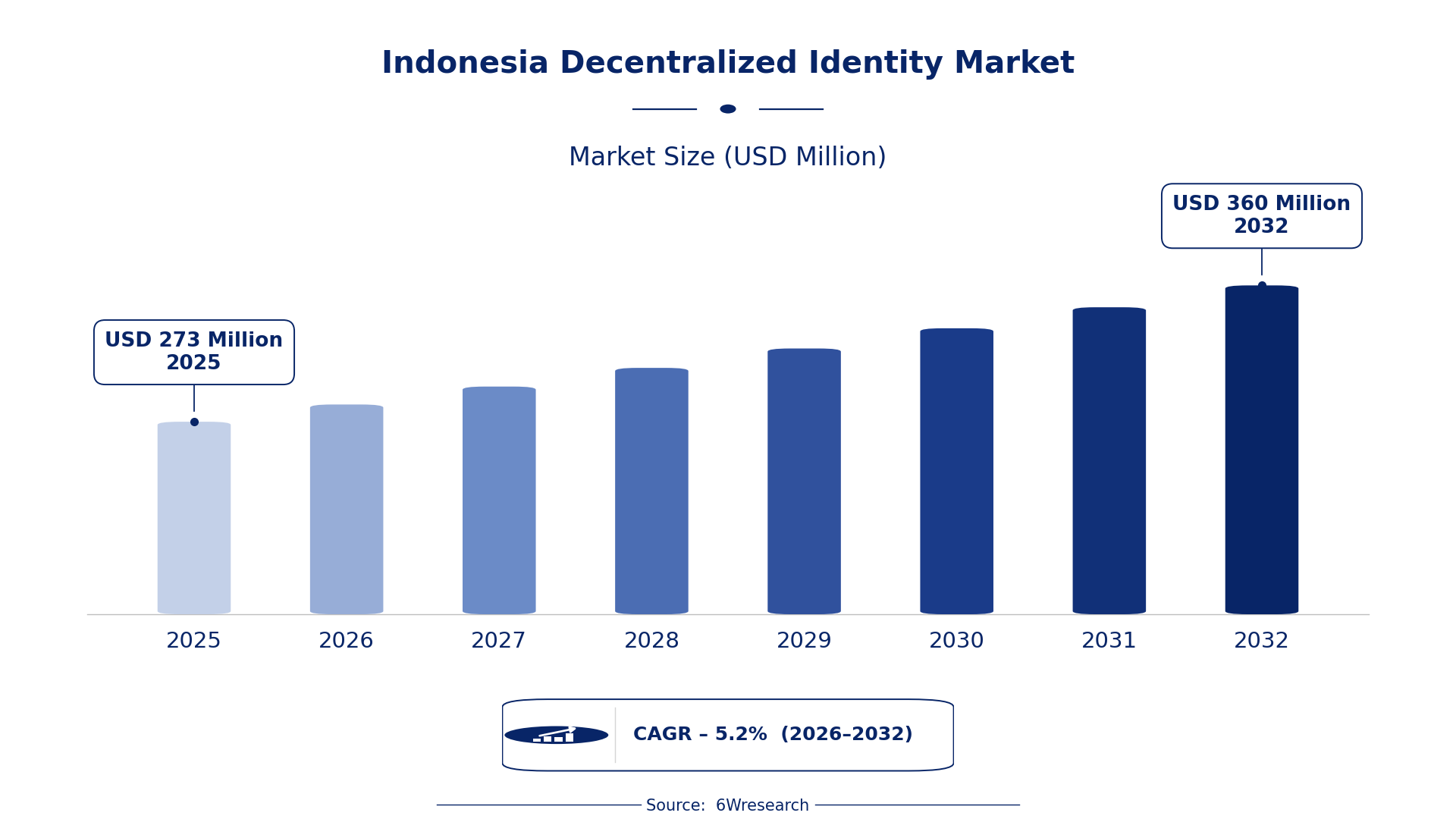
The Indonesia Decentralized Identity Market was estimated at USD 273 Million in 2025 and is projected to reach USD 360 Million by 2032, growing at a CAGR of 5.2% from 2026 to 2032.
Indonesia Decentralized Identity Market Synopsis
The decentralized identity market in Indonesia is witnessing a surge in interest as digital users demand greater autonomy over their personal data. This shift marks a substantial pivot from traditional identity management systems, positioning Indonesia at the forefront of digital identity innovation.
However, while momentum is palpable, the market still faces obstacles related to interoperability and the need for standardized frameworks. As players push for cohesive solutions, the focus is on establishing a collaborative environment that can sustain long-term growth.
Indonesia Decentralized Identity Market Year-wise Growth Rate and Key Drivers
This graph illustrates the annual growth rates of the Indonesia Decentralized Identity Market from 2021 to 2032, highlighting a steady upward trajectory and projected expansion over the forecast period.
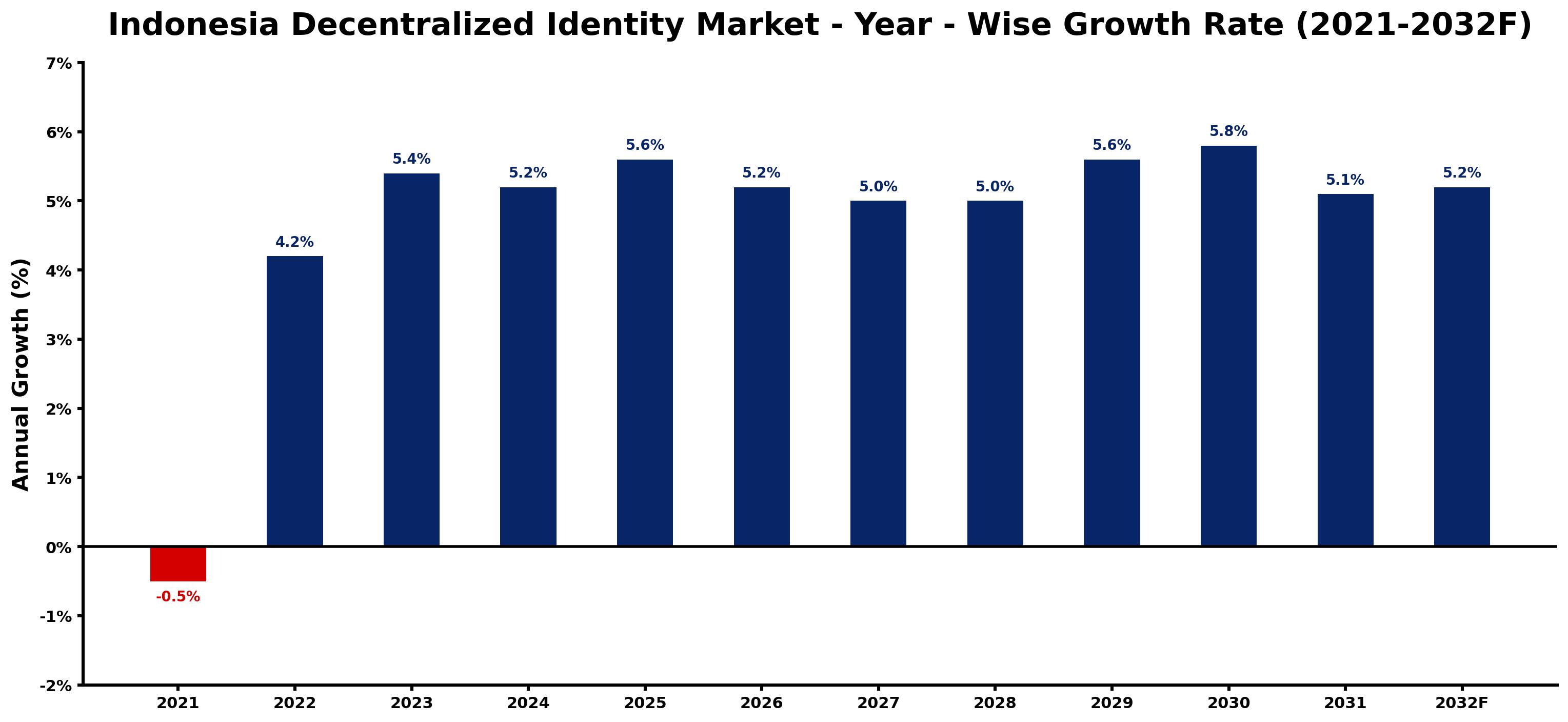
The table below presents the year‑wise growth rates along with the key drivers influencing the market
| Year | Growth Rate | Major Drivers |
| 2021 | -0.5% | Government's slow adoption of digital identity standards |
| 2022 | 4.2% | Government's focus on digital identity for citizen services |
| 2023 | 5.4% | Increase in blockchain adoption among local startups |
| 2024 | 5.2% | Regulatory push for data privacy and user control |
| 2025 | 5.6% | Rising concern over identity theft and fraud incidents |
| 2026 | 5.2% | Partnerships with tech firms to enhance digital identification |
| 2027 | 5.0% | Adoption of eKTP system supporting decentralized identity |
| 2028 | 5.0% | Growing tech-savvy population seeking secure online access |
| 2029 | 5.6% | Emergence of local players in digital identity solutions |
| 2030 | 5.8% | Support from national digital transformation initiatives |
| 2031 | 5.1% | Increased investments in cybersecurity infrastructure by firms |
| 2032 | 5.2% | Demand for seamless authentication in e-commerce platforms |
Note: Market size estimations and growth projections presented in this report are based on 6Wresearch's proprietary forecasting methodology, utilizing the latest available industry data, government publications, and primary research inputs.
Indonesia Decentralized Identity Market Key Takeaways
Below are some of the specific key takeaways from the market, including:
- Increased consumer awareness of data privacy is driving demand for decentralized identity solutions.
- Healthcare and education sectors are rapidly adopting decentralized identity systems due to the pandemic's impact.
- Standardization challenges remain a hurdle for widespread adoption in the market.
- Key stakeholders are working toward creating a cohesive framework that addresses interoperability issues.
- Government initiatives are shaping the regulatory landscape, encouraging market growth and innovation.
Evaluation of Restraints in Indonesia Decentralized Identity Market
Despite the promising outlook, the decentralized identity market in Indonesia faces real hurdles. One of the primary challenges is the lack of standardized frameworks across different platforms. This inconsistency complicates the integration of decentralized identity solutions, discouraging potential users. Additionally, the varying levels of technological infrastructure across the nation mean that certain regions may lag in adopting these advanced identity management solutions. Stakeholders must unite to overcome these barriers, as establishing a reliable ecosystem is critical for sustainable growth.
Indonesia Decentralized Identity Market Trends
Several trends are influencing the decentralized identity market in Indonesia. A notable shift is the growing emphasis on user-centric identity management, where individuals are empowered to control their data. Advances in blockchain technology are also enabling more secure and verifiable identity solutions. Furthermore, the demand for decentralized identity systems is expected to surge in response to an increase in digital service usage, particularly in financial sectors, where security is paramount.
Indonesia Decentralized Identity Market Opportunities
Significant opportunities exist in the healthcare and educational sectors, where the need for secure identity verification is paramount. Companies that can provide tailored decentralized solutions to these industries may find themselves at a competitive advantage. Furthermore, collaboration between technology providers and regulatory bodies can stimulate innovation and market expansion. Investment in public-private partnerships will also be essential to develop the necessary infrastructure and support frameworks.
Government Initiatives in the Indonesia Decentralized Identity Market
Government policy plays a crucial role in shaping the decentralized identity market in Indonesia. Recent initiatives have focused on enhancing digital identity frameworks, emphasizing security and user empowerment. By implementing regulatory measures that encourage innovation and interoperability, the government is setting the groundwork for a more cohesive ecosystem.
- A digital identity framework initiative launched in 2025 aims to standardize decentralized identity solutions across various platforms.
- An ongoing public consultation effort by the Ministry of Communications is focused on gathering stakeholder input for enhancing digital identity legislation.
- A planned initiative expected to start in 2026 will incentivize the adoption of decentralized identity solutions in financial services.
- Recently completed pilot programs in government sectors have showcased the potential of decentralized identity in enhancing service delivery.
- The government is actively promoting collaboration between tech startups and established firms to strengthen the decentralized identity landscape.
Future Insights of the Indonesia Decentralized Identity Market
Looking ahead to 2026-2032, the Indonesia Decentralized Identity Market is set for transformative growth. As data privacy becomes an even more pressing concern, individuals will increasingly gravitate towards systems that offer them control over their identity. The convergence of technology and regulation will likely unlock new pathways for innovation, compelling companies to adapt or risk obsolescence. Expect to see enhanced user engagement as solutions become more intuitive and accessible.
Indonesia Decentralized Identity Market Latest Developments
In the last year, the Indonesia decentralized identity market has seen notable activity that signals its potential. Companies are ramping up efforts to roll out innovative solutions while collaborating with government entities to create a supportive regulatory environment. This momentum reflects a growing recognition of the importance of secure, verifiable identity solutions in a digitally driven society.
- A major technology vendor announced a partnership in early 2025 with government agencies to enhance identity verification processes for citizens.
- An ongoing pilot program initiated in late 2024 is testing decentralized identity solutions within the public healthcare sector.
- A rollout of a new decentralized identity app is expected in Q3 2026, designed to streamline user experience and data management.
- A completed collaboration with a local startup in mid-2025 has led to the launch of a blockchain-based identity verification solution.
- Plans for a national conference in 2026 are underway to facilitate discussions on decentralized identity and encourage stakeholder engagement.
Indonesia Decentralized Identity Market - Key Attractiveness of the Report
- 10 Years of Market Numbers
- Historical Data Starting from 2022 to 2025
- Base Year: 2025
- Forecast Data until 2032
- Key Performance Indicators Impacting the Market
- Major Upcoming Developments and Projects
Key Highlights of the Report:
- Indonesia Decentralized Identity Market Outlook
- Market Size of Indonesia Decentralized Identity Market, 2025
- Forecast of Indonesia Decentralized Identity Market, 2032
- Historical Data and Forecast of Indonesia Decentralized Identity Revenues & Volume for the Period 2022-2032F
- Indonesia Decentralized Identity Market Trend Evolution
- Indonesia Decentralized Identity Market Drivers and Challenges
- Indonesia Decentralized Identity Price Trends
- Indonesia Decentralized Identity Porter's Five Forces
- Indonesia Decentralized Identity Industry Life Cycle
- Historical Data and Forecast of Indonesia Decentralized Identity Market Revenues & Volume By Vertical for the Period 2022-2032F
- Historical Data and Forecast of Indonesia Decentralized Identity Market Revenues & Volume By BFSI for the Period 2022-2032F
- Historical Data and Forecast of Indonesia Decentralized Identity Market Revenues & Volume By Government for the Period 2022-2032F
- Historical Data and Forecast of Indonesia Decentralized Identity Market Revenues & Volume By Healthcare and Life Sciences for the Period 2022-2032F
- Historical Data and Forecast of Indonesia Decentralized Identity Market Revenues & Volume By Retail and eCommerce for the Period 2022-2032F
- Historical Data and Forecast of Indonesia Decentralized Identity Market Revenues & Volume By Telecom and IT for the Period 2022-2032F
- Historical Data and Forecast of Indonesia Decentralized Identity Market Revenues & Volume By Transport and Logistics for the Period 2022-2032F
- Historical Data and Forecast of Indonesia Decentralized Identity Market Revenues & Volume By Real Estate for the Period 2022-2032F
- Historical Data and Forecast of Indonesia BFSI Decentralized Identity Market Revenues & Volume By Others for the Period 2022-2032F
- Historical Data and Forecast of Indonesia Decentralized Identity Market Revenues & Volume By Identity Type for the Period 2022-2032F
- Historical Data and Forecast of Indonesia Decentralized Identity Market Revenues & Volume By Non- biometrics for the Period 2022-2032F
- Historical Data and Forecast of Indonesia Decentralized Identity Market Revenues & Volume By Biometrics for the Period 2022-2032F
- Historical Data and Forecast of Indonesia Decentralized Identity Market Revenues & Volume By End User for the Period 2022-2032F
- Historical Data and Forecast of Indonesia Decentralized Identity Market Revenues & Volume By Enterprises for the Period 2022-2032F
- Historical Data and Forecast of Indonesia Decentralized Identity Market Revenues & Volume By Individual for the Period 2022-2032F
- Historical Data and Forecast of Indonesia Decentralized Identity Market Revenues & Volume By Organization Size for the Period 2022-2032F
- Historical Data and Forecast of Indonesia Decentralized Identity Market Revenues & Volume By Large Enterprises for the Period 2022-2032F
- Historical Data and Forecast of Indonesia Decentralized Identity Market Revenues & Volume By SMEs for the Period 2022-2032F
- Indonesia Decentralized Identity Import Export Trade Statistics
- Market Opportunity Assessment By Vertical
- Market Opportunity Assessment By Identity Type
- Market Opportunity Assessment By End User
- Market Opportunity Assessment By Organization Size
- Indonesia Decentralized Identity Top Companies Market Share
- Indonesia Decentralized Identity Competitive Benchmarking By Technical and Operational Parameters
- Indonesia Decentralized Identity Company Profiles
- Indonesia Decentralized Identity Key Strategic Recommendations






































