Indonesia Digital Workplace Market Size & Growth Rate (2026-2032)
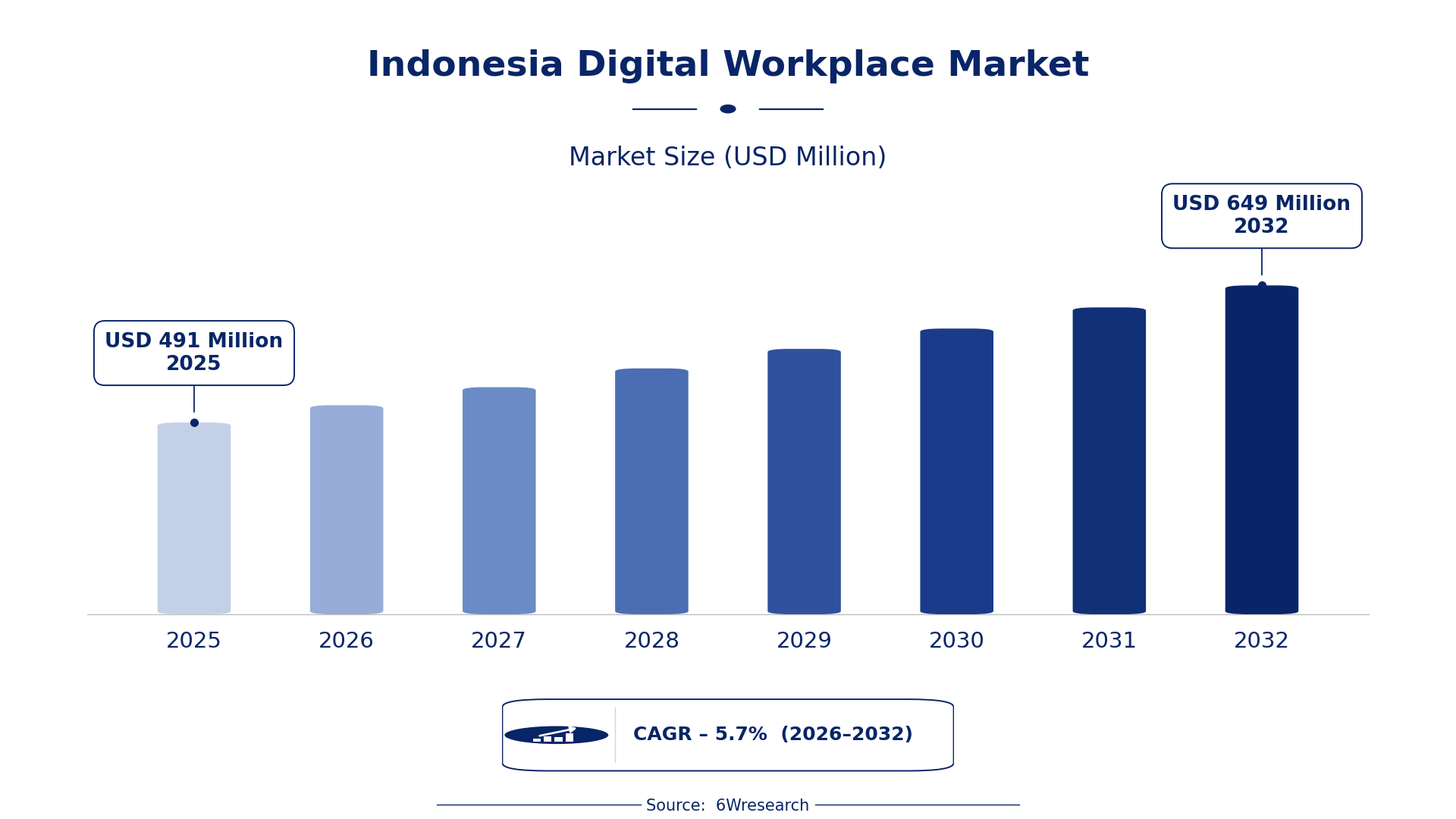
The Indonesia Digital Workplace Market was estimated at USD 491 Million in 2025 and is projected to reach USD 649 Million by 2032, growing at a CAGR of 5.7% from 2026 to 2032.
Indonesia Digital Workplace Market Synopsis
The digital workplace in Indonesia is rapidly evolving, reshaping how companies operate and employees interact. Organizations are increasingly adopting a variety of technologies, including collaboration tools and mobile applications, to foster a more productive and connected work environment.
The COVID-19 pandemic acted as a catalyst for this transformation, prompting a swift shift toward remote work solutions. Companies are now leveraging digital tools to enhance employee engagement and streamline business processes, reflecting a significant cultural shift in Indonesia's workforce.
Indonesia Digital Workplace Market Year-wise Growth Rate and Key Drivers
This graph illustrates the annual growth rates of the Indonesia Digital Workplace Market from 2021 to 2032, highlighting a steady upward trajectory and projected expansion over the forecast period.
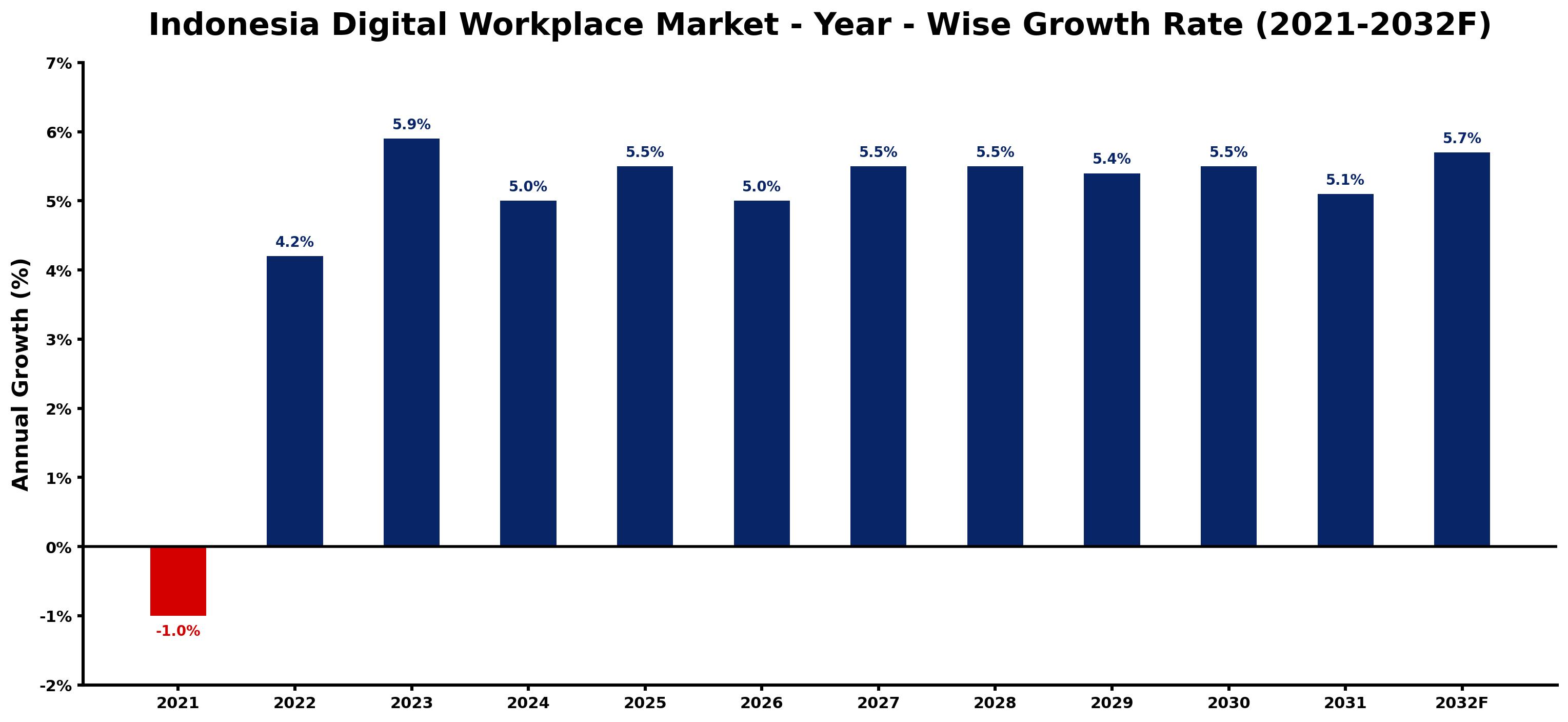
The table below presents the year‑wise growth rates along with the key drivers influencing the market
| Year | Growth Rate | Major Drivers |
| 2021 | -1.0% | Government restrictions on remote work during COVID-19 |
| 2022 | 4.2% | Rise of e-commerce driving remote work solutions demand |
| 2023 | 5.9% | Government incentives for digital transformation in workplaces |
| 2024 | 5.0% | Increased internet penetration fostering flexible work arrangements |
| 2025 | 5.5% | Corporate adoption of hybrid work models enhancing productivity tools |
| 2026 | 5.0% | Local tech startups innovating workplace collaboration software |
| 2027 | 5.5% | Growing education sector necessitating online teaching platforms |
| 2028 | 5.5% | Regulatory support for digital workforce skill development |
| 2029 | 5.4% | Cultural shift towards work-life balance driving digital adoption |
| 2030 | 5.5% | Increased foreign investment in technology-driven workspaces |
| 2031 | 5.1% | Emergence of local players offering tailored digital tools |
| 2032 | 5.7% | Increased focus on cybersecurity for remote workforce solutions |
Note: Market size estimations and growth projections presented in this report are based on 6Wresearch's proprietary forecasting methodology, utilizing the latest available industry data, government publications, and primary research inputs.
Indonesia Digital Workplace Market Key Takeaways
Below are some of the specific key takeaways from the market, including:
- Strong demand for remote collaboration tools is driving market growth.
- COVID-19 has accelerated the adoption of cloud-based solutions and virtual communication platforms.
- Companies are investing in integrated systems to enhance productivity and security.
- Flexibility in working arrangements is becoming a priority for organizations.
- Key technologies shaping the market include intranets and project management tools.
Evaluation of Restraints in Indonesia Digital Workplace Market
Despite the promising growth, several constraints are limiting the potential of the digital workplace market in Indonesia. A primary concern is the challenge of integrating various digital tools into a cohesive ecosystem. Organizations often struggle with ensuring that their chosen technologies work together effectively, which can lead to inefficiencies and security vulnerabilities. on top of that, the rapid pace of technological change can overwhelm smaller businesses, hindering their ability to keep up with larger competitors.
Indonesia Digital Workplace Market Trends
Emerging trends in the Indonesia digital workplace market are increasingly focused on enhancing user experience and collaboration. Companies are prioritizing employee engagement through interactive platforms that allow for real-time communication and project tracking. Additionally, there is a growing emphasis on cybersecurity measures as organizations seek to protect sensitive data in a remote work environment. The adoption of artificial intelligence and automation tools is also on the rise, streamlining processes and improving efficiency.
Indonesia Digital Workplace Market Opportunities
A wealth of opportunities exists for investment in the Indonesia digital workplace market. The ongoing shift towards hybrid working models presents a unique chance for companies to innovate their offerings. Organizations can capitalize on this trend by developing tailored solutions that address the specific needs of remote and in-office employees. on top of that, the increasing demand for training and support services around new technologies creates avenues for businesses to provide value-added services.
Government Initiatives in the Indonesia Digital Workplace Market
Government policy is playing a crucial role in shaping the digital workplace market in Indonesia. As the public sector prioritizes digital transformation, various initiatives have emerged to foster growth in this area. The regulatory landscape is increasingly supportive, encouraging businesses to adopt innovative technologies that enhance productivity.
- A national digital infrastructure upgrade programme now in its rollout phase aims to improve internet connectivity across urban and rural areas.
- Currently ongoing is a public-private partnership initiative focused on enhancing digital skills among the workforce, addressing gaps in technological proficiency.
- A regulatory framework introduced in 2025 mandates that businesses implement cybersecurity measures, ensuring data protection in digital workplaces.
- A planned public sector initiative expected to expand access to digital collaboration tools for small and medium enterprises (SMEs) by 2028.
Future Insights of the Indonesia Digital Workplace Market
Looking ahead to 2026-2032, the Indonesia digital workplace market is set for continued evolution. Companies will increasingly prioritize flexibility and employee satisfaction, which will drive demand for advanced collaboration tools. As technology continues to advance, organizations that embrace these changes are likely to gain a competitive edge. The integration of AI and machine learning into digital workplace solutions will further enhance operational efficiency and decision-making capabilities.
Indonesia Digital Workplace Market Latest Developments
Recent activity in the Indonesia digital workplace market indicates a strong momentum toward innovation and technological adoption. Over the past year, businesses have been focused on enhancing their digital capabilities to meet the evolving demands of the workforce.
- A major technology vendor launched a new suite of collaboration tools in Q1 2025, designed to facilitate seamless communication across teams.
- An initiative that began in mid-2025 and remains underway focuses on integrating advanced cybersecurity measures into existing digital workplace solutions.
- A leading regional operator is currently expanding its cloud services, aiming to support businesses in their digital transformation efforts.
- A rollout expected to begin in the second half of 2026 will introduce AI-driven analytics tools for workforce management.
Indonesia Digital Workplace Market - Key Attractiveness of the Report
- 10 Years of Market Numbers
- Historical Data Starting from 2022 to 2025
- Base Year: 2025
- Forecast Data until 2032
- Key Performance Indicators Impacting the Market
- Major Upcoming Developments and Projects
Key Highlights of the Report:
- Indonesia Digital Workplace Market Outlook
- Market Size of Indonesia Digital Workplace Market, 2025
- Forecast of Indonesia Digital Workplace Market, 2032
- Historical Data and Forecast of Indonesia Digital Workplace Revenues & Volume for the Period 2022-2032F
- Indonesia Digital Workplace Market Trend Evolution
- Indonesia Digital Workplace Market Drivers and Challenges
- Indonesia Digital Workplace Price Trends
- Indonesia Digital Workplace Porter's Five Forces
- Indonesia Digital Workplace Industry Life Cycle
- Historical Data and Forecast of Indonesia Digital Workplace Market Revenues & Volume By Component for the Period 2022-2032F
- Historical Data and Forecast of Indonesia Digital Workplace Market Revenues & Volume By Solutions for the Period 2022-2032F
- Historical Data and Forecast of Indonesia Digital Workplace Market Revenues & Volume By Services for the Period 2022-2032F
- Historical Data and Forecast of Indonesia Digital Workplace Market Revenues & Volume By Deployment for the Period 2022-2032F
- Historical Data and Forecast of Indonesia Digital Workplace Market Revenues & Volume By On-premises for the Period 2022-2032F
- Historical Data and Forecast of Indonesia Digital Workplace Market Revenues & Volume By Cloud for the Period 2022-2032F
- Historical Data and Forecast of Indonesia Digital Workplace Market Revenues & Volume By Organization Size for the Period 2022-2032F
- Historical Data and Forecast of Indonesia Digital Workplace Market Revenues & Volume By Large Enterprises for the Period 2022-2032F
- Historical Data and Forecast of Indonesia Digital Workplace Market Revenues & Volume By SMEs for the Period 2022-2032F
- Historical Data and Forecast of Indonesia Digital Workplace Market Revenues & Volume By Vertical for the Period 2022-2032F
- Historical Data and Forecast of Indonesia Digital Workplace Market Revenues & Volume By BFSI for the Period 2022-2032F
- Historical Data and Forecast of Indonesia Digital Workplace Market Revenues & Volume By Consumer goods and retail for the Period 2022-2032F
- Historical Data and Forecast of Indonesia Digital Workplace Market Revenues & Volume By Telecommunication and ITes for the Period 2022-2032F
- Historical Data and Forecast of Indonesia Digital Workplace Market Revenues & Volume By Manufacturing for the Period 2022-2032F
- Historical Data and Forecast of Indonesia Digital Workplace Market Revenues & Volume By Healthcare and pharmaceuticals for the Period 2022-2032F
- Historical Data and Forecast of Indonesia Digital Workplace Market Revenues & Volume By Government and public sector for the Period 2022-2032F
- Historical Data and Forecast of Indonesia Digital Workplace Market Revenues & Volume By Media and entertainment for the Period 2022-2032F
- Historical Data and Forecast of Indonesia Digital Workplace Market Revenues & Volume By Others for the Period 2022-2032F
- Indonesia Digital Workplace Import Export Trade Statistics
- Market Opportunity Assessment By Component
- Market Opportunity Assessment By Deployment
- Market Opportunity Assessment By Organization Size
- Market Opportunity Assessment By Vertical
- Indonesia Digital Workplace Top Companies Market Share
- Indonesia Digital Workplace Competitive Benchmarking By Technical and Operational Parameters
- Indonesia Digital Workplace Company Profiles
- Indonesia Digital Workplace Key Strategic Recommendations






































