Indonesia E-wallet Market Size, Share & Growth Rate
The Indonesia E-wallet Market was estimated at USD 150 Million in 2025 and is projected to reach USD 198 Million by 2032, growing at a CAGR of 4.0% from 2026 to 2032. This growth trajectory is primarily driven by the soaring adoption of smartphones and the increasing inclination of consumers towards digital payment solutions over traditional methods. Government initiatives focused on financial inclusion and an expanding ecosystem of e-wallet applications are poised to further fuel this upward trend.
Indonesia E-wallet Market Year-wise Growth Rate and Key Drivers
This graph highlights how the Indonesia E-wallet Market has steadily grown over the years, supported by major growth factors.
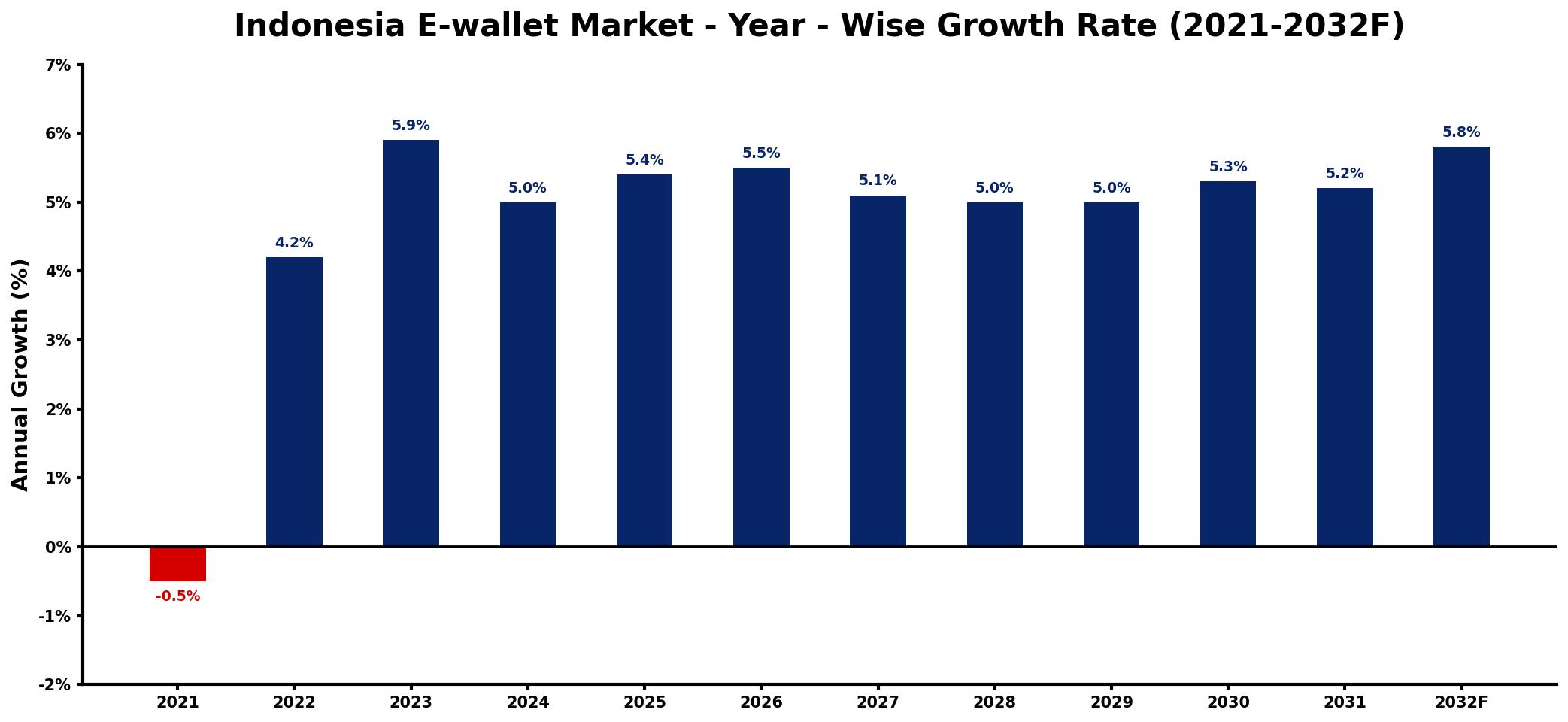
The table below presents the year‑wise growth rates along with the key drivers influencing the market
| Year | Growth Rate | Major Drivers |
| 2021 | -0.5% | Decreased consumer spending habits |
| 2022 | 4.2% | Increased digital payment adoption |
| 2023 | 5.9% | Rise in smartphone penetration rates |
| 2024 | 5.0% | Expansion of retail partnerships |
| 2025 | 5.4% | Growth in e-commerce transactions |
| 2026 | 5.5% | Surge in fintech innovations |
| 2027 | 5.1% | Increased investments in technology |
| 2028 | 5.0% | Uplift in cross-border transactions |
| 2029 | 5.0% | Enhanced user experience features |
| 2030 | 5.3% | growing regional consumption patterns |
| 2031 | 5.2% | increased pharmaceutical industry usage |
| 2032 | 5.8% | Increased regulatory support initiatives |
Note: Market size estimations and growth projections presented in this report are based on 6Wresearch's proprietary forecasting methodology, utilizing the latest available industry data, government publications, and primary research inputs.
Indonesia E-wallet Market Synopsis
The Indonesia E-wallet Market has witnessed impressive momentum, particularly in recent years, driven by heightened smartphone usage and changing consumer behaviors. However, the market is now at a pivotal juncture, transitioning from basic payment solutions to more comprehensive financial services that cater to diverse user needs.
As e-wallets gain traction, they are becoming integral to everyday transactions, offering security and convenience that surpasses traditional banking methods. The competitive landscape is vibrant, with major players continuously innovating to capture user attention and expand service offerings beyond just payments.
Indonesia E-wallet Market Key Takeaways
- Rapid growth driven by smartphone penetration and digital adoption.
- Government initiatives enhancing cashless transaction accessibility.
- Continuous evolution of e-wallet services beyond basic transactions.
- Increasing user preference for contactless payments post-COVID-19.
- Ongoing investments in infrastructure to support digital payment growth.
Evaluation of Restraints in Indonesia E-wallet Market
Despite its impressive growth, the Indonesia E-wallet Market faces several restraints that could impact its potential. One major concern is the need for greater consumer trust in digital payment security, as high-profile data breaches can deter usage. Additionally, many users lack the financial literacy necessary to navigate e-wallet services effectively, which hampers broader adoption. Interoperability issues among various e-wallet platforms further complicate the user experience, necessitating improved collaboration among service providers to create a seamless ecosystem. Lastly, regulatory changes and the evolving technological landscape pose ongoing challenges that stakeholders must address to maintain growth momentum.
Indonesia E-wallet Market Trends
Current trends indicate that e-wallets are diversifying their offerings, moving beyond simple peer-to-peer transactions to include features such as investment options, bill payments, and online shopping. Contactless payments continue to gain popularity as consumers prefer frictionless transaction experiences. Additionally, as consumers become more tech-savvy, there is a growing demand for features like loyalty programs and personalized offers, pushing e-wallet providers to innovate consistently. Integration with emerging technologies such as blockchain and artificial intelligence is also becoming more prevalent, enhancing the security and efficiency of e-wallet transactions.
Indonesia E-wallet Market Opportunities
The landscape of the Indonesia E-wallet Market is ripe with opportunities for growth and investment. The continued push for financial inclusion presents a significant opportunity, especially in underserved regions. Moreover, partnerships with e-commerce platforms can unlock new user segments and transaction volumes. The rise of small to medium enterprises (SMEs) looking for efficient payment solutions provides a target market for e-wallets. Finally, leveraging data analytics to offer personalized services can help providers enhance user engagement and retention, driving sustained growth in this competitive environment.
Government Initiatives in the Indonesia E-wallet Market
The Indonesian government has implemented several initiatives aimed at promoting cashless transactions and enhancing financial inclusion. Programs encouraging the adoption of digital payment methods are being prioritized, with public spending allocated to improving digital infrastructure. Moreover, regulatory bodies are working towards creating a framework that supports secure and efficient digital transactions. These government efforts play a pivotal role in fostering an environment conducive to the growth of e-wallet services across the country.
Future Insights of the Indonesia E-wallet Market
As we look ahead to 2026-2032, the Indonesia E-wallet Market is expected to evolve significantly. With a greater focus on interoperability among platforms, users will likely experience a more seamless transaction process. Furthermore, ongoing technological advancements will drive the emergence of innovative solutions tailored to diverse consumer needs. Enhanced government support for cashless transactions will also contribute to market growth, solidifying Indonesia's position as a leading player in the global digital payment landscape.
Indonesia E-wallet Market Latest Developments (2025 - 2026)
In recent months, the Indonesia E-wallet Market has seen a flurry of activities as companies seek to broaden their service offerings. Collaborations with fintech firms have been on the rise, enhancing the range of financial products available through e-wallet platforms. Furthermore, there has been a noticeable uptick in consumer adoption of contactless payment methods, attributed to changing habits initiated during the pandemic. Regulatory advancements are also in progress, aiming to bolster security measures and facilitate a more robust digital payment ecosystem.
Indonesia E-wallet Market - Key Attractiveness of the Report
- 10 Years of Market Numbers
- Historical Data Starting from 2022 to 2025
- Base Year: 2025
- Forecast Data until 2032
- Key Performance Indicators Impacting the Market
- Major Upcoming Developments and Projects
Key Highlights of the Report:
- Indonesia E-wallet Market Outlook
- Market Size of Indonesia E-wallet Market, 2025
- Forecast of Indonesia E-wallet Market, 2032
- Historical Data and Forecast of Indonesia E-wallet Revenues & Volume for the Period 2022-2032F
- Indonesia E-wallet Market Trend Evolution
- Indonesia E-wallet Market Drivers and Challenges
- Indonesia E-wallet Price Trends
- Indonesia E-wallet Porter's Five Forces
- Indonesia E-wallet Industry Life Cycle
- Historical Data and Forecast of Indonesia E-wallet Market Revenues & Volume By Application for the Period 2022-2032F
- Historical Data and Forecast of Indonesia E-wallet Market Revenues & Volume By Restaurants for the Period 2022-2032F
- Historical Data and Forecast of Indonesia E-wallet Market Revenues & Volume By Transportation for the Period 2022-2032F
- Historical Data and Forecast of Indonesia E-wallet Market Revenues & Volume By Banking for the Period 2022-2032F
- Historical Data and Forecast of Indonesia E-wallet Market Revenues & Volume By Retail for the Period 2022-2032F
- Historical Data and Forecast of Indonesia E-wallet Market Revenues & Volume By Type for the Period 2022-2032F
- Historical Data and Forecast of Indonesia E-wallet Market Revenues & Volume By Closed E Wallets for the Period 2022-2032F
- Historical Data and Forecast of Indonesia E-wallet Market Revenues & Volume By Semi Closed E Wallets for the Period 2022-2032F
- Historical Data and Forecast of Indonesia E-wallet Market Revenues & Volume By Open E Wallets for the Period 2022-2032F
- Historical Data and Forecast of Indonesia E-wallet Market Revenues & Volume By Mode for the Period 2022-2032F
- Historical Data and Forecast of Indonesia E-wallet Market Revenues & Volume By Online for the Period 2022-2032F
- Historical Data and Forecast of Indonesia E-wallet Market Revenues & Volume By M Wallet for the Period 2022-2032F
- Historical Data and Forecast of Indonesia E-wallet Market Revenues & Volume By Mode for the Period 2022-2032F
- Historical Data and Forecast of Indonesia E-wallet Market Revenues & Volume By Online for the Period 2022-2032F
- Historical Data and Forecast of Indonesia E-wallet Market Revenues & Volume By M Wallet for the Period 2022-2032F
- Indonesia E-wallet Import Export Trade Statistics
- Market Opportunity Assessment By Application
- Market Opportunity Assessment By Type
- Market Opportunity Assessment By Mode
- Indonesia E-wallet Top Companies Market Share
- Indonesia E-wallet Competitive Benchmarking By Technical and Operational Parameters
- Indonesia E-wallet Company Profiles
- Indonesia E-wallet Key Strategic Recommendations






































