Indonesia Electronics Accessories Market Size Growth Rate
The Indonesia Electronics Accessories Market is poised for steady growth rate improvements from 2025 to 2029. Commencing at 7.77% in 2025, growth builds up to 10.58% by 2029.

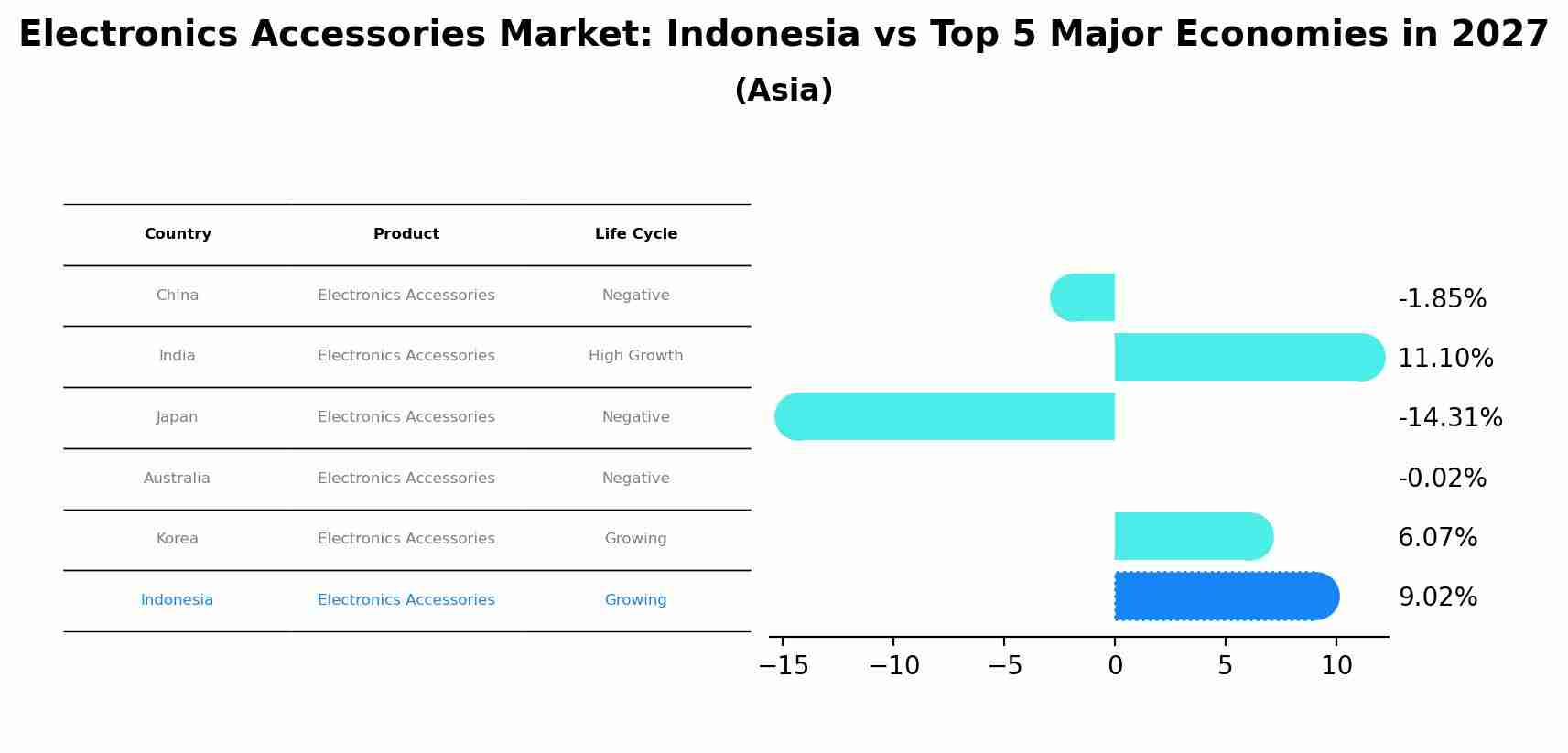
Electronics Accessories Market: Indonesia vs Top 5 Major Economies in 2027 (Asia)
The Electronics Accessories market in Indonesia is projected to grow at a growing growth rate of 9.02% by 2027, highlighting the country's increasing focus on advanced technologies within the Asia region, where China holds the dominant position, followed closely by India, Japan, Australia and South Korea, shaping overall regional demand.
Indonesia Electronics Accessories Market Synopsis
The Indonesia Electronics Accessories market is a dynamic and diverse sector encompassing a wide range of products, including phone cases, chargers, headphones, and more. With the increasing penetration of smartphones and other electronic gadgets in the country, the demand for accessories has surged. The market is highly competitive, with both domestic and international brands offering innovative and trendy accessories. Consumer preferences for customization and protection of their devices are driving the growth of this market.
Drivers of the Market
The Electronics Accessories market in Indonesia is thriving alongside the rapid adoption of consumer electronics. The proliferation of smartphones, tablets, and laptops has created a robust market for accessories such as chargers, cases, screen protectors, and headphones. Consumer preferences for customization and personalization further drive the demand for accessories. Additionally, the e-commerce boom in Indonesia has made it easier for consumers to access a wide range of electronics accessories, contributing to market growth.
Challenges of the Market
In the electronics accessories market, competition and price sensitivity pose significant challenges. Consumers in Indonesia often prioritize affordability over premium accessories. This makes it difficult for manufacturers to maintain profit margins. Additionally, intellectual property rights and counterfeiting issues can undermine the market, as low-quality counterfeit accessories flood the market.
COVID-19 Impact on the Market
The electronics accessories market was influenced by shifts in consumer behavior during the pandemic. Increased remote working and online learning led to a surge in demand for accessories such as headphones, webcams, and chargers. The market experienced a significant boost as consumers invested in these products to support their new digital lifestyles.
Key Players in the Market
The electronics accessories market in Indonesia is thriving alongside the growing consumer electronics industry. Key players in this market encompass a mix of international brands like Samsung, Apple, and Sony, as well as local players like Polytron and Advan. These companies offer a wide range of accessories, including phone cases, chargers, headphones, and screen protectors, catering to the diverse consumer preferences in the Indonesian market. The competition in this space is fierce, with key players constantly introducing new products and technologies to capture a larger share of the accessories market.
Key Highlights of the Report:
- Indonesia Electronics Accessories Market Outlook
- Market Size of Indonesia Electronics Accessories Market, 2024
- Forecast of Indonesia Electronics Accessories Market, 2031
- Historical Data and Forecast of Indonesia Electronics Accessories Revenues & Volume for the Period 2021-2031
- Indonesia Electronics Accessories Market Trend Evolution
- Indonesia Electronics Accessories Market Drivers and Challenges
- Indonesia Electronics Accessories Price Trends
- Indonesia Electronics Accessories Porter's Five Forces
- Indonesia Electronics Accessories Industry Life Cycle
- Historical Data and Forecast of Indonesia Electronics Accessories Market Revenues & Volume By Product Type for the Period 2021-2031
- Historical Data and Forecast of Indonesia Electronics Accessories Market Revenues & Volume By Mobile Phone Accessories for the Period 2021-2031
- Historical Data and Forecast of Indonesia Electronics Accessories Market Revenues & Volume By Headphone and Earbud for the Period 2021-2031
- Historical Data and Forecast of Indonesia Electronics Accessories Market Revenues & Volume By Computer Accessories for the Period 2021-2031
- Historical Data and Forecast of Indonesia Electronics Accessories Market Revenues & Volume By Automotive infotainment Accessories for the Period 2021-2031
- Historical Data and Forecast of Indonesia Electronics Accessories Market Revenues & Volume By End Use for the Period 2021-2031
- Historical Data and Forecast of Indonesia Electronics Accessories Market Revenues & Volume By Residential for the Period 2021-2031
- Historical Data and Forecast of Indonesia Electronics Accessories Market Revenues & Volume By Commercial for the Period 2021-2031
- Historical Data and Forecast of Indonesia Electronics Accessories Market Revenues & Volume By Distribution Channel for the Period 2021-2031
- Historical Data and Forecast of Indonesia Electronics Accessories Market Revenues & Volume By Multi-brand Store for the Period 2021-2031
- Historical Data and Forecast of Indonesia Electronics Accessories Market Revenues & Volume By Single-brand Store for the Period 2021-2031
- Historical Data and Forecast of Indonesia Electronics Accessories Market Revenues & Volume By Price Range for the Period 2021-2031
- Historical Data and Forecast of Indonesia Electronics Accessories Market Revenues & Volume By Premium for the Period 2021-2031
- Historical Data and Forecast of Indonesia Electronics Accessories Market Revenues & Volume By Medium for the Period 2021-2031
- Historical Data and Forecast of Indonesia Electronics Accessories Market Revenues & Volume By Low for the Period 2021-2031
- Indonesia Electronics Accessories Import Export Trade Statistics
- Market Opportunity Assessment By Product Type
- Market Opportunity Assessment By End Use
- Market Opportunity Assessment By Distribution Channel
- Market Opportunity Assessment By Price Range
- Indonesia Electronics Accessories Top Companies Market Share
- Indonesia Electronics Accessories Competitive Benchmarking By Technical and Operational Parameters
- Indonesia Electronics Accessories Company Profiles
- Indonesia Electronics Accessories Key Strategic Recommendations






































