Indonesia Food & Grocery Retail Market Size, Share & Growth Rate
The Indonesia Food & Grocery Retail Market was estimated at USD 613 Million in 2025 and is projected to reach USD 934 Million by 2032, growing at a CAGR of 6.2% from 2026 to 2032. This growth trajectory is primarily fueled by an expanding urban populace that increasingly favors modern retail formats, such as supermarkets and hypermarkets. Moreover, the rise in disposable incomes is enabling consumers to explore a diverse array of food options, propelling overall demand in the sector.
Indonesia Food & Grocery Retail Market Year-wise Growth Rate and Key Drivers
This graph highlights how the Indonesia Food & Grocery Retail Market has steadily grown over the years, supported by major growth factors.
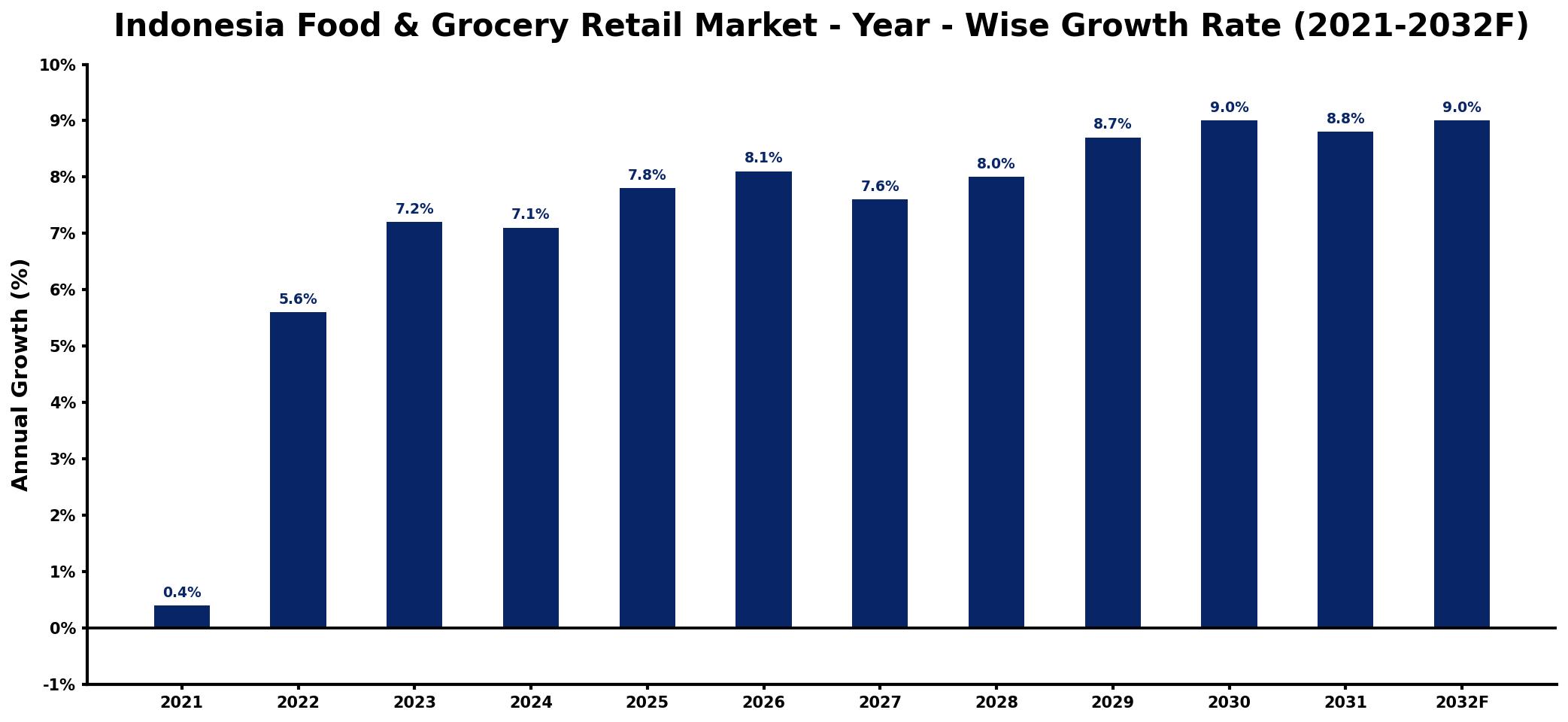
The table below presents the year‑wise growth rates along with the key drivers influencing the market
| Year | Growth Rate | Major Drivers |
| 2021 | 0.4% | Rising consumer spending habits |
| 2022 | 5.6% | E-commerce platforms gaining popularity |
| 2023 | 7.2% | Increased urban population density |
| 2024 | 7.1% | Expansion of local supply chains |
| 2025 | 7.8% | Growing interest in sustainability |
| 2026 | 8.1% | Technological advancements in logistics |
| 2027 | 7.6% | Diverse product offerings emerging |
| 2028 | 8.0% | Investment in cold storage facilities |
| 2029 | 8.7% | Health consciousness among consumers |
| 2030 | 9.0% | Innovative marketing strategies deployed |
| 2031 | 8.8% | Collaboration with local producers |
| 2032 | 9.0% | Enhanced customer loyalty programs |
Note: Market size estimations and growth projections presented in this report are based on 6Wresearch's proprietary forecasting methodology, utilizing the latest available industry data, government publications, and primary research inputs.
Indonesia Food & Grocery Retail Market Synopsis
The ongoing urbanization in Indonesia is the strongest force shaping the food grocery retail market. As more people migrate to urban centers, they bring with them a changing set of shopping behaviors that favor convenience and variety, thus driving modern retail growth.
Additionally, the increasing popularity of e-commerce and digital payment platforms is revolutionizing the grocery shopping experience. Consumers now prefer the ease of online shopping, leading to greater competition among brick-and-mortar stores to meet evolving preferences and safety standards.
- The market is witnessing significant growth due to urbanization and increasing purchasing power.
- Modern retail formats are rapidly becoming the preferred choice for consumers seeking variety and convenience.
- The rise of online grocery shopping is reshaping traditional retail dynamics.
- Supply chain and logistical challenges are impacting efficient product distribution.
- Consumer preferences are rapidly evolving, necessitating adaptability from retailers.
The Indonesia Food & Grocery Retail Market faces several restraints that could impede growth. One of the most significant challenges is the rapidly changing landscape of consumer behavior, driven largely by the digital transformation in shopping preferences. Traditional retailers struggle to keep pace with digital competitors, which could hinder their market share. Furthermore, regional logistical constraints pose challenges in ensuring efficient distribution networks, particularly in less developed areas. The challenge of maintaining competitive pricing while ensuring operational profitability also looms large as consumers become increasingly price-sensitive.
Several trends are currently reshaping the landscape of Indonesia's food grocery retail market. The rise of health-conscious consumers is steering demand towards organic and locally-sourced products, while sustainability initiatives are becoming increasingly prominent among retailers. Additionally, the integration of technology, such as AI and data analytics, is enhancing customer experiences through personalized marketing and improved inventory management. Notably, the expansion of online grocery platforms is also set to redefine shopping behaviors, as more consumers embrace the convenience of digital channels.
The Indonesian food grocery retail market presents a myriad of growth opportunities. Retailers can capitalize on the increasing trend towards health and wellness by offering organic and specialty products. The burgeoning e-commerce sector also offers untapped potential, particularly for retailers willing to enhance their digital presence. Additionally, partnerships with local suppliers could strengthen supply chains and cater to the growing demand for fresh produce. Further investment in logistics and distribution infrastructure will be crucial in meeting consumer expectations for speed and convenience.
The Indonesian government has been actively promoting initiatives aimed at boosting the food grocery retail market. Various policies focus on enhancing infrastructure and logistics capabilities to improve supply chains across the archipelago. Furthermore, public spending on urban development is contributing to the growth of modern retail outlets in metropolitan areas. Government incentives for small and medium enterprises (SMEs) are also fostering innovation and competition within the grocery sector.
Looking ahead to the period between 2026 and 2032, the Indonesia Food & Grocery Retail Market is expected to continue its upward trajectory. As urbanization progresses, the appetite for diverse food offerings will only intensify. Retailers who can effectively blend traditional retailing with cutting-edge digital solutions will stand to benefit the most. Additionally, consumer focus on sustainability and health will drive innovations in product offerings and operational practices, further enhancing the market's dynamics.
Recent developments in the Indonesia Food & Grocery Retail Market indicate a shift towards enhanced digital experiences, with many retailers investing heavily in their e-commerce platforms to capture the growing online consumer base. Efforts to streamline logistics and supply chains have also gained momentum, as companies aim to overcome regional distribution challenges. Additionally, consumer engagement strategies are evolving, with an increased focus on sustainability and community involvement driving brand loyalty.
- 10 Years of Market Numbers
- Historical Data Starting from 2022 to 2025
- Base Year: 2025
- Forecast Data until 2032
- Key Performance Indicators Impacting the Market
- Major Upcoming Developments and Projects
Key Highlights of the Report:
- Indonesia Food & Grocery Retail Market Outlook
- Market Size of Indonesia Food & Grocery Retail Market, 2025
- Forecast of Indonesia Food & Grocery Retail Market, 2032
- Historical Data and Forecast of Indonesia Food & Grocery Retail Revenues & Volume for the Period 2022-2032F
- Indonesia Food & Grocery Retail Market Trend Evolution
- Indonesia Food & Grocery Retail Market Drivers and Challenges
- Indonesia Food & Grocery Retail Price Trends
- Indonesia Food & Grocery Retail Porter's Five Forces
- Indonesia Food & Grocery Retail Industry Life Cycle
- Historical Data and Forecast of Indonesia Food & Grocery Retail Market Revenues & Volume By Product for the Period 2022-2032F
- Historical Data and Forecast of Indonesia Food & Grocery Retail Market Revenues & Volume By Fresh Food for the Period 2022-2032F
- Historical Data and Forecast of Indonesia Food & Grocery Retail Market Revenues & Volume By Frozen Food for the Period 2022-2032F
- Historical Data and Forecast of Indonesia Food & Grocery Retail Market Revenues & Volume By Food Cupboard for the Period 2022-2032F
- Historical Data and Forecast of Indonesia Food & Grocery Retail Market Revenues & Volume By Beverages for the Period 2022-2032F
- Historical Data and Forecast of Indonesia Food & Grocery Retail Market Revenues & Volume By Cleaning & Household for the Period 2022-2032F
- Historical Data and Forecast of Indonesia Food & Grocery Retail Market Revenues & Volume By Others for the Period 2022-2032F
- Historical Data and Forecast of Indonesia Food & Grocery Retail Market Revenues & Volume By Distribution Channel for the Period 2022-2032F
- Historical Data and Forecast of Indonesia Food & Grocery Retail Market Revenues & Volume By Supermarkets & Hypermarkets for the Period 2022-2032F
- Historical Data and Forecast of Indonesia Food & Grocery Retail Market Revenues & Volume By Convenience Stores for the Period 2022-2032F
- Historical Data and Forecast of Indonesia Food & Grocery Retail Market Revenues & Volume By Departmental Stores & Clubs for the Period 2022-2032F
- Historical Data and Forecast of Indonesia Food & Grocery Retail Market Revenues & Volume By Online for the Period 2022-2032F
- Indonesia Food & Grocery Retail Import Export Trade Statistics
- Market Opportunity Assessment By Product
- Market Opportunity Assessment By Distribution Channel
- Indonesia Food & Grocery Retail Top Companies Market Share
- Indonesia Food & Grocery Retail Competitive Benchmarking By Technical and Operational Parameters
- Indonesia Food & Grocery Retail Company Profiles
- Indonesia Food & Grocery Retail Key Strategic Recommendations






































