Indonesia Gamification Market Size, Share & Growth Rate
The Indonesia Gamification Market was estimated at USD 322 Million in 2025 and is projected to reach USD 423 Million by 2032, growing at a CAGR of 4.0% from 2026 to 2032. This growth trajectory is fueled by increasing consumer demand for interactive and engaging experiences, particularly in sectors such as telecom and education. As businesses seek innovative marketing strategies, gamification emerges as a key tool to enhance customer engagement and loyalty, driving a vibrant market landscape.
Indonesia Gamification Market Year-wise Growth Rate and Key Drivers
This graph highlights how the Indonesia Gamification Market has steadily grown over the years, supported by major growth factors.
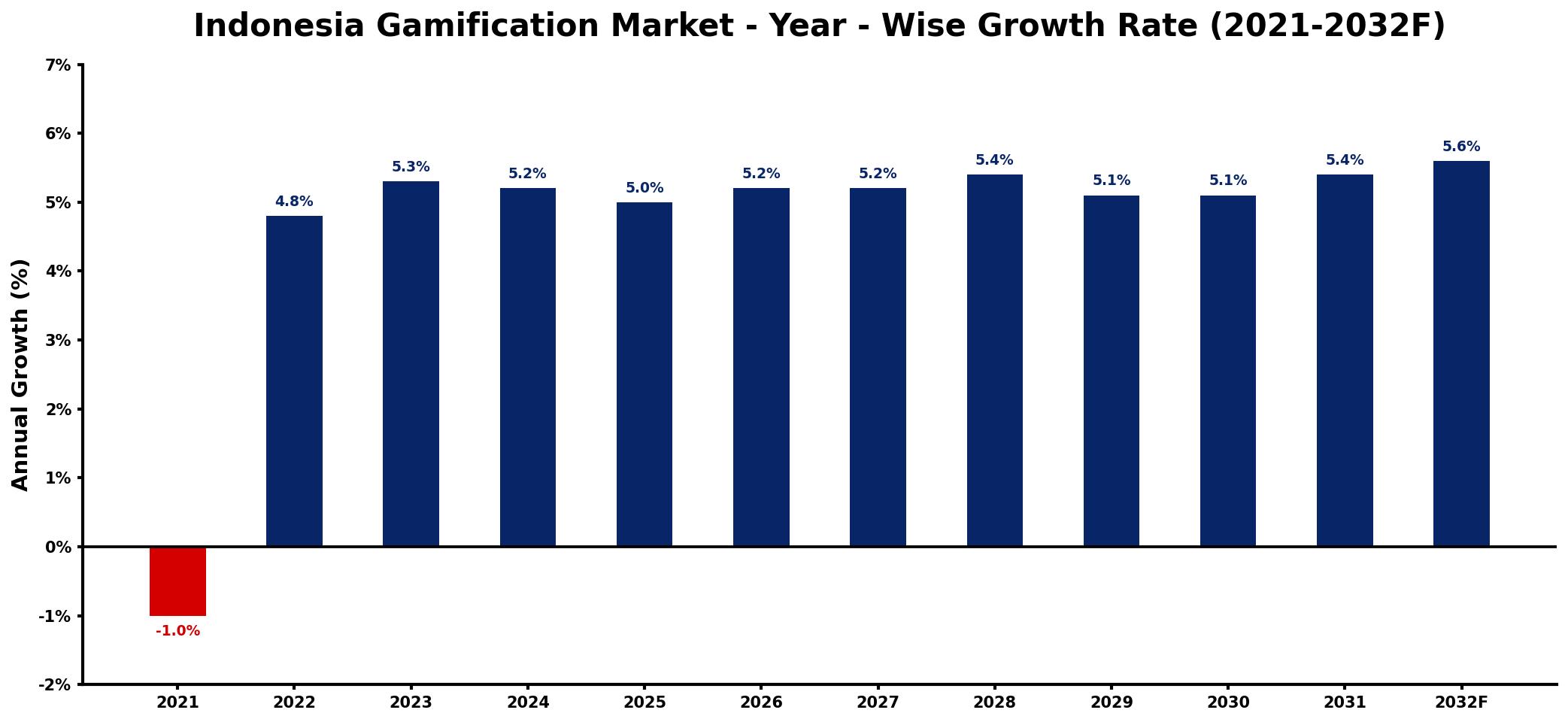
The table below presents the year‑wise growth rates along with the key drivers influencing the market
| Year | Growth Rate | Major Drivers |
| 2021 | -1.0% | reduced investment in digital engagement |
| 2022 | 4.8% | increased focus on employee training |
| 2023 | 5.3% | growing interest in interactive learning |
| 2024 | 5.2% | expanding applications in marketing strategies |
| 2025 | 5.0% | growing downstream application demand |
| 2026 | 5.2% | enhanced integration with mobile platforms |
| 2027 | 5.2% | broader adoption in educational institutions |
| 2028 | 5.4% | increased funding for tech startups |
| 2029 | 5.1% | growing popularity of loyalty programs |
| 2030 | 5.1% | emerging trends in customer experience |
| 2031 | 5.4% | growing commercial sector adoption |
| 2032 | 5.6% | rising awareness of behavioral incentives |
Note: Market size estimations and growth projections presented in this report are based on 6Wresearch's proprietary forecasting methodology, utilizing the latest available industry data, government publications, and primary research inputs.
Indonesia Gamification Market Synopsis
Recent momentum in the Indonesia gamification market highlights a robust engagement landscape where businesses are rapidly adopting gamified approaches to enhance customer interaction. Moving forward, this market is set to capitalize on the ongoing digital transformation and the growing mobile gaming trend, which plays a critical role in shaping consumer behavior.
As the pandemic highlighted the need for effective remote engagement solutions, various industries are now investing in gamification as a strategic initiative. This shift indicates a promising future for the market, as more enterprises recognize the potential of gamification to not only retain existing customers but also attract new ones through compelling, game-like experiences.
Indonesia Gamification Market Key Takeaways
- The market is experiencing a significant shift toward interactive customer engagement strategies.
- Telecom companies are leading the way by integrating gamification to improve customer loyalty.
- Educational institutions are leveraging gamification for enhanced remote learning experiences.
- Mobile gaming growth is driving gamification adoption across various industries.
- User engagement and data privacy remain critical focus areas for market players.
Evaluation of Restraints in Indonesia Gamification Market
Despite its promising growth, the Indonesia gamification market faces real constraints that could impede its progress. One significant challenge is crafting gamified experiences that resonate with the diverse cultural landscape of Indonesia while also adhering to stringent data privacy regulations. Companies must navigate the complex interplay of user preferences and security concerns, which can complicate the development of successful gamification strategies. Additionally, ensuring sustained user engagement remains a delicate balancing act, as users can quickly lose interest in gamified content that fails to deliver fresh and relevant experiences.
Indonesia Gamification Market Trends
Several current and emerging trends are shaping the gamification landscape in Indonesia. The integration of gamification with augmented reality (AR) and virtual reality (VR) technologies is becoming more prevalent, enhancing user experiences through immersive environments. Furthermore, there is a noticeable rise in gamified learning platforms among educational institutions aiming to boost student engagement. Businesses are also utilizing data analytics to refine gamification strategies, tailoring experiences based on user behavior and preferences for maximum impact.
Indonesia Gamification Market Opportunities
The gamification market in Indonesia presents genuine growth opportunities, particularly in sectors such as health and wellness, where engaging platforms can promote positive lifestyle choices. Additionally, the rise of e-commerce offers a fertile ground for gamified loyalty programs designed to reward customer engagement. As technology evolves, companies that harness AI and machine learning to personalize gamified experiences will likely lead the market. This focus on innovation and customer-centric strategies positions businesses to capture an expanding audience eager for interactive experiences.
Government Initiatives in the Indonesia Gamification Market
The Indonesian government is increasingly recognizing the importance of digital transformation, including gamification, as a means to stimulate economic growth. Initiatives aimed at enhancing the digital economy are being implemented, such as investing in technology infrastructure and supporting startups that explore innovative solutions. These efforts provide a conducive environment for the gamification market to thrive and encourage collaboration between public and private sectors to drive development.
Future Insights of the Indonesia Gamification Market
Looking ahead to 2026-2032, the Indonesia gamification market is expected to continue on its growth trajectory, driven by technological advancements and evolving consumer expectations. The growing popularity of mobile applications and a more digitally literate population will further enhance the market's potential. As organizations become more adept at leveraging data for personalized gamification experiences, the demand for innovative solutions will likely increase, setting the stage for dynamic market evolution.
Indonesia Gamification Market Latest Developments (2025 - 2026)
During the recent period, the gamification landscape in Indonesia has been marked by a surge in new collaborations between tech companies and educational institutions, aimed at creating interactive learning environments. Additionally, many businesses have begun to explore gamification as part of their broader digital transformation strategies, integrating it into customer relationship management systems to enhance user engagement. Overall, the focus remains on innovation and creating value through engaging experiences across various sectors.
Indonesia Gamification Market - Key Attractiveness of the Report
- 10 Years of Market Numbers
- Historical Data Starting from 2022 to 2025
- Base Year: 2025
- Forecast Data until 2032
- Key Performance Indicators Impacting the Market
- Major Upcoming Developments and Projects
Key Highlights of the Report:
- Indonesia Gamification Market Outlook
- Market Size of Indonesia Gamification Market, 2025
- Forecast of Indonesia Gamification Market, 2032
- Historical Data and Forecast of Indonesia Gamification Revenues & Volume for the Period 2022-2032F
- Indonesia Gamification Market Trend Evolution
- Indonesia Gamification Market Drivers and Challenges
- Indonesia Gamification Price Trends
- Indonesia Gamification Porter's Five Forces
- Indonesia Gamification Industry Life Cycle
- Historical Data and Forecast of Indonesia Gamification Market Revenues & Volume By Component for the Period 2022-2032F
- Historical Data and Forecast of Indonesia Gamification Market Revenues & Volume By Solution for the Period 2022-2032F
- Historical Data and Forecast of Indonesia Gamification Market Revenues & Volume By Services for the Period 2022-2032F
- Historical Data and Forecast of Indonesia Gamification Market Revenues & Volume By Deployment for the Period 2022-2032F
- Historical Data and Forecast of Indonesia Gamification Market Revenues & Volume By Cloud for the Period 2022-2032F
- Historical Data and Forecast of Indonesia Gamification Market Revenues & Volume By On-premises for the Period 2022-2032F
- Historical Data and Forecast of Indonesia Gamification Market Revenues & Volume By Organization Size for the Period 2022-2032F
- Historical Data and Forecast of Indonesia Gamification Market Revenues & Volume By SMEs for the Period 2022-2032F
- Historical Data and Forecast of Indonesia Gamification Market Revenues & Volume By Large Enterprises for the Period 2022-2032F
- Historical Data and Forecast of Indonesia Gamification Market Revenues & Volume By End-User for the Period 2022-2032F
- Historical Data and Forecast of Indonesia Gamification Market Revenues & Volume By Enterprise-Driven for the Period 2022-2032F
- Historical Data and Forecast of Indonesia Gamification Market Revenues & Volume By Consumer-Driven for the Period 2022-2032F
- Indonesia Gamification Import Export Trade Statistics
- Market Opportunity Assessment By Component
- Market Opportunity Assessment By Deployment
- Market Opportunity Assessment By Organization Size
- Market Opportunity Assessment By End-User
- Indonesia Gamification Top Companies Market Share
- Indonesia Gamification Competitive Benchmarking By Technical and Operational Parameters
- Indonesia Gamification Company Profiles
- Indonesia Gamification Key Strategic Recommendations






































