Indonesia Image Recognition Market Size & Growth Rate (2026-2032)
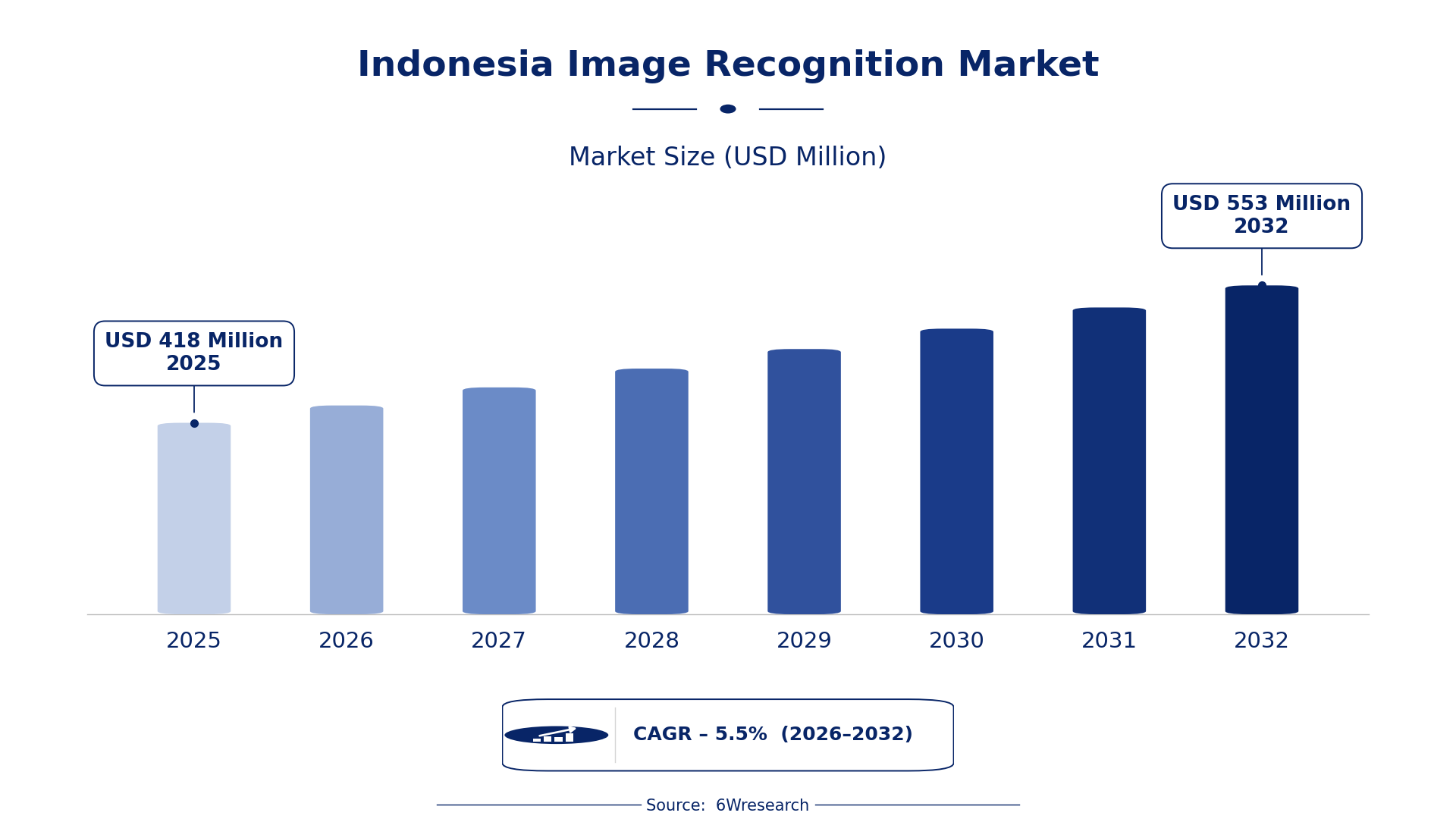
The Indonesia Image Recognition Market was estimated at USD 418 Million in 2025 and is projected to reach USD 553 Million by 2032, growing at a CAGR of 5.5% from 2026 to 2032.
Indonesia Image Recognition Market Synopsis
The Indonesia Image Recognition Market has gained impressive traction recently, fueled by advancements in AI and computer vision technologies. As businesses increasingly adopt these tools, the market is evolving into a key player across various sectors, including retail and healthcare, as organizations look to enhance efficiency and customer engagement.
Looking ahead, the future of image recognition in Indonesia appears promising. With the mounting need for automation and data-driven insights, the market is set to flourish, but it must also navigate complexities such as diverse data sources and stringent privacy regulations. Balancing innovation with compliance will be critical for sustained growth.
Indonesia Image Recognition Market Year-wise Growth Rate and Key Drivers
This graph illustrates the annual growth rates of the Indonesia Image Recognition Market from 2021 to 2032, highlighting a steady upward trajectory and projected expansion over the forecast period.
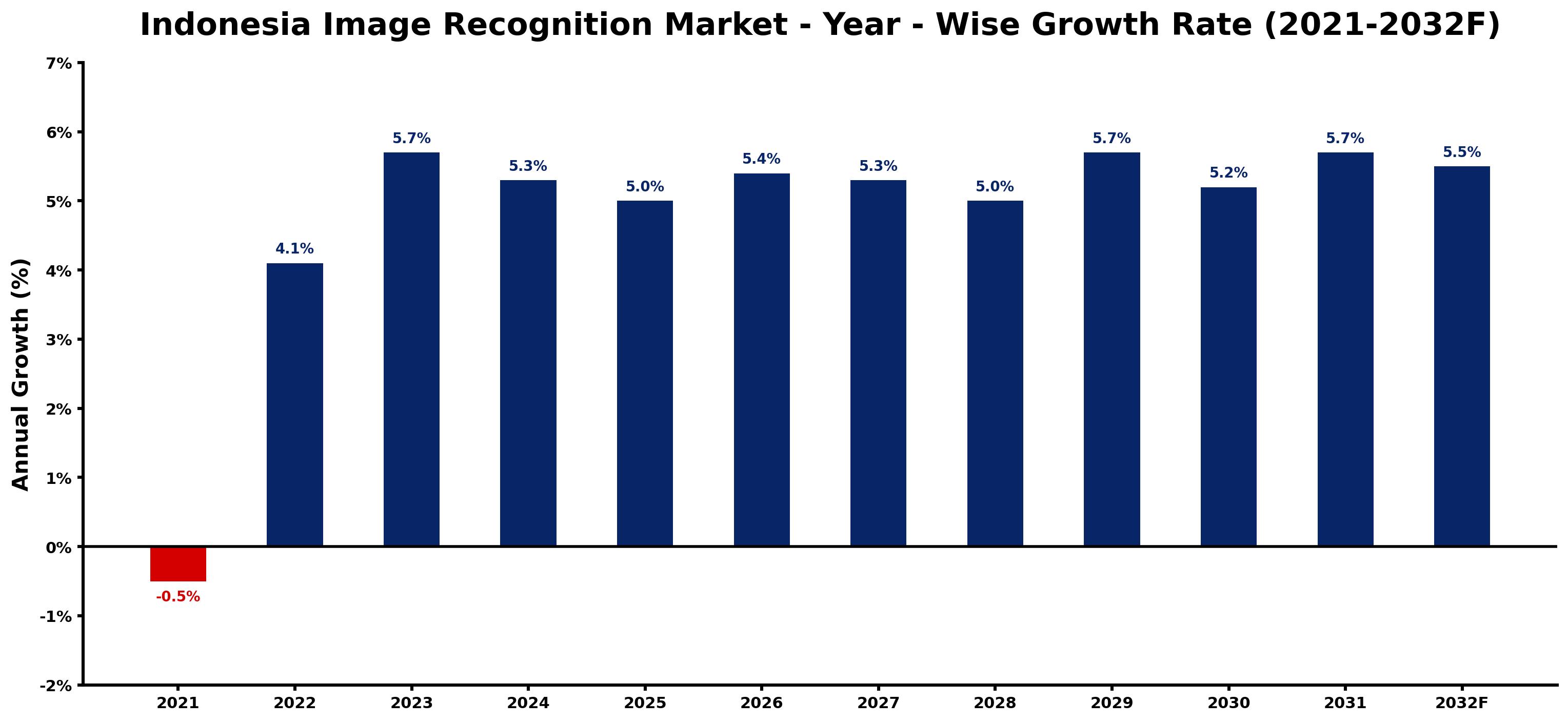
The table below presents the year‑wise growth rates along with the key drivers influencing the market
| Year | Growth Rate | Major Drivers |
| 2021 | -0.5% | PSEK software regulation limits AI development and investment. |
| 2022 | 4.1% | Government surveillance initiatives boost demand for analytics. |
| 2023 | 5.7% | Increased retail sector adoption of AI for customer insights. |
| 2024 | 5.3% | Healthcare sector utilizes image recognition for diagnostics enhancement. |
| 2025 | 5.0% | Growing e-commerce platforms integrate visual search technologies. |
| 2026 | 5.4% | Rising smartphone penetration drives image recognition applications. |
| 2027 | 5.3% | Local tech startups innovate in facial recognition solutions. |
| 2028 | 5.0% | Education sector adopts image recognition for administrative efficiency. |
| 2029 | 5.7% | Security industry invests in biometric systems for safety. |
| 2030 | 5.2% | Smart city projects incorporate image analysis for traffic management. |
| 2031 | 5.7% | Social media platforms leverage image recognition for content moderation. |
| 2032 | 5.5% | Increased regulatory focus on digital identity verification processes. |
Note: Market size estimations and growth projections presented in this report are based on 6Wresearch's proprietary forecasting methodology, utilizing the latest available industry data, government publications, and primary research inputs.
Indonesia Image Recognition Market Key Takeaways
Below are some of the specific key takeaways from the market, including:
- Increased adoption across sectors like retail, healthcare, and security is driving demand.
- The need for automation and enhanced user experiences is a primary market driver.
- Diverse data sources present significant challenges for accurate image recognition.
- Privacy concerns are shaping the regulatory landscape, impacting market dynamics.
- COVID-19 accelerated the use of image recognition technologies in contactless applications.
Evaluation of Restraints in Indonesia Image Recognition Market
Despite the positive outlook, the Indonesian image recognition market faces real restraints. One of the most pressing challenges is the variety of image types and data sources, which complicates the accuracy of recognition systems. Additionally, businesses must prioritize privacy and comply with evolving regulations, creating a tightrope to walk between technological advancement and legal obligations. This balancing act is crucial for any organization seeking to harness the potential of image recognition technology.
Indonesia Image Recognition Market Trends
As the market evolves, several trends are shaping its trajectory. The integration of AI-driven algorithms is enhancing the accuracy of image recognition systems, enabling real-time analysis and improved decision-making. on top of that, as businesses pivot towards e-commerce, the demand for visual search capabilities is on the rise, particularly in retail. Another notable trend is the focus on telemedicine, with healthcare providers increasingly utilizing image recognition for diagnostics and patient monitoring.
Indonesia Image Recognition Market Opportunities
Opportunities abound for businesses willing to invest in image recognition technology. The retail sector, in particular, offers significant growth potential, as brands seek to personalize customer interactions through visual data. Additionally, security applications are becoming increasingly critical, with government and private sectors looking for advanced surveillance solutions. The ongoing digital transformation across industries presents a fertile ground for innovative image recognition applications.
Government Initiatives in the Indonesia Image Recognition Market
Government policy plays a crucial role in shaping the Indonesia Image Recognition Market. With a focus on digital innovation and regulatory frameworks, the Indonesian government is prioritizing the growth of tech-driven sectors. This commitment to fostering a supportive environment is vital for companies looking to thrive in the competitive landscape of image recognition.
- A national digital infrastructure upgrade program was recently launched to enhance connectivity and support tech innovations.
- Current initiatives are underway to develop a regulatory framework focusing on data privacy and protection, impacting image recognition technologies.
- Planned public-private partnerships aim to promote research and development in AI and computer vision technologies, expected to roll out in 2026.
- Ongoing government campaigns to improve digital literacy are also expected to boost the demand for image recognition tools across various sectors.
Future Insights of the Indonesia Image Recognition Market
From 2026 to 2032, the Indonesia Image Recognition Market is likely to experience significant evolution. Companies will increasingly rely on advanced analytics and AI to drive their image recognition capabilities. The growing demand for efficient operational solutions will push businesses to adopt these technologies, creating a ripple effect across sectors. As regulatory frameworks mature, the market will need to adapt quickly to ensure compliance while maximizing the benefits of innovative technologies.
Indonesia Image Recognition Market Latest Developments
In the past year, the Indonesia Image Recognition Market has witnessed numerous developments that indicate a shift towards greater adoption and innovation. Companies are exploring new technologies and partnerships to enhance their offerings, reflecting the growing interest in image recognition applications.
- A major technology vendor announced a collaboration with local healthcare providers in early 2025 to integrate image recognition solutions for telemedicine applications.
- An initiative focusing on enhancing retail customer experiences through AI-driven visual search capabilities is currently underway, expected to be completed by late 2025.
- A rollout of a new image recognition software designed to improve security systems is planned to begin in Q2 2026.
- A pilot project aimed at deploying image recognition for quality control in manufacturing is currently in progress, with results expected by mid-2025.
Indonesia Image Recognition Market - Key Attractiveness of the Report
- 10 Years of Market Numbers
- Historical Data Starting from 2022 to 2025
- Base Year: 2025
- Forecast Data until 2032
- Key Performance Indicators Impacting the Market
- Major Upcoming Developments and Projects
Key Highlights of the Report:
- Indonesia Image Recognition Market Outlook
- Market Size of Indonesia Image Recognition Market, 2025
- Forecast of Indonesia Image Recognition Market, 2032
- Historical Data and Forecast of Indonesia Image Recognition Revenues & Volume for the Period 2022-2032F
- Indonesia Image Recognition Market Trend Evolution
- Indonesia Image Recognition Market Drivers and Challenges
- Indonesia Image Recognition Price Trends
- Indonesia Image Recognition Porter's Five Forces
- Indonesia Image Recognition Industry Life Cycle
- Historical Data and Forecast of Indonesia Image Recognition Market Revenues & Volume By Technology for the Period 2022-2032F
- Historical Data and Forecast of Indonesia Image Recognition Market Revenues & Volume By Digital Image Processing for the Period 2022-2032F
- Historical Data and Forecast of Indonesia Image Recognition Market Revenues & Volume By Facial Recognition for the Period 2022-2032F
- Historical Data and Forecast of Indonesia Image Recognition Market Revenues & Volume By Pattern Recognition for the Period 2022-2032F
- Historical Data and Forecast of Indonesia Image Recognition Market Revenues & Volume By Deployment Mode for the Period 2022-2032F
- Historical Data and Forecast of Indonesia Image Recognition Market Revenues & Volume By On-premises for the Period 2022-2032F
- Historical Data and Forecast of Indonesia Image Recognition Market Revenues & Volume By Cloud for the Period 2022-2032F
- Historical Data and Forecast of Indonesia Image Recognition Market Revenues & Volume By Component for the Period 2022-2032F
- Historical Data and Forecast of Indonesia Image Recognition Market Revenues & Volume By Hardware for the Period 2022-2032F
- Historical Data and Forecast of Indonesia Image Recognition Market Revenues & Volume By Software for the Period 2022-2032F
- Historical Data and Forecast of Indonesia Image Recognition Market Revenues & Volume By Services for the Period 2022-2032F
- Historical Data and Forecast of Indonesia Image Recognition Market Revenues & Volume By Application for the Period 2022-2032F
- Historical Data and Forecast of Indonesia Image Recognition Market Revenues & Volume By Scanning and Imaging for the Period 2022-2032F
- Historical Data and Forecast of Indonesia Image Recognition Market Revenues & Volume By Security and Surveillance for the Period 2022-2032F
- Historical Data and Forecast of Indonesia Image Recognition Market Revenues & Volume By Image Search for the Period 2022-2032F
- Historical Data and Forecast of Indonesia Image Recognition Market Revenues & Volume By Augmented Reality for the Period 2022-2032F
- Historical Data and Forecast of Indonesia Image Recognition Market Revenues & Volume By Marketing and Advertising for the Period 2022-2032F
- Indonesia Image Recognition Import Export Trade Statistics
- Market Opportunity Assessment By Technology
- Market Opportunity Assessment By Deployment Mode
- Market Opportunity Assessment By Component
- Market Opportunity Assessment By Application
- Indonesia Image Recognition Top Companies Market Share
- Indonesia Image Recognition Competitive Benchmarking By Technical and Operational Parameters
- Indonesia Image Recognition Company Profiles
- Indonesia Image Recognition Key Strategic Recommendations






































