Indonesia Multichannel Order Management Market Size & Growth Rate (2026-2032)
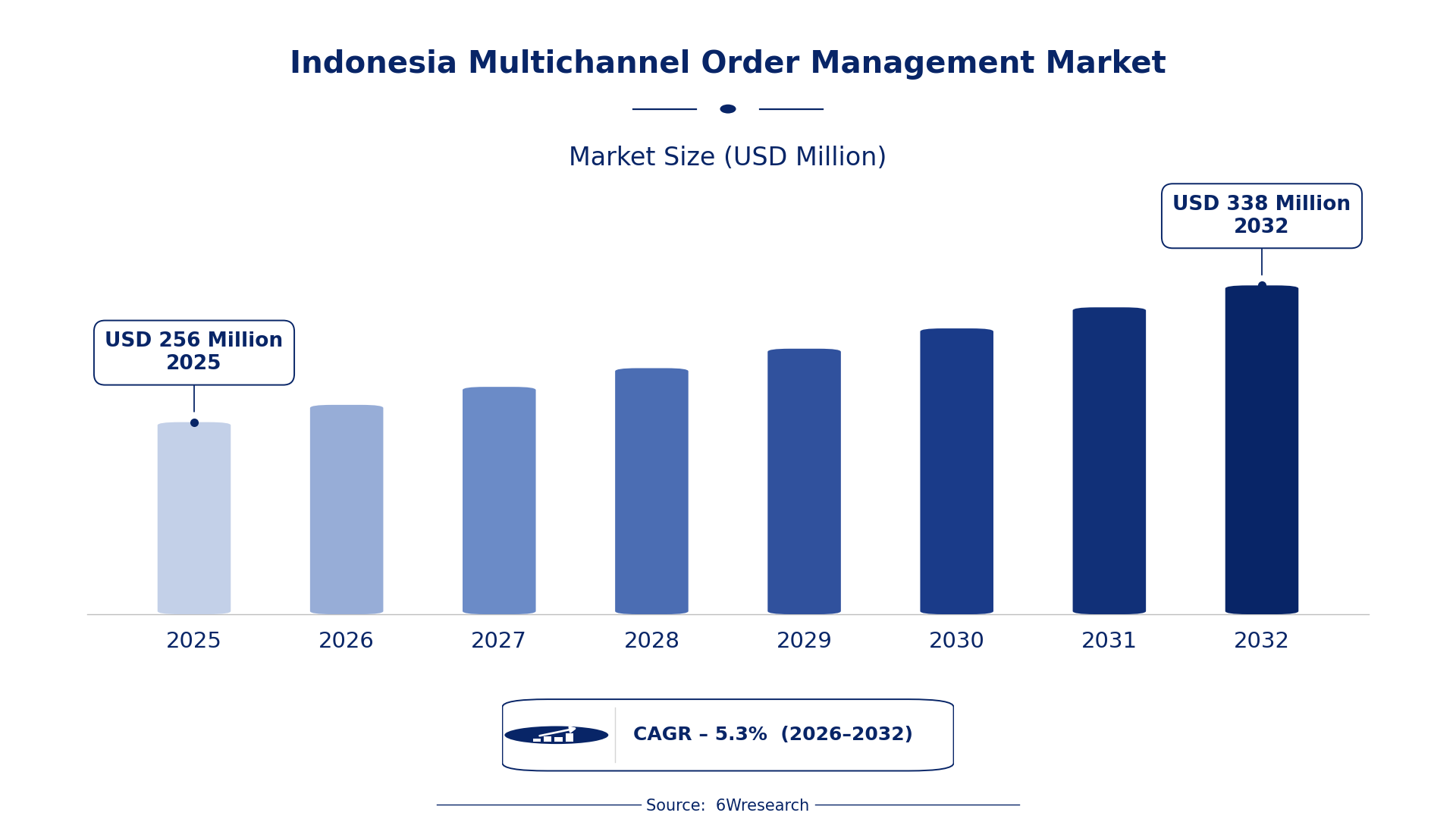
The Indonesia Multichannel Order Management Market was estimated at USD 256 Million in 2025 and is projected to reach USD 338 Million by 2032, growing at a CAGR of 5.3% from 2026 to 2032.
Indonesia Multichannel Order Management Market Synopsis
The Indonesian multichannel order management market is currently witnessing a transformative phase, driven by the rapid growth of e-commerce and changing consumer behavior. Businesses are increasingly recognizing the necessity for efficient order processing systems that can seamlessly integrate multiple sales channels, from websites to social media platforms.
As the demand for a unified shopping experience intensifies, companies are compelled to adopt multichannel order management solutions. This shift not only enhances customer satisfaction but also streamlines backend operations, setting a new standard for operational excellence in the retail sector.
Indonesia Multichannel Order Management Market Year-wise Growth Rate and Key Drivers
This graph illustrates the annual growth rates of the Indonesia Multichannel Order Management Market from 2021 to 2032, highlighting a steady upward trajectory and projected expansion over the forecast period.
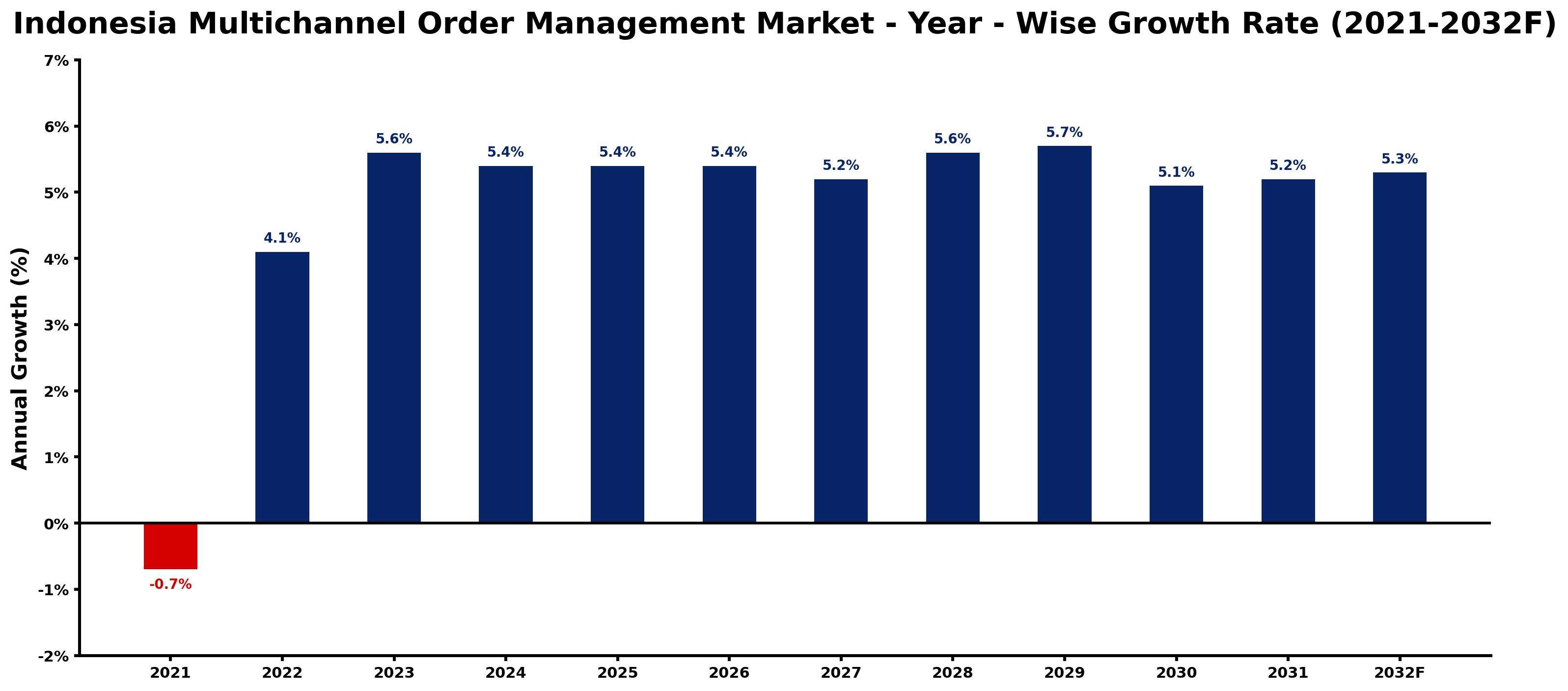
The table below presents the year‑wise growth rates along with the key drivers influencing the market
| Year | Growth Rate | Major Drivers |
| 2021 | -0.7% | Supply chain inefficiencies due to local shipping regulations. |
| 2022 | 4.1% | Surge in online retail due to pandemic consumer behavior. |
| 2023 | 5.6% | Government support for digital SMEs through funding initiatives. |
| 2024 | 5.4% | Increased smartphone usage driving e-commerce accessibility. |
| 2025 | 5.4% | High adoption of mobile wallets enhancing online transactions. |
| 2026 | 5.4% | Rising consumer confidence boosting retail spending online. |
| 2027 | 5.2% | Logistics partnerships expanding delivery capabilities in cities. |
| 2028 | 5.6% | Investments in fintech improving payment solutions for retailers. |
| 2029 | 5.7% | Digital marketing growth enhancing brand visibility for sellers. |
| 2030 | 5.1% | Government e-commerce regulations fostering market stability. |
| 2031 | 5.2% | Local marketplaces expanding reach to remote communities. |
| 2032 | 5.3% | Emergence of subscription models increasing customer loyalty. |
Note: Market size estimations and growth projections presented in this report are based on 6Wresearch's proprietary forecasting methodology, utilizing the latest available industry data, government publications, and primary research inputs.
Indonesia Multichannel Order Management Market Key Takeaways
Below are some of the specific key takeaways from the market, including:
- The increasing adoption of omnichannel retail strategies is reshaping order management practices.
- Businesses are prioritizing integration capabilities to ensure smooth order processing across platforms.
- Consumer expectations for fast and reliable fulfillment are driving technological innovations.
- Post-pandemic e-commerce growth has significantly influenced market dynamics.
- Investment in order management solutions is expected to accelerate as competition intensifies.
Evaluation of Restraints in Indonesia Multichannel Order Management Market
Several key restraints are impacting the growth of the Indonesia multichannel order management market. One prominent issue is the challenge of integrating various sales channels with existing backend systems. Businesses often struggle with achieving a unified view of customer orders, which complicates timely and accurate processing. on top of that, the pressure to meet heightened customer expectations for speedy fulfillment adds an additional layer of complexity, limiting some companies' ability to fully capitalize on multichannel opportunities.
Indonesia Multichannel Order Management Market Trends
A few trends are gaining traction within the Indonesia multichannel order management market. Firstly, the integration of artificial intelligence and machine learning technologies is enabling more efficient order processing and customer insights. Secondly, mobile commerce is on the rise, leading businesses to optimize their platforms for mobile users. Lastly, there's a growing emphasis on data analytics, helping organizations make informed decisions based on consumer behavior and market trends.
Indonesia Multichannel Order Management Market Opportunities
The current market landscape presents numerous growth opportunities. Companies can invest in enhanced order management systems that not only streamline operations but also provide analytics-driven insights. Additionally, partnerships with tech firms specializing in e-commerce solutions can further enhance capabilities. The increasing trend of social commerce also offers a unique channel for businesses to engage with customers directly, creating further avenues for growth.
Government Initiatives in the Indonesia Multichannel Order Management Market
Government policies are playing an influential role in shaping the multichannel order management market in Indonesia. The regulatory framework is becoming increasingly supportive of e-commerce growth, encouraging businesses to adopt advanced technologies. This shift is crucial for meeting both consumer expectations and international standards in retail.
- A national digital infrastructure upgrade program launched in 2023 is enhancing connectivity across urban and rural areas, facilitating better online order management.
- Currently underway is a government initiative aimed at streamlining e-commerce regulations to foster a more transparent and efficient market environment.
- A planned public-private partnership expected to roll out in 2025 aims to support small and medium enterprises in adopting multichannel order management solutions.
- The introduction of tax incentives for companies investing in digital solutions is anticipated to boost market growth by 2026.
Future Insights of the Indonesia Multichannel Order Management Market
Looking ahead to 2026-2032, the Indonesia multichannel order management market is expected to evolve significantly. As consumer preferences continue to shift towards personalized and immediate service, businesses will need to adapt their strategies accordingly. The integration of advanced technologies such as artificial intelligence will likely enhance operational efficiencies, while data-driven insights will empower companies to make informed decisions. In this context, organizations that prioritize innovation and agility will be well-positioned to thrive.
Indonesia Multichannel Order Management Market Latest Developments
In the past 12-14 months, the Indonesia multichannel order management market has seen notable activity, reflecting the sector's dynamic nature. Companies are increasingly focused on optimizing their order management processes to meet the growing demands of consumers, particularly in the wake of the pandemic.
- A major technology vendor launched a comprehensive order management solution in Q1 2025, aimed at improving integration across sales channels.
- An ongoing initiative by a regional operator to upgrade its logistics capabilities is expected to enhance order fulfillment efficiency, projected to complete by late 2025.
- A partnership between local e-commerce platforms and logistics providers initiated in mid-2025 is designed to streamline last-mile delivery services.
- Plans for an upcoming training program targeting SMEs on effective multichannel order management strategies are scheduled for launch in early 2026.
Indonesia Multichannel Order Management Market - Key Attractiveness of the Report
- 10 Years of Market Numbers
- Historical Data Starting from 2022 to 2025
- Base Year: 2025
- Forecast Data until 2032
- Key Performance Indicators Impacting the Market
- Major Upcoming Developments and Projects
Key Highlights of the Report:
- Indonesia Multichannel Order Management Market Outlook
- Market Size of Indonesia Multichannel Order Management Market, 2025
- Forecast of Indonesia Multichannel Order Management Market, 2032
- Historical Data and Forecast of Indonesia Multichannel Order Management Revenues & Volume for the Period 2022-2032F
- Indonesia Multichannel Order Management Market Trend Evolution
- Indonesia Multichannel Order Management Market Drivers and Challenges
- Indonesia Multichannel Order Management Price Trends
- Indonesia Multichannel Order Management Porter's Five Forces
- Indonesia Multichannel Order Management Industry Life Cycle
- Historical Data and Forecast of Indonesia Multichannel Order Management Market Revenues & Volume By Component for the Period 2022-2032F
- Historical Data and Forecast of Indonesia Multichannel Order Management Market Revenues & Volume By Software for the Period 2022-2032F
- Historical Data and Forecast of Indonesia Multichannel Order Management Market Revenues & Volume By Services for the Period 2022-2032F
- Historical Data and Forecast of Indonesia Multichannel Order Management Market Revenues & Volume By Vertical for the Period 2022-2032F
- Historical Data and Forecast of Indonesia Multichannel Order Management Market Revenues & Volume By Retail for the Period 2022-2032F
- Historical Data and Forecast of Indonesia Multichannel Order Management Market Revenues & Volume By e-commerce for the Period 2022-2032F
- Historical Data and Forecast of Indonesia Multichannel Order Management Market Revenues & Volume By Wholesale for the Period 2022-2032F
- Historical Data and Forecast of Indonesia Multichannel Order Management Market Revenues & Volume By Manufacturing for the Period 2022-2032F
- Historical Data and Forecast of Indonesia Multichannel Order Management Market Revenues & Volume By Transportation & Logistics for the Period 2022-2032F
- Historical Data and Forecast of Indonesia Multichannel Order Management Market Revenues & Volume By Application for the Period 2022-2032F
- Historical Data and Forecast of Indonesia Multichannel Order Management Market Revenues & Volume By Order Fulfillment for the Period 2022-2032F
- Historical Data and Forecast of Indonesia Multichannel Order Management Market Revenues & Volume By Inventory Management for the Period 2022-2032F
- Historical Data and Forecast of Indonesia Multichannel Order Management Market Revenues & Volume By Channel Integration for the Period 2022-2032F
- Historical Data and Forecast of Indonesia Multichannel Order Management Market Revenues & Volume By Workflow Automation for the Period 2022-2032F
- Historical Data and Forecast of Indonesia Multichannel Order Management Market Revenues & Volume By Integrated POS for the Period 2022-2032F
- Historical Data and Forecast of Indonesia Multichannel Order Management Market Revenues & Volume By Deployment Mode for the Period 2022-2032F
- Historical Data and Forecast of Indonesia Multichannel Order Management Market Revenues & Volume By On-premises for the Period 2022-2032F
- Historical Data and Forecast of Indonesia Multichannel Order Management Market Revenues & Volume By Cloud for the Period 2022-2032F
- Historical Data and Forecast of Indonesia Multichannel Order Management Market Revenues & Volume By Organization Size for the Period 2022-2032F
- Historical Data and Forecast of Indonesia Multichannel Order Management Market Revenues & Volume By Large Enterprises for the Period 2022-2032F
- Historical Data and Forecast of Indonesia Multichannel Order Management Market Revenues & Volume By SMEs for the Period 2022-2032F
- Indonesia Multichannel Order Management Import Export Trade Statistics
- Market Opportunity Assessment By Component
- Market Opportunity Assessment By Vertical
- Market Opportunity Assessment By Application
- Market Opportunity Assessment By Deployment Mode
- Market Opportunity Assessment By Organization Size
- Indonesia Multichannel Order Management Top Companies Market Share
- Indonesia Multichannel Order Management Competitive Benchmarking By Technical and Operational Parameters
- Indonesia Multichannel Order Management Company Profiles
- Indonesia Multichannel Order Management Key Strategic Recommendations






































