Indonesia Network Encryption Market Size & Growth Rate (2026-2032)
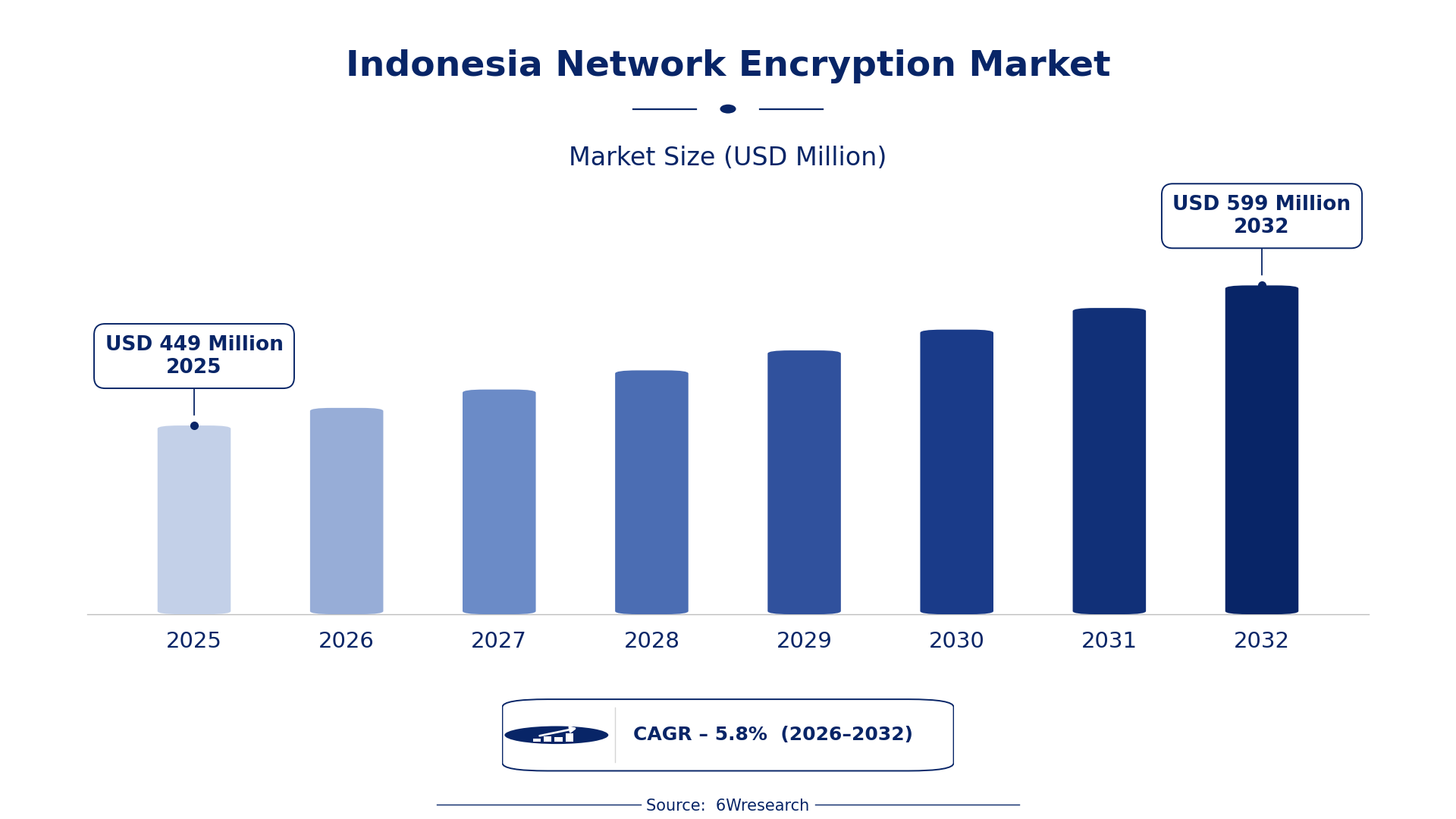
The Indonesia Network Encryption Market was estimated at USD 449 Million in 2025 and is projected to reach USD 599 Million by 2032, growing at a CAGR of 5.8% from 2026 to 2032.
Indonesia Network Encryption Market Synopsis
The Indonesia Network Encryption Market has gained momentum as organizations increasingly recognize the importance of protecting their data against cyber threats. As the digital transformation accelerates, businesses are not only investing in encryption solutions but are also adopting comprehensive cybersecurity strategies to secure sensitive communications.
Looking ahead, the market is set for continued growth driven by regulatory compliance, the rise of remote work, and the increasing sophistication of cyber threats. Organizations are shifting their focus towards advanced encryption technologies to ensure data integrity and confidentiality, indicating a strong future trajectory for the industry.
Indonesia Network Encryption Market Year-wise Growth Rate and Key Drivers
This graph illustrates the annual growth rates of the Indonesia Network Encryption Market from 2021 to 2032, highlighting a steady upward trajectory and projected expansion over the forecast period.
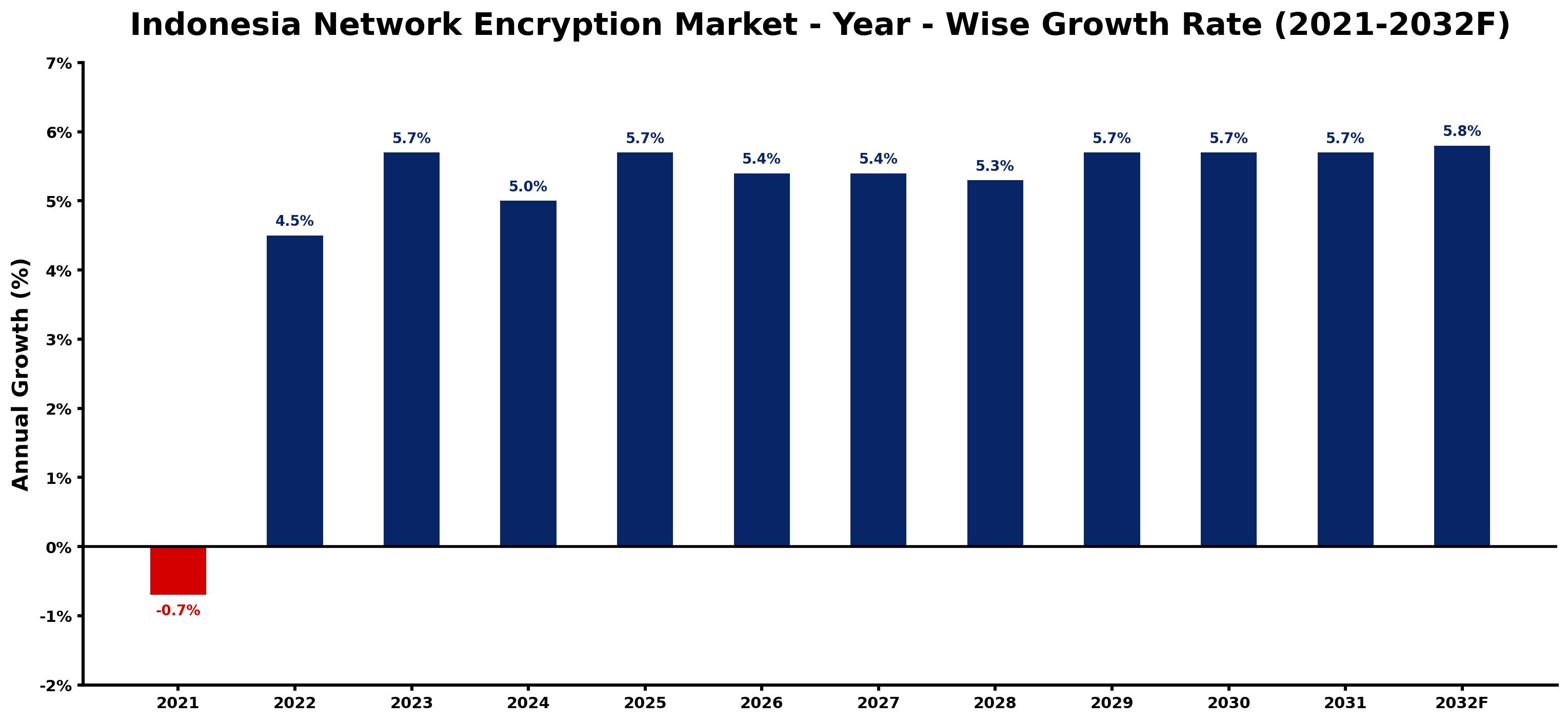
The table below presents the year‑wise growth rates along with the key drivers influencing the market
| Year | Growth Rate | Major Drivers |
| 2021 | -0.7% | Regulatory changes by Kominfo hindered technology adoption. |
| 2022 | 4.5% | Jakarta's cybersecurity regulations mandate encryption for sensitive data |
| 2023 | 5.7% | Government push for secure digital transactions boosts encryption demand |
| 2024 | 5.0% | Increased online banking fraud drives encryption technology adoption |
| 2025 | 5.7% | Regulatory compliance in fintech necessitates advanced encryption solutions |
| 2026 | 5.4% | Rising internet penetration increases need for data protection measures |
| 2027 | 5.4% | E-commerce growth spurs demand for secure network communications |
| 2028 | 5.3% | Telecom sector upgrades enhance encryption service utilization |
| 2029 | 5.7% | National data protection law strengthens encryption requirement for businesses |
| 2030 | 5.7% | Adoption of 5G technology elevates data security concerns |
| 2031 | 5.7% | Public sector initiatives prioritize encryption in government data management |
| 2032 | 5.8% | Smart city projects mandate advanced encryption for citizen data privacy |
Note: Market size estimations and growth projections presented in this report are based on 6Wresearch's proprietary forecasting methodology, utilizing the latest available industry data, government publications, and primary research inputs.
Indonesia Network Encryption Market Key Takeaways
Below are some of the specific key takeaways from the market, including:
- The market is driven primarily by the need to secure sensitive data and communications against evolving cyber threats.
- Compliance regulations are pushing organizations to implement robust encryption strategies.
- Remote work trends have significantly increased the demand for secure communication channels.
- Key players are innovating rapidly to offer advanced encryption solutions tailored to specific industry needs.
- Investment in encryption technology is expected to rise as businesses prioritize cybersecurity in their strategic planning.
Evaluation of Restraints in Indonesia Network Encryption Market
While the Indonesia Network Encryption Market is on a growth path, several restraints could limit its potential. High costs associated with implementing and maintaining advanced encryption solutions can deter smaller organizations from adopting necessary technologies. Additionally, a lack of skilled professionals in cybersecurity complicates the deployment and management of encryption tools. These challenges create a gap in effective data protection, particularly for businesses that are still catching up with the digital age.
Indonesia Network Encryption Market Trends
A notable trend in the Indonesia Network Encryption Market is the shift toward cloud-based encryption solutions. As more businesses migrate to cloud environments, the demand for encryption services that can protect data both in transit and at rest is increasing. on top of that, artificial intelligence and machine learning are becoming integral to encryption technologies, enabling more adaptive and responsive security measures.
Another emerging trend is the increased focus on user experience in encryption solutions. Companies are recognizing that while security is paramount, usability cannot be compromised. The balance between strong encryption protocols and user-friendly interfaces is becoming a focal point for developers and organizations alike.
Indonesia Network Encryption Market Opportunities
The opportunities for growth in the Indonesia Network Encryption Market are substantial. As regulatory frameworks become stricter, organizations will need to invest in compliance-driven encryption solutions. on top of that, the surge in digital transactions and online services presents a ripe environment for encryption providers to offer tailored solutions that meet specific industry requirements.
Investment in research and development can also foster innovation in encryption technologies, particularly in areas such as quantum encryption and blockchain integration. Companies that position themselves at the forefront of these advancements stand to gain a competitive edge in a rapidly evolving market.
Government Initiatives in the Indonesia Network Encryption Market
The Indonesian government has been actively shaping the Network Encryption Market through various initiatives aimed at enhancing cybersecurity. Public policy is focused on establishing a secure digital infrastructure that supports economic growth while protecting sensitive data. By implementing regulatory frameworks and promoting public-private partnerships, the government is paving the way for a more secure digital environment.
- A regulatory framework was introduced in 2025 mandating encryption for sensitive data across all sectors.
- Current initiatives include the rollout of a national cybersecurity awareness program designed to educate businesses about encryption and data protection.
- There is a planned public-private initiative aimed at enhancing the encryption capabilities of local SMEs, expected to launch in 2026.
- The government is also investing in a national digital infrastructure upgrade program to improve the overall security posture of the country's IT landscape.
Future Insights of the Indonesia Network Encryption Market
The outlook for the Indonesia Network Encryption Market from 2026 to 2032 is optimistic. With increasing investments in cybersecurity from both public and private sectors, the market is expected to see significant advancements in encryption technology. As organizations become more aware of the ramifications of data breaches, the demand for effective encryption solutions will only intensify.
By embracing innovative approaches and adapting to regulatory changes, the industry is likely to evolve, leading to more sophisticated encryption methods that not only protect data but also enhance operational efficiency. This evolution will ultimately contribute to a safer digital ecosystem in Indonesia.
Indonesia Network Encryption Market Latest Developments
Recent developments in the Indonesia Network Encryption Market indicate a strong focus on innovation and collaboration. Companies are increasingly prioritizing the integration of advanced encryption technologies into their existing infrastructures to enhance security. The past year has seen several noteworthy movements that highlight this trend.
- A major technology vendor announced the launch of a new encryption solution designed specifically for cloud applications, which began deployment in early 2025.
- An ongoing initiative focuses on upgrading encryption protocols across national government agencies, currently underway and expected to conclude by mid-2026.
- A partnership between leading cybersecurity firms was formed to develop next-generation encryption solutions, with collaborative projects currently in progress.
- A planned rollout of a comprehensive encryption training program for IT professionals is set to commence in late 2025, aimed at addressing the skills gap in the industry.
Indonesia Network Encryption Market - Key Attractiveness of the Report
- 10 Years of Market Numbers
- Historical Data Starting from 2022 to 2025
- Base Year: 2025
- Forecast Data until 2032
- Key Performance Indicators Impacting the Market
- Major Upcoming Developments and Projects
Key Highlights of the Report:
- Indonesia Network Encryption Market Outlook
- Market Size of Indonesia Network Encryption Market, 2025
- Forecast of Indonesia Network Encryption Market, 2032
- Historical Data and Forecast of Indonesia Network Encryption Revenues & Volume for the Period 2022-2032F
- Indonesia Network Encryption Market Trend Evolution
- Indonesia Network Encryption Market Drivers and Challenges
- Indonesia Network Encryption Price Trends
- Indonesia Network Encryption Porter's Five Forces
- Indonesia Network Encryption Industry Life Cycle
- Historical Data and Forecast of Indonesia Network Encryption Market Revenues & Volume By Component for the Period 2022-2032F
- Historical Data and Forecast of Indonesia Network Encryption Market Revenues & Volume By Hardware for the Period 2022-2032F
- Historical Data and Forecast of Indonesia Network Encryption Market Revenues & Volume By Platform for the Period 2022-2032F
- Historical Data and Forecast of Indonesia Network Encryption Market Revenues & Volume By Services for the Period 2022-2032F
- Historical Data and Forecast of Indonesia Network Encryption Market Revenues & Volume By Transmission Type for the Period 2022-2032F
- Historical Data and Forecast of Indonesia Network Encryption Market Revenues & Volume By Traditional Transmission for the Period 2022-2032F
- Historical Data and Forecast of Indonesia Network Encryption Market Revenues & Volume By Optical Transmission for the Period 2022-2032F
- Historical Data and Forecast of Indonesia Network Encryption Market Revenues & Volume By Organization Size for the Period 2022-2032F
- Historical Data and Forecast of Indonesia Network Encryption Market Revenues & Volume By Small and Medium-sized Enterprises for the Period 2022-2032F
- Historical Data and Forecast of Indonesia Network Encryption Market Revenues & Volume By Large-sized Enterprises for the Period 2022-2032F
- Historical Data and Forecast of Indonesia Network Encryption Market Revenues & Volume By Vertical for the Period 2022-2032F
- Historical Data and Forecast of Indonesia Network Encryption Market Revenues & Volume By Telecom & IT for the Period 2022-2032F
- Historical Data and Forecast of Indonesia Network Encryption Market Revenues & Volume By BFSI for the Period 2022-2032F
- Historical Data and Forecast of Indonesia Network Encryption Market Revenues & Volume By Government for the Period 2022-2032F
- Historical Data and Forecast of Indonesia Network Encryption Market Revenues & Volume By Media & Entertainment for the Period 2022-2032F
- Historical Data and Forecast of Indonesia Network Encryption Market Revenues & Volume By Other End-user Industries for the Period 2022-2032F
- Indonesia Network Encryption Import Export Trade Statistics
- Market Opportunity Assessment By Component
- Market Opportunity Assessment By Transmission Type
- Market Opportunity Assessment By Organization Size
- Market Opportunity Assessment By Vertical
- Indonesia Network Encryption Top Companies Market Share
- Indonesia Network Encryption Competitive Benchmarking By Technical and Operational Parameters
- Indonesia Network Encryption Company Profiles
- Indonesia Network Encryption Key Strategic Recommendations






































