Indonesia Nuclear Imaging Market Size, Share & Growth Rate
The Indonesia Nuclear Imaging Market was estimated at USD 237 Million in 2025 and is projected to reach USD 313 Million by 2032, growing at a CAGR of 4.1% from 2026 to 2032. This growth trajectory is underpinned by the rising prevalence of chronic diseases such as cancer and cardiovascular conditions, which necessitate advanced diagnostic methodologies. Additionally, increased healthcare investments and technological innovations in nuclear imaging equipment are set to further drive the markets expansion.
Indonesia Nuclear Imaging Market Year-wise Growth Rate and Key Drivers
This graph highlights how the Indonesia Nuclear Imaging Market has steadily grown over the years, supported by major growth factors.
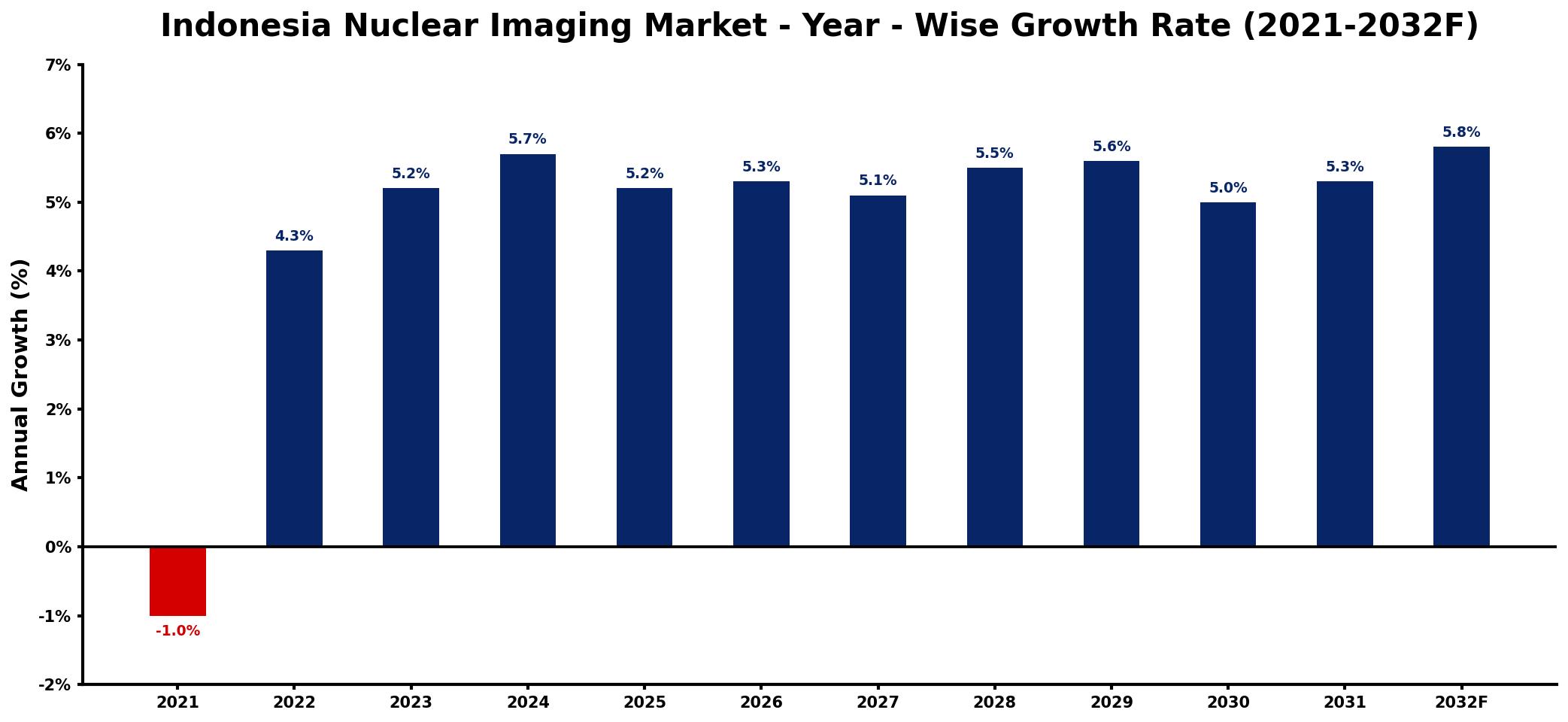
The table below presents the year‑wise growth rates along with the key drivers influencing the market
| Year | Growth Rate | Major Drivers |
| 2021 | -1.0% | healthcare investments experiencing decline |
| 2022 | 4.3% | rising healthcare expenditures in hospitals |
| 2023 | 5.2% | increased demand for diagnostic services |
| 2024 | 5.7% | growing awareness of preventive care |
| 2025 | 5.2% | expansion of healthcare infrastructure projects |
| 2026 | 5.3% | advancements in medical technology adoption |
| 2027 | 5.1% | emerging markets attracting investments |
| 2028 | 5.5% | increased focus on patient outcomes |
| 2029 | 5.6% | collaboration between healthcare providers |
| 2030 | 5.0% | enhanced government healthcare funding initiatives |
| 2031 | 5.3% | growth in telehealth service offerings |
| 2032 | 5.8% | rising prevalence of chronic diseases |
Note: Market size estimations and growth projections presented in this report are based on 6Wresearch's proprietary forecasting methodology, utilizing the latest available industry data, government publications, and primary research inputs.
Indonesia Nuclear Imaging Market Synopsis
In recent years, Indonesia has witnessed notable advancements in nuclear imaging, fueled by heightened awareness about early disease detection and improved medical technologies. The integration of positron emission tomography (PET) and single-photon emission computed tomography (SPECT) has become vital for accurate diagnosis and treatment planning, positioning these modalities as fundamental components of healthcare delivery.
However, the market is on the brink of a transformative phase as healthcare providers increasingly collaborate with technology suppliers. This partnership aims to improve service accessibility across urban and rural landscapes, addressing the critical need for reliable nuclear imaging services in a country marked by diverse healthcare challenges.
Indonesia Nuclear Imaging Market Key Takeaways
- Rising prevalence of chronic diseases is a significant market driver.
- Technological advancements are enhancing the effectiveness and accuracy of nuclear imaging diagnostics.
- Collaborations between healthcare providers and technology suppliers are improving service accessibility.
- Investment in healthcare infrastructure is critical for market expansion and addressing healthcare disparities.
- Growing demand for non-invasive and precise diagnostic solutions propels market growth.
Evaluation of Restraints in Indonesia Nuclear Imaging Market
The Indonesia Nuclear Imaging market faces several notable restraints that could impede its growth. One of the primary challenges is the stringent radiation safety regulations and the associated complexities in managing radioactive material disposal. Compliance with these regulations can be resource-intensive for healthcare facilities. Moreover, limited availability of nuclear imaging services in rural regions continues to create significant healthcare disparities, necessitating robust infrastructure development. Additionally, the high costs of acquiring and maintaining advanced nuclear imaging equipment pose a financial hurdle for many institutions, potentially stalling broader adoption of these essential technologies.
Indonesia Nuclear Imaging Market Trends
Current trends in the Indonesia Nuclear Imaging market indicate a shift towards more sophisticated imaging technologies that enhance diagnostic accuracy while minimizing patient exposure to radiation. The introduction of AI and machine learning into nuclear imaging processes is also gaining momentum, facilitating faster analysis and interpretation of imaging data. Moreover, the increased focus on personalized medicine is driving demand for advanced imaging techniques that can tailor treatment plans to individual patient needs, promoting better health outcomes.
Indonesia Nuclear Imaging Market Opportunities
Significant growth opportunities lie within the Indonesia Nuclear Imaging market, particularly in expanding service availability in underserved regions. As healthcare providers seek to bridge gaps in access, investing in mobile nuclear imaging units could greatly enhance outreach. Furthermore, increasing awareness among the public regarding early disease detection presents a fertile ground for expanding nuclear imaging services. The ongoing technological advancements present opportunities for providers to offer more efficient, cost-effective solutions that meet the evolving demands of patients and healthcare systems alike.
Government Initiatives in the Indonesia Nuclear Imaging Market
The Indonesian government is increasingly recognizing the importance of advanced medical technologies, including nuclear imaging, in improving public health outcomes. Initiatives aimed at enhancing healthcare infrastructure are underway, focusing on the establishment of new imaging centers and upgrading existing facilities. Additionally, public health programs are being developed to raise awareness about the benefits of early disease detection, thereby encouraging greater utilization of nuclear imaging technologies. Ongoing collaborations with international health organizations also aim to improve training and standards in this vital area.
Future Insights of the Indonesia Nuclear Imaging Market
Looking ahead to 2026-2032, the Indonesia Nuclear Imaging market is poised for substantial evolution. Anticipated advancements in imaging technology, coupled with strategic investments in healthcare infrastructure, will likely enhance service availability across the nation. Additionally, the push towards integrated healthcare systems will create synergies that improve patient care pathways. As awareness of nuclear imaging's role in early disease detection continues to rise, stakeholders will increasingly focus on driving innovations that align with patient-centered approaches, thereby solidifying the market's growth trajectory.
Indonesia Nuclear Imaging Market Latest Developments (2025 - 2026)
Recent developments in the Indonesia Nuclear Imaging market have highlighted a concerted effort among healthcare institutions to modernize and expand their diagnostic capabilities. Emphasis has been placed on upgrading existing imaging equipment and enhancing the skill set of medical professionals through targeted training programs. Collaborative projects aimed at establishing mobile nuclear imaging facilities are also gaining traction, facilitating improved access to these critical diagnostic services in remote areas. Furthermore, there has been a noticeable increase in public-private partnerships focused on expanding nuclear imaging offerings throughout the healthcare landscape.
Indonesia Nuclear Imaging Market - Key Attractiveness of the Report
- 10 Years of Market Numbers
- Historical Data Starting from 2022 to 2025
- Base Year: 2025
- Forecast Data until 2032
- Key Performance Indicators Impacting the Market
- Major Upcoming Developments and Projects
Key Highlights of the Report:
- Indonesia Nuclear Imaging Market Outlook
- Market Size of Indonesia Nuclear Imaging Market, 2025
- Forecast of Indonesia Nuclear Imaging Market, 2032
- Historical Data and Forecast of Indonesia Nuclear Imaging Revenues & Volume for the Period 2022-2032F
- Indonesia Nuclear Imaging Market Trend Evolution
- Indonesia Nuclear Imaging Market Drivers and Challenges
- Indonesia Nuclear Imaging Price Trends
- Indonesia Nuclear Imaging Porter's Five Forces
- Indonesia Nuclear Imaging Industry Life Cycle
- Historical Data and Forecast of Indonesia Nuclear Imaging Market Revenues & Volume By Product for the Period 2022-2032F
- Historical Data and Forecast of Indonesia Nuclear Imaging Market Revenues & Volume By Single Photon-Emission Computed Tomography (SPECT) for the Period 2022-2032F
- Historical Data and Forecast of Indonesia Nuclear Imaging Market Revenues & Volume By Hybrid Pet for the Period 2022-2032F
- Historical Data and Forecast of Indonesia Nuclear Imaging Market Revenues & Volume By Planar Scintigraphy for the Period 2022-2032F
- Historical Data and Forecast of Indonesia Nuclear Imaging Market Revenues & Volume By Application for the Period 2022-2032F
- Historical Data and Forecast of Indonesia Nuclear Imaging Market Revenues & Volume By Oncology for the Period 2022-2032F
- Historical Data and Forecast of Indonesia Nuclear Imaging Market Revenues & Volume By Cardiology for the Period 2022-2032F
- Historical Data and Forecast of Indonesia Nuclear Imaging Market Revenues & Volume By Neurology for the Period 2022-2032F
- Historical Data and Forecast of Indonesia Nuclear Imaging Market Revenues & Volume By Others for the Period 2022-2032F
- Historical Data and Forecast of Indonesia Nuclear Imaging Market Revenues & Volume By Portability for the Period 2022-2032F
- Historical Data and Forecast of Indonesia Nuclear Imaging Market Revenues & Volume By Pocket-Sized/Handheld Device for the Period 2022-2032F
- Historical Data and Forecast of Indonesia Nuclear Imaging Market Revenues & Volume By Fixed for the Period 2022-2032F
- Historical Data and Forecast of Indonesia Nuclear Imaging Market Revenues & Volume By End user for the Period 2022-2032F
- Historical Data and Forecast of Indonesia Nuclear Imaging Market Revenues & Volume By Hospitals for the Period 2022-2032F
- Historical Data and Forecast of Indonesia Nuclear Imaging Market Revenues & Volume By Imaging Centers for the Period 2022-2032F
- Historical Data and Forecast of Indonesia Nuclear Imaging Market Revenues & Volume By Academic and Research Centers for the Period 2022-2032F
- Historical Data and Forecast of Indonesia Nuclear Imaging Market Revenues & Volume By Others for the Period 2022-2032F
- Indonesia Nuclear Imaging Import Export Trade Statistics
- Market Opportunity Assessment By Product
- Market Opportunity Assessment By Application
- Market Opportunity Assessment By Portability
- Market Opportunity Assessment By End user
- Indonesia Nuclear Imaging Top Companies Market Share
- Indonesia Nuclear Imaging Competitive Benchmarking By Technical and Operational Parameters
- Indonesia Nuclear Imaging Company Profiles
- Indonesia Nuclear Imaging Key Strategic Recommendations






































