Indonesia Over the Top Market Size & Growth Rate (2026-2032)
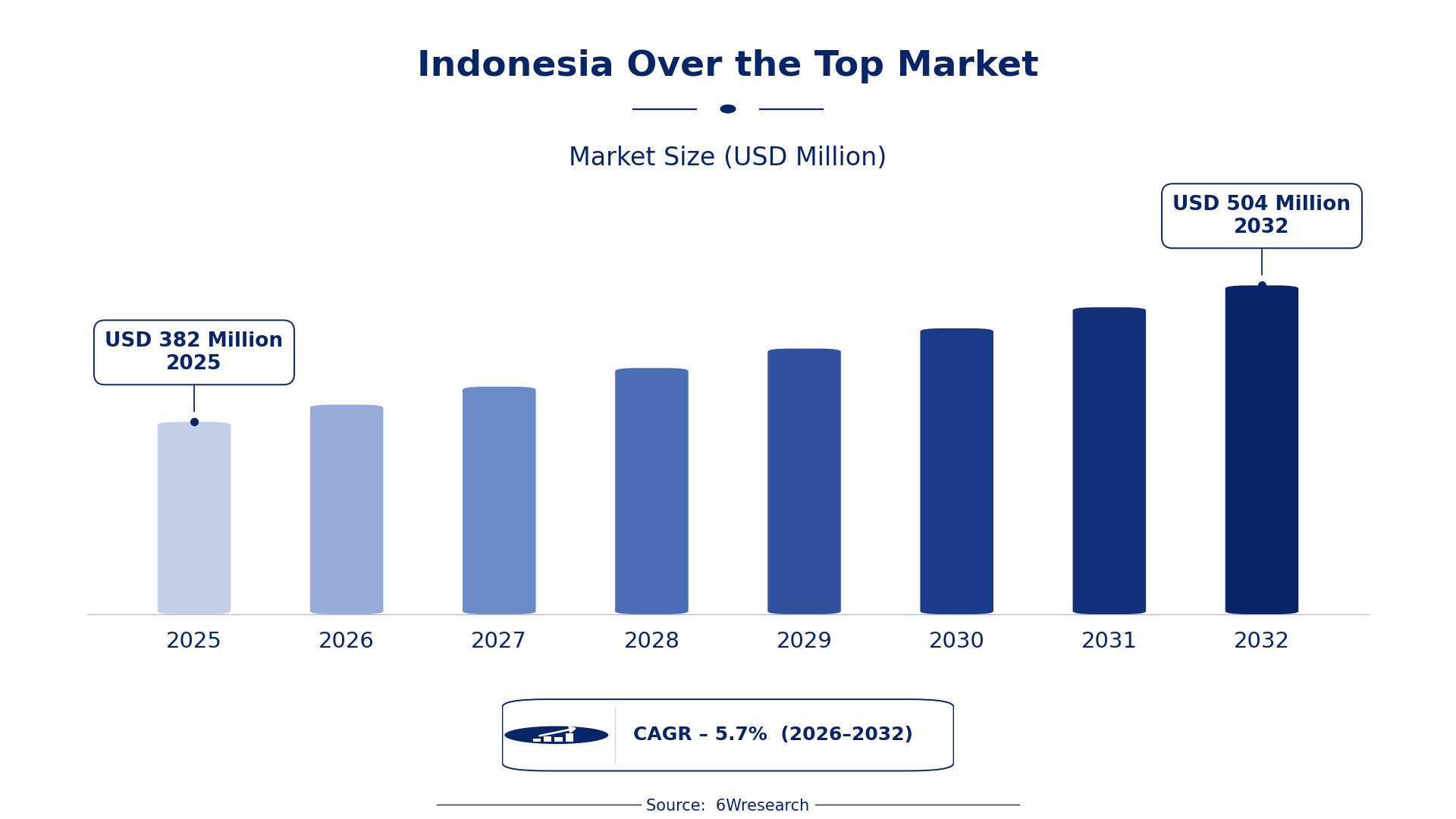
The Indonesia Over the Top Market was estimated at USD 382 Million in 2025 and is projected to reach USD 504 Million by 2032, growing at a CAGR of 5.7% from 2026 to 2032.
Indonesia Over the Top Market Synopsis
A substantial surge in streaming service adoption has been witnessed across Indonesia, with consumers increasingly favoring on-demand content over traditional broadcasting. This shift has resulted in a rich ecosystem for OTT players, making Indonesia a vibrant market for digital entertainment and communication services.
Consumer behavior is rapidly changing, with younger generations driving demand for diverse content offerings. Smartphone penetration continues to expand, coupled with an increase in internet accessibility, thus enhancing the appeal of OTT platforms in meeting the entertainment needs of the Indonesian populace.
Indonesia Over the Top Market Year-wise Growth Rate and Key Drivers
This graph illustrates the annual growth rates of the Indonesia Over the Top Market from 2021 to 2032, highlighting a steady upward trajectory and projected expansion over the forecast period.
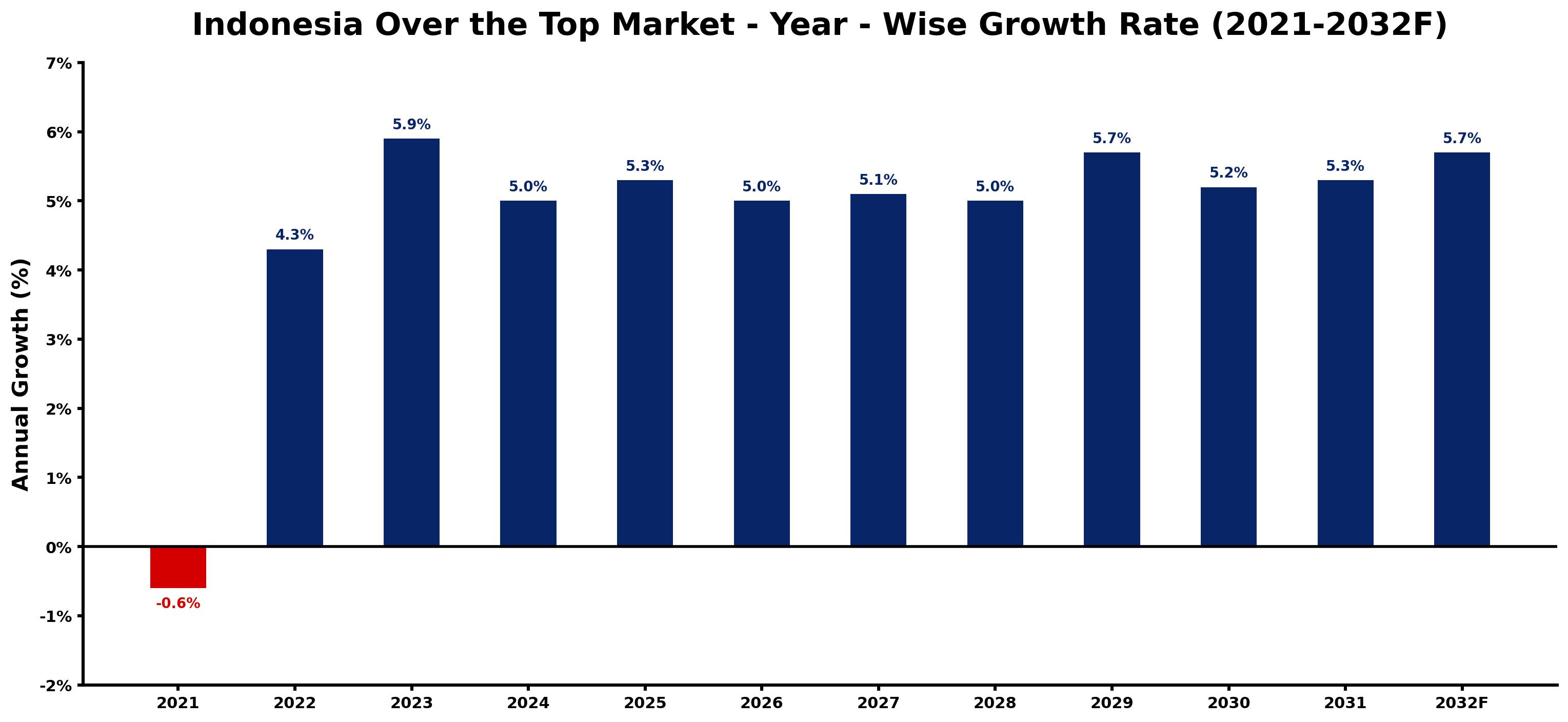
The table below presents the year‑wise growth rates along with the key drivers influencing the market
| Year | Growth Rate | Major Drivers |
| 2021 | -0.6% | implementation of strict content regulations by KOMINFO |
| 2022 | 4.3% | Increase in smartphone penetration across urban areas |
| 2023 | 5.9% | Government support for local content creation initiatives |
| 2024 | 5.0% | Rise in young population driving streaming service demand |
| 2025 | 5.3% | Partnerships with local telecom companies for bundled services |
| 2026 | 5.0% | Expanding internet access through national connectivity programs |
| 2027 | 5.1% | Attractive local streaming content boosting subscriber growth |
| 2028 | 5.0% | Growing popularity of esports tournaments and events |
| 2029 | 5.7% | Higher disposable income leading to premium subscriptions |
| 2030 | 5.2% | Emerging middle class fueling demand for diverse content |
| 2031 | 5.3% | Investment in original programming by local platforms |
| 2032 | 5.7% | Increasing trend of ad-supported video on demand services |
Note: Market size estimations and growth projections presented in this report are based on 6Wresearch's proprietary forecasting methodology, utilizing the latest available industry data, government publications, and primary research inputs.
Indonesia Over the Top Market Key Takeaways
Below are some of the specific key takeaways from the market, including:
- Increased consumer demand for streaming content fuels OTT market growth.
- Smartphone penetration is a crucial driver of OTT service adoption.
- The emergence of local platforms is intensifying competition in the market.
- Robust security measures are increasingly essential for user trust and data protection.
- Cultural and regulatory challenges remain significant hurdles for content providers.
Evaluation of Restraints in Indonesia Over the Top Market
Regulatory complexities pose notable restraints on the Indonesia Over the Top market. The government’s content regulations, aimed at ensuring cultural compliance, often hinder the availability of diverse programming options. Additionally, concerns over monopolistic behaviors have led to increased scrutiny of emerging OTT services, which could stifle innovation. These elements create a challenging environment for both local and international players trying to penetrate or expand within this growing market.
Indonesia Over the Top Market Trends
One prominent trend is the growing preference for localized content, as providers tailor their offerings to resonate with Indonesian audiences. This focus on regional storytelling and relatable themes is essential for gaining consumer loyalty. Furthermore, partnerships between tech companies and content creators are increasingly common, allowing platforms to enhance their libraries with exclusive offerings that cater specifically to local tastes.
Additionally, technological advancements in data analytics are enabling OTT providers to deliver personalized experiences, which are becoming a staple feature to attract subscribers. As competition intensifies, continuous innovation in user experience and content delivery methods will remain critical.
Indonesia Over the Top Market Opportunities
There exists a wealth of opportunities within the Indonesia Over the Top market, particularly in tapping into the younger demographics that are digital natives. Enhanced internet infrastructure and increased affordability of smartphones create a fertile ground for new services and platforms. Furthermore, leveraging partnerships with telecommunication providers can result in bundled services that broaden market reach and accessibility.
Emerging technologies such as artificial intelligence and machine learning are anticipated to drive content curation and improve viewer engagement, presenting additional pathways for growth. Investors should also look into potential collaborations with local influencers and content creators to enrich offerings, thus deepening user connection.
Government Initiatives in the Indonesia Over the Top Market
The Indonesian government’s approach to OTT services reflects a balancing act between fostering digital innovation and adhering to cultural norms. Recent regulatory measures are focused on ensuring that local content is prioritized while also addressing data privacy concerns. Such initiatives are crucial as they shape the framework for market players and influence competitive dynamics.
- A regulatory framework introduced in 2025 mandates content licensing for OTT providers, ensuring compliance with national standards.
- A national digital infrastructure upgrade programme is currently underway, expected to enhance broadband access across urban and rural areas by 2027.
- The government has launched a public initiative to promote local content creation, facilitating funding opportunities for Indonesian filmmakers and content producers.
- Plans for a comprehensive regulatory review are scheduled for 2026, aimed at assessing the impact of existing policies on market competition.
- Ongoing discussions about consumer data protection policies are intended to strengthen user trust and secure personal information in digital transactions.
Future Insights of the Indonesia Over the Top Market
Looking ahead, the Indonesia Over the Top market is set for continued growth driven by evolving consumer behaviors and enhanced digital capabilities. As more people embrace streaming as their primary source of entertainment, the market will likely see a rise in both domestic and international content providers. The ability to adapt to local tastes and regulatory requirements will determine success in this competitive arena. Furthermore, as technology continues to advance, the potential for immersive content experiences and interactive platforms will open new avenues for engagement and monetization.
Indonesia Over the Top Market Latest Developments
In recent months, the Indonesia Over the Top market has experienced a wave of activity, signaling a robust competitive environment. Platforms are racing to enrich their content libraries and enhance user experiences in response to growing consumer demands. Investments in technology and infrastructure are also ramping up, indicating a commitment to long-term growth in the sector.
- In early 2025, a major local streaming platform announced a successful acquisition of several regional production houses to bolster its content library.
- An ongoing initiative began in mid-2025 to integrate advanced AI technologies for personalized content recommendations across multiple OTT platforms.
- A rollout expected to begin in late 2025 aims to enhance mobile application capabilities for smoother user interfaces and offline content access.
- Recently, a partnership between a leading telecommunications provider and an OTT service was established to bundle internet services with streaming subscriptions, enhancing consumer accessibility.
- A product launch planned for early 2026 will introduce new interactive features that allow viewers to engage with content creators directly during live streams.
Indonesia Over the Top Market - Key Attractiveness of the Report
- 10 Years of Market Numbers
- Historical Data Starting from 2022 to 2025
- Base Year: 2025
- Forecast Data until 2032
- Key Performance Indicators Impacting the Market
- Major Upcoming Developments and Projects
Key Highlights of the Report:
- Indonesia Over the Top Market Outlook
- Market Size of Indonesia Over the Top Market, 2025
- Forecast of Indonesia Over the Top Market, 2032
- Historical Data and Forecast of Indonesia Over the Top Revenues & Volume for the Period 2022-2032F
- Indonesia Over the Top Market Trend Evolution
- Indonesia Over the Top Market Drivers and Challenges
- Indonesia Over the Top Price Trends
- Indonesia Over the Top Porter's Five Forces
- Indonesia Over the Top Industry Life Cycle
- Historical Data and Forecast of Indonesia Over the Top Market Revenues & Volume By Type for the Period 2022-2032F
- Historical Data and Forecast of Indonesia Over the Top Market Revenues & Volume By Game Streaming for the Period 2022-2032F
- Historical Data and Forecast of Indonesia Over the Top Market Revenues & Volume By Audio Streaming for the Period 2022-2032F
- Historical Data and Forecast of Indonesia Over the Top Market Revenues & Volume By Video Streaming for the Period 2022-2032F
- Historical Data and Forecast of Indonesia Over the Top Market Revenues & Volume By Communication for the Period 2022-2032F
- Historical Data and Forecast of Indonesia Over the Top Market Revenues & Volume By Monetization Model for the Period 2022-2032F
- Historical Data and Forecast of Indonesia Over the Top Market Revenues & Volume By Subscription-based for the Period 2022-2032F
- Historical Data and Forecast of Indonesia Over the Top Market Revenues & Volume By Advertising-based for the Period 2022-2032F
- Historical Data and Forecast of Indonesia Over the Top Market Revenues & Volume By Transaction-based for the Period 2022-2032F
- Historical Data and Forecast of Indonesia Over the Top Market Revenues & Volume By Streaming Device for the Period 2022-2032F
- Historical Data and Forecast of Indonesia Over the Top Market Revenues & Volume By Smartphones and Tablets for the Period 2022-2032F
- Historical Data and Forecast of Indonesia Over the Top Market Revenues & Volume By Desktops and Laptops for the Period 2022-2032F
- Historical Data and Forecast of Indonesia Over the Top Market Revenues & Volume By IPTV and Consoles for the Period 2022-2032F
- Historical Data and Forecast of Indonesia Over the Top Market Revenues & Volume By Vertical for the Period 2022-2032F
- Historical Data and Forecast of Indonesia Over the Top Market Revenues & Volume By Media and Entertainment for the Period 2022-2032F
- Historical Data and Forecast of Indonesia Over the Top Market Revenues & Volume By Education and Learning for the Period 2022-2032F
- Historical Data and Forecast of Indonesia Over the Top Market Revenues & Volume By Gaming for the Period 2022-2032F
- Historical Data and Forecast of Indonesia Over the Top Market Revenues & Volume By Service Utilities for the Period 2022-2032F
- Indonesia Over the Top Import Export Trade Statistics
- Market Opportunity Assessment By Type
- Market Opportunity Assessment By Monetization Model
- Market Opportunity Assessment By Streaming Device
- Market Opportunity Assessment By Vertical
- Indonesia Over the Top Top Companies Market Share
- Indonesia Over the Top Competitive Benchmarking By Technical and Operational Parameters
- Indonesia Over the Top Company Profiles
- Indonesia Over the Top Key Strategic Recommendations






































