Indonesia Personal Computers Market Size, Share & Growth Rate
The Indonesia Personal Computers Market was estimated at USD 462 Million in 2025 and is projected to reach USD 614 Million by 2032, growing at a CAGR of 4.1% from 2026 to 2032. This upward trajectory is primarily driven by increasing internet penetration across the archipelago, which fosters a greater reliance on personal computers for both professional and educational purposes. Additionally, the demand for remote work solutions and online learning platforms continues to bolster the market as more Indonesian consumers seek enhanced computing capabilities.
Indonesia Personal Computers Market Year-wise Growth Rate and Key Drivers
This graph highlights how the Indonesia Personal Computers Market has steadily grown over the years, supported by major growth factors.
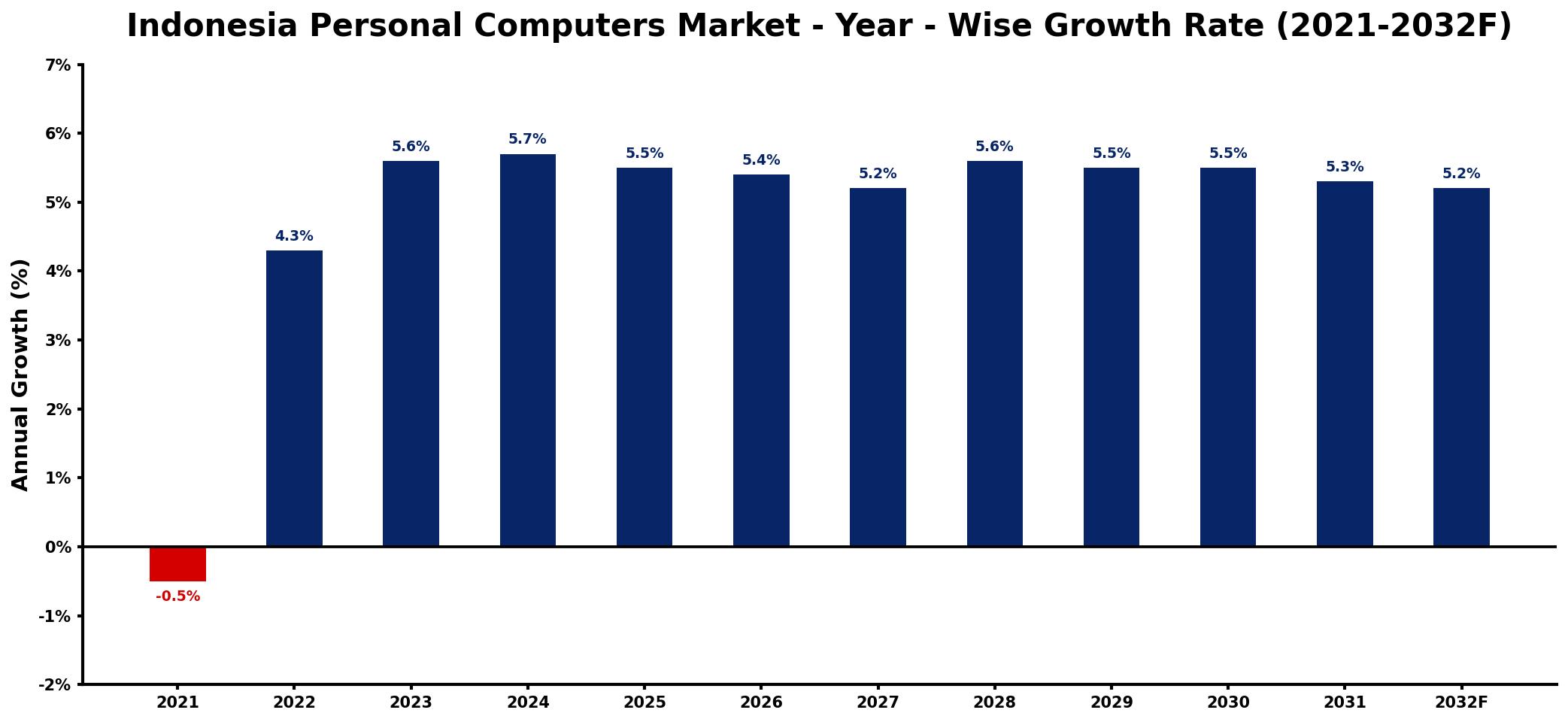
The table below presents the year‑wise growth rates along with the key drivers influencing the market
| Year | Growth Rate | Major Drivers |
| 2021 | -0.5% | Supply chain disruptions affecting availability |
| 2022 | 4.3% | Increase in remote working solutions |
| 2023 | 5.6% | Growth in online education platforms |
| 2024 | 5.7% | Rise in gaming industry investments |
| 2025 | 5.5% | Expansion of e-commerce infrastructure |
| 2026 | 5.4% | Increased demand for digital content |
| 2027 | 5.2% | Higher adoption of cloud services |
| 2028 | 5.6% | Surge in tech startup innovations |
| 2029 | 5.5% | Growing interest in AI applications |
| 2030 | 5.5% | Rising popularity of smart devices |
| 2031 | 5.3% | Enhanced focus on cybersecurity measures |
| 2032 | 5.2% | Development of sustainable technology solutions |
Note: Market size estimations and growth projections presented in this report are based on 6Wresearch's proprietary forecasting methodology, utilizing the latest available industry data, government publications, and primary research inputs.
Indonesia Personal Computers Market Synopsis
The strongest force shaping the Indonesia Personal Computers Market right now is the significant rise in remote work and online education. As businesses and educational institutions adapt to digital platforms, the demand for reliable personal computing devices has surged, fundamentally altering the landscape of technology consumption in the region.
Moreover, the ongoing technological advancements have led to the development of more powerful, versatile personal computers that meet the demands of a tech-savvy population. As disposable incomes rise, consumers are increasingly inclined to invest in high-quality devices, further stimulating market growth.
Indonesia Personal Computers Market Key Takeaways
- Growing internet penetration is a primary driver for the personal computers market.
- Increasing demand for remote work and online education continues to influence device sales.
- Technological advancements are enhancing the performance and appeal of personal computers.
- The rise in disposable income among consumers allows for greater investment in quality devices.
- A burgeoning tech-savvy population is shifting preferences towards advanced computing solutions.
Evaluation of Restraints in Indonesia Personal Computers Market
Despite promising growth, the Indonesia Personal Computers Market faces notable restraints. The increasing popularity of mobile devices, such as smartphones and tablets, presents a challenge, as consumers may opt for portable solutions over traditional PCs. Furthermore, economic fluctuations, particularly in exchange rates and consumer spending, can create uncertainty and impact overall market demand. The necessity for manufacturers to remain competitive while navigating these challenges adds complexity to the market landscape.
Indonesia Personal Computers Market Trends
Current trends in the Indonesia Personal Computers Market include a notable shift towards hybrid devices that cater to both work and entertainment needs. Consumers are increasingly looking for devices that offer versatility, allowing seamless transitions between tasks. Additionally, there is a growing emphasis on sustainability, with manufacturers striving to produce environmentally-friendly PCs that appeal to the conscientious consumer. Cloud computing and AI integration are also shaping the way personal computers are utilized, driving innovation and user engagement.
Indonesia Personal Computers Market Opportunities
The landscape presents several growth and investment opportunities, particularly in the realm of e-learning and remote work solutions. As online education becomes more entrenched, companies can capitalize on the demand for specialized devices tailored to educational purposes. Additionally, expanding internet connectivity in rural areas creates untapped markets for personal computers. Businesses that focus on developing innovative software solutions compatible with PCs can also find significant opportunities for growth.
Government Initiatives in the Indonesia Personal Computers Market
The Indonesian government has implemented several initiatives aimed at enhancing digital infrastructure and increasing access to technology. Programs promoting internet connectivity in underserved regions aim to ensure more citizens have access to online educational resources. Furthermore, public spending on technology in education is driving demand for personal computers, making them more accessible to students and institutions. Incentives for tech companies investing in local manufacturing can also spur growth in the market.
Future Insights of the Indonesia Personal Computers Market
Looking ahead to 2026-2032, the Indonesia Personal Computers Market is poised for robust growth driven by continuous advancements in technology and increased demand for high-performance devices. The shift towards hybrid work environments suggests that personal computers will remain essential tools for both professionals and students. As economic conditions stabilize and consumer spending improves, investments in personal computing technology will likely surge, positioning the market for sustained expansion.
Indonesia Personal Computers Market Latest Developments (2025 - 2026)
Recent developments in the Indonesia Personal Computers Market indicate a surge in demand for innovative computing solutions. Companies are increasingly launching devices tailored for remote work and e-learning, reflecting shifting consumer needs. Collaborative technologies are also gaining traction, providing tools for seamless integration of personal computing with communication platforms. Additionally, manufacturers are exploring sustainable practices in production, responding to the growing demand for eco-friendly devices.
Indonesia Personal Computers Market - Key Attractiveness of the Report
- 10 Years of Market Numbers
- Historical Data Starting from 2022 to 2025
- Base Year: 2025
- Forecast Data until 2032
- Key Performance Indicators Impacting the Market
- Major Upcoming Developments and Projects
Key Highlights of the Report:
- Indonesia Personal Computers Market Outlook
- Market Size of Indonesia Personal Computers Market, 2025
- Forecast of Indonesia Personal Computers Market, 2032
- Historical Data and Forecast of Indonesia Personal Computers Revenues & Volume for the Period 2022-2032F
- Indonesia Personal Computers Market Trend Evolution
- Indonesia Personal Computers Market Drivers and Challenges
- Indonesia Personal Computers Price Trends
- Indonesia Personal Computers Porter's Five Forces
- Indonesia Personal Computers Industry Life Cycle
- Historical Data and Forecast of Indonesia Personal Computers Market Revenues & Volume By Product Type for the Period 2022-2032F
- Historical Data and Forecast of Indonesia Personal Computers Market Revenues & Volume By Desktop for the Period 2022-2032F
- Historical Data and Forecast of Indonesia Personal Computers Market Revenues & Volume By Notebook for the Period 2022-2032F
- Historical Data and Forecast of Indonesia Personal Computers Market Revenues & Volume By Workstation for the Period 2022-2032F
- Historical Data and Forecast of Indonesia Personal Computers Market Revenues & Volume By Others for the Period 2022-2032F
- Historical Data and Forecast of Indonesia Personal Computers Market Revenues & Volume By Distribution Channel for the Period 2022-2032F
- Historical Data and Forecast of Indonesia Personal Computers Market Revenues & Volume By Business-To-Business (B2B) for the Period 2022-2032F
- Historical Data and Forecast of Indonesia Personal Computers Market Revenues & Volume By Business-To-Consumer (B2C) for the Period 2022-2032F
- Historical Data and Forecast of Indonesia Personal Computers Market Revenues & Volume By Application for the Period 2022-2032F
- Historical Data and Forecast of Indonesia Personal Computers Market Revenues & Volume By Consumer for the Period 2022-2032F
- Historical Data and Forecast of Indonesia Personal Computers Market Revenues & Volume By Commercial for the Period 2022-2032F
- Historical Data and Forecast of Indonesia Personal Computers Market Revenues & Volume By Industrial for the Period 2022-2032F
- Indonesia Personal Computers Import Export Trade Statistics
- Market Opportunity Assessment By Product Type
- Market Opportunity Assessment By Distribution Channel
- Market Opportunity Assessment By Application
- Indonesia Personal Computers Top Companies Market Share
- Indonesia Personal Computers Competitive Benchmarking By Technical and Operational Parameters
- Indonesia Personal Computers Company Profiles
- Indonesia Personal Computers Key Strategic Recommendations






































