Indonesia Predictive Maintenance Market Size & Growth Rate (2026-2032)
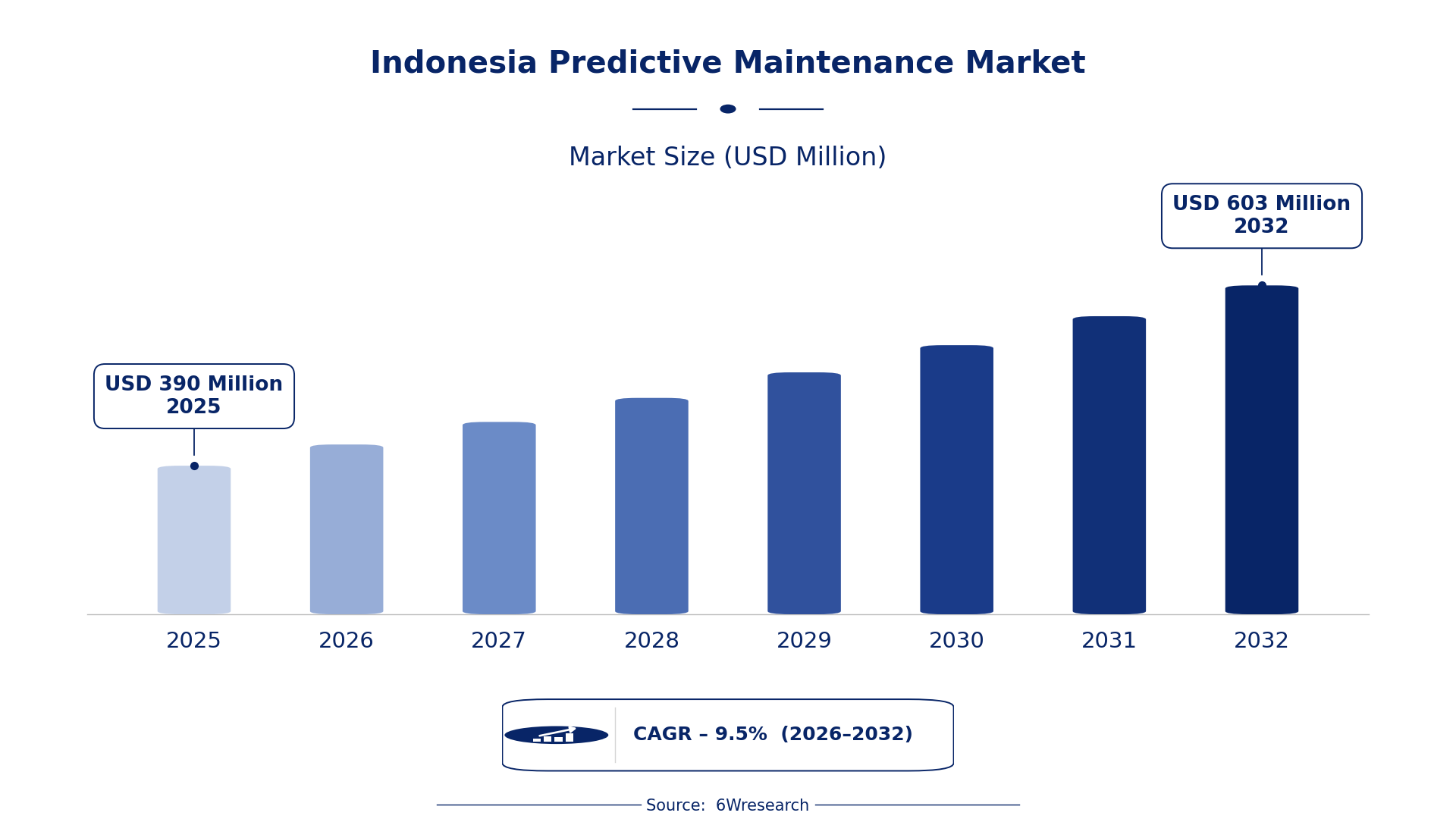
The Indonesia Predictive Maintenance Market was estimated at USD 390 Million in 2025 and is projected to reach USD 603 Million by 2032, growing at a CAGR of 9.5% from 2026 to 2032.
Indonesia Predictive Maintenance Market Synopsis
The demand for predictive maintenance solutions in Indonesia is being shaped primarily by the pressing need for operational efficiency across key industries. As businesses recognize the value of minimizing unplanned downtime, advanced analytics and IoT technologies are increasingly becoming integral to asset management strategies.
The manufacturing and energy sectors are at the forefront of this trend, embracing predictive maintenance to enhance equipment reliability and cut costs. This shift is supported by a growing awareness of condition-based monitoring benefits, which allows companies to accurately forecast equipment failures.
Indonesia Predictive Maintenance Market Year-wise Growth Rate and Key Drivers
This graph illustrates the annual growth rates of the Indonesia Predictive Maintenance Market from 2021 to 2032, highlighting a steady upward trajectory and projected expansion over the forecast period.
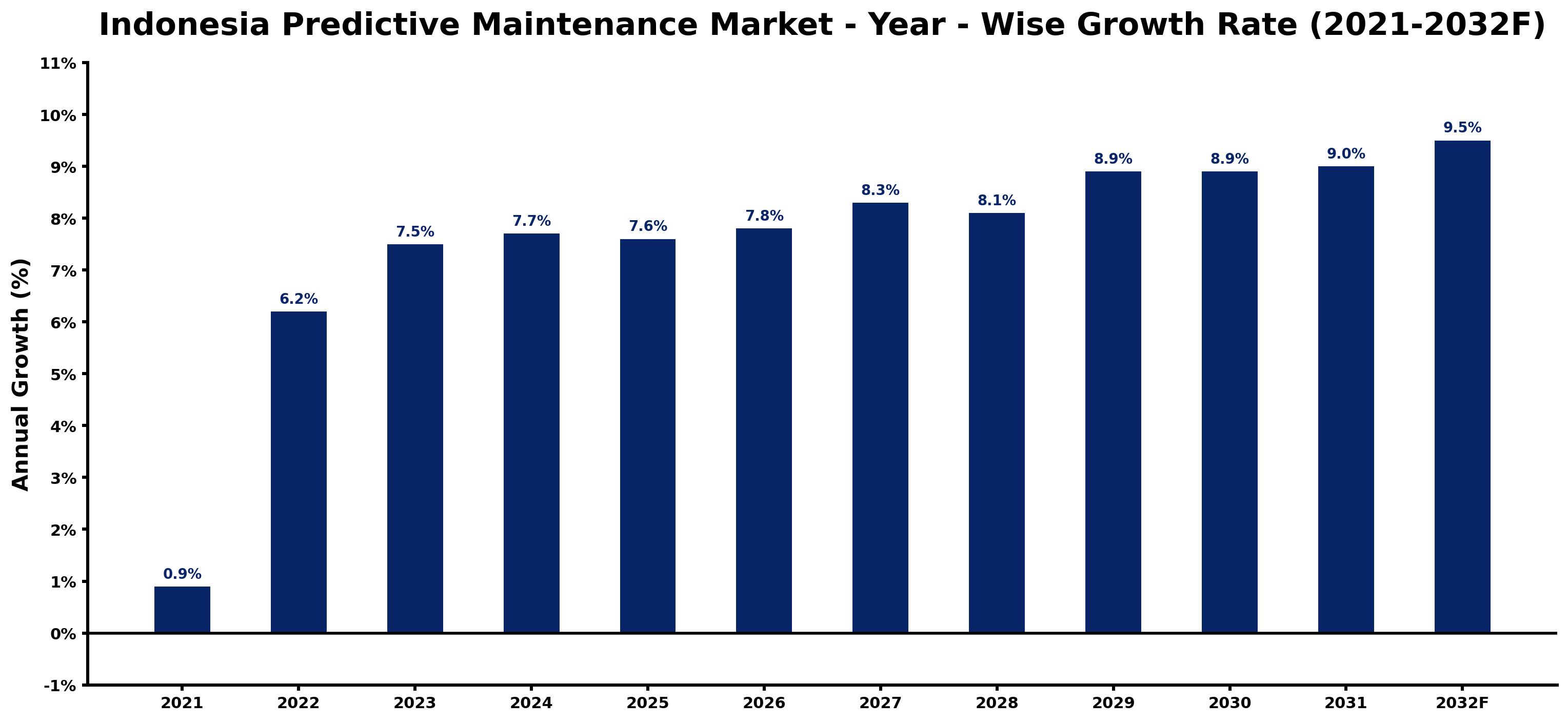
The table below presents the year‑wise growth rates along with the key drivers influencing the market
| Year | Growth Rate | Major Drivers |
| 2021 | 0.9% | Government incentives for digital transformation in industries |
| 2022 | 6.2% | Growing awareness of cost savings from predictive analytics |
| 2023 | 7.5% | Investment in cloud computing for real-time data analysis |
| 2024 | 7.7% | Implementation of Industry 4.0 regulations boosting predictive solutions |
| 2025 | 7.6% | Increase in skilled workforce for advanced maintenance technologies |
| 2026 | 7.8% | Partnerships with tech firms enhancing predictive capabilities |
| 2027 | 8.3% | Rise in industrial equipment age driving maintenance investments |
| 2028 | 8.1% | Focus on sustainability driving maintenance optimization initiatives |
| 2029 | 8.9% | Availability of localized predictive maintenance software solutions |
| 2030 | 8.9% | Enhanced government policies for workforce training in technology |
| 2031 | 9.0% | Escalating manufacturing output requiring efficient maintenance strategies |
| 2032 | 9.5% | Rise in foreign investments in Indonesian industrial sector |
Note: Market size estimations and growth projections presented in this report are based on 6Wresearch's proprietary forecasting methodology, utilizing the latest available industry data, government publications, and primary research inputs.
Indonesia Predictive Maintenance Market Key Takeaways
Below are some of the specific key takeaways from the market, including:
- The market is experiencing a shift towards condition-based monitoring, significantly enhancing asset management strategies.
- Industries such as manufacturing and energy are leading the adoption of predictive maintenance solutions.
- Growing awareness and acceptance of advanced analytics tools are driving the market's expansion.
- The COVID-19 pandemic underscored the necessity for reliable asset management, accelerating adoption rates.
- Infrastructure challenges, particularly concerning IoT, are barriers that need addressing for further growth.
Evaluation of Restraints in Indonesia Predictive Maintenance Market
Several factors continue to hold back the predictive maintenance market in Indonesia. The need for a robust IoT infrastructure is paramount, as many companies face challenges in integrating advanced technologies into their existing systems. on top of that, the accuracy of predictive models plays a critical role; without high-quality data and real-time accessibility, the effectiveness of these solutions is compromised. Resistance to change within industries also hampers adoption, as many organizations remain skeptical about the transition from traditional maintenance practices to more innovative predictive approaches.
Indonesia Predictive Maintenance Market Trends
The predictive maintenance market in Indonesia is witnessing several key trends that are shaping its future. There is an increasing shift towards data-driven decision-making, with companies investing in analytics tools that provide actionable insights into equipment performance. Additionally, the adoption of cloud-based solutions is on the rise, allowing for greater flexibility and scalability in maintenance operations. As businesses seek to improve their operational efficiency, predictive maintenance is becoming a cornerstone of their asset management strategies.
Indonesia Predictive Maintenance Market Opportunities
The growth trajectory of the predictive maintenance market presents several opportunities for businesses and investors alike. Industries not traditionally associated with predictive maintenance, such as transportation and utilities, are beginning to explore these solutions, creating new avenues for market expansion. on top of that, the continuous advancements in IoT technologies and machine learning algorithms are opening doors to more sophisticated predictive analytics capabilities, further enhancing operational efficiencies.
Government Initiatives in the Indonesia Predictive Maintenance Market
Government policies are playing an influential role in shaping the predictive maintenance market in Indonesia. The regulatory framework is increasingly focused on promoting technological advancements within critical sectors like manufacturing and energy. By prioritizing digital infrastructure and condition-based monitoring, the government aims to boost productivity and enhance competitiveness across industries.
- A national digital infrastructure upgrade programme launched in early 2025 aims to improve connectivity for predictive maintenance technologies.
- Currently ongoing initiatives are focused on incentivizing companies to adopt IoT solutions for enhanced operational efficiency.
- In 2026, a regulatory framework mandating the integration of predictive maintenance practices in major industries is expected to be introduced.
- A planned public-private initiative set to launch in 2027 will facilitate partnerships between tech firms and industries to drive innovation in predictive maintenance.
Future Insights of the Indonesia Predictive Maintenance Market
Looking ahead to 2026-2032, the Indonesia Predictive Maintenance Market is set to undergo transformative changes. As industries increasingly recognize the economic benefits of predictive maintenance, adoption rates are expected to soar. The integration of AI and machine learning into predictive analytics will enhance the accuracy of failure predictions, further compelling businesses to invest in these solutions. Additionally, as the government continues to support technological advancements, the market is likely to witness a surge in innovative applications and use cases.
Indonesia Predictive Maintenance Market Latest Developments
Recent activities in the Indonesia Predictive Maintenance Market indicate a vibrant shift towards technology adoption and innovation. Over the past year, several initiatives have been launched to enhance predictive maintenance capabilities across various sectors.
- A major technology vendor initiated a pilot project in mid-2025 to integrate predictive maintenance solutions within the manufacturing sector, which is currently underway.
- In early 2025, a leading regional operator launched a new predictive maintenance software aimed at improving equipment reliability, with positive feedback reported.
- Plans are in motion for a comprehensive training programme set to begin in late 2026, focusing on upskilling personnel in predictive maintenance technologies.
- A partnership between government agencies and private tech firms was formed in Q1 2025 to explore predictive maintenance applications in the energy sector, currently ongoing.
Indonesia Predictive Maintenance Market - Key Attractiveness of the Report
- 10 Years of Market Numbers
- Historical Data Starting from 2022 to 2025
- Base Year: 2025
- Forecast Data until 2032
- Key Performance Indicators Impacting the Market
- Major Upcoming Developments and Projects
Key Highlights of the Report:
- Indonesia Predictive Maintenance Market Outlook
- Market Size of Indonesia Predictive Maintenance Market, 2025
- Forecast of Indonesia Predictive Maintenance Market, 2032
- Historical Data and Forecast of Indonesia Predictive Maintenance Revenues & Volume for the Period 2022-2032F
- Indonesia Predictive Maintenance Market Trend Evolution
- Indonesia Predictive Maintenance Market Drivers and Challenges
- Indonesia Predictive Maintenance Price Trends
- Indonesia Predictive Maintenance Porter's Five Forces
- Indonesia Predictive Maintenance Industry Life Cycle
- Historical Data and Forecast of Indonesia Predictive Maintenance Market Revenues & Volume By Component for the Period 2022-2032F
- Historical Data and Forecast of Indonesia Predictive Maintenance Market Revenues & Volume By Solutions for the Period 2022-2032F
- Historical Data and Forecast of Indonesia Predictive Maintenance Market Revenues & Volume By Services for the Period 2022-2032F
- Historical Data and Forecast of Indonesia Predictive Maintenance Market Revenues & Volume By Organization Size for the Period 2022-2032F
- Historical Data and Forecast of Indonesia Predictive Maintenance Market Revenues & Volume By Large Enterprises for the Period 2022-2032F
- Historical Data and Forecast of Indonesia Predictive Maintenance Market Revenues & Volume By SME for the Period 2022-2032F
- Historical Data and Forecast of Indonesia Predictive Maintenance Market Revenues & Volume By Deployment Mode for the Period 2022-2032F
- Historical Data and Forecast of Indonesia Predictive Maintenance Market Revenues & Volume By On-premises for the Period 2022-2032F
- Historical Data and Forecast of Indonesia Predictive Maintenance Market Revenues & Volume By Cloud for the Period 2022-2032F
- Historical Data and Forecast of Indonesia Predictive Maintenance Market Revenues & Volume By Vertical for the Period 2022-2032F
- Historical Data and Forecast of Indonesia Predictive Maintenance Market Revenues & Volume By Government and Defense for the Period 2022-2032F
- Historical Data and Forecast of Indonesia Predictive Maintenance Market Revenues & Volume By Manufacturing for the Period 2022-2032F
- Historical Data and Forecast of Indonesia Predictive Maintenance Market Revenues & Volume By Energy and Utilities for the Period 2022-2032F
- Historical Data and Forecast of Indonesia Predictive Maintenance Market Revenues & Volume By Transportation and Logistics for the Period 2022-2032F
- Historical Data and Forecast of Indonesia Predictive Maintenance Market Revenues & Volume By Healthcare and Life Sciences for the Period 2022-2032F
- Indonesia Predictive Maintenance Import Export Trade Statistics
- Market Opportunity Assessment By Component
- Market Opportunity Assessment By Organization Size
- Market Opportunity Assessment By Deployment Mode
- Market Opportunity Assessment By Vertical
- Indonesia Predictive Maintenance Top Companies Market Share
- Indonesia Predictive Maintenance Competitive Benchmarking By Technical and Operational Parameters
- Indonesia Predictive Maintenance Company Profiles
- Indonesia Predictive Maintenance Key Strategic Recommendations






































