Indonesia Turmeric Market: Import Trend Analysis
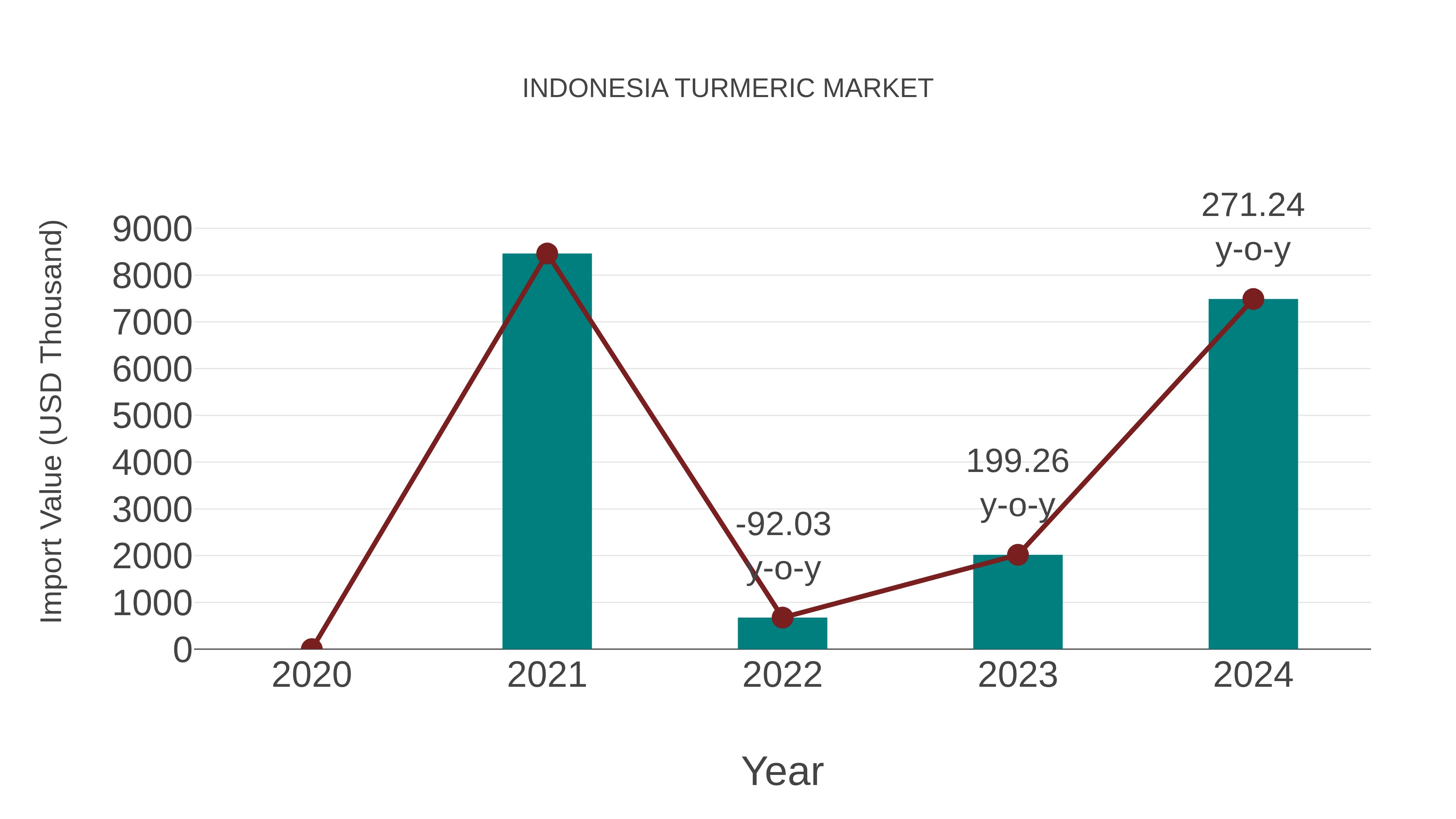
In the Indonesia turmeric market, the import trend showed significant growth from 2023 to 2024, with a notable increase of 271.24%. However, the compound annual growth rate (CAGR) for the period 2020-2024 was -3.99%. This decline in the CAGR could be attributed to shifts in demand patterns or changes in trade policies affecting market stability.
Indonesia Turmeric Market Overview
The Indonesia Turmeric Market is experiencing steady growth driven by increasing demand for turmeric as a key ingredient in traditional Indonesian cuisine and the rising awareness of its health benefits. The market is characterized by a strong presence of small-scale farmers cultivating turmeric across various regions in Indonesia. The country`s tropical climate is favorable for turmeric cultivation, leading to a consistent supply of high-quality turmeric. The market is also witnessing a surge in export activities, with Indonesia being one of the largest turmeric exporters globally. Key market players are focusing on expanding their product portfolios and enhancing distribution networks to capitalize on the growing demand for turmeric both domestically and internationally. Overall, the Indonesia Turmeric Market is poised for continued growth driven by the increasing popularity of turmeric among consumers for its culinary and medicinal properties.
Indonesia Turmeric Market Trends
Currently, the Indonesia Turmeric Market is experiencing growth driven by increasing consumer awareness of the health benefits associated with turmeric consumption. The market is witnessing a rise in demand for turmeric-based products such as supplements, teas, and beauty products due to the growing interest in natural and organic ingredients. Additionally, the popularity of traditional Indonesian cuisines using turmeric as a key ingredient is contributing to the market expansion. Suppliers and manufacturers are focusing on enhancing product quality, packaging, and marketing strategies to attract more consumers. Furthermore, the rising interest in alternative medicine and herbal remedies is fueling the demand for turmeric in various forms. Overall, the Indonesia Turmeric Market is expected to continue on a positive growth trajectory in the coming years.
Indonesia Turmeric Market Challenges
In the Indonesia Turmeric Market, some of the key challenges include fluctuating weather conditions affecting crop yields, inconsistent quality due to variations in cultivation practices, and price volatility influenced by global demand and supply dynamics. Additionally, limited access to advanced farming technologies and inadequate infrastructure for storage and transportation contribute to inefficiencies in the supply chain. Competition from other turmeric-producing countries further intensifies market pressures, potentially impacting local farmers` profitability. To address these challenges, stakeholders in the Indonesia Turmeric Market may need to invest in sustainable farming techniques, improve infrastructure, establish quality standards, and explore diversification strategies to enhance market competitiveness and resilience.
Indonesia Turmeric Market Investment Opportunities
The Indonesia turmeric market presents several promising investment opportunities due to the growing demand for turmeric both domestically and internationally. Investors can consider investing in turmeric farming operations to capitalize on the country`s conducive climate for turmeric cultivation. Additionally, there is potential in establishing turmeric processing facilities to produce value-added products like turmeric powder, extracts, and supplements for export markets. Another opportunity lies in investing in research and development to explore innovative uses of turmeric in various industries such as food, cosmetics, and pharmaceuticals. Overall, the Indonesia turmeric market offers diverse investment avenues that cater to the increasing consumer awareness of the health benefits and versatile applications of turmeric.
Indonesia Turmeric Market Government Policy
The Indonesian government has implemented various policies related to the turmeric market to support local farmers and promote the industry`s growth. These policies include providing subsidies for turmeric cultivation, offering financial assistance for technology adoption and infrastructure development, and facilitating market access through trade agreements and export incentives. Additionally, the government has established quality standards and regulations to ensure the safety and quality of turmeric products in the market. Overall, these policies aim to increase turmeric production, improve the livelihoods of farmers, enhance market competitiveness, and boost Indonesia`s position as a key player in the global turmeric market.
Indonesia Turmeric Market Future Outlook
The future outlook for the Indonesia Turmeric Market appears promising, driven by increasing consumer awareness of the health benefits associated with turmeric consumption. With a growing focus on natural remedies and traditional medicine, turmeric is gaining popularity for its anti-inflammatory and antioxidant properties. Additionally, the rising demand for turmeric in the food and beverage industry, particularly in the production of functional foods and beverages, is expected to further boost market growth. As Indonesia is one of the largest turmeric producers globally, the country is well-positioned to capitalize on this trend. However, challenges such as climate change and fluctuating market prices may impact the market`s growth trajectory, necessitating strategic planning and innovative solutions to ensure long-term sustainability and competitiveness in the global market.
Key Highlights of the Report:
- Indonesia Turmeric Market Outlook
- Market Size of Indonesia Turmeric Market,2025
- Forecast of Indonesia Turmeric Market, 2032
- Historical Data and Forecast of Indonesia Turmeric Revenues & Volume for the Period 2022-2032F
- Indonesia Turmeric Market Trend Evolution
- Indonesia Turmeric Market Drivers and Challenges
- Indonesia Turmeric Price Trends
- Indonesia Turmeric Porter's Five Forces
- Indonesia Turmeric Industry Life Cycle
- Historical Data and Forecast of Indonesia Turmeric Market Revenues & Volume By Type for the Period 2022-2032F
- Historical Data and Forecast of Indonesia Turmeric Market Revenues & Volume By Organic for the Period 2022-2032F
- Historical Data and Forecast of Indonesia Turmeric Market Revenues & Volume By Conventional for the Period 2022-2032F
- Historical Data and Forecast of Indonesia Turmeric Market Revenues & Volume By Processed for the Period 2022-2032F
- Historical Data and Forecast of Indonesia Turmeric Market Revenues & Volume By Infused for the Period 2022-2032F
- Historical Data and Forecast of Indonesia Turmeric Market Revenues & Volume By Others for the Period 2022-2032F
- Historical Data and Forecast of Indonesia Turmeric Market Revenues & Volume By Form for the Period 2022-2032F
- Historical Data and Forecast of Indonesia Turmeric Market Revenues & Volume By Powder for the Period 2022-2032F
- Historical Data and Forecast of Indonesia Turmeric Market Revenues & Volume By Whole for the Period 2022-2032F
- Historical Data and Forecast of Indonesia Turmeric Market Revenues & Volume By Extracts for the Period 2022-2032F
- Historical Data and Forecast of Indonesia Turmeric Market Revenues & Volume By Capsules for the Period 2022-2032F
- Historical Data and Forecast of Indonesia Turmeric Market Revenues & Volume By Application for the Period 2022-2032F
- Historical Data and Forecast of Indonesia Turmeric Market Revenues & Volume By Culinary Use for the Period 2022-2032F
- Historical Data and Forecast of Indonesia Turmeric Market Revenues & Volume By Medicinal Use for the Period 2022-2032F
- Historical Data and Forecast of Indonesia Turmeric Market Revenues & Volume By Skincare for the Period 2022-2032F
- Historical Data and Forecast of Indonesia Turmeric Market Revenues & Volume By Herbal Therapy for the Period 2022-2032F
- Historical Data and Forecast of Indonesia Turmeric Market Revenues & Volume By Nutritional Supplements for the Period 2022-2032F
- Historical Data and Forecast of Indonesia Turmeric Market Revenues & Volume By End Use for the Period 2022-2032F
- Historical Data and Forecast of Indonesia Turmeric Market Revenues & Volume By Households for the Period 2022-2032F
- Historical Data and Forecast of Indonesia Turmeric Market Revenues & Volume By Pharmaceuticals for the Period 2022-2032F
- Historical Data and Forecast of Indonesia Turmeric Market Revenues & Volume By Personal Care for the Period 2022-2032F
- Historical Data and Forecast of Indonesia Turmeric Market Revenues & Volume By Alternative Medicine for the Period 2022-2032F
- Historical Data and Forecast of Indonesia Turmeric Market Revenues & Volume By Nutraceuticals for the Period 2022-2032F
- Historical Data and Forecast of Indonesia Turmeric Market Revenues & Volume By End Use for the Period 2022-2032F
- Historical Data and Forecast of Indonesia Turmeric Market Revenues & Volume By Professional Tattooing for the Period 2022-2032F
- Historical Data and Forecast of Indonesia Turmeric Market Revenues & Volume By Tattoo Studios for the Period 2022-2032F
- Indonesia Turmeric Import Export Trade Statistics
- Market Opportunity Assessment By Type
- Market Opportunity Assessment By Form
- Market Opportunity Assessment By Application
- Market Opportunity Assessment By End Use
- Market Opportunity Assessment By End Use
- Indonesia Turmeric Top Companies Market Share
- Indonesia Turmeric Competitive Benchmarking By Technical and Operational Parameters
- Indonesia Turmeric Company Profiles
- Indonesia Turmeric Key Strategic Recommendations






































