Indonesia Wealth Management Platform Market Size & Growth Rate (2026-2032)
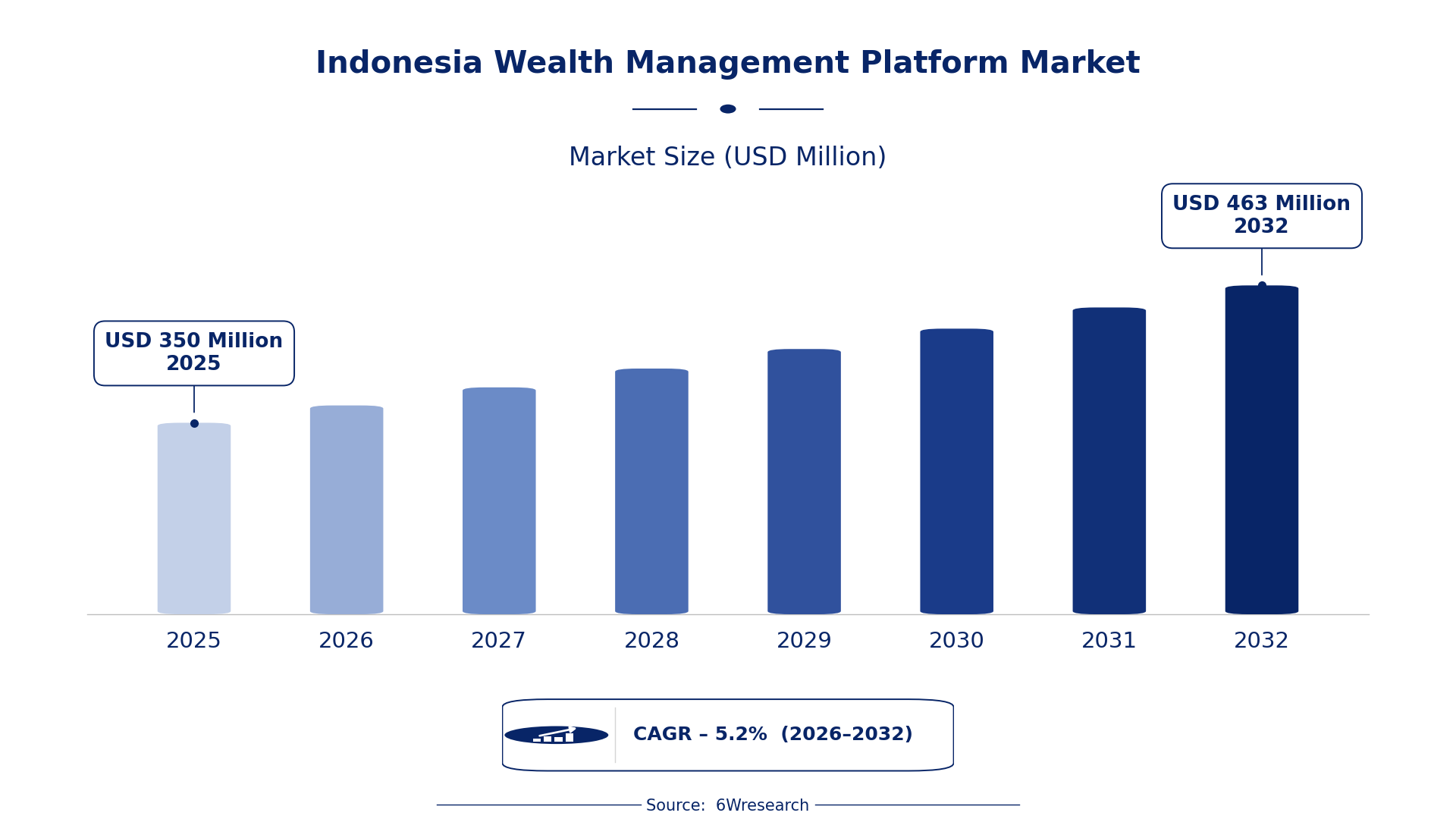
The Indonesia Wealth Management Platform Market was estimated at USD 350 Million in 2025 and is projected to reach USD 463 Million by 2032, growing at a CAGR of 5.2% from 2026 to 2032.
Indonesia Wealth Management Platform Market Synopsis
The primary driver shaping the Indonesia Wealth Management Platform Market today is the shift towards digital financial services. As more investors seek flexibility and ease of access in managing their wealth, platforms that offer streamlined digital solutions are gaining traction.
This transformation reflects a growing demand for personalized investment strategies and real-time portfolio management. As the Indonesian population becomes increasingly affluent and financially literate, the need for sophisticated wealth management solutions becomes imperative.
Indonesia Wealth Management Platform Market Year-wise Growth Rate and Key Drivers
This graph illustrates the annual growth rates of the Indonesia Wealth Management Platform Market from 2021 to 2032, highlighting a steady upward trajectory and projected expansion over the forecast period.
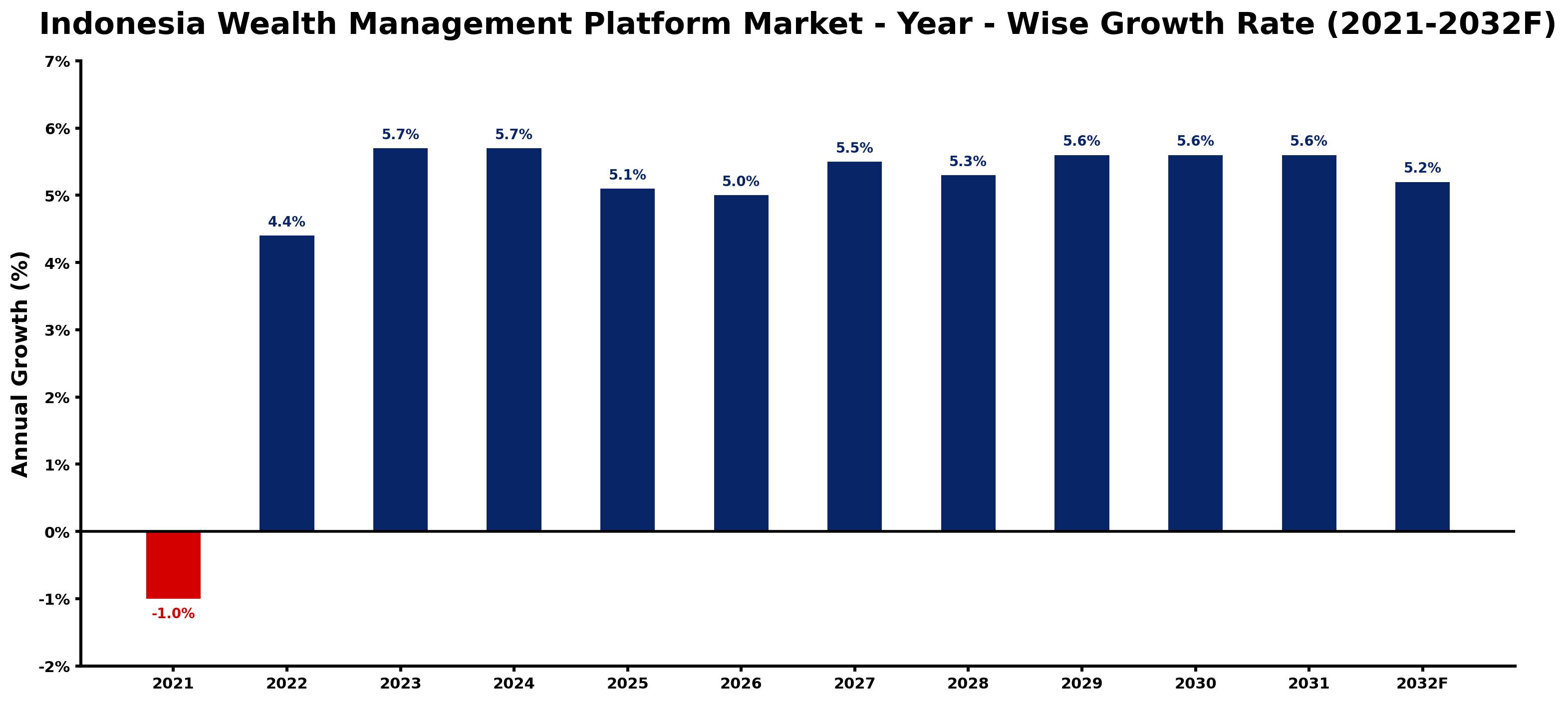
The table below presents the year‑wise growth rates along with the key drivers influencing the market
| Year | Growth Rate | Major Drivers |
| 2021 | -1.0% | OJK regulations restricted new platform licenses. |
| 2022 | 4.4% | Increased affluent millennial investor participation in markets. |
| 2023 | 5.7% | Surge in mobile app usage for personal finance management. |
| 2024 | 5.7% | Regulatory support for digital asset management platforms. |
| 2025 | 5.1% | Rising interest in sustainable and ethical investment funds. |
| 2026 | 5.0% | Evolving digital banking frameworks facilitating wealth access. |
| 2027 | 5.5% | Expanding urban middle-class population driving investment trends. |
| 2028 | 5.3% | Adoption of robo-advisory services gaining mainstream acceptance. |
| 2029 | 5.6% | Tech-savvy generation prioritizing diversified asset portfolios. |
| 2030 | 5.6% | Increased partnerships with fintech startups enhancing offerings. |
| 2031 | 5.6% | Focus on retirement planning products for growing retirees. |
| 2032 | 5.2% | Improved regulatory clarity boosting confidence in investments. |
Note: Market size estimations and growth projections presented in this report are based on 6Wresearch's proprietary forecasting methodology, utilizing the latest available industry data, government publications, and primary research inputs.
Indonesia Wealth Management Platform Market Key Takeaways
Below are some of the specific key takeaways from the market, including:
- The market is driven by rising affluence and financial awareness among Indonesians.
- Digital solutions are increasingly essential for investment management and advisory services.
- Security and regulatory compliance are critical challenges facing platform providers.
- COVID-19 accelerated the adoption of digital wealth management solutions.
- Key players are focusing on enhancing user experience through technology advancements.
Evaluation of Restraints in Indonesia Wealth Management Platform Market
Despite its growth potential, the Indonesia Wealth Management Platform Market faces notable restraints. Data security remains a paramount concern, as clients demand assurance that their financial information is protected from cyber threats. Regulatory compliance can also act as a hurdle, particularly as the government refines its approach to digital finance. on top of that, the diverse needs of clients complicate the development of universally appealing solutions, necessitating continuous innovation from service providers.
Indonesia Wealth Management Platform Market Trends
Several trends are currently shaping the Indonesia Wealth Management Platform Market. First, an increasing number of platforms are integrating artificial intelligence to provide personalized investment advice and predictive analytics. Secondly, mobile accessibility is becoming a priority, as users expect to manage their portfolios on-the-go. Additionally, environmental, social, and governance (ESG) investing is gaining traction, as investors seek to align their portfolios with their values.
Indonesia Wealth Management Platform Market Opportunities
Opportunities for growth in the Indonesia Wealth Management Platform Market are abundant. The ongoing digitalization of financial services presents a ripe environment for innovative startups to emerge. Established financial institutions are also looking to partner with tech firms to enhance their digital offerings. Additionally, there’s a growing interest in sustainable investing, with platforms that cater to this niche likely to see increased demand.
Government Initiatives in the Indonesia Wealth Management Platform Market
Government policy is crucial in shaping the Indonesia Wealth Management Platform Market, particularly as regulators adapt to the digital transformation of financial services. The Indonesian government has prioritized financial inclusion and technology adoption, creating an environment conducive to growth. As regulations evolve, they will likely emphasize security, transparency, and consumer protection, all of which matter significantly for market participants.
- A recently completed initiative focused on enhancing digital infrastructure to support fintech growth across urban and rural areas.
- A current regulatory framework is being established to ensure the transparency of digital transactions, which is crucial for building investor trust.
- A planned public-private partnership aimed at developing educational programs on financial literacy is expected to launch in 2026.
- Current efforts to streamline the licensing process for wealth management platforms aim to encourage new entrants into the market.
- Ongoing discussions around tax incentives for digital financial services are anticipated to be finalized in the next regulatory cycle.
Future Insights of the Indonesia Wealth Management Platform Market
Looking ahead to 2026-2032, the Indonesia Wealth Management Platform Market is on a clear trajectory of growth. The emphasis on digital solutions will likely intensify, as both individuals and institutions seek to optimize their investment strategies in a fast-paced economic environment. Advancements in technology, particularly in AI and machine learning, will redefine user experiences and service offerings, enhancing client engagement and satisfaction.
Indonesia Wealth Management Platform Market Latest Developments
Recent activity in the Indonesia Wealth Management Platform Market indicates a strong push towards enhancing digital services. Over the past year, various initiatives have emerged, focusing on improving user experience and expanding service offerings. This momentum reflects the sector's adaptability to changing consumer expectations and the necessity for innovation.
- A leading regional operator launched an advanced mobile app in early 2025, providing users with real-time portfolio tracking and personalized insights.
- An ongoing initiative has begun to integrate AI-driven analytics into existing platforms to improve investment recommendations and client engagement.
- A major technology vendor announced plans in Q2 2025 to develop a comprehensive cybersecurity framework for wealth management platforms.
- By mid-2026, a collaborative project aimed at developing ESG-focused investment products is expected to commence, reflecting growing consumer interest.
- A recent partnership between a fintech startup and a traditional bank aims to create a seamless digital onboarding process for new clients, expected to be completed by late 2025.
Indonesia Wealth Management Platform Market - Key Attractiveness of the Report
- 10 Years of Market Numbers
- Historical Data Starting from 2022 to 2025
- Base Year: 2025
- Forecast Data until 2032
- Key Performance Indicators Impacting the Market
- Major Upcoming Developments and Projects
Key Highlights of the Report:
- Indonesia Wealth Management Platform Market Outlook
- Market Size of Indonesia Wealth Management Platform Market, 2025
- Forecast of Indonesia Wealth Management Platform Market, 2032
- Historical Data and Forecast of Indonesia Wealth Management Platform Revenues & Volume for the Period 2022-2032F
- Indonesia Wealth Management Platform Market Trend Evolution
- Indonesia Wealth Management Platform Market Drivers and Challenges
- Indonesia Wealth Management Platform Price Trends
- Indonesia Wealth Management Platform Porter's Five Forces
- Indonesia Wealth Management Platform Industry Life Cycle
- Historical Data and Forecast of Indonesia Wealth Management Platform Market Revenues & Volume By Advisory Model for the Period 2022-2032F
- Historical Data and Forecast of Indonesia Wealth Management Platform Market Revenues & Volume By Human Advisory for the Period 2022-2032F
- Historical Data and Forecast of Indonesia Wealth Management Platform Market Revenues & Volume By Robo Advisory for the Period 2022-2032F
- Historical Data and Forecast of Indonesia Wealth Management Platform Market Revenues & Volume By Hybrid for the Period 2022-2032F
- Historical Data and Forecast of Indonesia Wealth Management Platform Market Revenues & Volume By Business Function for the Period 2022-2032F
- Historical Data and Forecast of Indonesia Wealth Management Platform Market Revenues & Volume By Financial advice management for the Period 2022-2032F
- Historical Data and Forecast of Indonesia Wealth Management Platform Market Revenues & Volume By Portfolio, accounting, and trading management for the Period 2022-2032F
- Historical Data and Forecast of Indonesia Wealth Management Platform Market Revenues & Volume By Performance management for the Period 2022-2032F
- Historical Data and Forecast of Indonesia Wealth Management Platform Market Revenues & Volume By Risk and compliance management for the Period 2022-2032F
- Historical Data and Forecast of Indonesia Wealth Management Platform Market Revenues & Volume By Reporting for the Period 2022-2032F
- Historical Data and Forecast of Indonesia Wealth Management Platform Market Revenues & Volume By Others for the Period 2022-2032F
- Historical Data and Forecast of Indonesia Wealth Management Platform Market Revenues & Volume By Deployment Model for the Period 2022-2032F
- Historical Data and Forecast of Indonesia Wealth Management Platform Market Revenues & Volume By Cloud for the Period 2022-2032F
- Historical Data and Forecast of Indonesia Wealth Management Platform Market Revenues & Volume By On-premises for the Period 2022-2032F
- Historical Data and Forecast of Indonesia Wealth Management Platform Market Revenues & Volume By End -User Industry for the Period 2022-2032F
- Historical Data and Forecast of Indonesia Wealth Management Platform Market Revenues & Volume By Banks for the Period 2022-2032F
- Historical Data and Forecast of Indonesia Wealth Management Platform Market Revenues & Volume By Investment management firms for the Period 2022-2032F
- Historical Data and Forecast of Indonesia Wealth Management Platform Market Revenues & Volume By Trading and exchange firms for the Period 2022-2032F
- Historical Data and Forecast of Indonesia Wealth Management Platform Market Revenues & Volume By Brokerage firms for the Period 2022-2032F
- Historical Data and Forecast of Indonesia Wealth Management Platform Market Revenues & Volume By Others for the Period 2022-2032F
- Indonesia Wealth Management Platform Import Export Trade Statistics
- Market Opportunity Assessment By Advisory Model
- Market Opportunity Assessment By Business Function
- Market Opportunity Assessment By Deployment Model
- Market Opportunity Assessment By End -User Industry
- Indonesia Wealth Management Platform Top Companies Market Share
- Indonesia Wealth Management Platform Competitive Benchmarking By Technical and Operational Parameters
- Indonesia Wealth Management Platform Company Profiles
- Indonesia Wealth Management Platform Key Strategic Recommendations






































