Iraq Edible Flakes Market Size, Share & Growth Rate
The Iraq Edible Flakes Market was estimated at USD 468 Million in 2025 and is projected to reach USD 651 Million by 2032, growing at a CAGR of 4.8% from 2026 to 2032. This growth is primarily driven by the increasing consumer focus on health and wellness, alongside a burgeoning middle class that prioritizes convenient breakfast options. Additionally, the urbanization trend is fostering a shift in lifestyle, further propelling the demand for nutritious and ready-to-eat cereals in Iraq.
Iraq Edible Flakes Market Year-wise Growth Rate and Key Drivers
This graph highlights how the Iraq Edible Flakes Market has steadily grown over the years, supported by major growth factors.
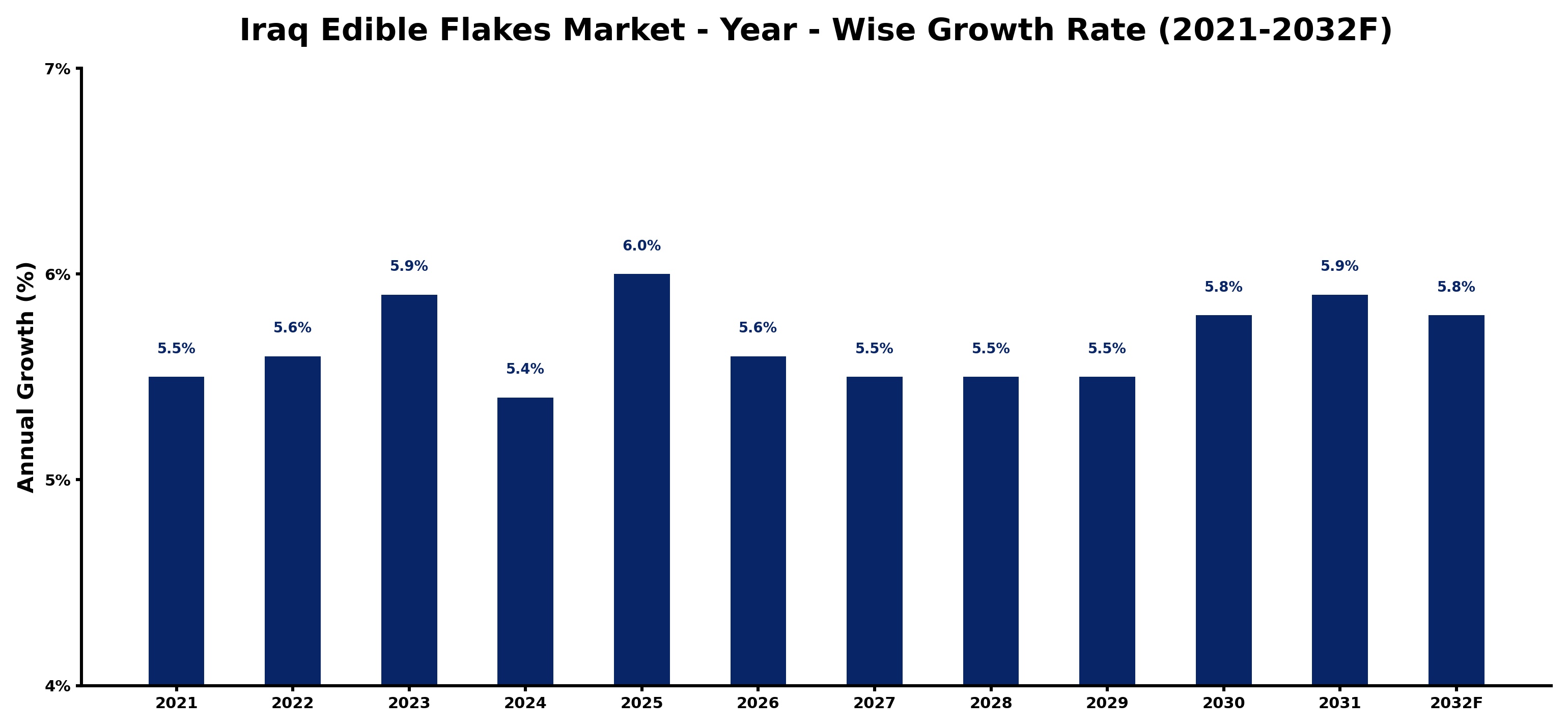
The table below presents the year‑wise growth rates along with the key drivers influencing the market
| Year | Growth Rate | Major Drivers |
| 2021 | 5.5% | Rising health consciousness among consumers |
| 2022 | 5.6% | Increased demand for convenience foods |
| 2023 | 5.9% | Growing popularity of breakfast options |
| 2024 | 5.4% | Expansion of local production facilities |
| 2025 | 6.0% | Innovative flavors attracting new customers |
| 2026 | 5.6% | Sustainability trends influencing purchasing behavior |
| 2027 | 5.5% | Increased marketing efforts driving awareness |
| 2028 | 5.5% | Industrial activity supported growth |
| 2029 | 5.5% | Emergence of new product lines |
| 2030 | 5.8% | Technological advancements improved production |
| 2031 | 5.9% | Consumer interest in organic options |
| 2032 | 5.8% | Enhanced distribution networks increased availability |
Note - Market size estimations and growth projections presented in this report are based on 6Wresearch’s advanced forecasting approach, validated with industry datasets as of June 2026.
Iraq Edible Flakes Market Synopsis
The landscape of the Iraq Edible Flakes Market is rapidly evolving, characterized by a growing appetite for diverse and healthy breakfast alternatives among consumers. Recent changes in dietary preferences, influenced by urban living and greater health consciousness, have positioned edible flakes, like corn and oat varieties, at the forefront of the breakfast options available in the market.
Furthermore, local manufacturers are enhancing product offerings by introducing innovative flavors and fortified options, responding effectively to the health and nutrition trends prevalent among Iraqi consumers. This dynamic environment is attracting attention from both domestic and international players aiming to capitalize on the expanding market potential.
Iraq Edible Flakes Market Key Takeaways
- Increasing health consciousness is driving demand for nutritious breakfast options.
- Urbanization and lifestyle changes are reshaping consumer preferences.
- Innovation in flavors and health benefits are key strategies for manufacturers.
- Economic growth and rising disposable incomes are boosting market potential.
- Local and international collaborations are enhancing product availability and variety.
Evaluation of Restraints in Iraq Edible Flakes Market
The Iraq Edible Flakes Market is facing significant restraints primarily due to ongoing economic instability and political unrest that affect overall consumer confidence. Supply chain disruptions are a common occurrence, complicating the sourcing of raw materials and the timely distribution of products. Additionally, inflationary pressures can impact pricing strategies, making it challenging for companies to maintain a competitive edge while ensuring affordability for consumers. As a result, navigating these complexities requires effective risk management and adaptable business strategies.
Iraq Edible Flakes Market Trends
Current trends indicate a substantial shift towards healthier breakfast options, with consumers increasingly opting for products perceived as nutritious, such as oat and wheat flakes. Additionally, the emergence of flavored and fortified edible flakes is gaining traction, as brands strive to cater to diverse taste preferences and dietary needs. The influence of Western eating habits is also shaping the demand, creating opportunities for new entrants and existing players to introduce innovative products into the market.
Iraq Edible Flakes Market Opportunities
There are abundant investment opportunities within the Iraq Edible Flakes Market, fueled by the rising consumer demand for convenient and health-oriented food products. The growing population and increased disposable incomes present a fertile ground for launching new cereal products, particularly those that align with health and wellness trends. Additionally, the shift towards organic and fortified offerings is paving the way for businesses to introduce cutting-edge products tailored to evolving consumer preferences.
Government Initiatives in the Iraq Edible Flakes Market
Government policies in Iraq aim to ensure food safety and quality within the Edible Flakes Market. Regulations are in place to oversee the production, import, and distribution of these products, thus safeguarding consumer health. By promoting domestic production, the government seeks to reduce dependency on imports while bolstering the local economy. Strict labeling requirements are enforced to enhance transparency regarding nutritional information, further reinforcing consumer trust.
Future Insights of the Iraq Edible Flakes Market
The future outlook for the Iraq Edible Flakes Market is bright, with projected steady growth anticipated from 2026 to 2032. Increasing awareness around healthy eating, alongside rising incomes and urban lifestyles, will likely continue to drive demand for ready-to-eat cereals. Innovation will play a crucial role in maintaining a competitive edge, as manufacturers focus on diversifying their product ranges and adopting marketing strategies that resonate with the health-conscious consumer demographic.
Iraq Edible Flakes Market Latest Developments (May 2025 - June 2026)
In recent months, there has been a noticeable uptick in the introduction of health-focused products within the Iraq Edible Flakes Market. Companies are increasingly investing in research and development to enhance nutritional profiles and flavor variety. Furthermore, strategic partnerships are emerging, aimed at expanding distribution channels and reaching untapped consumer segments. This proactive approach indicates a robust market response to evolving consumer demands and preferences.
Iraq Edible Flakes Market - Key Attractiveness of the Report
- 10 Years of Market Numbers
- Historical Data Starting from 2022 to 2025
- Base Year: 2025
- Forecast Data until 2032
- Key Performance Indicators Impacting the Market
- Major Upcoming Developments and Projects
Key Highlights of the Report:
- Iraq Edible Flakes Market Outlook
- Market Size of Iraq Edible Flakes Market, 2025
- Forecast of Iraq Edible Flakes Market, 2032
- Historical Data and Forecast of Iraq Edible Flakes Revenues & Volume for the Period 2022-2032F
- Iraq Edible Flakes Market Trend Evolution
- Iraq Edible Flakes Market Drivers and Challenges
- Iraq Edible Flakes Price Trends
- Iraq Edible Flakes Porter's Five Forces
- Iraq Edible Flakes Industry Life Cycle
- Historical Data and Forecast of Iraq Edible Flakes Market Revenues & Volume By Product for the Period 2022-2032F
- Historical Data and Forecast of Iraq Edible Flakes Market Revenues & Volume By Corn flakes for the Period 2022-2032F
- Historical Data and Forecast of Iraq Edible Flakes Market Revenues & Volume By Wheat flakes for the Period 2022-2032F
- Historical Data and Forecast of Iraq Edible Flakes Market Revenues & Volume By Rice flakes for the Period 2022-2032F
- Historical Data and Forecast of Iraq Edible Flakes Market Revenues & Volume By Flakey oats for the Period 2022-2032F
- Historical Data and Forecast of Iraq Edible Flakes Market Revenues & Volume By Others for the Period 2022-2032F
- Historical Data and Forecast of Iraq Edible Flakes Market Revenues & Volume By Distribution Channel for the Period 2022-2032F
- Historical Data and Forecast of Iraq Edible Flakes Market Revenues & Volume By Supermarkets & hypermarkets for the Period 2022-2032F
- Historical Data and Forecast of Iraq Edible Flakes Market Revenues & Volume By Convenience stores for the Period 2022-2032F
- Historical Data and Forecast of Iraq Edible Flakes Market Revenues & Volume By Online retailers for the Period 2022-2032F
- Iraq Edible Flakes Import Export Trade Statistics
- Market Opportunity Assessment By Product
- Market Opportunity Assessment By Distribution Channel
- Iraq Edible Flakes Top Companies Market Share
- Iraq Edible Flakes Competitive Benchmarking By Technical and Operational Parameters
- Iraq Edible Flakes Company Profiles
- Iraq Edible Flakes Key Strategic Recommendations






































