Iraq Incinerator Market Size, Share & Growth Rate
The Iraq Incinerator Market was estimated at USD 617 Million in 2025 and is projected to reach USD 895 Million by 2032, growing at a CAGR of 5.5% from 2026 to 2032. This growth trajectory is fueled by an increasing urban population and industrial expansion, which are heightening the demand for efficient waste disposal solutions. Furthermore, government initiatives to combat pollution and enhance waste management practices play a crucial role in shaping this market's landscape.
Iraq Incinerator Market Year-wise Growth Rate and Key Drivers
This graph highlights how the Iraq Incinerator Market has steadily grown over the years, supported by major growth factors.
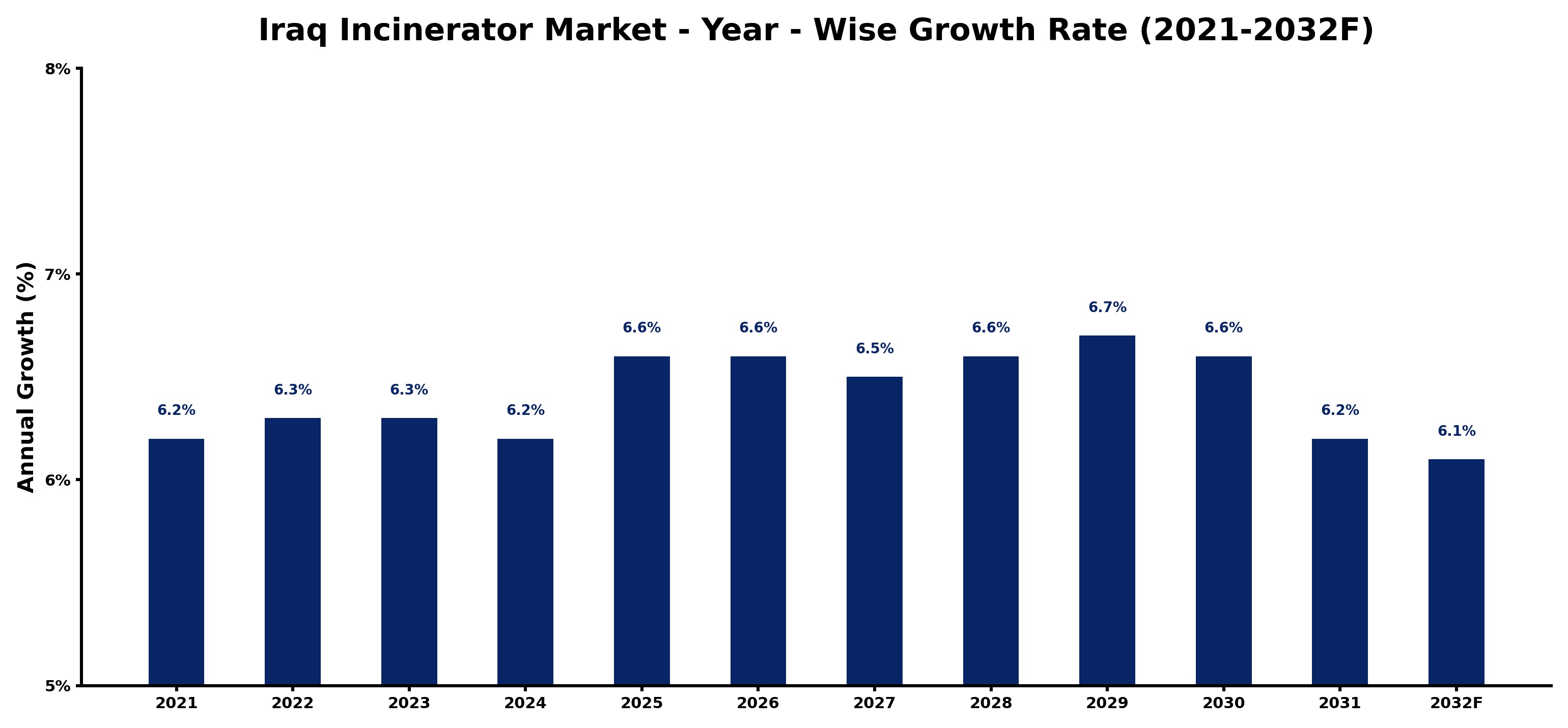
The table below presents the year‑wise growth rates along with the key drivers influencing the market
| Year | Growth Rate | Major Drivers |
| 2021 | 6.2% | Expansion of transportation and logistics networks |
| 2022 | 6.3% | Government infrastructure modernization initiatives |
| 2023 | 6.3% | Increasing industrial infrastructure investments |
| 2024 | 6.2% | Increasing smart city development projects |
| 2025 | 6.6% | Expansion of manufacturing activities |
| 2026 | 6.6% | Increasing adoption of advanced technologies |
| 2027 | 6.5% | Government infrastructure modernization initiatives |
| 2028 | 6.6% | Increasing industrial infrastructure investments |
| 2029 | 6.7% | Growing renewable energy integration projects |
| 2030 | 6.6% | Expansion of manufacturing activities |
| 2031 | 6.2% | Expansion of transportation and logistics networks |
| 2032 | 6.1% | Increasing industrial automation investments |
Note - Market size estimations and growth projections presented in this report are based on 6Wresearch’s advanced forecasting approach, validated with industry datasets as of June 2026.
Iraq Incinerator Market Synopsis
The incinerator market in Iraq is characterized by a growing need for modern waste management technologies, particularly in urban centers where traditional methods are proving inadequate. Small-scale incinerators are gaining traction among households, while larger industrial units cater to the escalating waste disposal needs of commercial enterprises.
As awareness of environmental sustainability increases, the demand for advanced incineration technologies that minimize emissions and enhance energy efficiency is also on the rise. The integration of public-private partnerships is further stimulating growth, facilitating the development of essential waste management infrastructure across the country.
Iraq Incinerator Market Key Takeaways
- Significant market growth driven by urbanization and government environmental initiatives.
- Adoption of advanced incineration technologies aimed at improving efficiency and reducing emissions.
- Public-private partnerships emerging as a key strategy for infrastructure development.
- Increased awareness of sustainable waste management practices influencing consumer preferences.
- Investment opportunities present due to rising industrial waste generation and urban population pressures.
Evaluation of Restraints in Iraq Incinerator Market
The Iraq Incinerator Market faces several significant restraints that hinder its full potential. Economic constraints and sanctions limit access to advanced incineration technology and equipment, creating challenges for local operators. Additionally, the existing regulatory frameworks and infrastructure are often inadequate, resulting in inefficient waste disposal practices. Political instability and security concerns compound these issues, making it difficult for investors to engage meaningfully in the market. Furthermore, a general lack of awareness regarding the benefits of incineration as a sustainable waste management solution continues to be a barrier, requiring concerted efforts to educate stakeholders.
Iraq Incinerator Market Trends
The current trends in the Iraq Incinerator Market reflect a significant shift towards the adoption of advanced incineration technologies. These modern solutions not only ensure higher efficiency in waste treatment but also significantly reduce harmful emissions. There is also a pronounced trend towards sustainability, leading to the development of incinerators capable of converting waste into energy, thereby maximizing resource utilization. Additionally, the rise in public-private partnerships is driving innovative waste management projects, enhancing operational capabilities and infrastructure.
Iraq Incinerator Market Opportunities
The Iraq Incinerator Market presents notable investment opportunities as the country seeks to address its growing waste management challenges. With urbanization and industrialization on the rise, the demand for efficient waste disposal solutions is only expected to increase. Investors can tap into this market by supplying state-of-the-art incineration systems that align with stringent environmental regulations. Collaborations with local municipalities and enterprises to establish incineration facilities can offer lucrative returns, especially as the regulatory landscape continues to evolve favorably.
Government Initiatives in the Iraq Incinerator Market
The Iraqi government has been proactive in implementing policies that address the urgent need for better waste management solutions. Initiatives include the establishment of regulations on emissions standards and guidelines for waste disposal practices. Furthermore, the government offers incentives for companies willing to invest in modern incineration technologies, aiming to decrease reliance on traditional landfills and enhance overall waste management efficiency across municipalities.
Future Insights of the Iraq Incinerator Market
Looking ahead to 2026-2032, the Iraq Incinerator Market is expected to experience steady growth, driven by continuous efforts toward environmental sustainability and enhanced waste management practices. The expanding urban population, coupled with a growing industrial sector, will further elevate the demand for effective waste disposal solutions, including incinerators. Moreover, ongoing advancements in technology, particularly concerning energy efficiency and emission control systems, will facilitate market expansion and attract further investment. This momentum positions the Iraq Incinerator Market favorably as the country reinforces its commitment to improving waste management infrastructure.
Iraq Incinerator Market Latest Developments (May 2025 - June 2026)
Recent developments in the Iraq Incinerator Market indicate a growing emphasis on the integration of advanced technology within waste management solutions. As local authorities seek to modernize their facilities, numerous initiatives are being explored to enhance operational efficiency and reduce emissions. Public-private partnerships are increasingly common, facilitating the exchange of expertise and resources necessary for establishing effective incineration facilities across the region. Ongoing investments in waste management infrastructure highlight a commitment to sustainable practices, driving market evolution.
Iraq Incinerator Market - Key Attractiveness of the Report
- 10 Years of Market Numbers
- Historical Data Starting from 2022 to 2025
- Base Year: 2025
- Forecast Data until 2032
- Key Performance Indicators Impacting the Market
- Major Upcoming Developments and Projects
Key Highlights of the Report:
- Iraq Incinerator Market Outlook
- Market Size of Iraq Incinerator Market, 2025
- Forecast of Iraq Incinerator Market, 2032
- Historical Data and Forecast of Iraq Incinerator Revenues & Volume for the Period 2022-2032F
- Iraq Incinerator Market Trend Evolution
- Iraq Incinerator Market Drivers and Challenges
- Iraq Incinerator Price Trends
- Iraq Incinerator Porter's Five Forces
- Iraq Incinerator Industry Life Cycle
- Historical Data and Forecast of Iraq Incinerator Market Revenues & Volume By Product Type for the Period 2022-2032F
- Historical Data and Forecast of Iraq Incinerator Market Revenues & Volume By Moving Grate for the Period 2022-2032F
- Historical Data and Forecast of Iraq Incinerator Market Revenues & Volume By Static Hearth, Furnace and Multiple Hearth for the Period 2022-2032F
- Historical Data and Forecast of Iraq Incinerator Market Revenues & Volume By Rotary Kiln for the Period 2022-2032F
- Historical Data and Forecast of Iraq Incinerator Market Revenues & Volume By Fluidized Bed for the Period 2022-2032F
- Historical Data and Forecast of Iraq Incinerator Market Revenues & Volume By End-user for the Period 2022-2032F
- Historical Data and Forecast of Iraq Incinerator Market Revenues & Volume By Municipal Sector for the Period 2022-2032F
- Historical Data and Forecast of Iraq Incinerator Market Revenues & Volume By Industrial Sector for the Period 2022-2032F
- Iraq Incinerator Import Export Trade Statistics
- Market Opportunity Assessment By Product Type
- Market Opportunity Assessment By End-user
- Iraq Incinerator Top Companies Market Share
- Iraq Incinerator Competitive Benchmarking By Technical and Operational Parameters
- Iraq Incinerator Company Profiles
- Iraq Incinerator Key Strategic Recommendations






































