Israel Emollient Market Top 5 Importing Countries and Market Competition (HHI) Analysis
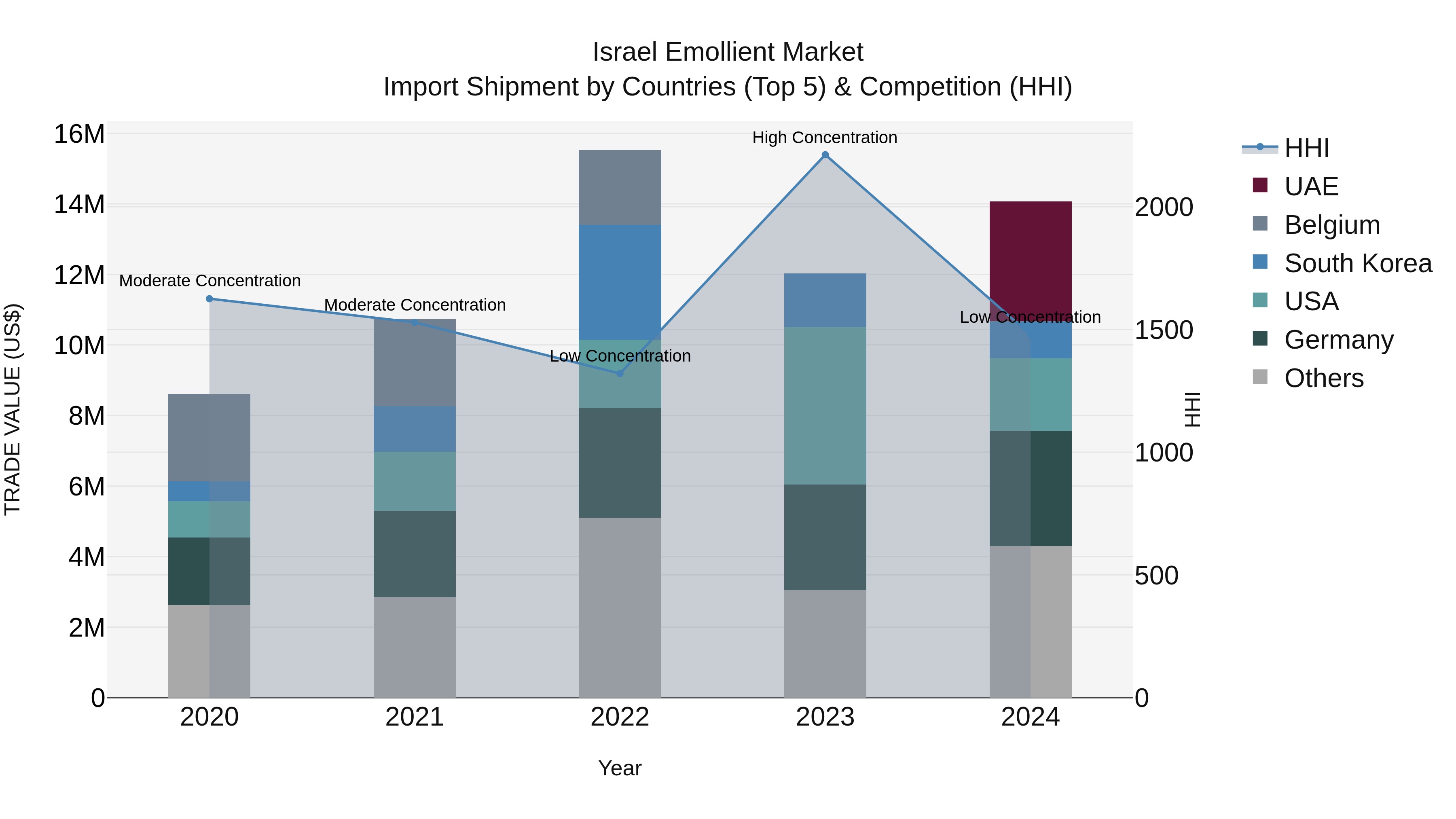
Israel`s emollient import market experienced a shift in concentration from high to low in 2024, indicating increased diversification of import sources. The top exporting countries - UAE, Germany, USA, South Korea, and Italy - played a key role in this trend. With a notable Compound Annual Growth Rate (CAGR) of 13.06% from 2020 to 2024 and a robust growth rate of 16.95% in 2024 alone, the market shows promising expansion opportunities. This data suggests a dynamic and evolving landscape for emollient imports in Israel, presenting potential for strategic partnerships and market development.
Israel Emollient Market Overview
The Israel Emollient Market is experiencing steady growth driven by increasing consumer demand for skincare products and cosmetics. Emollients are essential ingredients in personal care products for their moisturizing and skin softening properties, making them popular in a wide range of applications including lotions, creams, and lip balms. Key players in the market are focusing on developing innovative emollient formulations to cater to evolving consumer preferences for natural and sustainable ingredients. The market is also witnessing a shift towards plant-based and organic emollients in line with the rising trend of clean beauty products. Overall, the Israel Emollient Market is expected to continue its growth trajectory supported by a growing emphasis on skincare routines and self-care practices among consumers.
Israel Emollient Market Trends and Opportunities
The Israel Emollient Market is experiencing a growing demand for natural and organic ingredients due to increasing consumer awareness about the benefits of clean beauty products. There is a trend towards incorporating plant-based emollients such as shea butter, coconut oil, and argan oil in skincare formulations. With a focus on sustainability and eco-friendly practices, there is also a rising interest in emollients sourced from renewable resources. Opportunities exist for companies to innovate and develop novel emollient blends that cater to specific skin types or address particular skin concerns. Additionally, the market presents prospects for partnerships with local suppliers of natural ingredients to ensure traceability and quality in emollient products, aligning with the clean beauty movement in Israel.
Israel Emollient Market Challenges
In the Israel Emollient Market, some key challenges include regulatory hurdles and compliance requirements, market saturation due to the presence of established players, and the need for continuous product innovation to meet evolving consumer preferences and demands. Additionally, fluctuating raw material prices and the increasing focus on sustainability and natural ingredients pose challenges for emollient manufacturers in Israel. The market also faces competition from imported emollient products, which can impact local manufacturers` market share. To succeed in this competitive landscape, companies in the Israel Emollient Market need to invest in research and development, maintain high-quality standards, and establish strong distribution networks to reach a wider customer base.
Israel Emollient Market Drivers
The Israel Emollient Market is primarily driven by the increasing awareness among consumers regarding the benefits of emollients for skincare and haircare purposes. The growing demand for natural and organic ingredients in cosmetic products has also fueled the market growth, as emollients are often derived from plant-based sources. The rising disposable income levels in Israel have led to a higher willingness to invest in premium skincare products, further boosting the demand for emollients. Additionally, the expanding beauty and personal care industry in the region, coupled with the influence of social media and beauty influencers, has contributed to the growing popularity of emollients among consumers looking for effective and nourishing skincare solutions.
Israel Emollient Market Government Policy
The Israeli government has implemented various policies to regulate the emollient market within the country. These policies include stringent quality standards for emollient products to ensure consumer safety and efficacy. Additionally, regulations are in place to monitor and control the import and export of emollients, with a focus on compliance with international trade agreements. The government also encourages research and development in the emollient industry, providing support and incentives for innovation and sustainable practices. Overall, the regulatory framework aims to promote a competitive and transparent market while safeguarding consumer interests and supporting the growth of the emollient sector in Israel.
Israel Emollient Market Future Outlook
The Israel Emollient Market is expected to experience steady growth in the coming years, driven by increasing consumer awareness about skincare and beauty products. Growing demand for natural and organic emollients, along with the rising popularity of specialty emollients for specific skin concerns, such as anti-aging and hydration, are key factors fueling market growth. Additionally, the trend towards personalized skincare routines and the influence of social media on beauty trends are expected to further boost the market. Innovations in emollient formulations, such as incorporating advanced ingredients and technologies, will also play a significant role in shaping the market landscape. Overall, the Israel Emollient Market is poised for expansion, with opportunities for market players to cater to evolving consumer preferences and capitalize on the growing demand for high-quality skincare products.
Key Highlights of the Report:
- Israel Emollient Market Outlook
- Market Size of Israel Emollient Market, 2024
- Forecast of Israel Emollient Market, 2031
- Historical Data and Forecast of Israel Emollient Revenues & Volume for the Period 2021- 2031
- Israel Emollient Market Trend Evolution
- Israel Emollient Market Drivers and Challenges
- Israel Emollient Price Trends
- Israel Emollient Porter's Five Forces
- Israel Emollient Industry Life Cycle
- Historical Data and Forecast of Israel Emollient Market Revenues & Volume By Type for the Period 2021- 2031
- Historical Data and Forecast of Israel Emollient Market Revenues & Volume By Esters for the Period 2021- 2031
- Historical Data and Forecast of Israel Emollient Market Revenues & Volume By Fatty Alcohols for the Period 2021- 2031
- Historical Data and Forecast of Israel Emollient Market Revenues & Volume By Fatty Acids for the Period 2021- 2031
- Historical Data and Forecast of Israel Emollient Market Revenues & Volume By Ethers for the Period 2021- 2031
- Historical Data and Forecast of Israel Emollient Market Revenues & Volume By Silicones for the Period 2021- 2031
- Historical Data and Forecast of Israel Emollient Market Revenues & Volume By Others for the Period 2021- 2031
- Historical Data and Forecast of Israel Emollient Market Revenues & Volume By Form for the Period 2021- 2031
- Historical Data and Forecast of Israel Emollient Market Revenues & Volume By Solid for the Period 2021- 2031
- Historical Data and Forecast of Israel Emollient Market Revenues & Volume By Liquid for the Period 2021- 2031
- Historical Data and Forecast of Israel Emollient Market Revenues & Volume By Application for the Period 2021- 2031
- Historical Data and Forecast of Israel Emollient Market Revenues & Volume By Skin Care for the Period 2021- 2031
- Historical Data and Forecast of Israel Emollient Market Revenues & Volume By Hair Care for the Period 2021- 2031
- Historical Data and Forecast of Israel Emollient Market Revenues & Volume By Deodorants for the Period 2021- 2031
- Historical Data and Forecast of Israel Emollient Market Revenues & Volume By Oral Care for the Period 2021- 2031
- Historical Data and Forecast of Israel Emollient Market Revenues & Volume By Others for the Period 2021- 2031
- Israel Emollient Import Export Trade Statistics
- Market Opportunity Assessment By Type
- Market Opportunity Assessment By Form
- Market Opportunity Assessment By Application
- Israel Emollient Top Companies Market Share
- Israel Emollient Competitive Benchmarking By Technical and Operational Parameters
- Israel Emollient Company Profiles
- Israel Emollient Key Strategic Recommendations






































