Israel Lumber Market Size Growth Rate
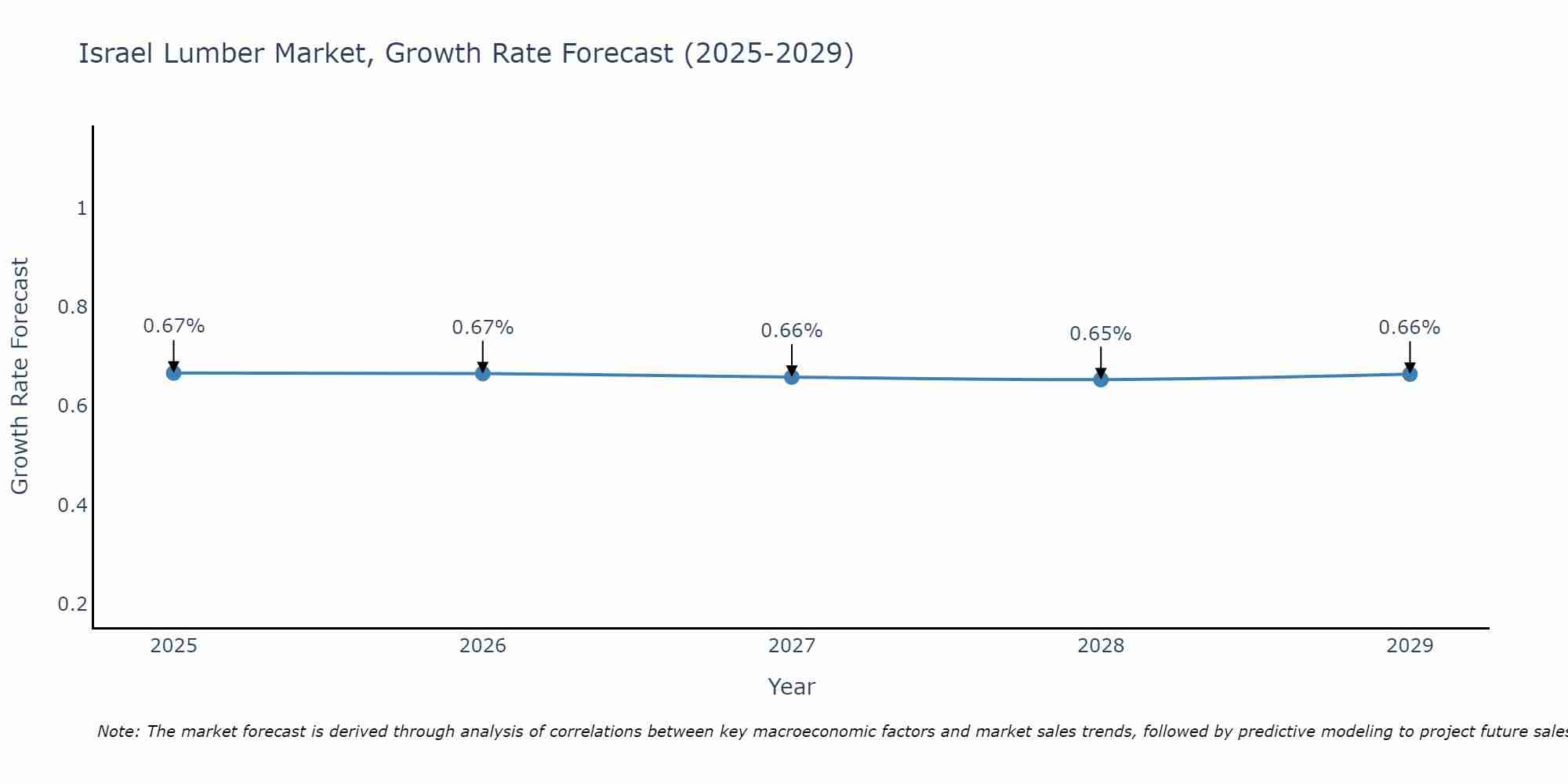
The Israel Lumber Market is projected to witness mixed growth rate patterns during 2025 to 2029. Beginning strongly at 0.67% in 2025, growth softens to 0.66% in 2029.
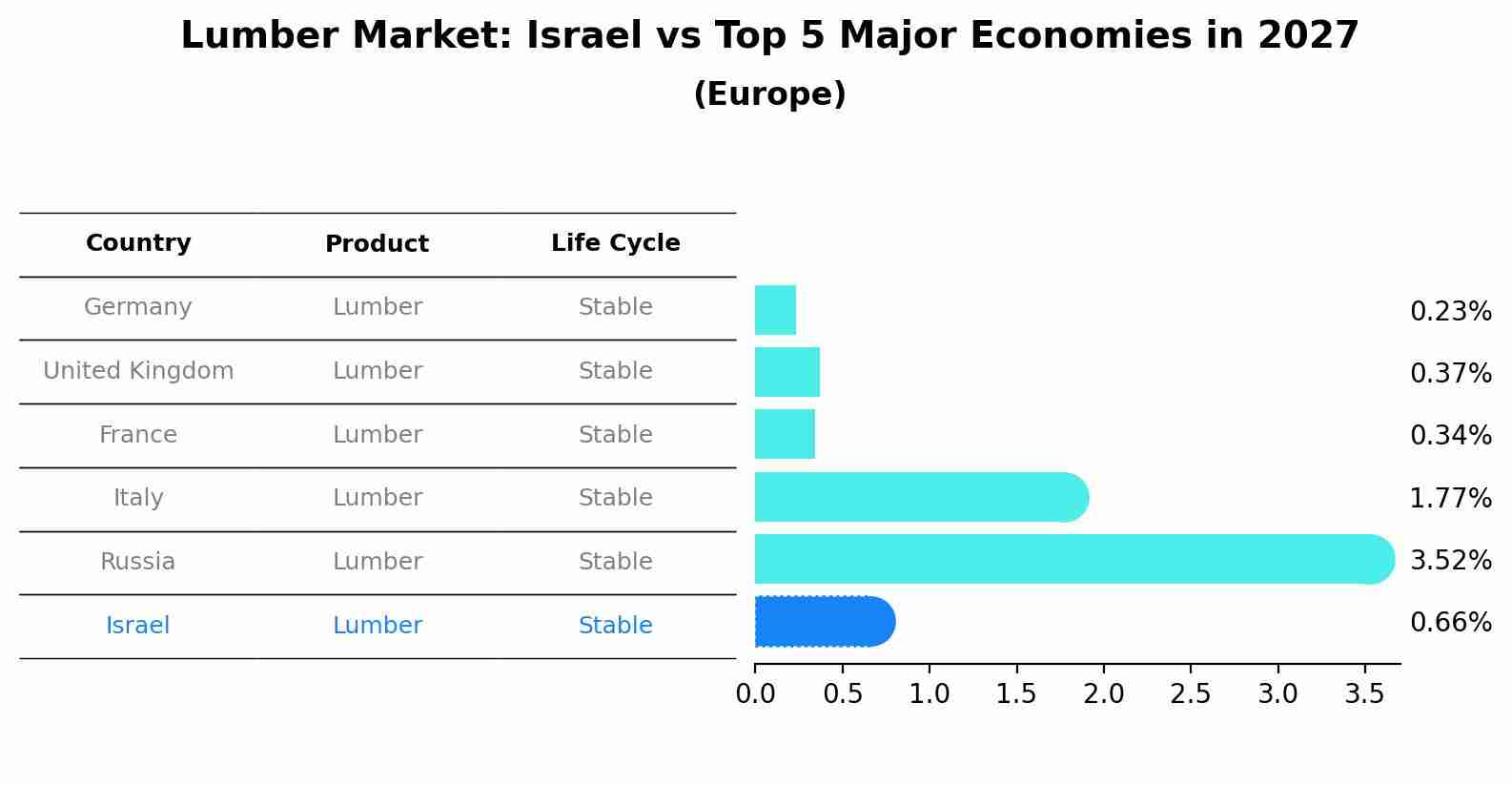
Lumber Market: Israel vs Top 5 Major Economies in 2027 (Europe)
By 2027, the Lumber market in Israel is anticipated to reach a growth rate of 0.66%, as part of an increasingly competitive Europe region, where Germany remains at the forefront, supported by United Kingdom, France, Italy and Russia, driving innovations and market adoption across sectors.
Israel Lumber Market Synopsis
The lumber market in Israel involves the importation and distribution of wood products such as timber, boards, and planks for construction, furniture manufacturing, and woodworking industries. Israel imports lumber from various countries to meet domestic demand and support its growing construction and infrastructure development projects.
Drivers of the market
The lumber market in Israel is witnessing significant growth, driven by several key factors. Firstly, the increasing demand for wood products in construction and manufacturing industries is propelling market expansion. Lumber serves as a primary raw material for various applications, including building construction, furniture manufacturing, and packaging. Moreover, the growing population and urbanization trends are driving the demand for residential and commercial construction projects, further fueling lumber consumption. Additionally, the adoption of sustainable forestry practices and certification schemes is promoting responsible timber harvesting and forest management in Israel. Furthermore, the expansion of the woodworking and carpentry sectors is creating new opportunities for lumber suppliers and distributors in Israel, as businesses seek high-quality and environmentally friendly wood products to meet consumer demand.
Challenges of the market
The Israel lumber market confronts challenges related to supply chain disruptions, sustainability concerns, and market volatility. As a relatively small market with limited domestic timber resources, Israel relies heavily on imports to meet its lumber demand. However, fluctuations in global timber prices, trade tensions, and supply chain disruptions, such as port congestion and transportation delays, can impact lumber availability and pricing. Additionally, addressing sustainability issues, such as deforestation and illegal logging, requires cooperation among industry stakeholders and adherence to responsible sourcing practices. Balancing economic considerations with environmental and social responsibility poses a challenge for businesses operating in the lumber market.
Government Policy of the market
The Israel government regulates the lumber market to ensure sustainable forest management and environmental protection. Policies promote the use of certified sustainable wood and encourage reforestation efforts. The government also supports the lumber industry through subsidies and incentives for adopting eco-friendly practices and technologies.
Key Highlights of the Report:
- Israel Lumber Market Outlook
- Market Size of Israel Lumber Market, 2024
- Forecast of Israel Lumber Market, 2031
- Historical Data and Forecast of Israel Lumber Revenues & Volume for the Period 2021-2031
- Israel Lumber Market Trend Evolution
- Israel Lumber Market Drivers and Challenges
- Israel Lumber Price Trends
- Israel Lumber Porter`s Five Forces
- Israel Lumber Industry Life Cycle
- Historical Data and Forecast of Israel Lumber Market Revenues & Volume By Types for the Period 2021-2031
- Historical Data and Forecast of Israel Lumber Market Revenues & Volume By Hardwood Lumber for the Period 2021-2031
- Historical Data and Forecast of Israel Lumber Market Revenues & Volume By Softwood Lumber for the Period 2021-2031
- Historical Data and Forecast of Israel Lumber Market Revenues & Volume By Application for the Period 2021-2031
- Historical Data and Forecast of Israel Lumber Market Revenues & Volume By Construction for the Period 2021-2031
- Historical Data and Forecast of Israel Lumber Market Revenues & Volume By Furniture for the Period 2021-2031
- Historical Data and Forecast of Israel Lumber Market Revenues & Volume By Flooring for the Period 2021-2031
- Historical Data and Forecast of Israel Lumber Market Revenues & Volume By Moldings for the Period 2021-2031
- Historical Data and Forecast of Israel Lumber Market Revenues & Volume By Others for the Period 2021-2031
- Israel Lumber Import Export Trade Statistics
- Market Opportunity Assessment By Types
- Market Opportunity Assessment By Application
- Israel Lumber Top Companies Market Share
- Israel Lumber Competitive Benchmarking By Technical and Operational Parameters
- Israel Lumber Company Profiles
- Israel Lumber Key Strategic Recommendations






































