Italy Activated Carbon Market Size (2020-2030)
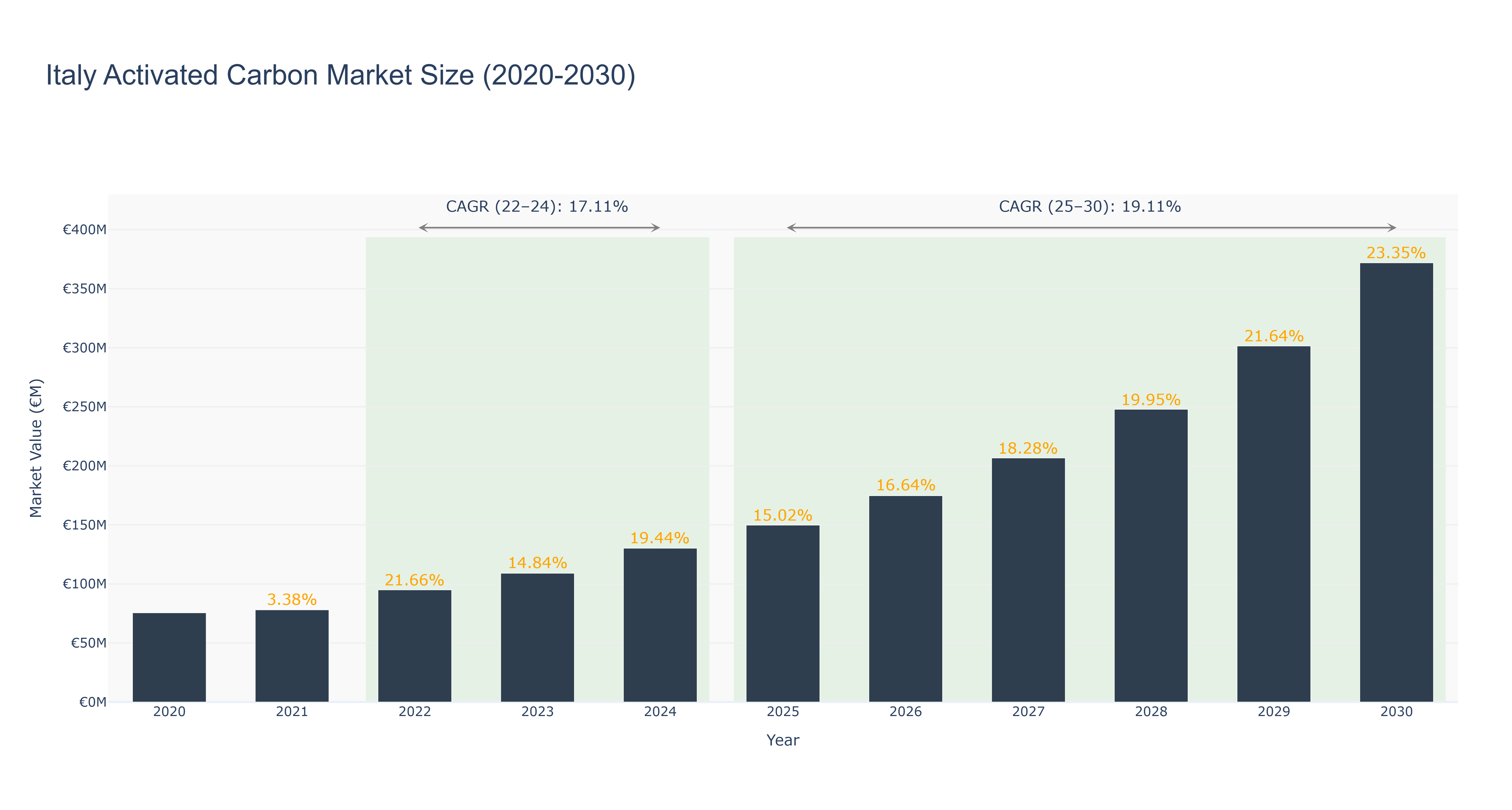
Italy's Activated Carbon Market has shown a positive growth trend over the years. The market peaked at €371.89 million in 2030, with a steady increase from €75.48 million in 2020. The CAGR for the period 2022-24 was 17.11%, while for 2025-30 it is projected to be 19.11%. The market experienced significant growth due to increasing environmental regulations driving the demand for activated carbon in air and water purification applications. Looking ahead, Italy is set to invest in new sustainable technologies for activated carbon production, aiming to further boost market growth and meet the rising demand for clean air and water solutions. This strategic focus on sustainability and innovation is expected to drive continued expansion in the activated carbon market in Italy.
Italy Activated Carbon Market: Production & Trade Performance (2019-2025)
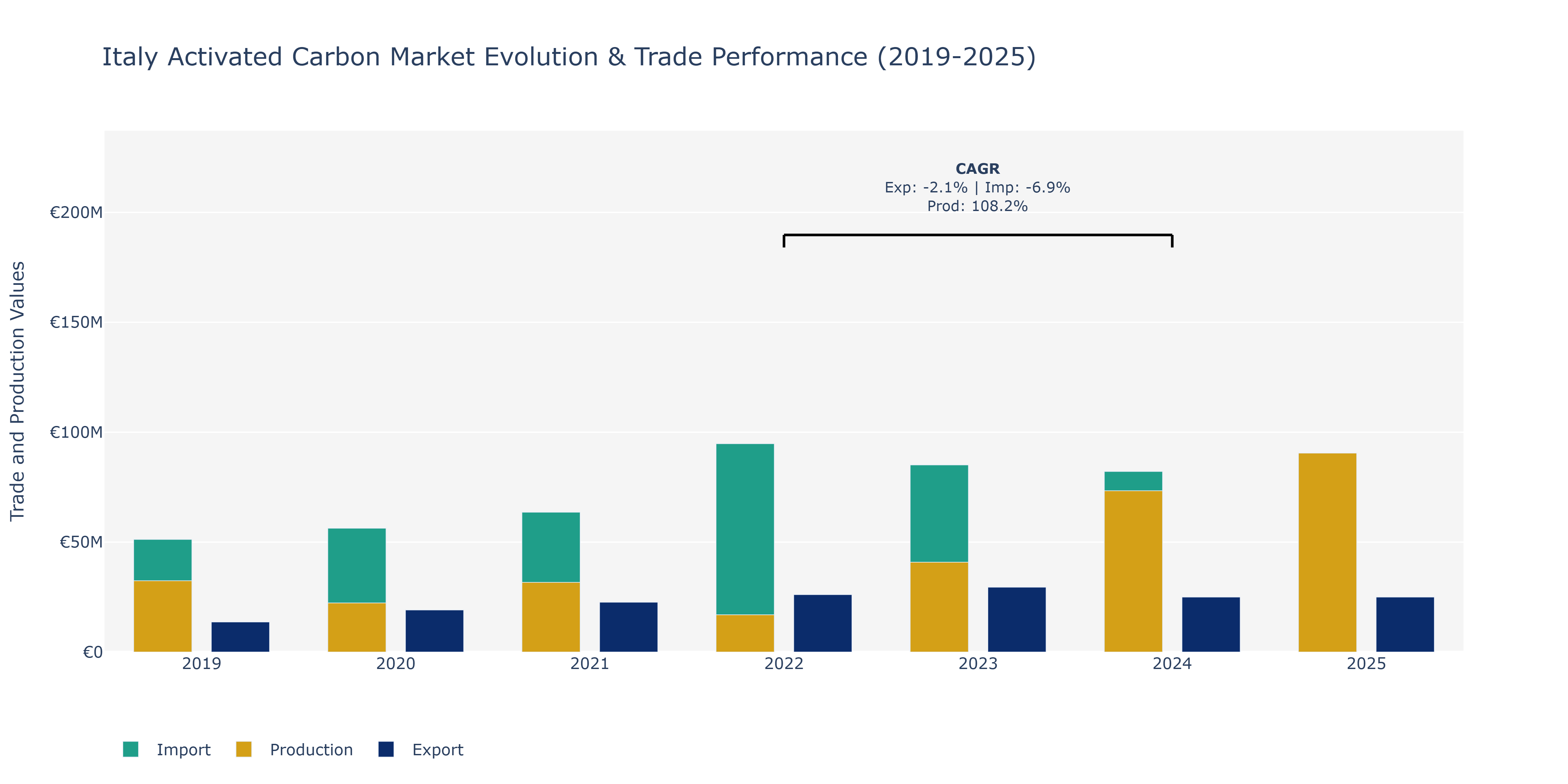
In the Italy Activated Carbon Market, exports exhibited a fluctuating pattern over the years, starting at €13.69 million in 2019, peaking in 2023 at €29.49 million, and then slightly declining to €24.99 million in 2025. Imports consistently increased from €51.24 million in 2019 to €78.92 million in 2025, with a peak in 2022 at €94.76 million. Production, on the other hand, showed a significant increase from €32.42 million in 2019 to €90.48 million in 2025, with the year 2022 recording the lowest production value at €16.93 million. The rise in production can be attributed to the growing demand for activated carbon in various industries such as water treatment, air purification, and pharmaceuticals. The fluctuations in exports could be influenced by global market demand shifts and trade policies affecting the activated carbon industry. Import levels may reflect the country's reliance on imported activated carbon to meet domestic demands amidst variable production capacities and technological advancements in the market.
Italy Activated Carbon Market Overview
The Italy activated carbon market is experiencing steady growth driven by increasing awareness and stringent environmental regulations regarding air and water pollution control. The market is primarily driven by the industrial sector, particularly in water treatment, air purification, and food and beverage processing applications. The growing adoption of activated carbon in gas phase applications for removing volatile organic compounds and odors further contributes to market expansion. Additionally, the rising demand for activated carbon in automotive emission control systems and pharmaceutical manufacturing processes is expected to fuel market growth in Italy. Key market players in the region are focusing on product innovation and strategic partnerships to gain a competitive edge in the market. The Italy activated carbon market shows promising growth prospects due to the increasing emphasis on environmental sustainability and pollution control measures.
Italy Activated Carbon Market Trends
The Italy Activated Carbon Market is experiencing growth due to increasing environmental regulations and a rising focus on water and air purification. The market is witnessing a shift towards more sustainable and efficient activated carbon products, driven by the demand for clean and safe drinking water. Additionally, there is a growing awareness of the benefits of using activated carbon in various industries such as pharmaceuticals, food and beverage, and automotive. Manufacturers are investing in research and development to innovate new products with enhanced properties for better performance and cost-effectiveness. The market is also seeing collaborations and partnerships between key players to expand their product portfolios and geographical presence. Overall, the Italy Activated Carbon Market is expected to continue its growth trajectory in the coming years.
Italy Activated Carbon Market Challenges
In the Italy Activated Carbon Market, some challenges that are faced include increasing competition from alternative filtration technologies such as membrane filtration and ion exchange resins. Additionally, the rising cost of raw materials and production processes is putting pressure on profit margins for activated carbon manufacturers. Strict environmental regulations and the need for continuous innovation to meet evolving customer requirements also present challenges in this market. Furthermore, fluctuations in the prices of key raw materials, such as coconut shells or coal, can impact the overall cost structure for activated carbon production in Italy. Overall, companies operating in the Italy Activated Carbon Market need to navigate these challenges effectively to maintain their competitiveness and sustainable growth in the industry.
Italy Activated Carbon Market Investment Opportunities
The Italy Activated Carbon Market presents promising investment opportunities due to increasing environmental regulations and growing awareness about water and air purification. With a focus on sustainability and the need for cleaner resources, the demand for activated carbon in applications such as water treatment, air purification, and industrial processes is expected to surge. Investing in companies that manufacture or distribute activated carbon products, as well as those involved in research and development to enhance product efficiency and sustainability, could yield favorable returns. Additionally, opportunities exist in providing customized solutions for specific industries and applications, as well as exploring partnerships with government bodies and environmental organizations to address the country`s environmental challenges effectively.
Italy Activated Carbon Market Government Policy
In Italy, government policies related to the activated carbon market primarily focus on environmental protection and sustainable development. The Italian government has implemented regulations to reduce emissions of pollutants that require the use of activated carbon in industries such as water treatment, air purification, and gas processing. These policies aim to promote the adoption of cleaner technologies and processes to ensure compliance with European Union standards for air and water quality. Additionally, the government provides incentives and subsidies for the research and development of innovative activated carbon products and technologies to support the growth of the market while also addressing environmental concerns. Overall, Italy`s policies in the activated carbon market are geared towards achieving environmental sustainability and fostering the transition to a greener economy.
Italy Activated Carbon Market Future Outlook
The Italy activated carbon market is expected to witness steady growth in the coming years due to the increasing awareness about environmental pollution and the need for effective air and water purification solutions. The market is likely to be driven by the growing industrial sector, stringent environmental regulations, and the rising adoption of activated carbon in various applications such as water treatment, air purification, and pharmaceuticals. Additionally, the shift towards sustainable and eco-friendly products is anticipated to further propel market growth in Italy. Market players are focusing on product innovations, strategic collaborations, and expansions to strengthen their market presence and gain a competitive edge in the evolving activated carbon market landscape in Italy.
Key Highlights of the Report:
- Italy Activated Carbon Market Outlook
- Market Size of Italy Activated Carbon Market, 2021
- Forecast of Italy Activated Carbon Market, 2027
- Historical Data and Forecast of Italy Activated Carbon Revenues & Volume for the Period 2018 - 2027
- Italy Activated Carbon Market Trend Evolution
- Italy Activated Carbon Market Drivers and Challenges
- Italy Activated Carbon Price Trends
- Italy Activated Carbon Porter's Five Forces
- Italy Activated Carbon Industry Life Cycle
- Historical Data and Forecast of Italy Activated Carbon Market Revenues & Volume By Product for the Period 2018 - 2027
- Historical Data and Forecast of Italy Activated Carbon Market Revenues & Volume By Powdered for the Period 2018 - 2027
- Historical Data and Forecast of Italy Activated Carbon Market Revenues & Volume By Granular for the Period 2018 - 2027
- Historical Data and Forecast of Italy Activated Carbon Market Revenues & Volume By Others for the Period 2018 - 2027
- Historical Data and Forecast of Italy Activated Carbon Market Revenues & Volume By Application for the Period 2018 - 2027
- Historical Data and Forecast of Italy Activated Carbon Market Revenues & Volume By Liquid Phase for the Period 2018 - 2027
- Historical Data and Forecast of Italy Activated Carbon Market Revenues & Volume By Gas Phase for the Period 2018 - 2027
- Historical Data and Forecast of Italy Activated Carbon Market Revenues & Volume By End-use for the Period 2018 - 2027
- Historical Data and Forecast of Italy Activated Carbon Market Revenues & Volume By Water Treatment for the Period 2018 - 2027
- Historical Data and Forecast of Italy Activated Carbon Market Revenues & Volume By Food & Beverage Processing for the Period 2018 - 2027
- Historical Data and Forecast of Italy Activated Carbon Market Revenues & Volume By Pharmaceutical & Medical for the Period 2018 - 2027
- Historical Data and Forecast of Italy Activated Carbon Market Revenues & Volume By Automotive for the Period 2018 - 2027
- Historical Data and Forecast of Italy Activated Carbon Market Revenues & Volume By Air Purification for the Period 2018 - 2027
- Historical Data and Forecast of Italy Activated Carbon Market Revenues & Volume By Others for the Period 2018 - 2027
- Italy Activated Carbon Import Export Trade Statistics
- Market Opportunity Assessment By Product
- Market Opportunity Assessment By Application
- Market Opportunity Assessment By End-use
- Italy Activated Carbon Top Companies Market Share
- Italy Activated Carbon Competitive Benchmarking By Technical and Operational Parameters
- Italy Activated Carbon Company Profiles
- Italy Activated Carbon Key Strategic Recommendations






































