Italy Cognitive Analytics Market Size & Growth Rate (2026-2032)
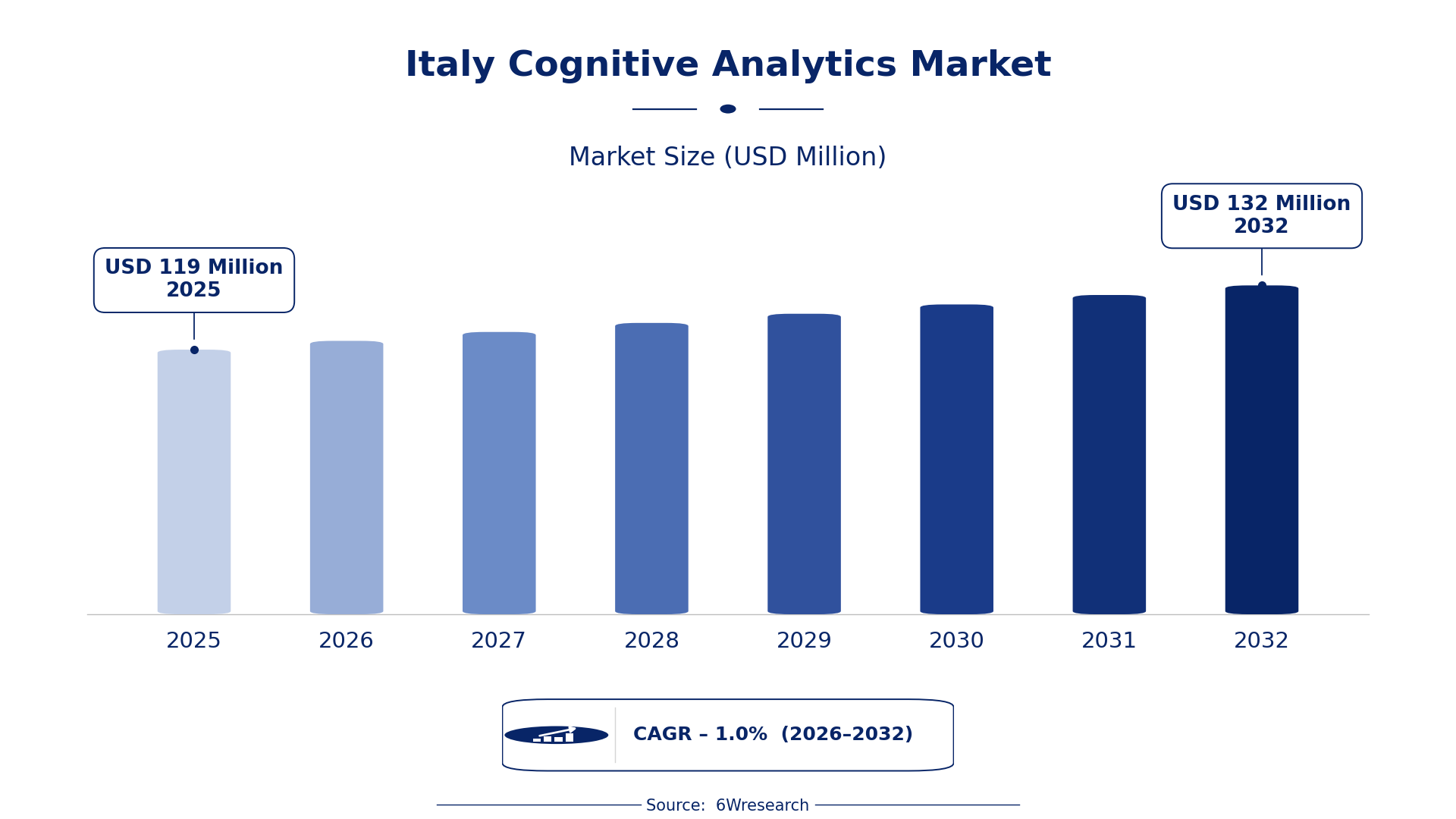
The Italy Cognitive Analytics Market was estimated at USD 119 Million in 2025 and is projected to reach USD 132 Million by 2032, growing at a CAGR of 1.0% from 2026 to 2032.
Italy Cognitive Analytics Market Synopsis
The cognitive analytics market in Italy is rapidly evolving, fueled by the increasing demand for advanced analytical solutions across various sectors. Organizations are turning to cognitive analytics to transform vast amounts of data into actionable insights, enhancing decision-making processes and fostering innovation.
As industries such as finance, healthcare, and retail embrace data-driven strategies, the market for cognitive analytics is set to flourish. Companies recognize that leveraging artificial intelligence technologies is not just a competitive advantage, but a necessity for operational efficiency and growth.
Italy Cognitive Analytics Market Year-wise Growth Rate and Key Drivers
This graph illustrates the annual growth rates of the Italy Cognitive Analytics Market from 2021 to 2032, highlighting a steady upward trajectory and projected expansion over the forecast period.
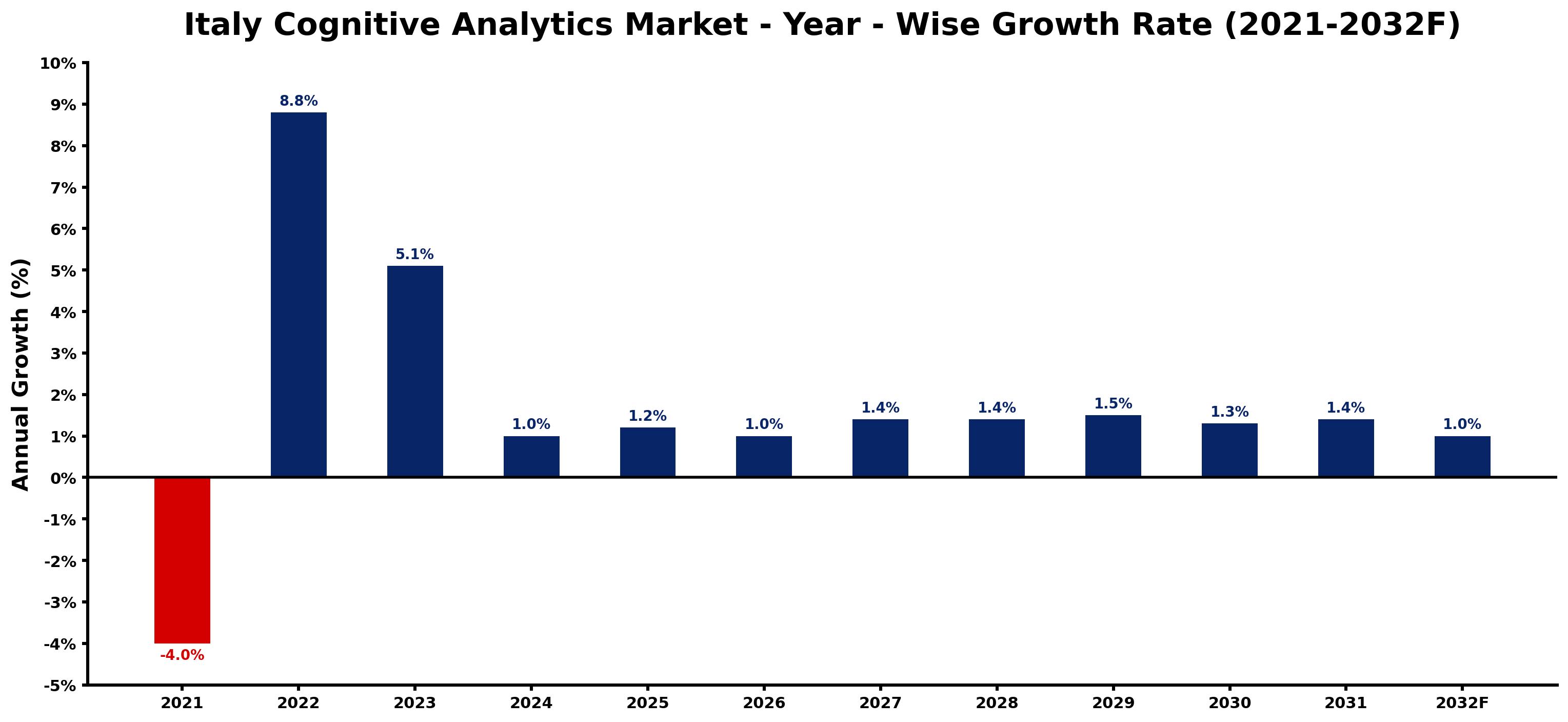
The table below presents the year‑wise growth rates along with the key drivers influencing the market
| Year | Growth Rate | Major Drivers |
| 2021 | -4.0% | Delayed EU funding for AI innovation projects. |
| 2022 | 8.8% | Increased demand for AI in healthcare sector. |
| 2023 | 5.1% | Government incentives for digitalization in public administration. |
| 2024 | 1.0% | Growth in retail analytics for consumer behavior insights. |
| 2025 | 1.2% | Rising focus on data-driven decision-making in enterprises. |
| 2026 | 1.0% | Adoption of cloud services enhancing analytics accessibility. |
| 2027 | 1.4% | Investment in smart manufacturing driving predictive analytics needs. |
| 2028 | 1.4% | Local startups innovating in AI technology applications. |
| 2029 | 1.5% | Partnerships between universities and tech companies boosting R&D. |
| 2030 | 1.3% | Growing emphasis on cybersecurity analytics for data protection. |
| 2031 | 1.4% | Increased regulatory requirements for data compliance driving analytics. |
| 2032 | 1.0% | Rising interest in sustainability metrics and reporting analytics. |
Note: Market size estimations and growth projections presented in this report are based on 6Wresearch's proprietary forecasting methodology, utilizing the latest available industry data, government publications, and primary research inputs.
Italy Cognitive Analytics Market Key Takeaways
Below are some of the specific key takeaways from the market, including:
- The market is projected to grow steadily, reflecting increased investment in AI technologies.
- Data privacy concerns pose challenges to market expansion and adoption.
- Integration of cognitive analytics with existing systems remains a complex endeavor.
- Healthcare and finance are leading sectors driving demand for cognitive analytics solutions.
- Government initiatives are crucial in shaping the regulatory environment for data management.
Evaluation of Restraints in Italy Cognitive Analytics Market
Despite its promising growth, the Italy cognitive analytics market faces notable restraints. Data privacy is a significant concern, as businesses must ensure the protection of sensitive information while harnessing analytics. The technical complexities involved in integrating cognitive tools with legacy systems often require substantial investment and specialized skills, limiting accessibility for smaller enterprises. Additionally, the fast-paced evolution of cognitive technologies demands ongoing training and adaptation, which can strain resources and focus.
Italy Cognitive Analytics Market Trends
Current trends in the Italy cognitive analytics market reveal a strong shift towards real-time data processing and AI-driven decision support systems. Businesses are increasingly adopting machine learning algorithms to refine predictive analytics, improving operational efficiencies and customer experiences. Another emerging trend is the focus on ethical AI, as organizations strive to ensure transparency and fairness in their analytics processes, addressing public concerns about bias and data misuse.
Italy Cognitive Analytics Market Opportunities
Opportunities for growth within the Italy cognitive analytics market are abundant, particularly for companies that can provide tailored solutions addressing industry-specific needs. The healthcare sector, with its vast amounts of data, presents a fertile ground for analytics applications, from patient management to predictive modeling. Additionally, as regulatory frameworks evolve, businesses that align their strategies with compliance requirements can gain a competitive edge, enabling them to foster trust and drive wider adoption of cognitive analytics technologies.
Government Initiatives in the Italy Cognitive Analytics Market
Government policies in Italy are actively promoting the cognitive analytics market through strategic investments in digital infrastructure and data management practices. These initiatives are designed to create a favorable environment for innovation, ensuring that businesses can utilize advanced analytics while adhering to regulatory standards.
- A national digital infrastructure upgrade programme, recently completed, enhances connectivity and data accessibility across sectors.
- The National Plan for Research and Innovation, currently underway, provides funding for projects focusing on artificial intelligence and data analytics.
- A regulatory framework introduced in 2025 mandates improved data privacy standards, fostering a secure environment for analytics applications.
- Planned initiatives aim to bolster educational programs in data science and AI, ensuring a skilled workforce for the future.
- Public-private partnerships are being formed to drive innovation in cognitive analytics across critical industries.
Future Insights of the Italy Cognitive Analytics Market
Looking ahead to 2026-2032, the Italy cognitive analytics market is expected to witness steady growth driven by advancements in AI and machine learning technologies. Organizations will increasingly prioritize data-driven decision-making, leading to enhanced operational efficiencies and customer engagement. The focus on ethical AI will also shape the market, as businesses strive to balance innovation with responsible data usage, positioning themselves for sustainable growth in an increasingly competitive landscape.
Italy Cognitive Analytics Market Latest Developments
In the past year, the Italy cognitive analytics market has seen a flurry of activity, with numerous initiatives aimed at enhancing data capabilities and fostering innovation. As organizations adapt to the evolving technological landscape, significant strides have been made in integrating advanced analytics into various sectors.
- A major technology vendor launched a new cognitive analytics platform in early 2025, enabling businesses to streamline their data processing capabilities.
- An initiative that began in mid-2025 focuses on upgrading IT infrastructure in public healthcare institutions, enhancing data accessibility for analytics.
- A public-private partnership was established in Q3 2025 to develop AI-driven solutions tailored for the retail sector, aiming to improve customer experiences.
- A rollout expected to begin in the second half of 2026 will introduce new regulatory compliance tools, supporting businesses in navigating data privacy challenges.
Italy Cognitive Analytics Market - Key Attractiveness of the Report
- 10 Years of Market Numbers
- Historical Data Starting from 2022 to 2025
- Base Year: 2025
- Forecast Data until 2032
- Key Performance Indicators Impacting the Market
- Major Upcoming Developments and Projects
Key Highlights of the Report:
- Italy Cognitive Analytics Market Outlook
- Market Size of Italy Cognitive Analytics Market, 2025
- Forecast of Italy Cognitive Analytics Market, 2032
- Historical Data and Forecast of Italy Cognitive Analytics Revenues & Volume for the Period 2022-2032F
- Italy Cognitive Analytics Market Trend Evolution
- Italy Cognitive Analytics Market Drivers and Challenges
- Italy Cognitive Analytics Price Trends
- Italy Cognitive Analytics Porter's Five Forces
- Italy Cognitive Analytics Industry Life Cycle
- Historical Data and Forecast of Italy Cognitive Analytics Market Revenues & Volume By Application for the Period 2022-2032F
- Historical Data and Forecast of Italy Cognitive Analytics Market Revenues & Volume By Automation for the Period 2022-2032F
- Historical Data and Forecast of Italy Cognitive Analytics Market Revenues & Volume By Intelligent Virtual Assistants for the Period 2022-2032F
- Historical Data and Forecast of Italy Cognitive Analytics Market Revenues & Volume By Behavioral Analysis for the Period 2022-2032F
- Historical Data and Forecast of Italy Cognitive Analytics Market Revenues & Volume By Biometrics for the Period 2022-2032F
- Historical Data and Forecast of Italy Cognitive Analytics Market Revenues & Volume By Others for the Period 2022-2032F
- Historical Data and Forecast of Italy Cognitive Analytics Market Revenues & Volume By Component for the Period 2022-2032F
- Historical Data and Forecast of Italy Cognitive Analytics Market Revenues & Volume By Platform for the Period 2022-2032F
- Historical Data and Forecast of Italy Cognitive Analytics Market Revenues & Volume By Service for the Period 2022-2032F
- Historical Data and Forecast of Italy Cognitive Analytics Market Revenues & Volume By Technology for the Period 2022-2032F
- Historical Data and Forecast of Italy Cognitive Analytics Market Revenues & Volume By Machine Learning (ML) for the Period 2022-2032F
- Historical Data and Forecast of Italy Cognitive Analytics Market Revenues & Volume By Human Computer Interaction for the Period 2022-2032F
- Historical Data and Forecast of Italy Cognitive Analytics Market Revenues & Volume By Natural Language Processing (NLP) for the Period 2022-2032F
- Historical Data and Forecast of Italy Cognitive Analytics Market Revenues & Volume By Deep Learning for the Period 2022-2032F
- Historical Data and Forecast of Italy Cognitive Analytics Market Revenues & Volume By Deployment Mode for the Period 2022-2032F
- Historical Data and Forecast of Italy Cognitive Analytics Market Revenues & Volume By On-premise for the Period 2022-2032F
- Historical Data and Forecast of Italy Cognitive Analytics Market Revenues & Volume By Cloud for the Period 2022-2032F
- Historical Data and Forecast of Italy Cognitive Analytics Market Revenues & Volume By Hybrid for the Period 2022-2032F
- Historical Data and Forecast of Italy Cognitive Analytics Market Revenues & Volume By Industry for the Period 2022-2032F
- Historical Data and Forecast of Italy Cognitive Analytics Market Revenues & Volume By BFSI for the Period 2022-2032F
- Historical Data and Forecast of Italy Cognitive Analytics Market Revenues & Volume By Retail and eCommerce for the Period 2022-2032F
- Historical Data and Forecast of Italy Cognitive Analytics Market Revenues & Volume By Telecommunication and IT for the Period 2022-2032F
- Historical Data and Forecast of Italy Cognitive Analytics Market Revenues & Volume By Healthcare and Life Sciences for the Period 2022-2032F
- Historical Data and Forecast of Italy Cognitive Analytics Market Revenues & Volume By Manufacturing for the Period 2022-2032F
- Historical Data and Forecast of Italy Cognitive Analytics Market Revenues & Volume By Government and Defense for the Period 2022-2032F
- Historical Data and Forecast of Italy Cognitive Analytics Market Revenues & Volume By Media and Entertainment for the Period 2022-2032F
- Historical Data and Forecast of Italy Cognitive Analytics Market Revenues & Volume By Organization Size for the Period 2022-2032F
- Historical Data and Forecast of Italy Cognitive Analytics Market Revenues & Volume By Large Enterprises for the Period 2022-2032F
- Historical Data and Forecast of Italy Cognitive Analytics Market Revenues & Volume By Small and Medium-Sized Enterprises (SMEs) for the Period 2022-2032F
- Italy Cognitive Analytics Import Export Trade Statistics
- Market Opportunity Assessment By Application
- Market Opportunity Assessment By Component
- Market Opportunity Assessment By Technology
- Market Opportunity Assessment By Deployment Mode
- Market Opportunity Assessment By Industry
- Market Opportunity Assessment By Organization Size
- Italy Cognitive Analytics Top Companies Market Share
- Italy Cognitive Analytics Competitive Benchmarking By Technical and Operational Parameters
- Italy Cognitive Analytics Company Profiles
- Italy Cognitive Analytics Key Strategic Recommendations






































