Italy Dark Analytics Market Size & Growth Rate (2026-2032)
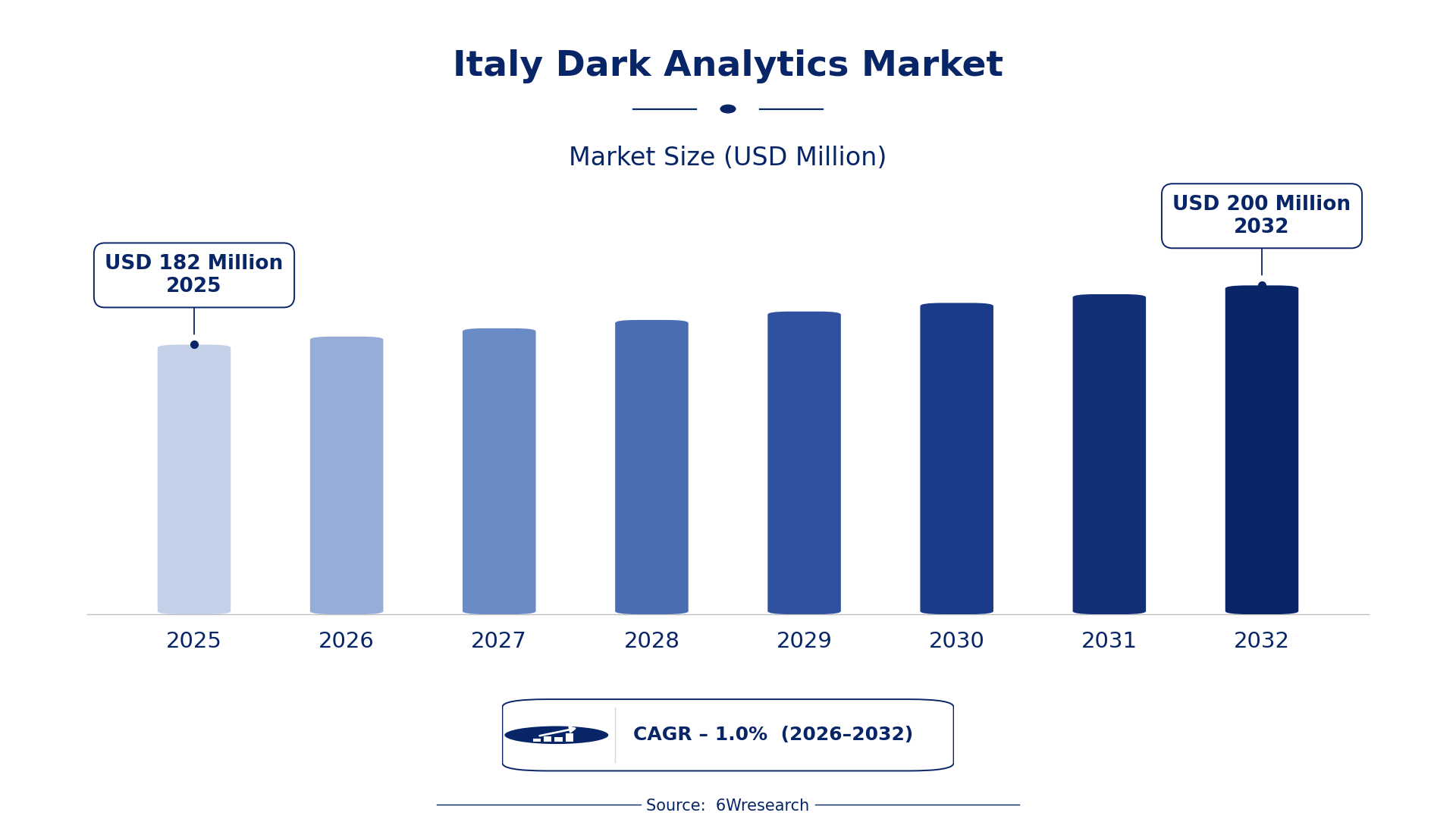
The Italy Dark Analytics Market was estimated at USD 182 Million in 2025 and is projected to reach USD 200 Million by 2032, growing at a CAGR of 1.0% from 2026 to 2032.
Italy Dark Analytics Market Synopsis
The Italy Dark Analytics Market has gained momentum in recent years, driven by organizations' growing recognition of the potential embedded in unstructured and hidden data. As businesses across various sectors, including finance and healthcare, embrace data-driven decision-making, the demand for dark analytics is expected to escalate.
Looking ahead, the market is set for further expansion as advancements in artificial intelligence and machine learning enhance analytical capabilities. The appetite for actionable insights from previously untapped data sources will catalyze this growth, making dark analytics an essential component of competitive strategy for Italian enterprises.
Italy Dark Analytics Market Year-wise Growth Rate and Key Drivers
This graph illustrates the annual growth rates of the Italy Dark Analytics Market from 2021 to 2032, highlighting a steady upward trajectory and projected expansion over the forecast period.
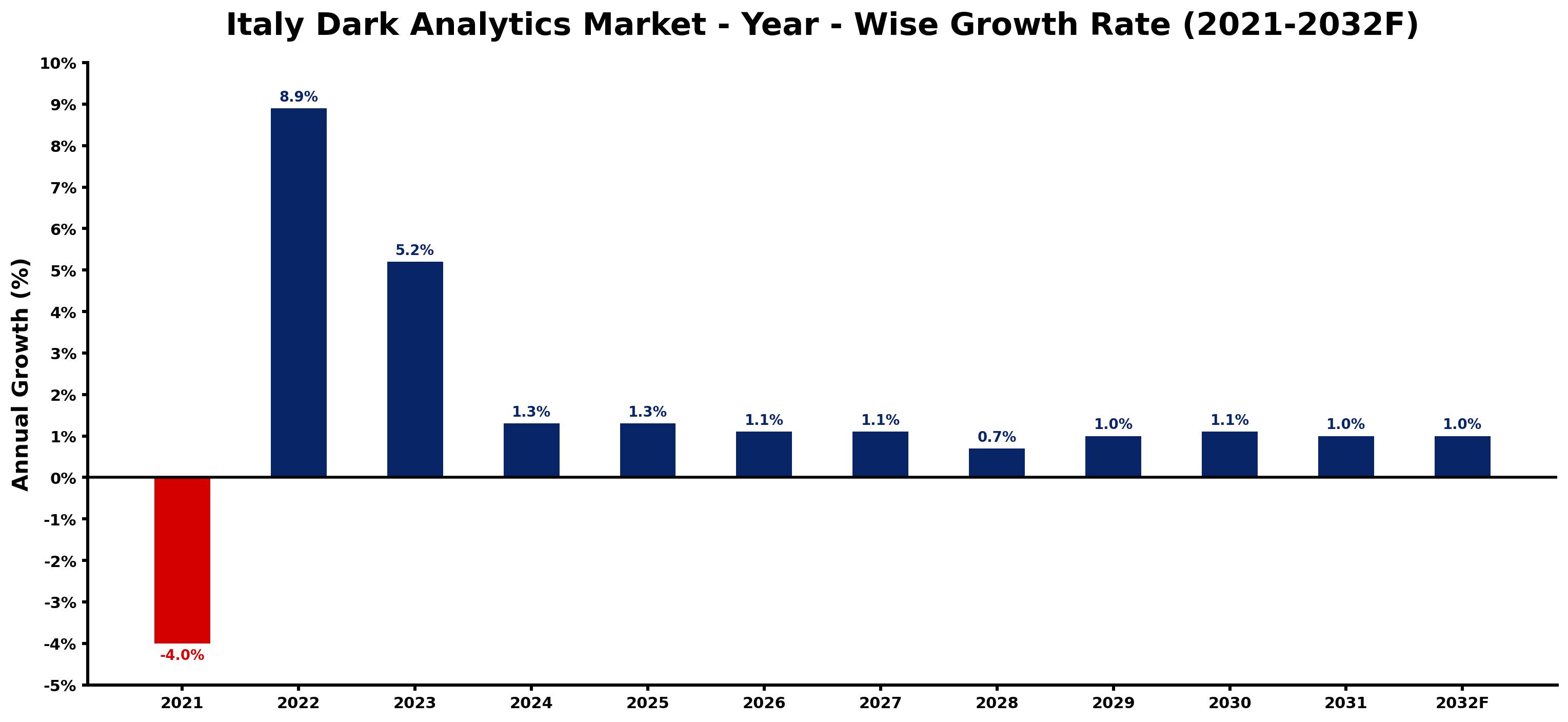
The table below presents the year‑wise growth rates along with the key drivers influencing the market
| Year | Growth Rate | Major Drivers |
| 2021 | -4.0% | GDPR compliance costs hindered analytics project funding. |
| 2022 | 8.9% | Emerging AI regulations from Garante Privacy Authority |
| 2023 | 5.2% | Investments in digital forensic capabilities by Italian enterprises |
| 2024 | 1.3% | Growing local adoption of machine learning technologies |
| 2025 | 1.3% | Increased funding for cybersecurity research in universities |
| 2026 | 1.1% | Rise in cyber threats prompting enhanced data analysis tools |
| 2027 | 1.1% | Regulatory requirements for improved data analytics practices |
| 2028 | 0.7% | Government incentives for businesses adopting dark analytics |
| 2029 | 1.0% | Shift towards comprehensive fraud detection mechanisms |
| 2030 | 1.1% | Breach of personal data driving forensic analytics demands |
| 2031 | 1.0% | Strengthening of legal frameworks around data breaches |
| 2032 | 1.0% | Growing interest in predictive analytics for risk management |
Note: Market size estimations and growth projections presented in this report are based on 6Wresearch's proprietary forecasting methodology, utilizing the latest available industry data, government publications, and primary research inputs.
Italy Dark Analytics Market Key Takeaways
Below are some of the specific key takeaways from the market, including:
- The market is driven by the increasing need for insights from unstructured data sources.
- Technologies like machine learning and natural language processing are at the forefront of this growth.
- Investment in advanced analytical tools is critical for companies looking to maintain a competitive edge.
- Data privacy and compliance with regulations like GDPR pose ongoing challenges.
- Collaboration with cybersecurity firms is essential for addressing risks associated with dark data.
Evaluation of Restraints in Italy Dark Analytics Market
Several factors limit the potential of the Italy Dark Analytics Market. Chief among these are the stringent data privacy regulations that companies must navigate, particularly the General Data Protection Regulation (GDPR). The sensitive nature of dark data presents risks that organizations must mitigate while attempting to glean insights.
on top of that, the absence of standardized methodologies for analyzing dark data makes it challenging for businesses to effectively harness its value. This lack of uniformity can lead to inefficiencies and missed opportunities, underscoring the need for strategic approaches that prioritize both innovation in analytics techniques and adherence to regulatory frameworks.
Italy Dark Analytics Market Trends
The demand for advanced analytical tools is on the rise as organizations increasingly recognize the value of dark data. Companies are investing in technologies that enable them to analyze unstructured data, including text, images, and videos, to enhance decision-making and operational efficiency.
The integration of artificial intelligence and machine learning is transforming the capabilities of dark analytics, allowing for sophisticated analysis of complex data sets. This shift not only boosts the accuracy of insights but also supports businesses in uncovering hidden opportunities that can drive growth.
Italy Dark Analytics Market Opportunities
Investment opportunities in the Italy Dark Analytics Market are particularly promising for organizations focused on cybersecurity and data analytics. The increasing volume of hidden data necessitates solutions that can extract insights and mitigate associated risks effectively.
By investing in advanced data mining technologies and machine learning capabilities, companies can enhance their cybersecurity posture and identify potential threats. Collaborating with local firms and tailoring solutions to meet the specific needs of Italian businesses will be crucial for maximizing growth in this sector.
Government Initiatives in the Italy Dark Analytics Market
The Italian government has actively shaped the dark analytics market through a framework that emphasizes data privacy and security. Regulatory measures are designed to protect sensitive information while promoting innovation in analytics technologies. This balanced approach is vital for fostering a thriving ecosystem for dark analytics.
- A national data protection regulation implemented in 2025 aims to enhance compliance standards for businesses utilizing dark analytics.
- Currently ongoing initiatives focus on funding research and development programs to boost innovation in analytics technologies.
- Planned public-private partnerships are set to roll out by 2028, aimed at enhancing data infrastructure across various sectors.
- A framework established in 2024 mandates transparency in the use of dark analytics tools, ensuring accountability in data practices.
Future Insights of the Italy Dark Analytics Market
Looking towards 2026-2032, the Italy Dark Analytics Market is expected to witness substantial growth as organizations increasingly prioritize data-driven strategies. The integration of advanced technologies will not only refine the analytical processes but also expand the potential applications of dark analytics across diverse sectors.
As companies adapt to the evolving regulatory landscape, investment in secure and efficient dark analytics solutions will be crucial. The focus on leveraging unstructured data for strategic decision-making will define the trajectory of this market, driving continued innovation and competitive advantage.
Italy Dark Analytics Market Latest Developments
In recent months, the Italy Dark Analytics Market has seen a surge in activity as organizations strive to capitalize on unstructured data. The push for enhanced analytical capabilities is evident as businesses invest in new technologies and partnerships to better leverage dark data.
- A major technology vendor launched a new dark analytics platform in early 2025, designed to streamline the extraction of insights from unstructured data.
- Current projects are focused on integrating machine learning algorithms into existing analytics frameworks, aimed at enhancing predictive capabilities.
- Upcoming initiatives planned for late 2025 involve partnerships with local universities to advance research in dark data analytics.
- An ongoing collaboration between analytics firms and cybersecurity experts aims to develop tools that address data privacy concerns while maximizing the utility of dark data.
Italy Dark Analytics Market - Key Attractiveness of the Report
- 10 Years of Market Numbers
- Historical Data Starting from 2022 to 2025
- Base Year: 2025
- Forecast Data until 2032
- Key Performance Indicators Impacting the Market
- Major Upcoming Developments and Projects
Key Highlights of the Report:
- Italy Dark Analytics Market Outlook
- Market Size of Italy Dark Analytics Market, 2025
- Forecast of Italy Dark Analytics Market, 2032
- Historical Data and Forecast of Italy Dark Analytics Revenues & Volume for the Period 2022-2032F
- Italy Dark Analytics Market Trend Evolution
- Italy Dark Analytics Market Drivers and Challenges
- Italy Dark Analytics Price Trends
- Italy Dark Analytics Porter's Five Forces
- Italy Dark Analytics Industry Life Cycle
- Historical Data and Forecast of Italy Dark Analytics Market Revenues & Volume By Component for the Period 2022-2032F
- Historical Data and Forecast of Italy Dark Analytics Market Revenues & Volume By Solutions for the Period 2022-2032F
- Historical Data and Forecast of Italy Dark Analytics Market Revenues & Volume By Services for the Period 2022-2032F
- Historical Data and Forecast of Italy Dark Analytics Market Revenues & Volume By Business Application for the Period 2022-2032F
- Historical Data and Forecast of Italy Dark Analytics Market Revenues & Volume By Marketing for the Period 2022-2032F
- Historical Data and Forecast of Italy Dark Analytics Market Revenues & Volume By Operations for the Period 2022-2032F
- Historical Data and Forecast of Italy Dark Analytics Market Revenues & Volume By Finance for the Period 2022-2032F
- Historical Data and Forecast of Italy Dark Analytics Market Revenues & Volume By Human Resource (HR) for the Period 2022-2032F
- Historical Data and Forecast of Italy Dark Analytics Market Revenues & Volume By Deployment Mode for the Period 2022-2032F
- Historical Data and Forecast of Italy Dark Analytics Market Revenues & Volume By Cloud for the Period 2022-2032F
- Historical Data and Forecast of Italy Dark Analytics Market Revenues & Volume By On-premises for the Period 2022-2032F
- Historical Data and Forecast of Italy Dark Analytics Market Revenues & Volume By Vertical for the Period 2022-2032F
- Historical Data and Forecast of Italy Dark Analytics Market Revenues & Volume By Retail & E-commerce for the Period 2022-2032F
- Historical Data and Forecast of Italy Dark Analytics Market Revenues & Volume By BFSI for the Period 2022-2032F
- Historical Data and Forecast of Italy Dark Analytics Market Revenues & Volume By Healthcare for the Period 2022-2032F
- Historical Data and Forecast of Italy Dark Analytics Market Revenues & Volume By Travel & Hospitality for the Period 2022-2032F
- Historical Data and Forecast of Italy Dark Analytics Market Revenues & Volume By Government for the Period 2022-2032F
- Historical Data and Forecast of Italy Dark Analytics Market Revenues & Volume By Telecommunication for the Period 2022-2032F
- Historical Data and Forecast of Italy Dark Analytics Market Revenues & Volume By Others for the Period 2022-2032F
- Italy Dark Analytics Import Export Trade Statistics
- Market Opportunity Assessment By Component
- Market Opportunity Assessment By Business Application
- Market Opportunity Assessment By Deployment Mode
- Market Opportunity Assessment By Vertical
- Italy Dark Analytics Top Companies Market Share
- Italy Dark Analytics Competitive Benchmarking By Technical and Operational Parameters
- Italy Dark Analytics Company Profiles
- Italy Dark Analytics Key Strategic Recommendations






































