Italy Energy Security Market Size & Growth Rate (2026-2032)
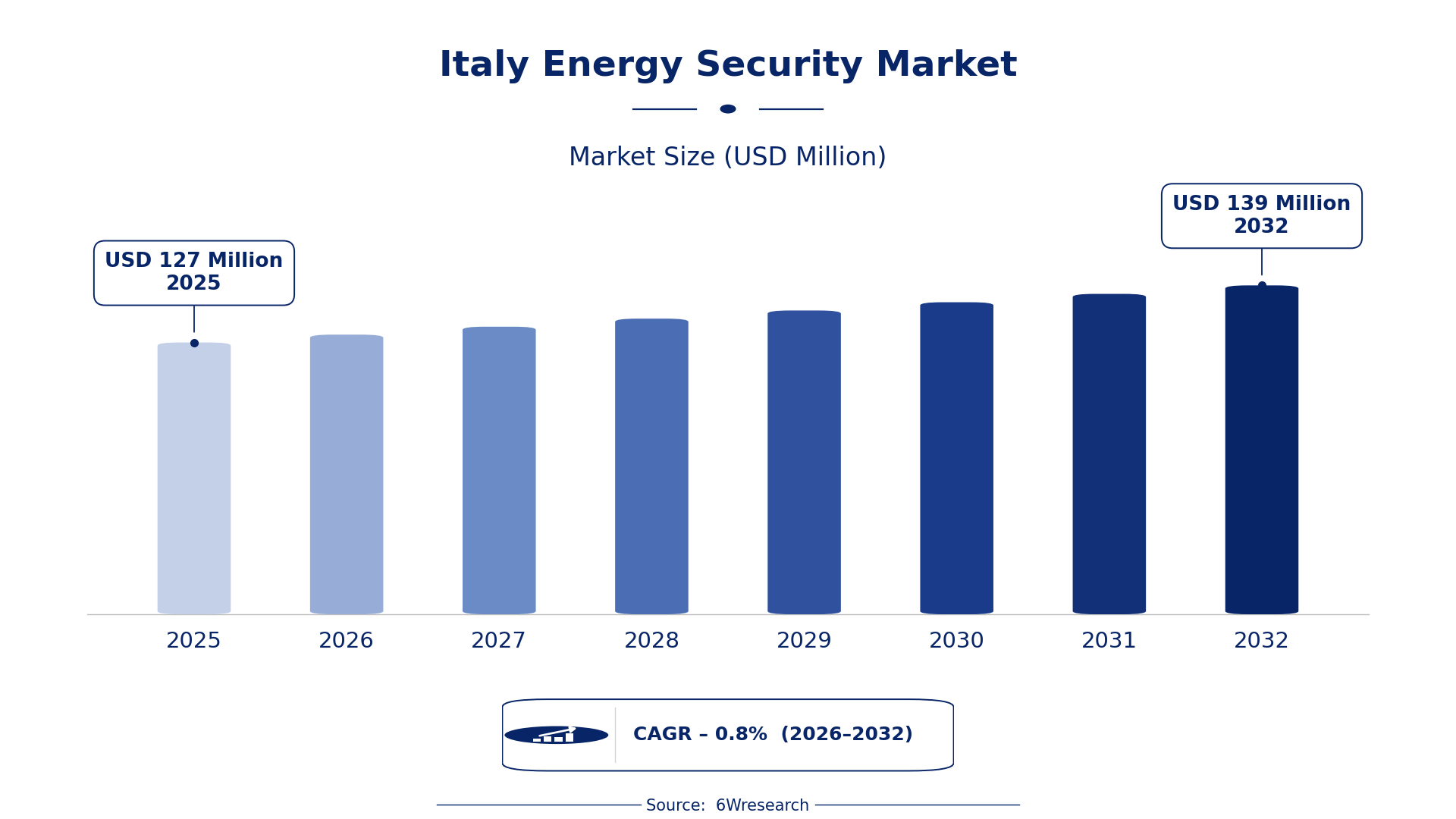
The Italy Energy Security Market was estimated at USD 127 Million in 2025 and is projected to reach USD 139 Million by 2032, growing at a CAGR of 0.8% from 2026 to 2032.
Italy Energy Security Market Synopsis
A primary force reshaping the Italy Energy Security Market is the country's intensified commitment to renewable energy. This drive is not merely an environmental consideration; it’s a strategic move to secure energy independence and bolster national resilience against supply disruptions. The focus on diversifying energy sources is apparent in Italy's policies that encourage investments in renewables, coupled with enhancements in energy efficiency.
Italy's energy security strategy is increasingly aligned with regional cooperation initiatives that aim to create a unified and resilient energy framework. This includes diversifying gas supply routes and ensuring strategic reserves of oil. As sustainability takes center stage, Italy's approach reflects a broader ambition to transition into a cleaner energy future, directly impacting its energy security landscape.
Italy Energy Security Market Year-wise Growth Rate and Key Drivers
This graph illustrates the annual growth rates of the Italy Energy Security Market from 2021 to 2032, highlighting a steady upward trajectory and projected expansion over the forecast period.
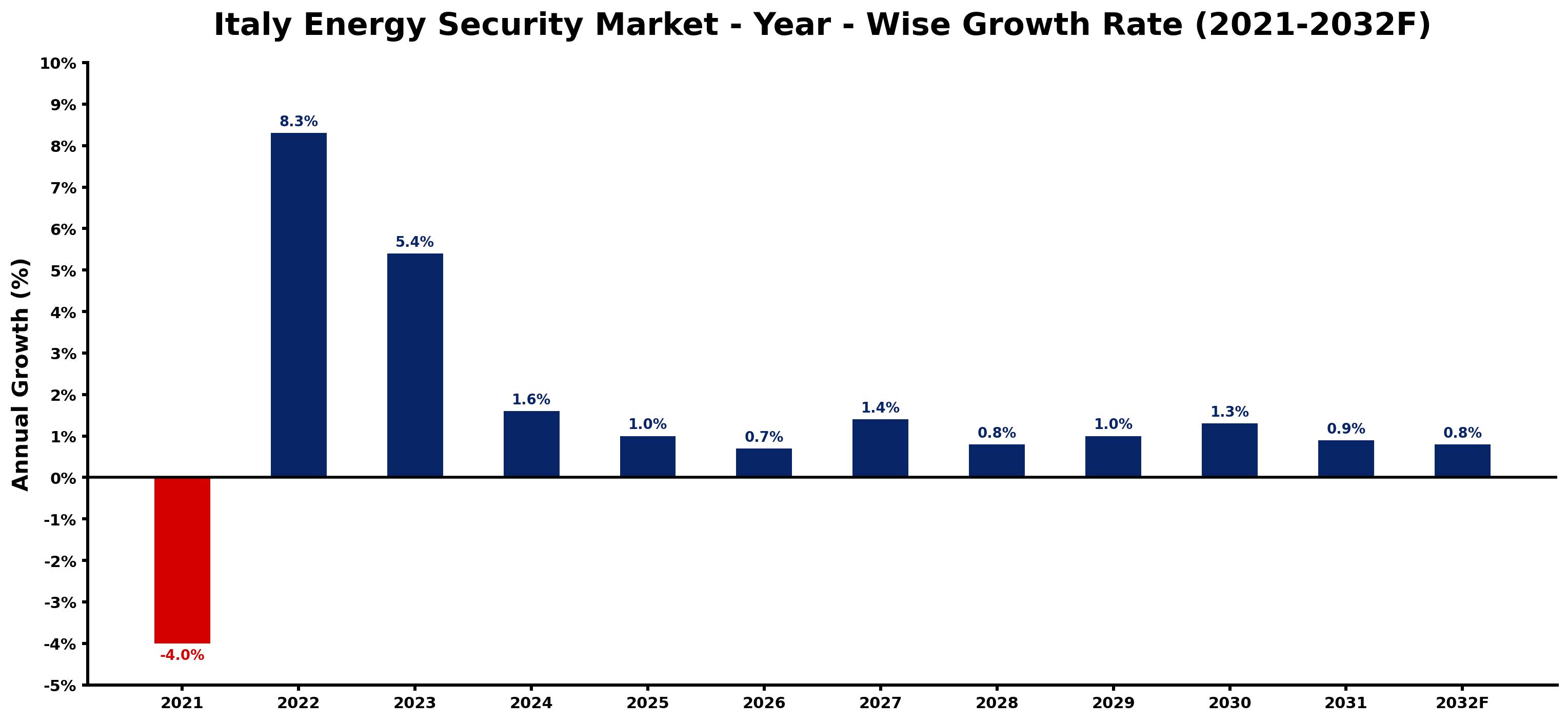
The table below presents the year‑wise growth rates along with the key drivers influencing the market
| Year | Growth Rate | Major Drivers |
| 2021 | -4.0% | Implementation delays of NECP by Italian Ministry |
| 2022 | 8.3% | Increased investments in energy storage solutions by ENEL. |
| 2023 | 5.4% | Government subsidies for solar energy adoption in households. |
| 2024 | 1.6% | High demand for energy efficiency driven by EU regulations. |
| 2025 | 1.0% | Emerging geothermal projects initiated by regional authorities. |
| 2026 | 0.7% | Strengthened regulatory framework for energy resilience improvements. |
| 2027 | 1.4% | Revamped energy security measures due to climate threats. |
| 2028 | 0.8% | Rising public awareness about energy independence initiatives. |
| 2029 | 1.0% | Implementation of smart grid technologies by distribution companies. |
| 2030 | 1.3% | Active participation in EU energy transition programs. |
| 2031 | 0.9% | Increased installations of offshore wind facilities along coast. |
| 2032 | 0.8% | Local investments in hydrogen fuel projects gain momentum. |
Note: Market size estimations and growth projections presented in this report are based on 6Wresearch's proprietary forecasting methodology, utilizing the latest available industry data, government publications, and primary research inputs.
Italy Energy Security Market Key Takeaways
Below are some of the specific key takeaways from the market, including:
- Renewable energy investments are the cornerstone of Italy's strategy to enhance energy independence.
- Energy efficiency measures are being prioritized to optimize consumption and reduce reliance on imported fuels.
- Government policies are aggressively promoting the development of alternative energy sources.
- Cybersecurity measures are gaining importance to protect critical energy infrastructure.
- Investment opportunities are plentiful in renewable technologies and energy storage solutions.
Evaluation of Restraints in Italy Energy Security Market
Despite the progress made, the Italy Energy Security Market faces considerable restraints. A significant challenge lies in the nation’s reliance on imported energy, particularly natural gas, which exposes Italy to geopolitical tensions and price volatility. Regulatory uncertainties can impede investments in domestic energy production, creating hesitation among stakeholders. Additionally, integrating intermittent renewable sources like wind and solar into the grid complicates efforts to maintain stability and reliability in the energy supply, underscoring the complexities of transitioning toward a more diversified energy system.
Italy Energy Security Market Trends
Shifting focus towards renewables is a key trend influencing the Italy Energy Security Market. The government is implementing various policies aimed at reducing carbon emissions and fostering energy independence through significant investments in solar and wind technologies. on top of that, the rise of energy storage solutions is critical for ensuring a consistent and reliable power supply, particularly as the integration of renewable sources becomes more pronounced.
Cybersecurity has also entered the spotlight, with increased emphasis on safeguarding the energy infrastructure from cyber threats. This growing awareness is driving investments in advanced technologies to bolster security and resilience, as Italy navigates the dual challenges of transitioning to cleaner energy while ensuring a reliable supply chain.
Italy Energy Security Market Opportunities
Opportunities abound within the Italy Energy Security Market, particularly in the renewable energy sector. With government initiatives promoting the reduction of fossil fuel dependence, projects in solar, wind, and hydroelectric power generation are highly attractive. The development of energy-efficient technologies, including smart grids and demand-side management solutions, presents further prospects for optimizing energy usage and cost reduction.
Infrastructure upgrades, particularly in transmission and distribution networks, offer a pathway for enhancing energy reliability and security. Investors focusing on these areas are likely to find favorable conditions as Italy progresses toward a more sustainable energy framework.
Government Initiatives in the Italy Energy Security Market
Italian government policies are heavily focused on bolstering energy security through a mix of legislative and regulatory initiatives. By promoting renewable energy and enhancing energy efficiency, the government aims to create a more self-sufficient energy ecosystem. Such strategic priorities are crucial for addressing energy security concerns in light of Italy's high import dependence and environmental commitments.
- A recently completed initiative introduced a set of regulations aimed at increasing the share of renewables in the energy mix, supporting solar and wind energy projects.
- A current program is underway to enhance energy efficiency in buildings, targeting significant reductions in energy consumption across urban centers.
- Planned policies include incentives for energy storage development, aimed at improving grid stability and integrating renewable sources more effectively.
- The government has launched initiatives to promote regional cooperation in energy supply diversification, enhancing resilience against supply disruptions.
- Ongoing regulatory reforms are addressing billing transparency in energy consumption, aimed at increasing consumer awareness and encouraging energy-saving practices.
Future Insights of the Italy Energy Security Market
Looking ahead to 2026-2032, the Italy Energy Security Market appears set for growth, bolstered by ongoing diversification of energy sources and a heightened commitment to renewable energy. With the government's proactive stance on reducing reliance on imported fuels and increasing domestic production, the landscape is ripe for innovations in energy technology and infrastructure upgrades. The emphasis on clean energy investments and integrated energy solutions will likely propel Italy toward a more resilient and environmentally friendly energy future.
Italy Energy Security Market Latest Developments
The past year has been characterized by significant developments within the Italy Energy Security Market. As the country pushes toward a greener energy portfolio, various initiatives and collaborations are emerging, all aimed at enhancing energy security and efficiency. These movements reflect a broader trend in Italy’s energy policies and are indicative of the nation's strategic ambitions in both renewables and efficiency.
- A major technology vendor launched a new energy management platform designed to optimize energy efficiency in industrial applications, currently underway as of Q3 2025.
- A leading regional operator completed the installation of a series of solar farms in Southern Italy, enhancing local energy generation capabilities by mid-2025.
- An initiative focused on improving cybersecurity measures for energy infrastructure began implementation in early 2025, aiming to protect critical assets from potential threats.
- A new public-private partnership aimed at advancing research into energy storage technologies is expected to commence in early 2026, with significant potential for innovation.
- A planned upgrade to national transmission networks is set to begin in late 2025, expected to significantly enhance the reliability of electricity supply.
Italy Energy Security Market - Key Attractiveness of the Report
- 10 Years of Market Numbers
- Historical Data Starting from 2022 to 2025
- Base Year: 2025
- Forecast Data until 2032
- Key Performance Indicators Impacting the Market
- Major Upcoming Developments and Projects
Key Highlights of the Report:
- Italy Energy Security Market Outlook
- Market Size of Italy Energy Security Market, 2025
- Forecast of Italy Energy Security Market, 2032
- Historical Data and Forecast of Italy Energy Security Revenues & Volume for the Period 2022-2032F
- Italy Energy Security Market Trend Evolution
- Italy Energy Security Market Drivers and Challenges
- Italy Energy Security Price Trends
- Italy Energy Security Porter's Five Forces
- Italy Energy Security Industry Life Cycle
- Historical Data and Forecast of Italy Energy Security Market Revenues & Volume By Power Plants for the Period 2022-2032F
- Historical Data and Forecast of Italy Energy Security Market Revenues & Volume By Nuclear for the Period 2022-2032F
- Historical Data and Forecast of Italy Energy Security Market Revenues & Volume By Thermal for the Period 2022-2032F
- Historical Data and Forecast of Italy Energy Security Market Revenues & Volume By Hydro for the Period 2022-2032F
- Historical Data and Forecast of Italy Energy Security Market Revenues & Volume By Oil for the Period 2022-2032F
- Historical Data and Forecast of Italy Energy Security Market Revenues & Volume By Gas for the Period 2022-2032F
- Historical Data and Forecast of Italy Energy Security Market Revenues & Volume By Renewable Energy for the Period 2022-2032F
- Historical Data and Forecast of Italy Energy Security Market Revenues & Volume By Technologies for the Period 2022-2032F
- Historical Data and Forecast of Italy Energy Security Market Revenues & Volume By Physical for the Period 2022-2032F
- Historical Data and Forecast of Italy Energy Security Market Revenues & Volume By Network Security for the Period 2022-2032F
- Italy Energy Security Import Export Trade Statistics
- Market Opportunity Assessment By Power Plants
- Market Opportunity Assessment By Technologies
- Italy Energy Security Top Companies Market Share
- Italy Energy Security Competitive Benchmarking By Technical and Operational Parameters
- Italy Energy Security Company Profiles
- Italy Energy Security Key Strategic Recommendations






































