Italy Formaldehyde Market Size (2020-2030)
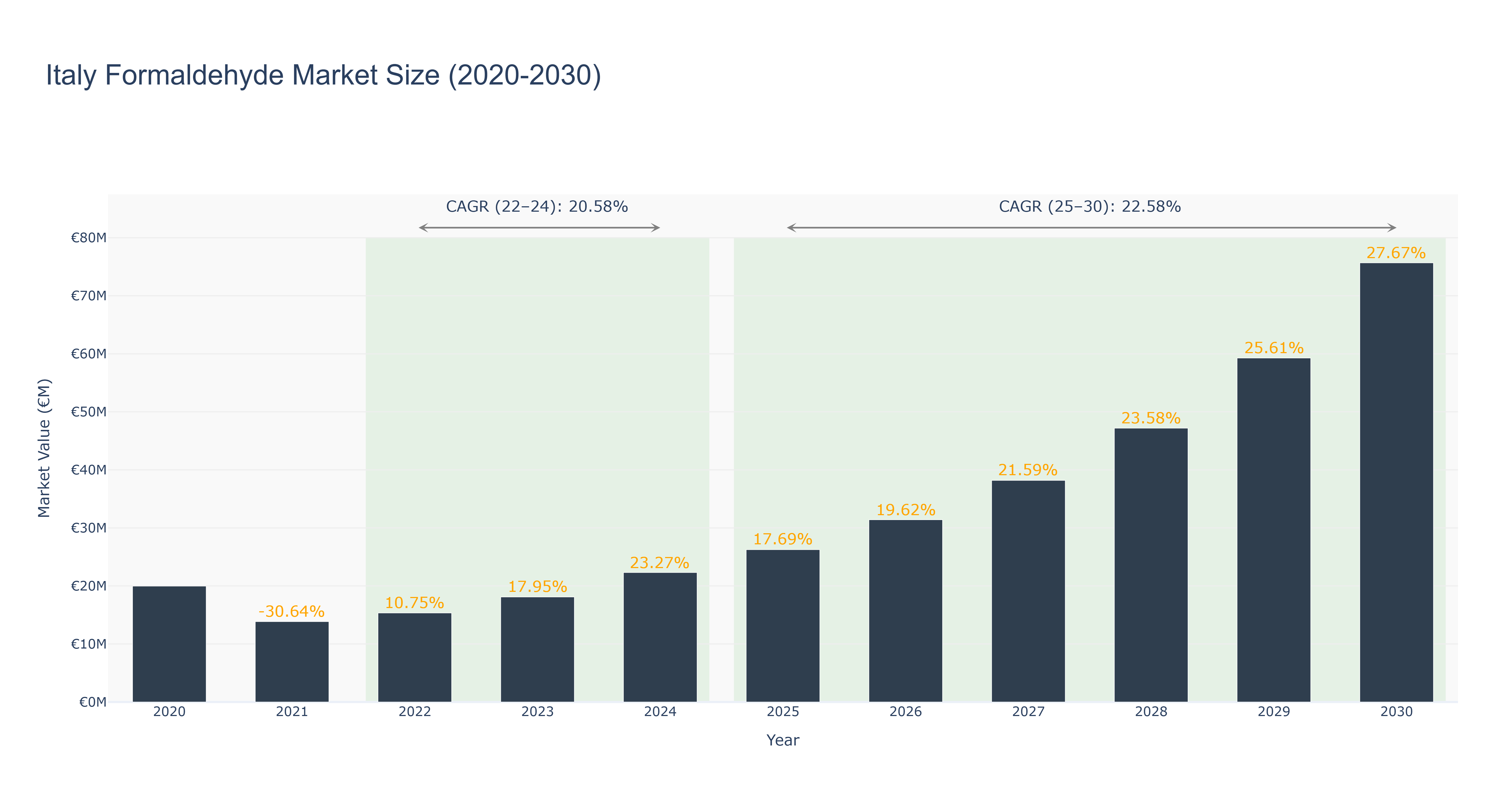
Italy's Formaldehyde Market has shown a steady growth trajectory over the past decade. The peak market size of €75.68 million was achieved in 2030, reflecting a strong upward trend. From 2020 to 2024, the market size increased from €19.98 million to €22.31 million, driven by consistent demand and industrial expansion. Looking ahead, the forecasted market size from 2025 to 2030 is expected to reach €59.27 million in 2029, showcasing a robust growth potential. The CAGR values for the periods 2022-24 and 2025-30 are 20.58% and 22.58%, respectively, indicating sustained growth momentum. Industry drivers such as increasing applications in construction and automotive sectors are fueling this growth. In the near future, Italy's Formaldehyde Market is set to witness advancements in sustainable production practices to meet environmental regulations and cater to eco-conscious consumers.
Italy Formaldehyde Market: Production & Trade Performance (2019-2025)
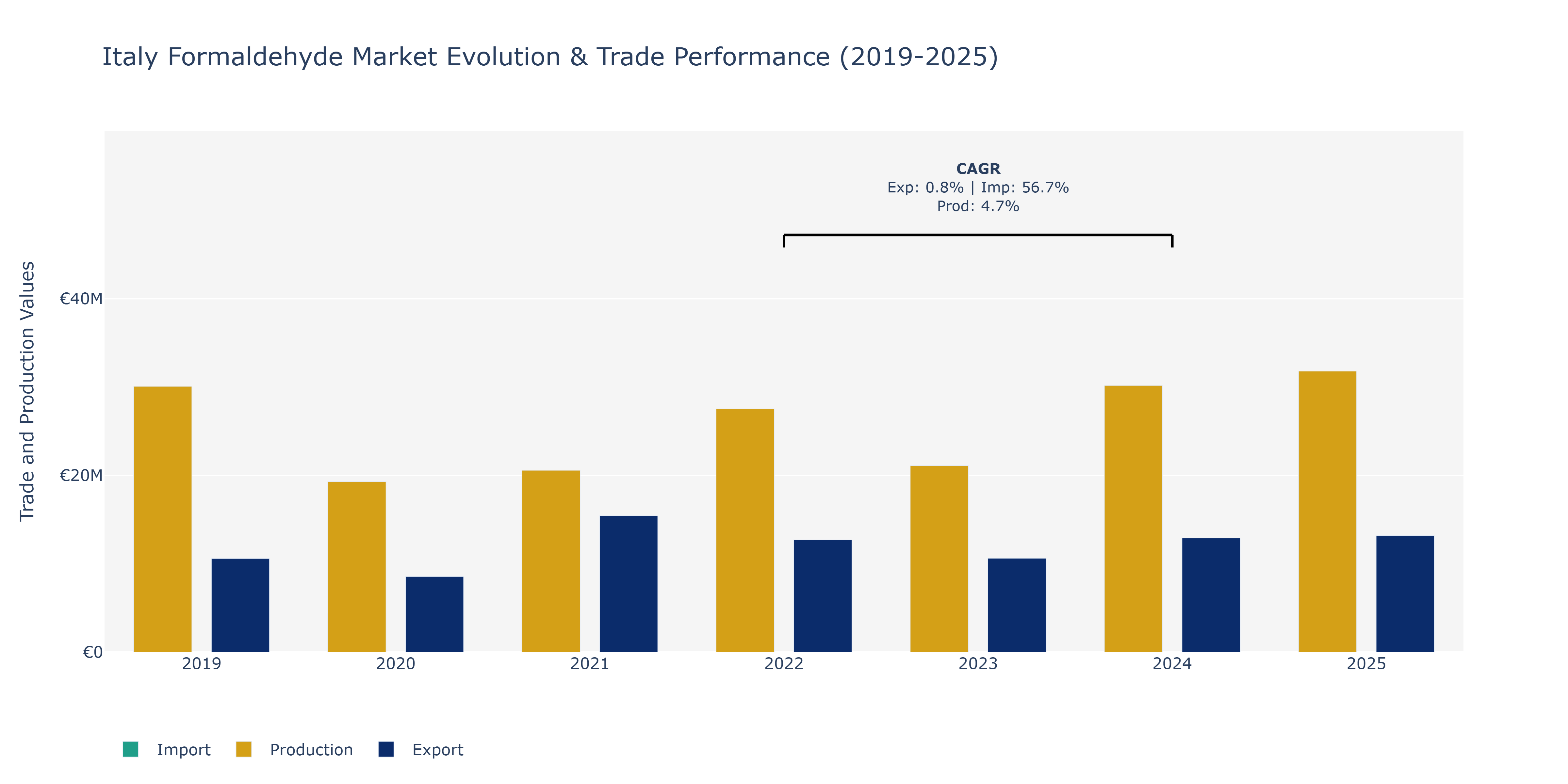
Between 2019 and 2025, Italy's Formaldehyde market experienced varied trends in Exports, Imports, and Production. Exports showed a decline from €10.59 million in 2019 to €8.55 million in 2020, followed by a recovery and an increase to €15.42 million in 2021, indicating market volatility. The peak export value of €13.2 million was observed in 2025. Imports fluctuated, with a notable peak of €10.35 million in 2025, showcasing an upward trajectory from €3.75 million in 2019. Production demonstrated an overall positive trend, with a peak in 2025 reaching €31.81 million from €30.08 million in 2019. The surge in imports in 2025 could be attributed to increased demand for raw materials or advanced technologies in the formaldehyde production process. Italy's growing focus on sustainable manufacturing and stringent regulations could have influenced the rising production levels, aligning with global sustainability initiatives driving the market forward.
Italy Formaldehyde Market Synopsis
The formaldehyde market in Italy is expanding, driven by its use in the production of resins, adhesives, and various chemical intermediates. Formaldehyde is a key component in many industrial processes. The market benefits from the demand in construction, automotive, and furniture industries, which utilize formaldehyde-based products.
Drivers of the market
The Italy Formaldehyde Market is experiencing growth due to its widespread use as a key chemical intermediate in various industries such as construction, automotive, and textiles. Formaldehyde is utilized in the production of resins, adhesives, and coatings, driving its demand for manufacturing processes, building materials, and consumer products.
Challenges of the market
In the Italy Formaldehyde Market, manufacturers face significant regulatory and environmental challenges. The use of formaldehyde is highly regulated due to its toxic and potentially carcinogenic properties, leading to strict controls on its production, handling, and use. Compliance with these regulations necessitates substantial investment in safety measures and monitoring systems. Additionally, there is growing consumer and industrial demand for safer, more sustainable alternatives to formaldehyde, which pressures manufacturers to innovate and develop new products. This shift also poses a challenge in terms of transitioning existing manufacturing processes to accommodate new materials without compromising efficiency or performance.
Government Policy of the market
In Italy, government policies aim to regulate the formaldehyde market to protect public health and the environment. Measures include emission standards for formaldehyde-producing industries, regulations on formaldehyde content in consumer products, and incentives for companies to adopt alternative, less harmful manufacturing processes.
Key Highlights of the Report:
- Italy Formaldehyde Market Outlook
- Market Size of Italy Formaldehyde Market, 2024
- Forecast of Italy Formaldehyde Market, 2031
- Historical Data and Forecast of Italy Formaldehyde Revenues & Volume for the Period 2018 - 2031
- Italy Formaldehyde Market Trend Evolution
- Italy Formaldehyde Market Drivers and Challenges
- Italy Formaldehyde Price Trends
- Italy Formaldehyde Porter's Five Forces
- Italy Formaldehyde Industry Life Cycle
- Historical Data and Forecast of Italy Formaldehyde Market Revenues & Volume By Application for the Period 2018 - 2031
- Historical Data and Forecast of Italy Formaldehyde Market Revenues & Volume By Resins for the Period 2018 - 2031
- Historical Data and Forecast of Italy Formaldehyde Market Revenues & Volume By Fibers for the Period 2018 - 2031
- Historical Data and Forecast of Italy Formaldehyde Market Revenues & Volume By Solvents for the Period 2018 - 2031
- Historical Data and Forecast of Italy Formaldehyde Market Revenues & Volume By Plasticizers for the Period 2018 - 2031
- Historical Data and Forecast of Italy Formaldehyde Market Revenues & Volume By Drying Agents for the Period 2018 - 2031
- Historical Data and Forecast of Italy Formaldehyde Market Revenues & Volume By Other Chemical Intermediates for the Period 2018 - 2031
- Historical Data and Forecast of Italy Formaldehyde Market Revenues & Volume By Derivative for the Period 2018 - 2031
- Historical Data and Forecast of Italy Formaldehyde Market Revenues & Volume By Urea-formaldehyde Resin for the Period 2018 - 2031
- Historical Data and Forecast of Italy Formaldehyde Market Revenues & Volume By Phenol Formaldehyde Resin for the Period 2018 - 2031
- Historical Data and Forecast of Italy Formaldehyde Market Revenues & Volume By Polyoxymethylene for the Period 2018 - 2031
- Historical Data and Forecast of Italy Formaldehyde Market Revenues & Volume By Melamine Formaldehyde Resin for the Period 2018 - 2031
- Historical Data and Forecast of Italy Formaldehyde Market Revenues & Volume By Pentaerythritol for the Period 2018 - 2031
- Historical Data and Forecast of Italy Formaldehyde Market Revenues & Volume By Methylene Diphenyl Diisocyanate for the Period 2018 - 2031
- Historical Data and Forecast of Italy Formaldehyde Market Revenues & Volume By Hexamethylenetetramine for the Period 2018 - 2031
- Historical Data and Forecast of Italy Formaldehyde Market Revenues & Volume By Others for the Period 2018 - 2031
- Historical Data and Forecast of Italy Formaldehyde Market Revenues & Volume By End-Use for the Period 2018 - 2031
- Historical Data and Forecast of Italy Formaldehyde Market Revenues & Volume By Chemicals for the Period 2018 - 2031
- Historical Data and Forecast of Italy Formaldehyde Market Revenues & Volume By Agriculture for the Period 2018 - 2031
- Historical Data and Forecast of Italy Formaldehyde Market Revenues & Volume By Building & Construction for the Period 2018 - 2031
- Historical Data and Forecast of Italy Formaldehyde Market Revenues & Volume By Personal Care & Cosmetics for the Period 2018 - 2031
- Historical Data and Forecast of Italy Formaldehyde Market Revenues & Volume By Healthcare for the Period 2018 - 2031
- Historical Data and Forecast of Italy Formaldehyde Market Revenues & Volume By Automotive for the Period 2018 - 2031
- Historical Data and Forecast of Italy Formaldehyde Market Revenues & Volume By Others for the Period 2018 - 2031
- Italy Formaldehyde Import Export Trade Statistics
- Market Opportunity Assessment By Application
- Market Opportunity Assessment By Derivative
- Market Opportunity Assessment By End-Use
- Italy Formaldehyde Top Companies Market Share
- Italy Formaldehyde Competitive Benchmarking By Technical and Operational Parameters
- Italy Formaldehyde Company Profiles
- Italy Formaldehyde Key Strategic Recommendations






































