Italy Hair Care Market: Import Trend Analysis
In 2024, Italy hair care Market: Import Trend Analysis witnessed a notable uptick in imports. The trend indicated a growing preference for international hair care products among Italian consumers. This surge in imports potentially influenced the competitive landscape of the domestic Market: Import Trend Analysis.
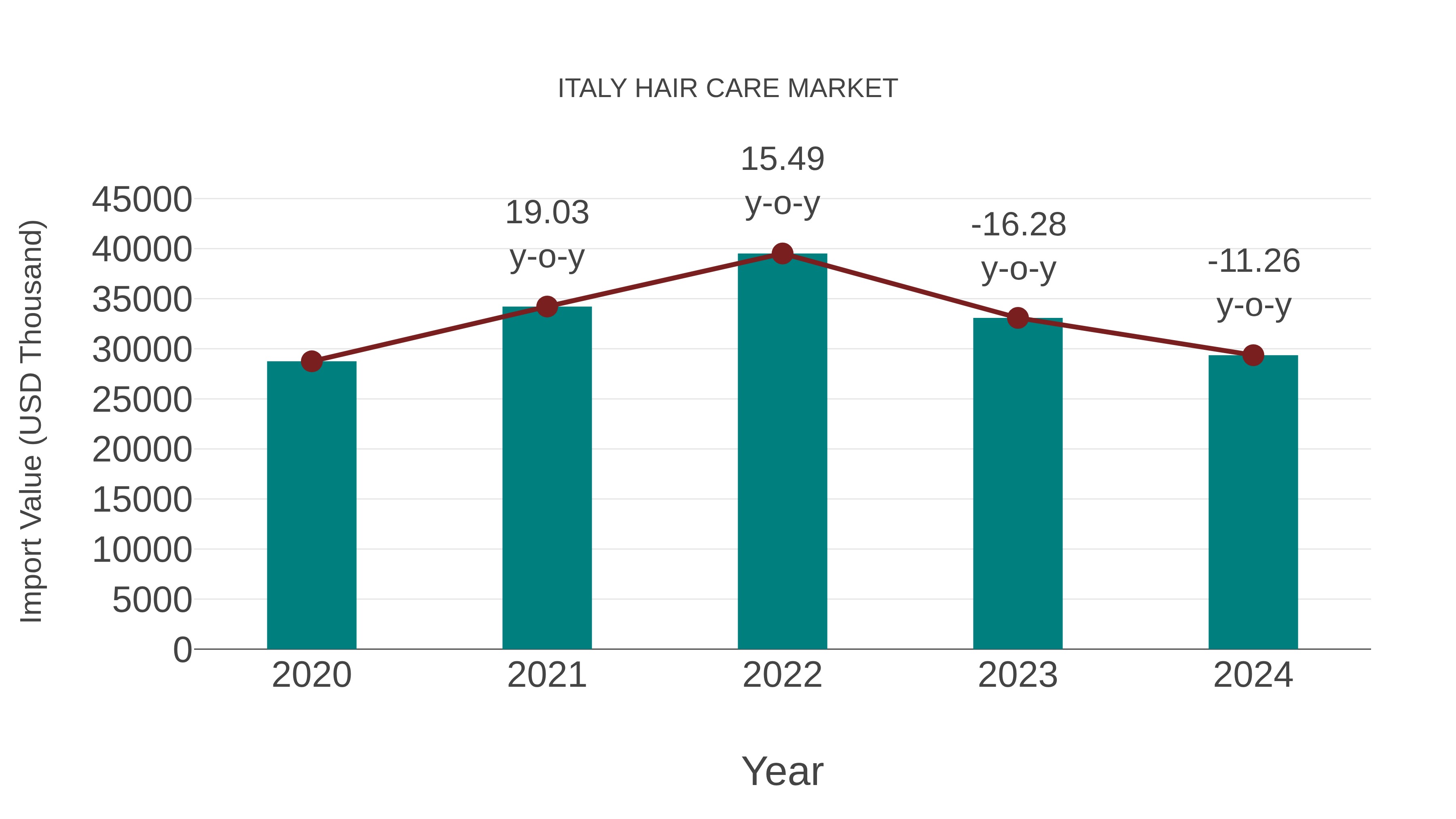
Italy Hair Care Market Growth Rate
According to 6Wresearch internal database and industry insights, the Italy Hair Care Market is projected to grow at a compound annual growth rate (CAGR) of 4.7% during the forecast period from 2026 to 2032.
Topics Covered in the Italy Hair Care Market Report
The India Hair Oil Market report covers the market comprehensively by Type, Product Type and Distribution Channel. The report provides a detailed and unbiased analysis of the ongoing market trends, opportunities, challenges, and market drivers, assisting stakeholders in aligning strategies with current and future market dynamics.
Italy Hair Care Market Highlights
| Report Name | Italy Hair Care Market |
| Forecast period | 2026-2032 |
| CAGR | 4.7% |
| Growing Sector | Personal Care |
Italy Hair Care Market Synopsis
The Italy Hair Care Market has been experiencing a steady growth as it has been driven by increasing consumer awareness of hair health and the growing popularity of premium and natural hair care products. With a significant focus on quality, sustainability, and organic ingredients, consumers in Italy are increasingly looking for products that meet their specific hair care needs. The growth of online shopping and the demand for salon-grade professional products are likely to boost the market forward.
Evaluation of Growth Drivers in the Italy Hair Care Market
Below mentioned are some major drivers and their impact on the Italy Hair Care Market dynamics:
| Drivers | Primary Segment Affected | Why It Matters (Evidence) |
| Rising Awareness about Hair Health | By Product Type (Shampoos, Conditioners, Hair Oils) | As consumers become more health-conscious, they prefer products that promote hair vitality. |
| Demand for Natural and Organic Products | By Product Type (Shampoos, Conditioners, Hair Oils) | Country’s growing preference for eco-friendly, organic products increases demand for natural ingredients. |
| Increasing Disposable Income | By Product Type (Premium Hair Care Products) | There is a higher disposable income, which allows consumers to invest in premium hair care brands |
| E-commerce Growth | By Distribution Channel (Online Retail Stores) | The rise in online shopping provides consumers with easy access to a variety of hair care products, especially for those seeking professional brands. |
| Focus on Sustainable Beauty | By Product Type (Shampoos, Conditioners) | The increasing demand for sustainable packaging is encouraging brands to offer eco-friendly hair care solutions. |
The Italy Hair Care Market is expected to grow at a CAGR of 4.7% during the forecast period from 2026–2032. This growth is backed by the increasing awareness about the benefits of organic hair care, combined with higher spending power and the rise in disposable income that allows consumers to invest in premium, salon-grade products. Also, the expanding e-commerce sector makes hair care products more accessible. Celebrity endorsements and social media influence play an important role in shaping consumer preferences, fueling demand for high-quality, innovative hair care products.
Restraints in the Italy Hair Care Market
Below mentioned are some major restraints and their influence on the Italy Hair Care Market dynamics:
| Restraints | Primary Segment Affected | What This Means (Evidence) |
| High Competition from International Brands | By Product Type (Shampoos, Hair Styling Products) | Global brands offering lower-priced products challenge local brands, which makes it harder for smaller companies to compete. |
| Instable Raw Material Prices | By Product Type (Shampoos, Hair Oils, Conditioners) | Price changes of ingredients like essential oils and botanicals can hamper profit margins for manufacturers. |
| Regulatory Difficulties | By Product Type (Hair Color, Shampoos) | Strict EU regulations on product formulation and safety may limit ingredient use, slowing innovation. |
| Environmental Sustainability Pressures | By Product Type (All Products) | Increasing demand for sustainable packaging needs manufacturers to invest in eco-friendly solutions. |
| Supply Chain and Distribution Challenges | By Distribution Channel (Online Stores, Hypermarkets) | There are delays in logistics, which can affect the timely supply of products. |
Challenges in the Italy Hair Care Market
Despite a positive outlook for the market, it has a number of challenges, which include stiff competition from global brands that offer more affordable products and the high costs associated with sourcing natural and organic ingredients. Regulatory constraints, especially within the EU, also affect the ability to innovate with certain ingredients. Also, the rising pressure to adopt sustainable practices adds costs that can affect profit margins. Supply chain disruptions and rising logistics costs further compound these issues.
Trends Shaping the Italy Hair Care Market
Here are the following key trends that fuel the Germany Hair Care Market growth:
- Personalized Hair Care Solutions: Customized hair care products are in high demand, with customers looking for solutions that are specific to their hair types and concerns.
- Surge of Natural and Organic Products: Consumers are facing some issues while using chemical-based products, hence they are now increasingly spending on natural, organic, and cruelty-free hair care products.
- Hair Care for Men: There is an increasing demand for specialized men's hair care products, particularly in the categories of hair styling, scalp care, and beard grooming. This trend is fueled by a growing acceptance of grooming products among male consumers.
Major Investment Opportunities in the Italy Hair Care Market
Below mentioned are some major investment opportunities in the market:
- Sustainable and Eco-Friendly Products: Investing in the development of natural and sustainable hair care solutions, including biodegradable packaging, organic ingredients, and cruelty-free formulations, provides an opportunity for brands to meet environmentally conscious consumers.
- An Expansion of E-commerce Channels: As online shopping continues to grow, investing in digital platforms and direct-to-consumer sales models provides potential for reaching a broader audience.
- Men’s Grooming Products: Working men are now shifting towards grooming factor, especially in urban areas, which opens up opportunities to create specialized hair care products for male consumers, such as hair styling products and beard care solutions.
Top 5 Leading Players in the Italy Hair Care Market
Here are some top companies contributing to the Italy Hair Care Market share:
L'Oréal Italia
| Company Name | L'Oréal Italia |
| Established Year | 1909 (Italy operations since early 20th century) |
| Headquarters | Milan, Italy (Global: Clichy, France) |
| Official Website | Click Here |
As the market leader, L'Oréal dominates both the mass-market (Garnier, L'Oréal Paris) and professional salon segments (L'Oréal Professionnel, Kérastase).
Henkel Italia (Consumer Brands)
| Company Name | Henkel Italia (Consumer Brands) |
| Established Year | 1876 (Italy operations since 1970) |
| Headquarters | Milan, Italy (Global: Düsseldorf, Germany) |
| Official Website | Click Here |
Henkel holds a significant share through its Schwarzkopf and Palette brands. They are a primary force in the hair colorant segment, which accounts for over a third of professional hair care sales in Italy, particularly targeting the aging demographic with anti-aging hair solutions.
Davines Group
| Company Name | Davines Group |
| Established Year | 1983 |
| Headquarters | Parma, Italy |
| Official Website | Click Here |
A premium, "Made in Italy" success story, Davines focuses on high-end, sustainable professional hair care. They are a B Corp-certified company, appealing to the growing 48% of Italian consumers who prioritize natural and organic products during their salon visits.
Procter & Gamble (P&G) Italia
| Company Name | Procter & Gamble (P&G) Italia |
| Established Year | 1837 (Italy operations since 1956) |
| Headquarters | Rome, Italy (Global: Cincinnati, USA) |
| Official Website | Click Here |
P&G maintains a strong foothold in the mass-market shampoo and conditioner categories with brands like Pantene and Head & Shoulders.
Alfaparf Milano (Alfaparf Group)
| Company Name | Alfaparf Milano (Alfaparf Group) |
| Established Year | 1980 |
| Headquarters | Osio Sotto (Bergamo), Italy |
| Official Website | Click Here |
Alfaparf is a leading independent Italian multinational in the professional hair care industry. They are renowned for their technical products, specifically hair color and keratin treatments.
Government Regulations in the Italy Hair Care Market
According to Italian government data, the market is measured by the European Union's Cosmetic Products Regulation, which needs that all hair care products, including shampoos, conditioners, and styling products, meet safety standards before being sold to consumers. This rule has mandated manufacturers to conduct safety assessments, and comply with restrictions on harmful substances, alongside adhering to good manufacturing practices. To make sure consumer safety, hair care products must be properly labeled, including ingredient lists and usage instructions. The Italian Ministry of Health enforces these regulations to ensure that products on the market are safe for use.
Future Insights of the Italy Hair Care Market
The Italy Hair Care Market share is expected to increase, which is underpinned by increasing consumer demand for natural, organic, and sustainable products. As consumers are becoming more health-conscious and eco-aware, the demand for premium, ingredient-conscious hair care solutions are increasing. Also, the market will also benefit from the growth of e-commerce, making hair care products more accessible to a wider audience. There are some ongoing technological advancements in personalized hair care and treatments targeting specific concerns, such as scalp health and hair loss, which are likely to shape the market.
Segmentation Analysis
The report offers a comprehensive study of the following market segments and their leading categories:
By Type - Hair care products to Lead the Market
According to Ashutosh, Senior Research Analyst at 6Wresearch, hair care products will continue to dominate the market, as consumers are increasingly focused on daily hair care routines involving shampoos, conditioners, hair oils, and styling products. While hair care services, such as salon treatments and professional services, are also rising, they will remain secondary compared to product sales.
By Product Type - Shampoo to Lead the Market
Shampoo will lead the product type category due to its important role in daily hair care routines. Hair color products are seeing steady growth, especially with the increasing demand for hair coloring solutions among both men and women. Conditioners follow closely behind, as they complement shampoos in providing hair nourishment and softness.
Key Attractiveness of the Report
- 10 Years of Market Numbers
- Historical Data Starting from 2022 to 2025
- Base Year: 2025
- Forecast Data until 2032
- Key Performance Indicators Impacting the Market
- Major Upcoming Developments and Projects
Key Highlights of the Report:
- Italy Hair Care Market Outlook
- Market Size of Italy Hair Care Market, 2025
- Forecast of Italy Hair Care Market, 2032
- Historical Data and Forecast of Italy Hair Care Revenues & Volume for the Period 2022- 2032F
- Italy Hair Care Market Trend Evolution
- Italy Hair Care Market Drivers and Challenges
- Italy Hair Care Price Trends
- Italy Hair Care Porter's Five Forces
- Italy Hair Care Industry Life Cycle
- Historical Data and Forecast of Italy Hair Care Market Revenues & Volume By Product Type for the Period 2022- 2032F
- Historical Data and Forecast of Italy Hair Care Market Revenues & Volume By Hair Colorants for the Period 2022- 2032F
- Historical Data and Forecast of Italy Hair Care Market Revenues & Volume By Hair Sprays for the Period 2022- 2032F
- Historical Data and Forecast of Italy Hair Care Market Revenues & Volume By Conditioners for the Period 2022- 2032F
- Historical Data and Forecast of Italy Hair Care Market Revenues & Volume By Styling Gels for the Period 2022- 2032F
- Historical Data and Forecast of Italy Hair Care Market Revenues & Volume By Hair Oils for the Period 2022- 2032F
- Historical Data and Forecast of Italy Hair Care Market Revenues & Volume By Shampoos for the Period 2022- 2032F
- Historical Data and Forecast of Italy Hair Care Market Revenues & Volume By Others for the Period 2022- 2032F
- Historical Data and Forecast of Italy Hair Care Market Revenues & Volume By Distribution Channel for the Period 2022- 2032F
- Historical Data and Forecast of Italy Hair Care Market Revenues & Volume By Hypermarket/Supermarkets for the Period 2022- 2032F
- Historical Data and Forecast of Italy Hair Care Market Revenues & Volume By Specialty Stores for the Period 2022- 2032F
- Historical Data and Forecast of Italy Hair Care Market Revenues & Volume By Online Retail Stores for the Period 2022- 2032F
- Historical Data and Forecast of Italy Hair Care Market Revenues & Volume By Pharmacies/Health Stores for the Period 2022- 2032F
- Historical Data and Forecast of Italy Hair Care Market Revenues & Volume By Others for the Period 2022- 2032F
- Italy Hair Care Import Export Trade Statistics
- Market Opportunity Assessment By Product Type
- Market Opportunity Assessment By Distribution Channel
- Italy Hair Care Top Companies Market Share
- Italy Hair Care Competitive Benchmarking By Technical and Operational Parameters
- Italy Hair Care Company Profiles
- Italy Hair Care Key Strategic Recommendations
Market Scope and Segmentation
The report provides a detailed analysis of the following market segments
By Type
- Product
- Services
By Product Type
- Shampoo
- Hair Color
- Conditioner
- Hair Styling Product
- Hair Oil
- Hair Spray
- Hair Gel
- Others
By Distribution Channel
- Online Stores
- Hypermarkets
- Direct Selling






































