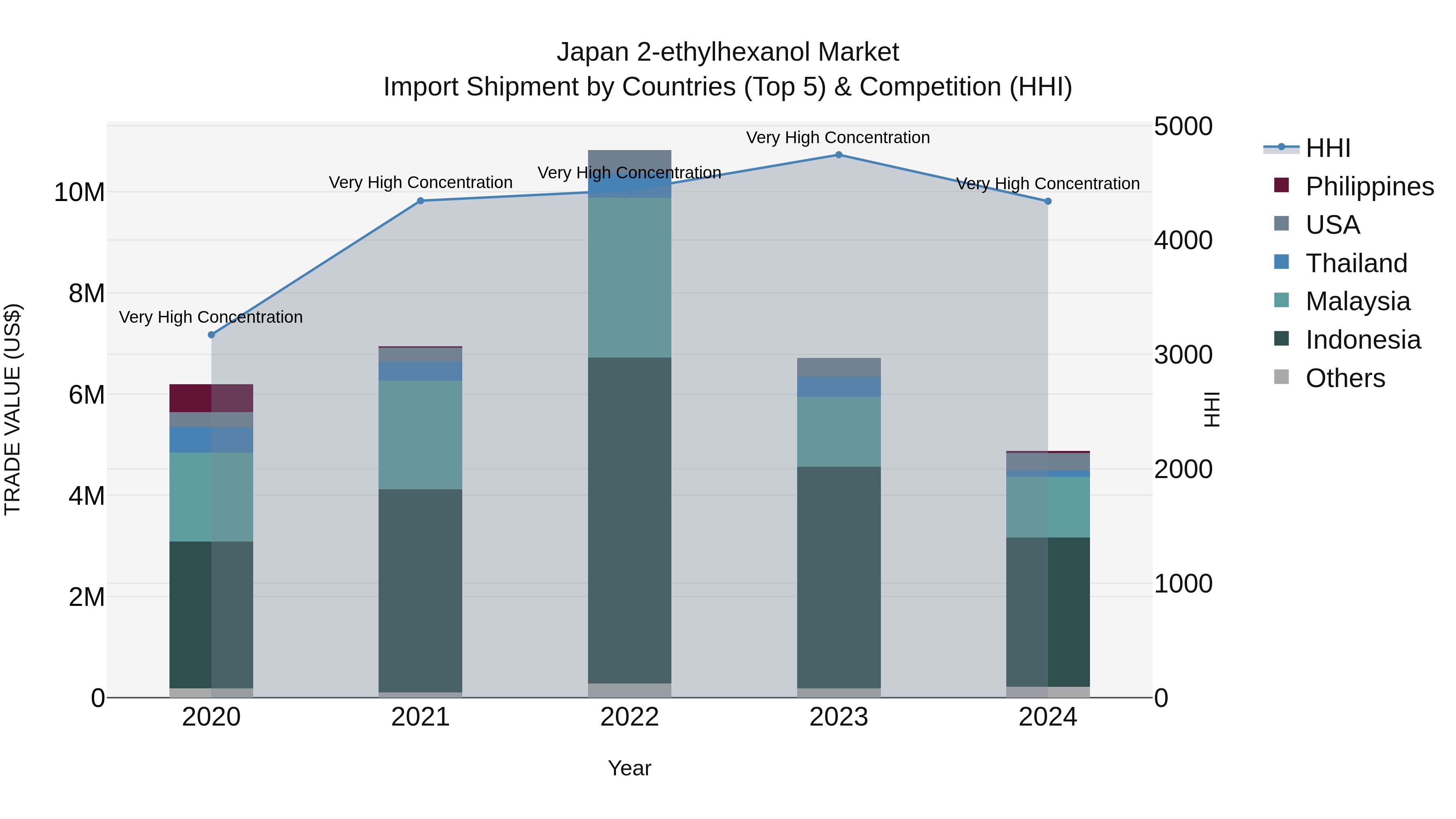
Japan 2-ethylhexanol Market Import Shipment by Countries (Top 5) & Competition (HHI)
Japan's 2-ethylhexanol import shipments in 2024 continued to see a high level of market concentration, with Indonesia, Malaysia, USA, India, and Thailand emerging as the top exporters to Japan. Despite a challenging CAGR of -5.83% from 2020 to 2024, the industry experienced a significant decline in growth rate from 2023 to 2024 at -27.4%. These trends suggest a complex landscape for the 2-ethylhexanol market in Japan, indicating the need for careful analysis and strategic planning for stakeholders in the industry.
Japan 2-Ethylhexanol (2-EH) Market Growth Rate
According to 6Wresearch internal database and industry insights, the Japan 2-Ethylhexanol (2-EH) Market is projected to grow at a compound annual growth rate (CAGR) of 5.1% during the forecast period (2025–2031).
Five-Year Growth Trajectory of the Japan 2-Ethylhexanol (2-EH) Market with Core Drivers
Below mentioned are the evaluation of year-wise growth rate along with key drivers:
| Year | Est. Annual Growth | Growth Drivers |
| 2020 | 1.6 | Stable demand from PVC plasticizers in construction materials; steady exports in oxo-alcohol chemicals. |
| 2021 | 2.8 | Recovery in automotive and coatings sectors supported by renewed domestic consumption. |
| 2022 | 3.7 | Transition to eco-friendly, non-phthalate plasticizers driving consistent 2-EH usage. |
| 2023 | 4.5 | Strong demand for 2-ethylhexyl acrylate in adhesives, coatings, and packaging materials. |
| 2024 | 5 | Growth in lubricant ester production and construction infrastructure refurbishments. |
Topics Covered in the Japan 2-Ethylhexanol (2-EH) Market Report
The Japan 2-Ethylhexanol (2-EH) Market report thoroughly covers the market by Application, End-Use, Product Form, and Distribution Channel. The report provides an unbiased and detailed analysis of ongoing market trends, high-growth opportunities, and market drivers to help stakeholders formulate strategies aligned with current and future market dynamics.
Japan 2-Ethylhexanol (2-EH) Market Highlights
| Report Name | Japan 2-Ethylhexanol (2-EH) Market |
| Forecast period | 2025-2031 |
| CAGR | 5.1% |
| Growing Sector | Plasticizers & Coatings |
Japan 2-Ethylhexanol (2-EH) Market Synopsis
The Japan 2-Ethylhexanol (2-EH) Market is witnessing steady growth driven by the rising demand for high-performance plasticizers, coatings, and adhesives in the construction, chemical, and automotive sectors. Market growth is supported by stringent environmental regulations promoting non-phthalate formulations, along with growing investment in domestic oxo-alcohol manufacturing. Additionally, advancements in lubricant ester production and increased application in adhesives, coatings, and sealants are expanding market potential across multiple industrial sectors.
Evaluation of Growth Drivers in the Japan 2-Ethylhexanol (2-EH) Market
Below mentioned are some growth drivers and their influence on market dynamics:
| Drivers | Primary Segments Affected | Why It Matters |
| Rising Demand for Non-Phthalate Plasticizers | Plasticizers | Transition from DOP to DOTP and DEHA increases 2-EH utilization in eco-compliant PVC products. |
| Expansion in Coatings & Adhesives Applications | Coatings, Adhesives | Growth in 2-ethylhexyl acrylate-based adhesives supports electronics and packaging industries. |
| Automotive Sector Recovery | Lubricants, Coatings | Increased production of vehicles boosts need for 2-EH-based lubricants and paints. |
| Infrastructure and Housing Upgrades | Plasticizers | Construction refurbishments increase PVC flooring and window profile consumption. |
| R&D in Specialty Chemicals | All Applications | New 2-EH derivatives enhance performance of coatings and lubricant esters. |
Japan 2-Ethylhexanol (2-EH) Market is expected to grow significantly, with a CAGR of 5.1% during the forecast period of 2025-2031. Japan 2-Ethylhexanol (2-EH) Market is experiencing steady growth driven by increasing investment in sustainable manufacturing and environmentally friendly chemicals. The Japan 2-Ethylhexanol (2-EH) Market Growth is primarily driven by the increasing demand for high purity oxo-alcohols in advanced coatings, adhesives, and lubricant applications. Non-phthalate plasticizers and new catalytic technology will continue to improve production efficiency, product quality, and long-term competitiveness across Japan industrial and specialty chemicals.
Evaluation of Restraints in the Japan 2-Ethylhexanol (2-EH) Market
Below mentioned are some major restraints and their influence on market dynamics:
| Restraints | Primary Segments Affected | What This Means |
| Volatility in Feedstock Prices | All Segments | Rising propylene costs impact production economics and pricing consistency. |
| Dependence on Imports for Raw Materials | Chemicals, Plasticizers | Limited domestic feedstock sources raise dependency on regional imports. |
| Regulatory Compliance Costs | Plasticizers, Solvents | Strict VOC and REACH standards increase operational complexity for producers. |
| Limited Awareness of Bio-based Alternatives | Lubricants | Slow adoption of renewable 2-EH esters in conventional industries. |
| Supply Chain Delays | Coatings, Adhesives | Logistics bottlenecks impact delivery of intermediate and final 2-EH-based products. |
Japan 2-Ethylhexanol (2-EH) Market Challenges
Although the market outlook remains positive, the Japan 2-Ethylhexanol (2-EH) Industry continues to encounter challenges such as fluctuating raw material prices, import dependency, and the ongoing requirement for technological upgrades. Furthermore, limited awareness of the benefits of bio-based 2-EH and stringent regulatory norms restrict large-scale adoption. In order to overcome these barriers, manufacturers are emphasizing process optimization, vertical integration, and collaborative partnerships to lower production costs, streamline supply chains, and strengthen competitiveness in Japan’s chemical sector.
Japan 2-Ethylhexanol (2-EH) Market Trends
The factors leading to the growth of the Japan 2-Ethylhexanol (2-EH) Market include:
- The shift towards green plasticizers, as manufacturers move to non-phthalate and environmentally friendly formulations to meet regulations.
- The growth in specialty coatings and adhesives as the demand grows for specialty coatings with high-performance attributes used in electronics and packaging.
- Bio-based chemical development, as R&D around renewable oxo-alcohols provides a more sustainable option for the chemical industry.
- Automation and process optimization, as new catalytic processes lead to increased yield and lower production costs.
- Growth in automotive lubricant esters, as more synthetic ester lubricants are being used in higher precision engines, leading to greater market consumption of 2-EH.
Investment Opportunities in the Japan 2-Ethylhexanol (2-EH) Market
Some notable investment opportunities include:
- Growth of Local Production: Establishing new 2-EH plants to minimize reliance on imports and increase the reliability of supply.
- Green Chemistry: Investing in bio-based feedstock to support Japan's goal of carbon neutrality.
- Adhesive and Coating Businesses: Focusing on expansion in electronics, packaging and construction.
- Lubricant Ester Production: Producing synthetic lubricants from 2-EH for industrial applications with high performance.
- R&D Collaborations: Working with research institutes on innovative catalytic technologies to improve process performance.
Top 5 Leading Players in the Japan 2-Ethylhexanol (2-EH) Market
Here are some top companies contributing to Japan 2-Ethylhexanol (2-EH) Market Share:
1. Mitsubishi Chemical Corporation
| Company Name | Mitsubishi Chemical Corporation |
|---|---|
| Headquarters | Tokyo, Japan |
| Established Year | 1933 |
| Official Website | Click Here |
Mitsubishi Chemical Corporation produces oxo-alcohols and derivatives, including 2-Ethylhexanol (2-EH) used in plasticizers, coatings, and lubricant esters. With a robust domestic distribution network and advanced chemical synthesis capabilities, the company ensures high-quality and reliable supply across industrial applications.
2. Mitsui Chemicals, Inc.
| Company Name | Mitsui Chemicals, Inc. |
|---|---|
| Headquarters | Tokyo, Japan |
| Established Year | 1912 |
| Official Website | Click Here |
Mitsui Chemicals, Inc. manufactures 2-Ethylhexanol primarily used in plasticizers, coatings, and adhesives. The company emphasizes environmentally responsible production technologies, integrating innovation and sustainability into its chemical manufacturing processes.
3. Kuraray Co., Ltd.
| Company Name | Kuraray Co., Ltd. |
|---|---|
| Headquarters | Tokyo, Japan |
| Established Year | 1926 |
| Official Website | Click Here |
Kuraray Co., Ltd. provides chemical intermediates such as 2-Ethylhexanol (2-EH) for use in adhesives, coatings, and specialty polymers. The company is recognized for its high-purity synthesis methods and energy-efficient production systems, ensuring reliable quality and reduced environmental impact.
4. BASF Japan Ltd.
| Company Name | BASF Japan Ltd. |
|---|---|
| Headquarters | Tokyo, Japan |
| Established Year | 1865 |
| Official Website | Click Here |
BASF Japan Ltd., a subsidiary of the global BASF Group, produces 2-Ethylhexanol (2-EH) and its derivatives for plasticizers, coatings, and lubricant applications. The company maintains sustainable operations in Japan, combining advanced R&D with eco-friendly chemical production.
5. Daihachi Chemical Industry Co., Ltd.
| Company Name | Daihachi Chemical Industry Co., Ltd. |
|---|---|
| Headquarters | Osaka, Japan |
| Established Year | 1919 |
| Official Website | Click Here |
Daihachi Chemical Industry Co., Ltd. specializes in oxo-based intermediates and specialty 2-Ethylhexanol (2-EH) compounds for adhesives, coatings, and industrial formulations. The company’s focus on precision manufacturing and chemical innovation supports high-performance product development across multiple sectors.
Government Regulations Introduced in the Japan 2-Ethylhexanol (2-EH) Market
According to Japanese Government data, the Japan Ministry of Economy, Trade and Industry (METI) advances sustainable production of chemicals in accordance with its Green Growth Strategy Toward Carbon Neutrality 2050. The Chemical Substances Control Law (CSCL) imposes rigorous requirements on the manufacture of chemical products and their labeling. The Act on the Rational Use of Energy also incentivizes energy-efficient practices in the manufacture of oxo-alcohols. Additionally, regional strategies, like the Low Carbon Society Initiative, promote the bio-based manufacture of oxo intermediates to support local and national goals of environmental and industrial advancement.
Future Insights of the Japan 2-Ethylhexanol (2-EH) Market
The Japan 2-Ethylhexanol (2-EH) Market is projected to maintain continuous growth, driven by rising demand for non-phthalate plasticizers, advanced coatings, and lubricant esters. The rising applications in automotive and construction industries, along with continued R&D in bio-based 2-EH and high-purity derivatives, will enhance Japan’s domestic manufacturing capabilities. Furthermore, the adoption of digital monitoring systems and improvements in catalytic process efficiency are expected to boost productivity and sustainability, reinforcing Japan’s leadership in the Asia-Pacific chemical manufacturing landscape.
Market Segmentation Analysis
The report offers a comprehensive study of the subsequent market segments and their leading categories.
By Application – Plasticizers to Dominate the Market
According to Ritika Kalra, Senior Research Analyst, 6Wresearch, the plasticizers segment dominates the Japan 2-Ethylhexanol (2-EH) Market Share due to the extensive use of 2-EH in producing dioctyl terephthalate (DOTP) and other non-phthalate plasticizers. These are essential for flexible PVC applications such as cables, flooring, and automotive interiors, supported by Japan’s strong manufacturing base and export-oriented chemical sector.
By End-Use – Automotive to Dominate the Market
The automotive industry leads the market, driven by rising production of vehicles, lightweight components, and demand for high-performance coatings and lubricants. The use of 2-EH-based acrylates and lubricants enhances durability, fuel efficiency, and precision in Japanese automotive manufacturing.
By Product Form – Liquid Form to Dominate the Market
Liquid form holds the largest market share as it is preferred for industrial processing and formulation flexibility in coatings, adhesives, and plasticizers. Its high miscibility and easy handling make it the most demanded form among chemical producers.
By Distribution Channel – Offline Segment to Dominate the Market
The offline distribution channel dominates the Japan 2-Ethylhexanol (2-EH) Market, supported by long-standing partnerships between manufacturers, distributors, and industrial buyers. Bulk trading and contract-based supply networks ensure consistency, technical support, and reliability across end-user industries.
Key Attractiveness of the Report
- 10 Years Market Numbers
- Historical Data Starting from 2021 to 2024
- Base Year: 2024
- Forecast Data until 2031
- Key Performance Indicators Impacting the Market
- Major Upcoming Developments and Projects
Key Highlights of the Report:
- Japan 2-Ethylhexanol Market Outlook
- Market Size of Japan 2-Ethylhexanol Market, 2024
- Forecast of Japan 2-Ethylhexanol Market, 2031
- Historical Data and Forecast of Japan 2-Ethylhexanol Revenues & Volume for the Period 2021 - 2031
- Japan 2-Ethylhexanol Market Trend Evolution
- Japan 2-Ethylhexanol Market Drivers and Challenges
- Japan 2-Ethylhexanol Price Trends
- Japan 2-Ethylhexanol Porter's Five Forces
- Japan 2-Ethylhexanol Industry Life Cycle
- Historical Data and Forecast of Japan 2-Ethylhexanol Market Revenues & Volume By Applications for the Period 2021 - 2031
- Historical Data and Forecast of Japan 2-Ethylhexanol Market Revenues & Volume By Plasticizers for the Period 2021 - 2031
- Historical Data and Forecast of Japan 2-Ethylhexanol Market Revenues & Volume By 2-EH Acrylate for the Period 2021 - 2031
- Historical Data and Forecast of Japan 2-Ethylhexanol Market Revenues & Volume By 2-EH Nitrate for the Period 2021 - 2031
- Historical Data and Forecast of Japan 2-Ethylhexanol Market Revenues & Volume By Others for the Period 2021 - 2031
- Japan 2-Ethylhexanol Import Export Trade Statistics
- Market Opportunity Assessment By Applications
- Japan 2-Ethylhexanol Top Companies Market Share
- Japan 2-Ethylhexanol Competitive Benchmarking By Technical and Operational Parameters
- Japan 2-Ethylhexanol Company Profiles
- Japan 2-Ethylhexanol Key Strategic Recommendations
Market Covered
The report subsequently covers the market by following segments and subsegments:
By Application
- Plasticizers
- Solvents
- Coatings
- Adhesives
- Lubricants
By End-Use
- Automotive
- Constructions
- Chemicals
- Textiles
By Product Form
- Liquid
- Powder
- Solid
By Distribution Channel
- Online
- Offline






































