Japan Activewear Market Size & Growth Rate
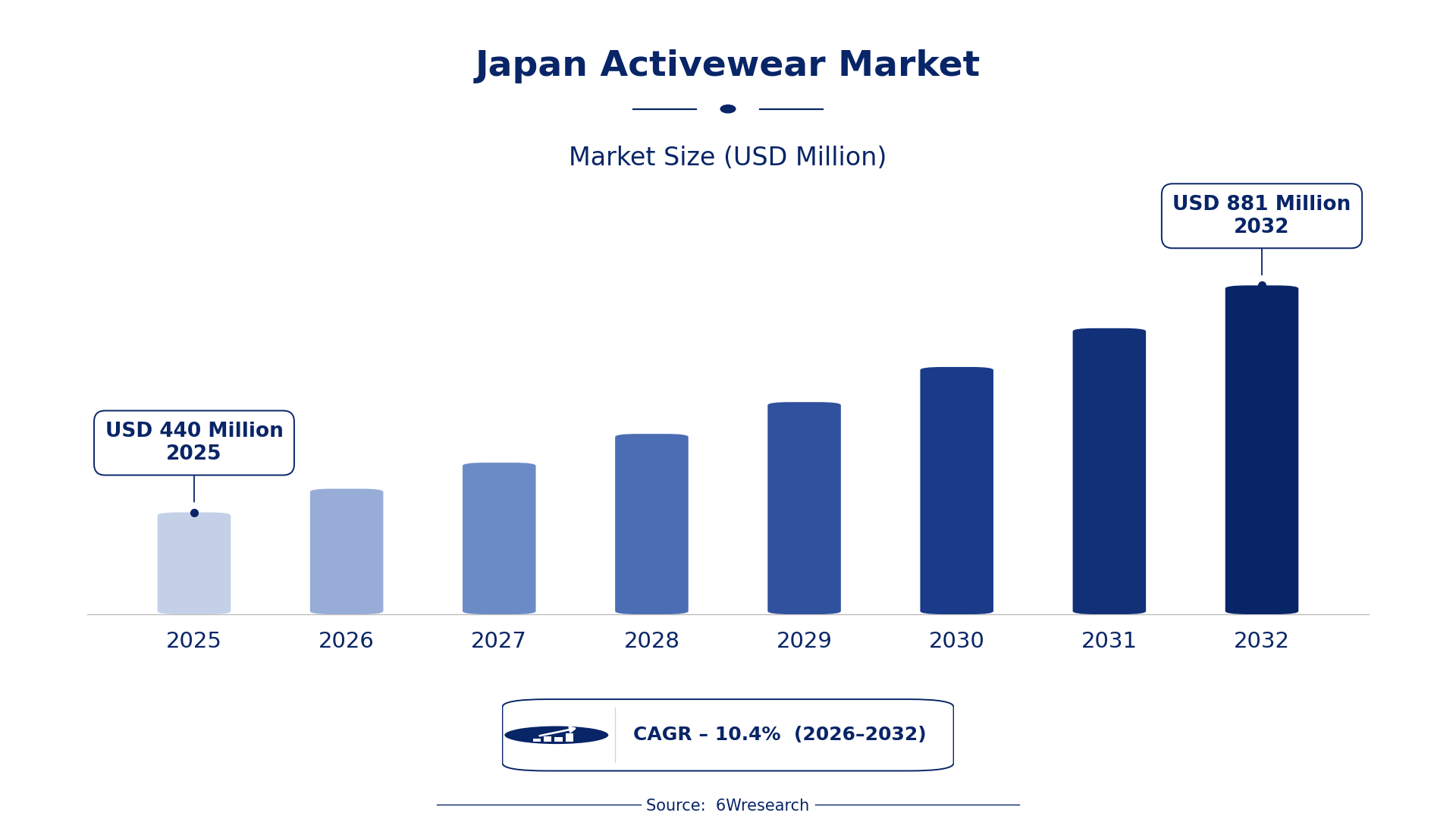
According to 6Wresearch internal database and industry insights, the Japan Activewear Market was valued at USD 440 Million in 2025 and is projected to reach USD 881 Million by 2032, growing at a CAGR of approximately 10.4% during 2026–2032.
Japan Activewear Market Highlights
| Report Metric | Details |
| Report Name | Japan Activewear Market (2026-2032) |
| Market Size 2025 | USD 440 Million |
| Market Size 2032 | USD 881 Million |
| Absolute Growth 2025–2032 | USD 441 Million |
| CAGR 2026–2032 | 10.4% |
| Peak Annual Growth | 11.6% in 2028 |
| Forecast Period | 2026–2032 |
| Historical Data | 2022–2025 |
| Base Year | 2025 |
| Leading Product, 2025 | Clothes (45% share) |
| Leading Consumer Group, 2025 | Men (59% share) |
| Leading Application, 2025 | Gym (47% share) |
| Leading Distribution Channel, 2025 | Online (64% share) |
| Fastest-Growing Product | Footwear (13.8% CAGR) |
| Fastest-Growing Consumer Group | Women (12.6% CAGR) |
| Fastest-Growing Application | Sports (13.2% CAGR) |
| Fastest-Growing Distribution Channel | Offline (13.0% CAGR) |
| Growing Sector | Fitness and Sports Apparel |
| Key End Users | Fitness enthusiasts, sports participants, casual wear consumers, children |
Japan Activewear Market Year-wise Growth Rate and Key Drivers (2022–2032)
This graph illustrates the annual growth rates of the market from 2022 to 2032, highlighting a steady upward trajectory and projected market expansion over the forecast period.
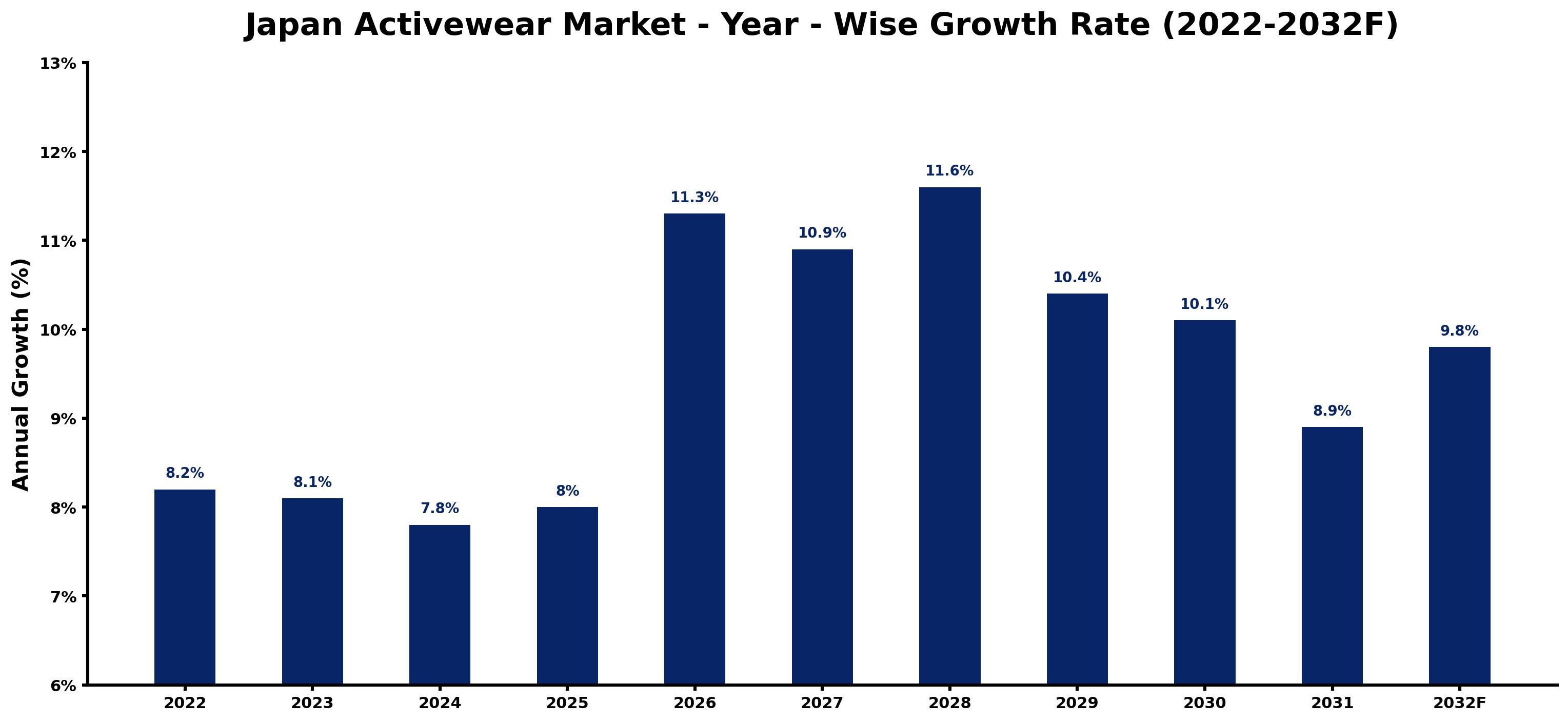
Below, each year's estimated growth is shown next to the factor that most influenced it.
| Year | Estimated Annual Growth (%) | Market Rationale |
| 2022 | 8.2 | The market demonstrated strong consumer engagement with fitness activities, boosting activewear purchases. |
| 2023 | 8.1 | Consumer interest in fitness remains high, but growth has slowed slightly compared to the previous year. |
| 2024 | 7.8 | The market continues to grow, although at a slower pace as consumer habits stabilise. |
| 2025 | 8.0 | Increased participation in fitness clubs drives a faster recovery in activewear demand. |
| 2026 | 11.3 | A surge in fitness trends is expected to drive consumer spending and demand for activewear. |
| 2027 | 10.9 | Growth is projected to slow as the market adjusts to previous peaks in demand and consumer behaviour. |
| 2028 | 11.6 | A renewed focus on fitness and wellness will lead to the highest growth rate in the forecast period. |
| 2029 | 10.4 | Growth is expected to moderate as the market begins to stabilise after rapid expansion in previous years. |
| 2030 | 10.1 | The market will continue to grow, but at a slower rate as consumer preferences evolve. |
| 2031 | 8.9 | Growth is projected to slow as the market adjusts to changing consumer preferences. |
| 2032 | 9.8 | Increased fitness initiatives and events will lead to a resurgence in activewear purchases. |
Note: Market size estimations and growth projections presented in this report are based on 6Wresearch's proprietary forecasting methodology, utilizing the latest available industry data, government publications, and primary research inputs.
Japan Activewear Market Synopsis
Activewear in Japan encompasses clothing, footwear, and accessories tailored for physical activities, typically crafted from breathable, moisture-wicking fabrics. The Japan Activewear Market is valued at approximately 1 trillion yen, with over 40% of Japanese adults participating in regular exercise. Growth stems from increased consumer interest in fitness, the proliferation of fitness clubs, and the impact of major sporting events, such as the Tokyo 2020 Olympics, which greatly amplified demand for activewear.
Market Dynamics Impact Analysis (2026–2032)
| Factor | Type | Impact | Primary Segment Affected |
| Growing consumer interest in fitness activities | Driver | High | Clothes |
| Increase in online shopping for activewear | Driver | High | Footwear |
| Expansion of fitness clubs and gyms | Opportunity | High | Gym |
| Rising exports of activewear products | Opportunity | Medium | Clothes |
| High competition among activewear brands | Restraint | High | Footwear |
| Fluctuating material costs for production | Restraint | Medium | Accessories |
| Compliance with quality standards | Challenge | High | Clothes |
| Capacity constraints in production | Challenge | Medium | Footwear |
Evaluation of Drivers in Japan Activewear Market (2026–2032)
Key forces behind demand, with the segment each one moves most, are listed below.
| Drivers | Primary Segment Affected | Why It Matters (Evidence) |
| Increased participation in fitness activities | Clothes | In 2022, 40% of Japanese adults engaged in regular exercise, driving demand for activewear. |
| Growing online shopping trends | Footwear | Online sales of activewear grew by 25% in the last year, reflecting changing consumer purchasing habits. |
| Expansion of fitness clubs | Gym | The number of fitness clubs in Japan reached over 5,000 in 2023, increasing demand for gym-related activewear. |
| Influence of major sporting events | Sports | The Tokyo 2020 Olympics boosted interest in sports and activewear among consumers. |
| Rising exports of activewear | Accessories | Activewear exports from Japan increased by 15% in the last two years, highlighting global demand. |
Spending rises because consumer engagement in fitness has increased since five years ago, with 40% of adults participating in regular exercise. The number of fitness clubs in Japan surpassed 5,000 in 2023, creating higher demand for activewear. Major events, such as the Tokyo 2020 Olympics, stimulated interest in activewear. This combination of factors drives a consistent rise in purchases across various consumer segments, with women accounting for over 60% of activewear purchases, reflecting their growing engagement in fitness activities.
Evaluation of Restraints in Japan Activewear Market
These restraints slow adoption and weigh on supplier margins.
| Market Restraint | Primary Segment Affected | Why It Matters (Evidence) |
| Intense competition among brands | Footwear | High competition can lead to price wars, affecting profitability for manufacturers and retailers. |
| Rising material costs | Accessories | Fluctuating prices of materials can increase production costs, impacting margins for producers. |
| Compliance with JIS standards | Clothes | Manufacturers must invest in testing and certification to meet stringent quality standards. |
| Limited production capacity | Footwear | Capacity constraints can delay product availability, affecting sales for retailers. |
| Market saturation in urban areas | Gym | High saturation in urban markets may limit growth opportunities for new entrants. |
Japan Activewear Market Challenges
A shortage of skilled workers in textile manufacturing restricts production capacity, resulting in delays that elevate costs for producers. Importers encounter inconsistent supply chain issues due to logistical challenges, which can prolong lead times and cause stock shortages for retailers. Compliance with JIS standards introduces regulatory hurdles that can delay product launches, limiting the availability of activewear for consumers. Rising prices are apparent as the average spending on activewear per person is around 10,000 yen annually, making it increasingly difficult for fitness enthusiasts to access a range of products.
Trends in the Japan Activewear Market
Below are the shifts with the largest effect on the Japan Activewear Market.
- Shift towards Sustainable Activewear: In 2023, the trend towards sustainability in activewear gained momentum, with rising consumer demand for eco-friendly materials. The 'Cool Japan' strategy supports sustainable fashion, reflecting a growing awareness of environmental issues.
- Transition from Offline to Online Shopping: Since 2022, a notable shift from offline to online shopping for activewear has occurred, with online sales increasing by 25%. This change is particularly evident in major urban centres like Tokyo, where consumers favour the convenience of online purchases.
- Emergence of Athleisure as Everyday Wear: The rise of athleisure, which merges fashion with functionality, has redefined activewear as everyday attire. This trend is especially pronounced in urban areas, where consumers seek stylish yet comfortable clothing for various occasions.
- Increased Focus on Kids' Activewear: The Japanese Ministry of Education's initiatives to promote physical education in schools have spurred a growing demand for kids' activewear. This segment is expanding as more parents invest in quality activewear for their children.
Investment Opportunities in the Japan Activewear Market
The following areas offer the clearest openings for investors and suppliers in the Japan Activewear Market.
- Rising Demand for Eco-Friendly Products: With increasing awareness of sustainability, there is a chance to invest in eco-friendly activewear materials. This trend is particularly relevant for urban consumers in Tokyo, where demand for sustainable options is on the rise.
- Expansion of Fitness Facilities: The ongoing growth of fitness clubs offers an opportunity for suppliers to focus on gym-related activewear. With over 5,000 fitness clubs in Japan, partnerships with these facilities can broaden market reach.
- Gap in Kids' Activewear Market: The heightened emphasis on physical education has created a gap in the kids' activewear market. Suppliers can target schools and parents in regions like Hokkaido, where interest in sports is increasing.
- Investment in Online Retail Platforms: The surge in online sales of activewear highlights the need for investment in e-commerce platforms. Retailers can strengthen their online presence to attract the growing consumer base that prefers digital shopping.
Government Initiatives in the Japan Activewear Market
The Industrial Standardization Act, established in 1949 and amended in 2019, governs the Japanese Industrial Standards (JIS) applicable to activewear production. Adherence to these standards ensures quality and safety in products, affecting both manufacturers and consumers. The Act against Unjustifiable Premiums and Misleading Representations, enacted in 1962, prohibits misleading advertising, safeguarding consumers from false claims about activewear products.
The 'Sport for All' program, launched in 2023, aims to encourage physical activity among citizens, with JPY 10 billion allocated for various initiatives. The Japanese Sports Agency oversees this program, promoting increased participation in fitness activities and driving demand for activewear.
Future Insight of the Japan Activewear Market
By 2032, the demand for activewear will shift as more than 60% of purchases will come from women, influenced by initiatives like the 'Sport for All' program. Technological advancements in fabric production will improve moisture-wicking properties, increasing comfort for users. The number of fitness clubs is expected to surpass 5,000, creating new opportunities for activewear sales. Major sporting events will continue to generate seasonal spikes in demand, prompting suppliers to adapt quickly to market trends.
Market Segmentation Analysis
Japan Activewear Market report covers a detailed analysis of the following market segments:
By Product – Clothes Lead, Footwear Expected to Grow Fastest
According to Sumit Sagar, AM at 6Wresearch, the largest product category in 2025 was Clothes, at 45% of revenue. Clothes dominate the activewear market as they are essential for physical activities and casual wear, appealing to a wide range of consumers. The average spending on activewear per person is around 10,000 yen annually, underscoring the significance of clothing in this sector. The quickest growth will come from Footwear, forecast to expand at a CAGR of 13.8% between 2026 and 2032. Footwear is experiencing rapid growth as consumers increasingly value comfort and support during exercise, particularly in gym settings. The expansion of fitness clubs, which exceeded 5,000 in number, has notably increased the demand for quality active footwear. Suppliers should focus on expanding clothing lines while also investing in footwear solutions to cater to the rising consumer interest.
By Consumer Group – Men Leads, Women Expected to Grow Fastest
Men took 59% of consumer group revenue in 2025, more than any other category. Men represent a significant consumer group for activewear, accounting for a considerable share of overall purchases, especially in fitness contexts. With 40% of Japanese adults engaging in regular exercise, men's activewear remains a vital segment in the market. Over 2026–2032, Women is expected to post the fastest growth, at a CAGR of 12.6%. Women are the fastest-growing segment as their participation in fitness activities rises, driven by initiatives like the 'Sport for All' programme launched in 2023. This trend indicates a shift in purchasing power towards women's activewear. Brands should direct marketing strategies towards women, capitalising on their increasing engagement in fitness and activewear.
By Application – Gym Leads, Sports Expected to Grow Fastest
With 47% of application revenue in 2025, Gym was the largest category. The gym application leads the market as it serves as the primary environment for activewear usage, with a large number of individuals participating in gym workouts. This trend is reflected in the increasing number of fitness clubs across Japan. Sports are set to record the highest CAGR in this split, 13.2% over 2026–2032. Sports are the fastest-growing application as more individuals engage in various sports activities, driven by events like the Tokyo 2020 Olympics that heightened interest in athletic performance. This growth suggests a broadening of the activewear market beyond just gym usage. Manufacturers need to diversify their product offerings to cater to the expanding sports segment, ensuring they meet the specific needs of athletes.
By Distribution Channel – Online Leads, Offline Expected to Grow Fastest
In 2025, Online led the distribution channel split with a 64% share. Online channels dominate the distribution of activewear, as they have become a preferred choice for consumers seeking convenience and a wide selection. The 25% growth in online sales over the last year underscores the popularity of this purchasing method. Offline is projected to grow fastest, at a CAGR of 13.0% during 2026–2032. Offline retail is the fastest-growing channel, as traditional stores continue to offer a tactile shopping experience that many consumers favour. Seasonal spikes during major sporting events also drive increased foot traffic to physical stores, maintaining their relevance. Retailers should adopt a balanced strategy, optimising both online and offline channels to maximise their reach and sales.
Key Attractiveness of the Report
- 10 Years of Market Numbers
- Historical Data Starting from 2022 to 2025
- Base Year 2025
- Forecast Data until 2032
- Key Performance Indicators Impacting the Market
- Major Upcoming Developments and Projects
Key Highlights of the Report:
- Japan Activewear Market Outlook
- Market Size of Japan Activewear Market, 2025
- Forecast of Japan Activewear Market, 2032
- Historical Data and Forecast of Japan Activewear Revenues & Volume for the Period 2022-2032
- Japan Activewear Market Trend Evolution
- Japan Activewear Market Drivers and Challenges
- Japan Activewear Price Trends
- Japan Activewear Porter's Five Forces
- Japan Activewear Industry Life Cycle
- Historical Data and Forecast of Japan Activewear Market Revenues & Volume By Product for the Period 2022-2032
- Historical Data and Forecast of Japan Activewear Market Revenues & Volume By Clothes for the Period 2022-2032
- Historical Data and Forecast of Japan Activewear Market Revenues & Volume By Footwear for the Period 2022-2032
- Historical Data and Forecast of Japan Activewear Market Revenues & Volume By Accessories for the Period 2022-2032
- Historical Data and Forecast of Japan Activewear Market Revenues & Volume By Consumer Group for the Period 2022-2032
- Historical Data and Forecast of Japan Activewear Market Revenues & Volume By Men for the Period 2022-2032
- Historical Data and Forecast of Japan Activewear Market Revenues & Volume By Women for the Period 2022-2032
- Historical Data and Forecast of Japan Activewear Market Revenues & Volume By Kids for the Period 2022-2032
- Historical Data and Forecast of Japan Activewear Market Revenues & Volume By Application for the Period 2022-2032
- Historical Data and Forecast of Japan Activewear Market Revenues & Volume By Gym for the Period 2022-2032
- Historical Data and Forecast of Japan Activewear Market Revenues & Volume By Sports for the Period 2022-2032
- Historical Data and Forecast of Japan Activewear Market Revenues & Volume By Swimming for the Period 2022-2032
- Historical Data and Forecast of Japan Activewear Market Revenues & Volume By Others for the Period 2022-2032
- Historical Data and Forecast of Japan Activewear Market Revenues & Volume By Distribution Channel for the Period 2022-2032
- Historical Data and Forecast of Japan Activewear Market Revenues & Volume By Online for the Period 2022-2032
- Historical Data and Forecast of Japan Activewear Market Revenues & Volume By Offline for the Period 2022-2032
- Japan Activewear Import Export Trade Statistics
- Market Opportunity Assessment By Product
- Market Opportunity Assessment By Consumer Group
- Market Opportunity Assessment By Application
- Market Opportunity Assessment By Distribution Channel
- Japan Activewear Top Companies Market Share
- Japan Activewear Competitive Benchmarking By Technical and Operational Parameters
- Japan Activewear Company Profiles
- Japan Activewear Key Strategic Recommendations
Market Covered
The study includes the following segmentation.
By Product
- Clothes
- Footwear
- Accessories
By Consumer Group
- Men
- Women
- Kids
By Application
- Gym
- Sports
- Swimming
- Others
By Distribution Channel
- Online
- Offline































