Japan App Analytics Market Size & Growth Rate (2026-2032)
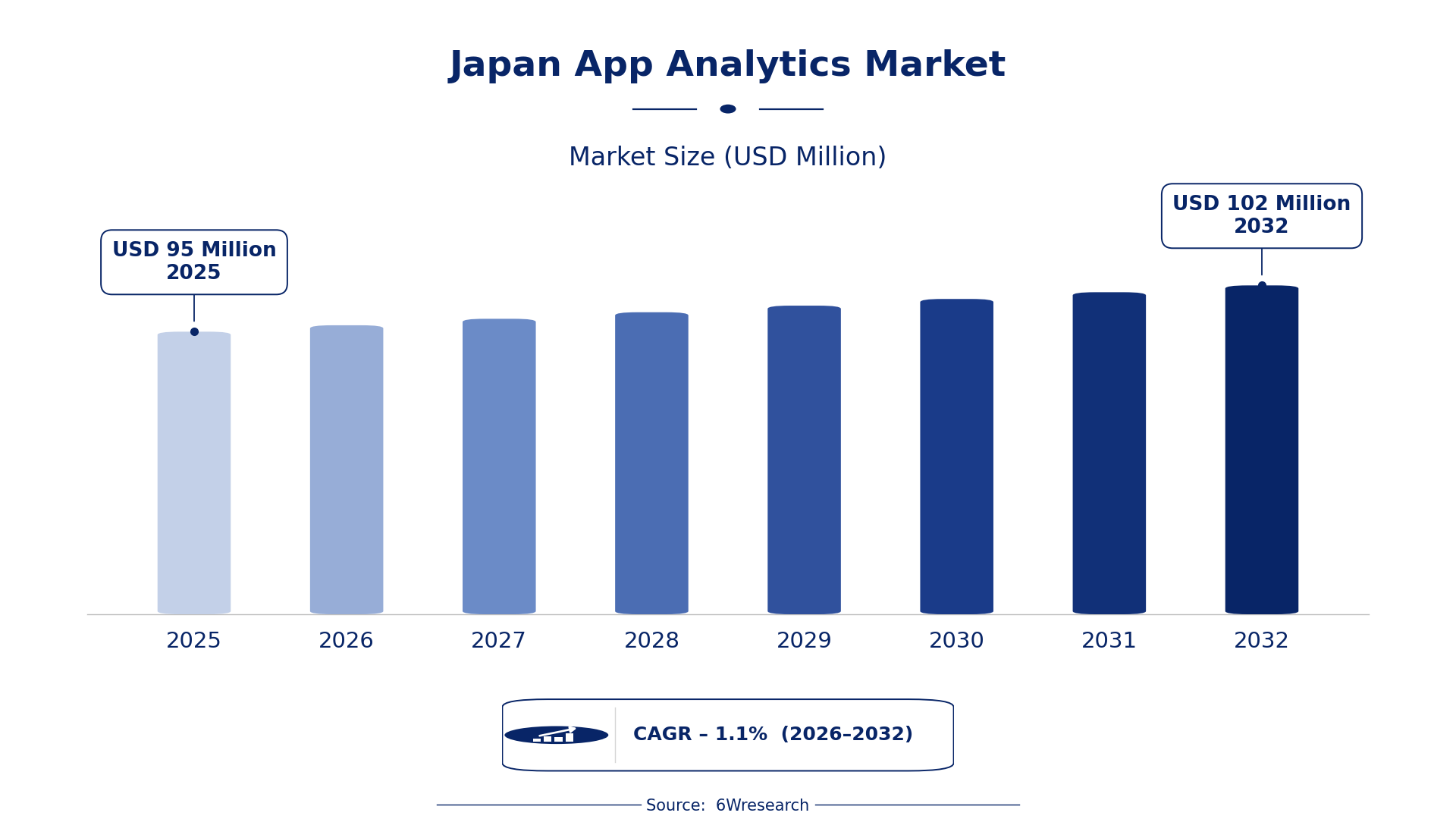
The Japan App Analytics Market was estimated at USD 95 Million in 2025 and is projected to reach USD 102 Million by 2032, growing at a CAGR of 1.1% from 2026 to 2032.
Japan App Analytics Market Synopsis
The Japan App Analytics Market is witnessing a transformative phase as businesses across diverse sectors increasingly recognize the value of data-driven insights. The rapid proliferation of mobile applications is compelling organizations to adopt advanced analytics tools to enhance user engagement and optimize performance.
This market is characterized by a blend of competitive dynamics featuring both domestic innovations and international solutions. As companies focus on personalization and monetization strategies, there is a clear trend toward adopting real-time analytics, reflecting a shift in how Japanese businesses approach their app development and marketing efforts.
Japan App Analytics Market Year-wise Growth Rate and Key Drivers
This graph illustrates the annual growth rates of the Japan App Analytics Market from 2021 to 2032, highlighting a steady upward trajectory and projected expansion over the forecast period.
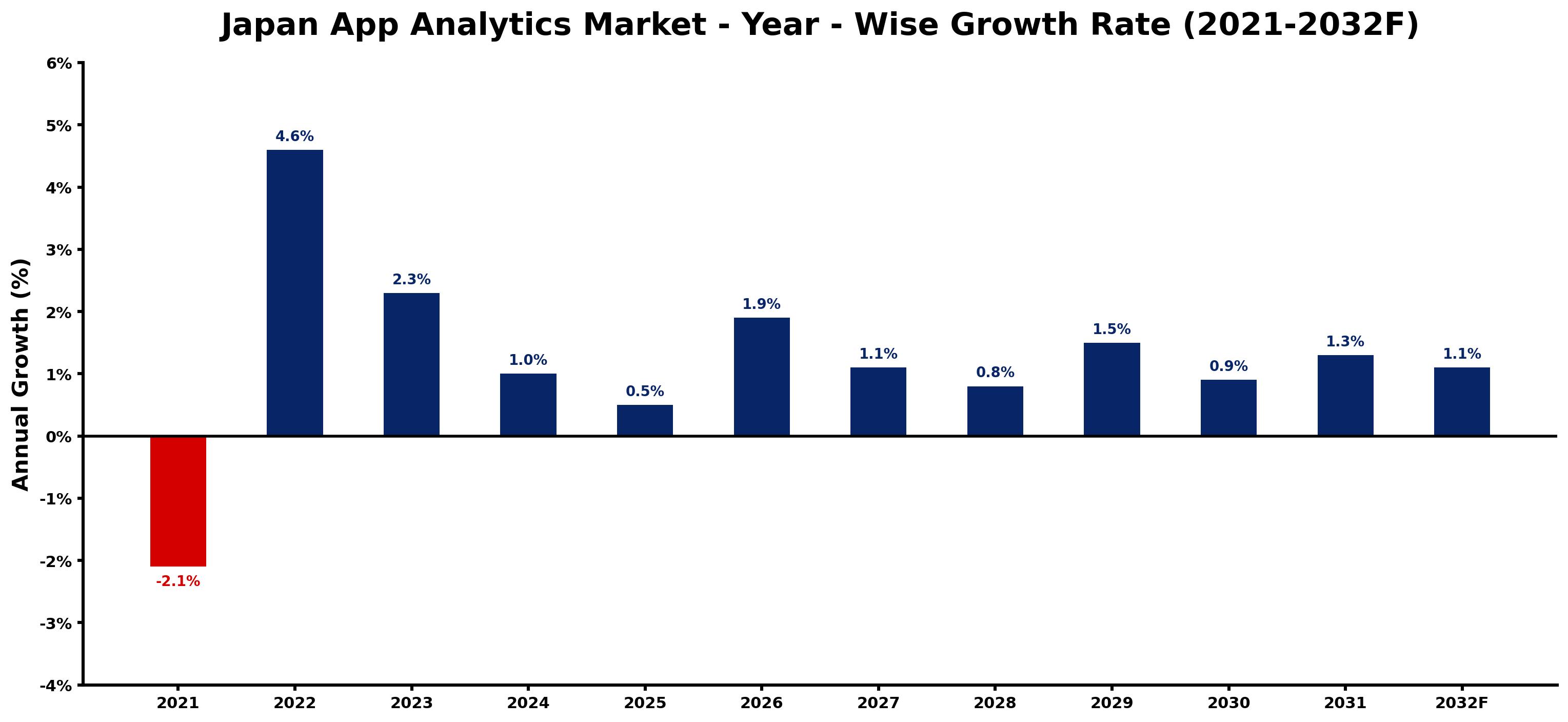
The table below presents the year‑wise growth rates along with the key drivers influencing the market
| Year | Growth Rate | Major Drivers |
| 2021 | -2.1% | Apple's new privacy rules hindered user tracking effectiveness. |
| 2022 | 4.6% | Rise in mobile gaming popularity among Japanese consumers |
| 2023 | 2.3% | Increased focus on user retention strategies by developers |
| 2024 | 1.0% | Launch of new app monetization regulations by METI |
| 2025 | 0.5% | Growing usage of AR features in Japanese applications |
| 2026 | 1.9% | Emergence of localized analytics tools for Japanese market |
| 2027 | 1.1% | Boost in smartphone penetration among older demographics |
| 2028 | 0.8% | Surge in demand for e-commerce app functionalities |
| 2029 | 1.5% | Adoption of 5G technology enhancing app experiences |
| 2030 | 0.9% | Regulatory support for privacy-compliant analytics solutions |
| 2031 | 1.3% | Rising interest in AI integration for app optimization |
| 2032 | 1.1% | Continued investment in app development by tech startups |
Note: Market size estimations and growth projections presented in this report are based on 6Wresearch's proprietary forecasting methodology, utilizing the latest available industry data, government publications, and primary research inputs.
Japan App Analytics Market Key Takeaways
Below are some of the specific key takeaways from the market, including:
- The market is driven by the increasing adoption of mobile applications across various industries.
- Advanced analytics tools are critical for understanding user behavior and optimizing app performance.
- Compliance with data privacy regulations is a growing concern for app analytics providers.
- AI and machine learning technologies are gaining traction for predictive analytics in app development.
- Real-time analytics capabilities are becoming essential for agile decision-making in businesses.
Evaluation of Restraints in Japan App Analytics Market
The Japan App Analytics Market faces multiple restraints that inhibit its growth potential. One significant hurdle is the intricate nature of app ecosystems, which demands more sophisticated tools to decipher user behavior effectively. Companies must invest in advanced technologies to keep pace with the evolving landscape.
on top of that, the stringent data privacy laws in Japan create an additional layer of complexity for firms seeking to collect and analyze user data. The Personal Information Protection Act (PIPA) adds pressure on companies to ensure compliance, complicating analytics strategies. In such a competitive environment, firms must continuously innovate to stay relevant.
Japan App Analytics Market Trends
A noticeable trend in the Japan App Analytics Market is the escalating demand for tools that provide granular insights into user interactions. Developers are increasingly emphasizing personalization to enhance user experiences, directly impacting retention rates.
The integration of AI and machine learning into analytics platforms is a game changer, enabling predictive capabilities that can forecast user behavior. on top of that, the rise of marketing automation tools is enhancing the synergy between app analytics and overall marketing strategies, leading to more informed decision-making.
Japan App Analytics Market Opportunities
The Japan App Analytics Market offers substantial investment opportunities, particularly for entities focused on developing advanced analytics solutions. With the mounting necessity for data-driven insights, companies that can provide tailored analytics platforms are well-positioned for growth.
Businesses seeking to optimize their mobile app strategies will continue to fuel demand for analytics services. on top of that, investing in consulting firms that specialize in app analytics could yield significant returns as organizations strive to adapt to the digital-first paradigm.
Government Initiatives in the Japan App Analytics Market
Government policies in Japan are actively shaping the App Analytics Market, primarily through regulatory frameworks that ensure data privacy while promoting innovation. The balance between protecting consumer information and fostering a competitive environment is critical for market players today.
- A recently completed initiative includes updates to the Personal Information Protection Act, enhancing compliance measures for app analytics providers.
- Currently ongoing is a national awareness campaign focused on data privacy that aims to educate businesses on compliance with regulations.
- Planned is a public-private partnership expected to launch in 2026, designed to improve digital infrastructure and support app analytics development.
- The Japan Fair Trade Commission is actively monitoring competition within the market to prevent anti-competitive practices.
- The Ministry of Economy, Trade and Industry is introducing guidelines for ethical data use in app analytics, expected to be finalized by late 2025.
Future Insights of the Japan App Analytics Market
Looking ahead to 2026-2032, the Japan App Analytics Market is set for considerable advancements. The focus will shift more towards integrating analytics with other digital tools, allowing for a more cohesive approach to app development and marketing.
As consumer preferences continue to evolve, businesses that prioritize real-time data insights will gain a competitive edge. The ongoing digital transformation will likely result in higher demand for analytics solutions that not only measure performance but also predict future trends.
Japan App Analytics Market Latest Developments
In the past year, the Japan App Analytics Market has seen a flurry of activity, with companies racing to innovate in response to growing user expectations. This has included a shift toward more integrated analytics solutions that combine various data sources for comprehensive insights.
- A major technology vendor launched a new analytics platform in Q2 2025 that leverages AI for predictive user behavior analysis, currently ongoing.
- A partnership between two regional firms was established in early 2025 to develop a suite of privacy-compliant analytics tools.
- In mid-2025, a leading analytics provider introduced an upgraded version of its platform, featuring enhanced real-time reporting capabilities.
- An initiative to promote analytics literacy among app developers began in late 2025 and continues to gain traction.
- A planned rollout of a user-friendly analytics dashboard is expected to begin in early 2026, targeting SMEs looking to enhance their app strategies.
Japan App Analytics Market - Key Attractiveness of the Report
- 10 Years of Market Numbers
- Historical Data Starting from 2022 to 2025
- Base Year: 2025
- Forecast Data until 2032
- Key Performance Indicators Impacting the Market
- Major Upcoming Developments and Projects
Key Highlights of the Report:
- Japan App Analytics Market Outlook
- Market Size of Japan App Analytics Market, 2025
- Forecast of Japan App Analytics Market, 2032
- Historical Data and Forecast of Japan App Analytics Revenues & Volume for the Period 2022-2032F
- Japan App Analytics Market Trend Evolution
- Japan App Analytics Market Drivers and Challenges
- Japan App Analytics Price Trends
- Japan App Analytics Porter's Five Forces
- Japan App Analytics Industry Life Cycle
- Historical Data and Forecast of Japan App Analytics Market Revenues & Volume By Component for the Period 2022-2032F
- Historical Data and Forecast of Japan App Analytics Market Revenues & Volume By Software for the Period 2022-2032F
- Historical Data and Forecast of Japan App Analytics Market Revenues & Volume By Services for the Period 2022-2032F
- Historical Data and Forecast of Japan App Analytics Market Revenues & Volume By Application for the Period 2022-2032F
- Historical Data and Forecast of Japan App Analytics Market Revenues & Volume By Revenue analytics for the Period 2022-2032F
- Historical Data and Forecast of Japan App Analytics Market Revenues & Volume By App performance analytics and operations for the Period 2022-2032F
- Historical Data and Forecast of Japan App Analytics Market Revenues & Volume By User analytics for the Period 2022-2032F
- Historical Data and Forecast of Japan App Analytics Market Revenues & Volume By Ad monitoring and marketing analytics for the Period 2022-2032F
- Historical Data and Forecast of Japan App Analytics Market Revenues & Volume By Type for the Period 2022-2032F
- Historical Data and Forecast of Japan App Analytics Market Revenues & Volume By Mobile app analytics for the Period 2022-2032F
- Historical Data and Forecast of Japan App Analytics Market Revenues & Volume By Web app analytics for the Period 2022-2032F
- Historical Data and Forecast of Japan App Analytics Market Revenues & Volume By Vertical for the Period 2022-2032F
- Historical Data and Forecast of Japan App Analytics Market Revenues & Volume By Banking, Financial Services, and Insurance (BFSI) for the Period 2022-2032F
- Historical Data and Forecast of Japan App Analytics Market Revenues & Volume By Retail for the Period 2022-2032F
- Historical Data and Forecast of Japan App Analytics Market Revenues & Volume By Media and entertainment for the Period 2022-2032F
- Historical Data and Forecast of Japan App Analytics Market Revenues & Volume By Logistics, travel, and transportation for the Period 2022-2032F
- Historical Data and Forecast of Japan App Analytics Market Revenues & Volume By Telecom and IT for the Period 2022-2032F
- Historical Data and Forecast of Japan App Analytics Market Revenues & Volume By Others for the Period 2022-2032F
- Japan App Analytics Import Export Trade Statistics
- Market Opportunity Assessment By Component
- Market Opportunity Assessment By Application
- Market Opportunity Assessment By Type
- Market Opportunity Assessment By Vertical
- Japan App Analytics Top Companies Market Share
- Japan App Analytics Competitive Benchmarking By Technical and Operational Parameters
- Japan App Analytics Company Profiles
- Japan App Analytics Key Strategic Recommendations






































