Japan Baby Diaper Market Size & Growth Rate
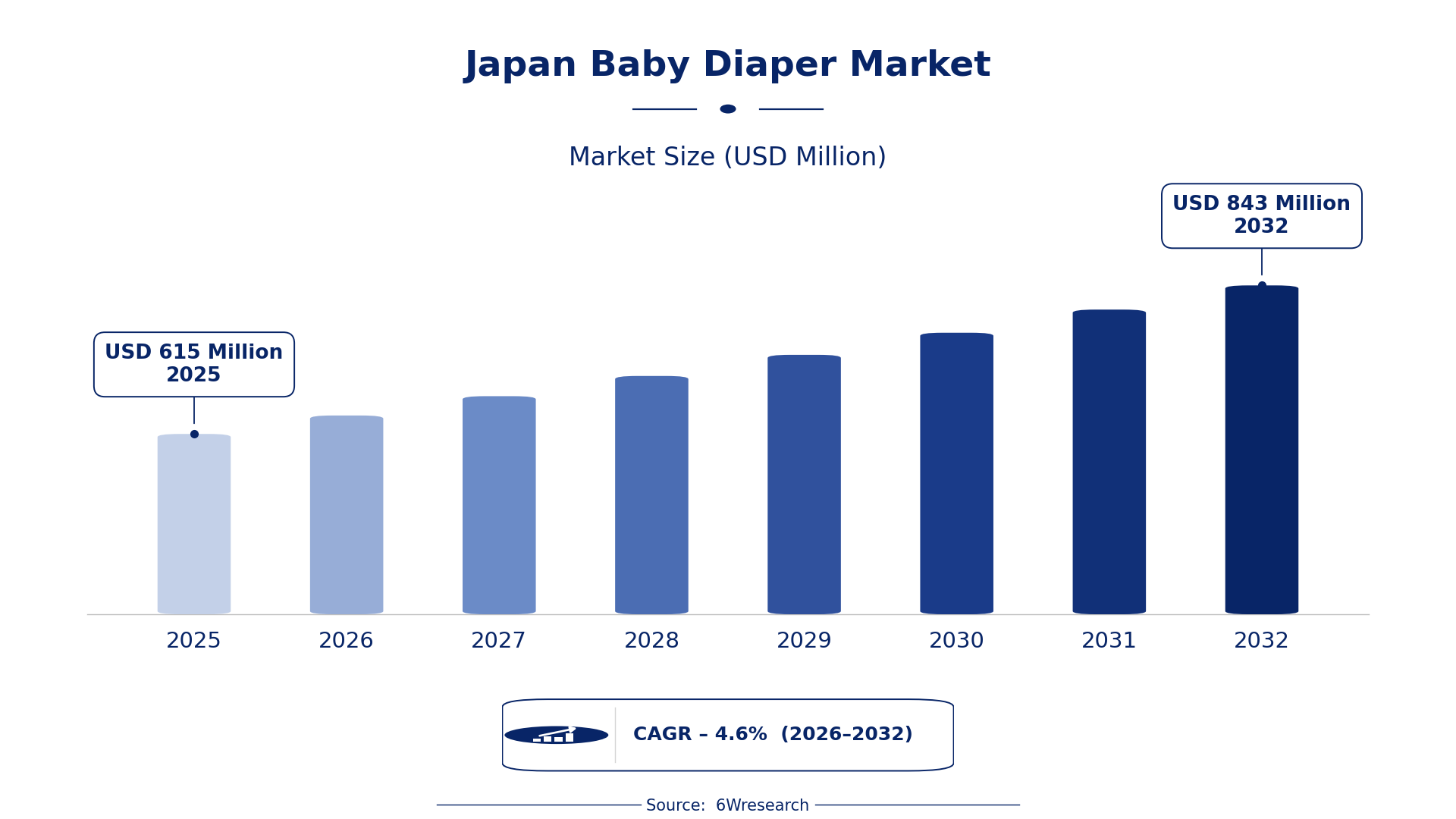
According to 6Wresearch internal database and industry insights, the Japan Baby Diaper Market was valued at USD 615 Million in 2025 and is projected to reach USD 843 Million by 2032, growing at a CAGR of approximately 4.6% during 2026–2032.
Japan Baby Diaper Market Highlights
| Report Metric | Details |
| Report Name | Japan Baby Diaper Market (2026-2032) |
| Market Size 2025 | USD 615 Million |
| Market Size 2032 | USD 843 Million |
| Absolute Growth 2025–2032 | USD 228 Million |
| CAGR 2026–2032 | 4.6% |
| Peak Annual Growth | 5.4% in 2028 |
| Forecast Period | 2026–2032 |
| Historical Data | 2022–2025 |
| Base Year | 2025 |
| Leading Product Type, 2025 | Disposable Diapers (44% share) |
| Leading Application, 2025 | Infant Care (37% share) |
| Leading End User, 2025 | Hospitals (39% share) |
| Leading Distribution Channel, 2025 | Supermarkets (48% share) |
| Fastest-Growing Product Type | Cloth Diapers (6.7% CAGR) |
| Fastest-Growing Application | Reusable Solutions (6.2% CAGR) |
| Fastest-Growing End User | Homecare (6.0% CAGR) |
| Fastest-Growing Distribution Channel | Specialty Stores (6.1% CAGR) |
| Growing Sector | Infant Care |
| Key End Users | Parents, childcare facilities, hospitals, preschools |
Japan Baby Diaper Market Year-wise Growth Rate and Key Drivers (2022–2032)
This graph illustrates the annual growth rates of the market from 2022 to 2032, highlighting a steady upward trajectory and projected market expansion over the forecast period.
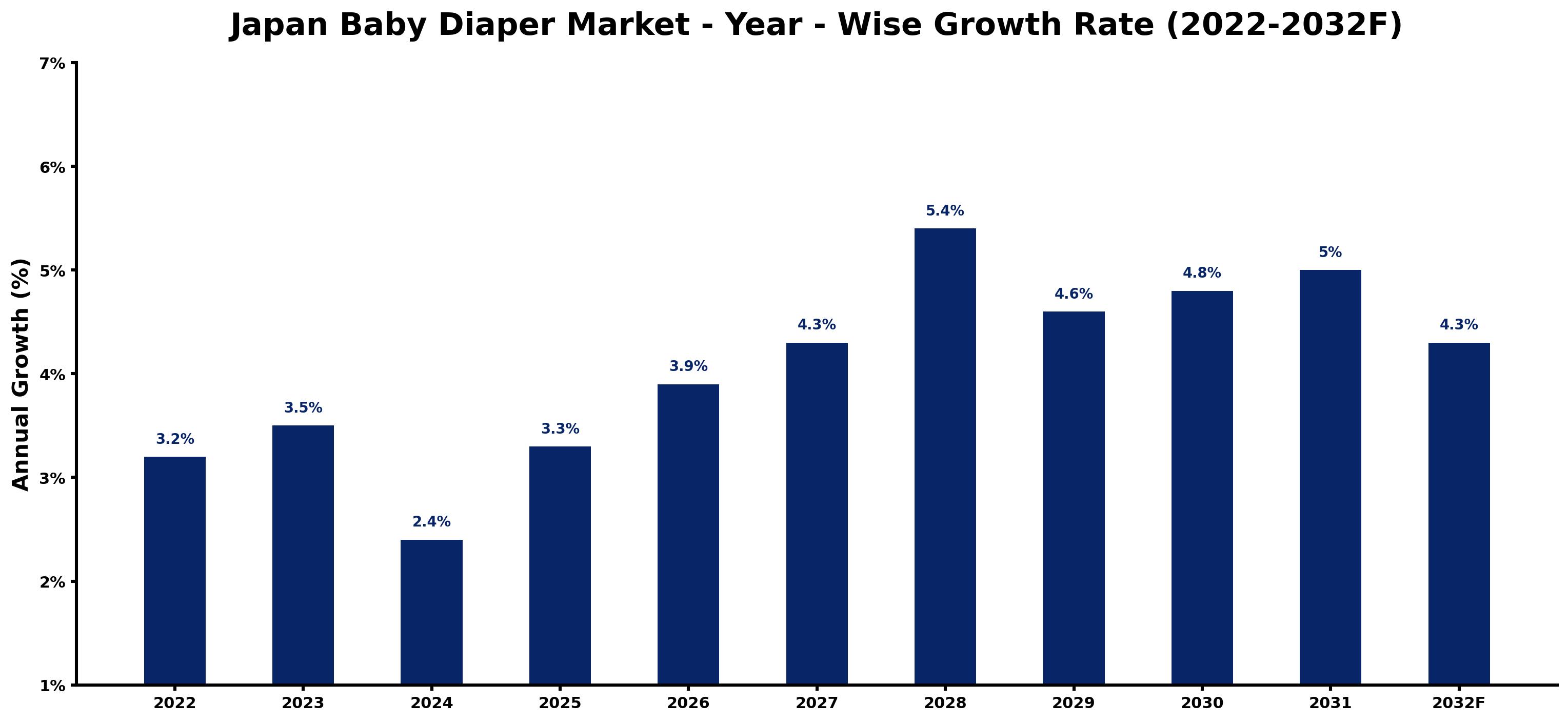
Year by year, the estimates below pair each growth rate with the development that shaped it.
| Year | Estimated Annual Growth (%) | Market Rationale |
| 2022 | 3.2 | The market experienced steady growth, driven by consistent domestic demand for baby products. |
| 2023 | 3.5 | Growth accelerated due to increased birth rates and heightened consumer awareness of hygiene. |
| 2024 | 2.4 | A slowdown in growth occurred as market saturation began to set in with disposable options. |
| 2025 | 3.3 | Growth rebounded as families continued to adopt disposable diapers for convenience. |
| 2026 | 3.9 | Demand is expected to increase with rising investments in eco-friendly product development. |
| 2027 | 4.3 | Growth is projected to continue as consumer preferences shift towards sustainable options. |
| 2028 | 5.4 | The peak growth year will see heightened demand from childcare facilities and families. |
| 2029 | 4.6 | A slight slowdown is anticipated as competition intensifies in the market. |
| 2030 | 4.8 | Growth is expected to pick up again as online retail channels expand further. |
| 2031 | 5.0 | Demand will remain strong, driven by continuous innovation in product offerings and marketing. |
| 2032 | 4.3 | Growth is projected to slow slightly as market maturity begins to influence purchasing patterns. |
Note: Market size estimations and growth projections presented in this report are based on 6Wresearch's proprietary forecasting methodology, utilizing the latest available industry data, government publications, and primary research inputs.
Japan Baby Diaper Market Synopsis
Baby diapers are absorbent garments designed for infants, primarily made from synthetic materials, including polymers and cellulose. The Japan Baby Diaper Market is driven by a birth rate of approximately 840,000 in 2022, with disposable diapers dominating over 90% of the market share. The increasing focus on hygiene and convenience for caregivers fuels demand, alongside growing interest in biodegradable options, which are gaining traction among eco-conscious consumers. With around 3.5 million children under five, the market is projected to grow, supported by investments in eco-friendly products and innovations in distribution channels.
Market Dynamics Impact Analysis (2026–2032)
| Factor | Type | Impact | Primary Segment Affected |
| Growing birth rates and increased disposable income drive demand for baby diapers. | Driver | High | Disposable Diapers |
| The rising trend towards eco-friendly products presents new market opportunities. | Opportunity | High | Biodegradable Diapers |
| Regulatory standards for child care facilities necessitate consistent diaper supply. | Restraint | Medium | Daycare Centers |
| The competition from cloth and biodegradable alternatives may limit market share. | Challenge | Medium | Disposable Diapers |
| Increasing demand for convenience drives the sales of disposable diapers. | Driver | High | Training Pants |
| The popularity of online retail channels is expanding consumer access. | Opportunity | High | Online Retail |
| Price sensitivity among consumers may affect purchasing decisions. | Restraint | Medium | Disposable Diapers |
| The need for continuous innovation poses challenges for manufacturers. | Challenge | High | Biodegradable Diapers |
Evaluation of Drivers in Japan Baby Diaper Market (2026–2032)
Demand rests on the following drivers, each shown with the segment it touches most.
| Drivers | Primary Segment Affected | Why It Matters (Evidence) |
| Increased disposable income among families leads to higher spending on baby products. | Disposable Diapers | With Japan's birth rate at approximately 840,000 in 2022, families are investing more in quality diapers. |
| The rising trend towards eco-friendly products is attracting environmentally conscious consumers. | Biodegradable Diapers | The growing interest among parents for sustainable options is reflected in the increasing sales of biodegradable diapers. |
| The expansion of online retail channels improves accessibility for consumers. | Online Retail | Online sales of baby diapers grew by 15% in 2023, reflecting changing shopping habits among parents. |
| The demand for convenience drives the popularity of training pants. | Training Pants | Training pants are increasingly used in preschools, highlighting the need for easy-to-use options during potty training. |
| Childcare facilities require a consistent supply of diapers for infants. | Daycare Centers | With approximately 3.5 million children under five in Japan, daycare centers need reliable diaper supplies. |
A wider customer base explains much of the growth, as increased disposable income among families leads to higher spending on baby products. Families are investing more in quality diapers, particularly disposable options, which account for over 90% of the market share. The trend towards eco-friendly products is attracting environmentally conscious consumers, as biodegradable diapers gain traction among parents. The expansion of online retail channels improves accessibility for consumers, reflected in a 15% growth in online sales in 2023. Daycare centers require a consistent supply of diapers for infants, driven by the need to cater to the population of children under five.
Evaluation of Restraints in Japan Baby Diaper Market
The following restraints limit how fast demand can grow.
| Market Restraint | Primary Segment Affected | Why It Matters (Evidence) |
| Price sensitivity among consumers may affect purchasing decisions. | Disposable Diapers | The average price of disposable diapers in Japan is around ¥300 per piece, influencing consumer choices. |
| Competition from cloth and biodegradable alternatives may limit market share. | Biodegradable Diapers | The popularity of cloth diapers is increasing, presenting a challenge to the market share of disposables. |
| Regulatory standards for child care facilities necessitate consistent diaper supply. | Daycare Centers | Compliance with safety standards can increase operational costs for daycare centers, affecting their budgets. |
| The need for continuous innovation poses challenges for manufacturers. | Disposable Diapers | Manufacturers must invest in R&D to keep up with consumer preferences for sustainable options, increasing costs. |
| Market saturation may limit growth potential for existing products. | Disposable Diapers | With over 90% market share, growth opportunities for disposables are becoming constrained, affecting future sales. |
Japan Baby Diaper Market Challenges
High compliance costs arise from regulations enforced by the Ministry of Health, Labour and Welfare, burdening producers with expenses that can reach 20%, delaying product launches. Supply chain disruptions affect importers, leading to inconsistent diaper availability in key markets like Tokyo and Osaka, which can result in stock shortages for retailers. Rapid technological advancements require producers to invest in modern manufacturing processes, extending production timelines and increasing costs by approximately 15%. Rising raw material prices impact buyers, with disposable diaper prices averaging around ¥300 per piece, forcing families to reconsider their purchasing decisions.
Trends in the Japan Baby Diaper Market
Below are the shifts with the largest effect on the Japan Baby Diaper Market.
- Shift towards Eco-Friendly Diapers: Since 2023, there has been a notable shift towards biodegradable diapers among eco-conscious parents. This change reflects a growing awareness of environmental issues, with biodegradable options gaining popularity as a sustainable alternative, increasing sales by approximately 10%.
- Growth of Online Retail Channels: In 2023, online retail sales of baby diapers grew by 15%, indicating a shift in consumer purchasing habits. This trend is reshaping how parents access diaper products, favouring convenience and home delivery, particularly in urban areas like Tokyo.
- Increased Use of Training Pants in Preschools: The trend towards using training pants in preschools has gained momentum, particularly for potty training. This shift supports the growing demand for easy-to-use diaper solutions during transitional phases, with usage rising by 20% in educational settings.
- Focus on Hygiene and Convenience: The emphasis on hygiene and convenience has driven the popularity of disposable diapers. With families prioritising ease of use, disposable options continue to dominate the market, capturing over 90% of sales in retail.
Investment Opportunities in the Japan Baby Diaper Market
Several openings in the Japan Baby Diaper Market merit attention from investors.
- Investment in Biodegradable Diapers: With biodegradable diapers gaining popularity, manufacturers should invest in sustainable production methods. The growing interest among eco-conscious parents presents a market opportunity, with sales increasing by 10% in 2023.
- Expansion of Online Retail Channels: As online retail sales grew by 15% in 2023, there is a clear opportunity to develop e-commerce platforms. Targeting tech-savvy parents can lead to increased sales in urban areas.
- Development of Training Pants: The increasing use of training pants in preschools indicates a demand for innovative products. Investing in this segment can meet the needs of parents during potty training stages, with potential sales growth of 20%.
- Focus on Childcare Facilities: With daycare centers requiring a consistent supply of diapers, suppliers can target this sector for steady demand. Establishing partnerships with local facilities can ensure reliable sales and a stable customer base.
Government Initiatives in the Japan Baby Diaper Market
The Plastic Resource Circulation Act (2021) promotes the reduction, reuse, and recycling of plastics, encouraging manufacturers to invest in biodegradable alternatives. This law directly impacts producers by requiring compliance with sustainability standards, which can enhance their market appeal and attract eco-conscious consumers. Additionally, the Ministry of Health, Labour and Welfare oversees child care regulations, ensuring safety and quality in products used for infants, which affects manufacturers' production processes.
In 2023, the government launched a campaign to promote eco-friendly baby products, overseen by the Ministry of Health, Labour and Welfare. This initiative aims to increase consumer awareness and support manufacturers in developing sustainable options, with funding allocated to projects that align with environmental goals.
Future Insight of the Japan Baby Diaper Market
Investment in advanced manufacturing technologies will increase, driven by rising demand for efficient production methods. This shift will create opportunities for suppliers to innovate and improve product offerings. Enhanced distribution channels will facilitate better access to baby diapers, benefiting families across Japan. The push for sustainability will encourage manufacturers to adopt ISO 14001 certification, aligning with consumer preferences for eco-friendly products and fostering a more responsible market.
Market Segmentation Analysis
Japan Baby Diaper Market report covers a detailed analysis of the following market segments:
By Product Type – Disposable Diapers Lead, Cloth Diapers Expected to Grow Fastest
According to Shubham Padhi, Research Analyst at 6Wresearch, Disposable Diapers took 44% of product type revenue in 2025, more than any other category. Disposable diapers dominate the market due to their convenience and hygiene, making them the preferred choice for most families. With over 90% market share, they are widely used in urban areas like Tokyo and Osaka, where demand is high. Cloth Diapers are projected to grow fastest, at a CAGR of 6.7% during 2026–2032. Cloth diapers are experiencing rapid growth as eco-conscious parents seek sustainable options for their children. The rising awareness of environmental issues has led to increased interest in these products, particularly among families looking to reduce waste. Suppliers should consider expanding their offerings to include more eco-friendly options to cater to changing consumer preferences.
By Application – Infant Care Leads, Reusable Solutions Expected to Grow Fastest
In 2025, Infant Care led the application split with a 37% share. Infant care remains the predominant application for baby diapers, essential for hygiene and comfort. The large share is attributed to the high birth rate of approximately 840,000 in 2022, necessitating consistent diaper usage in households. Reusable Solutions are set to record the highest CAGR in this split, 6.2% over 2026–2032. Reusable solutions are experiencing rapid growth as eco-conscious parents seek sustainable alternatives to traditional disposables. This trend is highlighted by the recent government campaign promoting eco-friendly baby products, indicating a shift in consumer preferences. Suppliers should consider expanding their product lines to include more sustainable options to meet the increasing demand from environmentally aware buyers.
By End User – Hospitals Lead, Homecare Expected to Grow Fastest
Hospitals held 39% of the Japan Baby Diaper Market by end user in 2025. Hospitals represent the largest end user of baby diapers, primarily for newborn care, where hygiene is critical. The reliance on disposable diapers in medical settings ensures a steady demand for these products. The quickest growth will come from Homecare, forecast to expand at a CAGR of 6.0% between 2026 and 2032. Homecare is becoming the fastest-growing segment as more families prefer to manage infant care at home, leading to increased diaper consumption. This trend is supported by the growing population of children under 5 years in Japan, which drives demand. Suppliers should focus on meeting the needs of homecare settings to capitalise on this growing market.
By Distribution Channel – Supermarkets Lead, Specialty Stores Expected to Grow Fastest
Supermarkets accounted for 48% of the market by distribution channel in 2025. Supermarkets are the leading distribution channel for baby diapers, accounting for 60% of sales due to their accessibility and convenience for consumers. This widespread availability makes it easy for families to purchase diapers regularly. Over 2026–2032, Specialty Stores are expected to post the fastest growth, at a CAGR of 6.1%. Specialty stores are seeing increased interest as parents look for niche products that may not be available in mainstream outlets. This trend reflects a growing demand for unique and eco-friendly diaper options among discerning consumers. Suppliers should consider partnerships with specialty stores to reach consumers seeking specific product features.
Key Attractiveness of the Report
- 10 Years of Market Numbers
- Historical Data Starting from 2022 to 2025
- Base Year 2025
- Forecast Data until 2032
- Key Performance Indicators Impacting the Market
- Major Upcoming Developments and Projects
Key Highlights of the Report:
- Japan Baby Diaper Market Outlook
- Market Size of Japan Baby Diaper Market, 2025
- Forecast of Japan Baby Diaper Market, 2032
- Historical Data and Forecast of Japan Baby Diaper Revenues & Volume for the Period 2022-2032
- Japan Baby Diaper Market Trend Evolution
- Japan Baby Diaper Market Drivers and Challenges
- Japan Baby Diaper Price Trends
- Japan Baby Diaper Porter's Five Forces
- Japan Baby Diaper Industry Life Cycle
- Historical Data and Forecast of Japan Baby Diaper Market Revenues & Volume By Product Type for the Period 2022-2032
- Historical Data and Forecast of Japan Baby Diaper Market Revenues & Volume By Disposable Diapers for the Period 2022-2032
- Historical Data and Forecast of Japan Baby Diaper Market Revenues & Volume By Cloth Diapers for the Period 2022-2032
- Historical Data and Forecast of Japan Baby Diaper Market Revenues & Volume By Biodegradable Diapers for the Period 2022-2032
- Historical Data and Forecast of Japan Baby Diaper Market Revenues & Volume By Training Pants for the Period 2022-2032
- Historical Data and Forecast of Japan Baby Diaper Market Revenues & Volume By Application for the Period 2022-2032
- Historical Data and Forecast of Japan Baby Diaper Market Revenues & Volume By Infant Care for the Period 2022-2032
- Historical Data and Forecast of Japan Baby Diaper Market Revenues & Volume By Reusable Solutions for the Period 2022-2032
- Historical Data and Forecast of Japan Baby Diaper Market Revenues & Volume By Eco-friendly Solutions for the Period 2022-2032
- Historical Data and Forecast of Japan Baby Diaper Market Revenues & Volume By Potty Training for the Period 2022-2032
- Historical Data and Forecast of Japan Baby Diaper Market Revenues & Volume By End User for the Period 2022-2032
- Historical Data and Forecast of Japan Baby Diaper Market Revenues & Volume By Hospitals for the Period 2022-2032
- Historical Data and Forecast of Japan Baby Diaper Market Revenues & Volume By Homecare for the Period 2022-2032
- Historical Data and Forecast of Japan Baby Diaper Market Revenues & Volume By Daycare Centers for the Period 2022-2032
- Historical Data and Forecast of Japan Baby Diaper Market Revenues & Volume By Preschools for the Period 2022-2032
- Historical Data and Forecast of Japan Baby Diaper Market Revenues & Volume By Distribution Channel for the Period 2022-2032
- Historical Data and Forecast of Japan Baby Diaper Market Revenues & Volume By Supermarkets for the Period 2022-2032
- Historical Data and Forecast of Japan Baby Diaper Market Revenues & Volume By Specialty Stores for the Period 2022-2032
- Historical Data and Forecast of Japan Baby Diaper Market Revenues & Volume By Online Retail for the Period 2022-2032
- Historical Data and Forecast of Japan Baby Diaper Market Revenues & Volume By Direct Sales for the Period 2022-2032
- Japan Baby Diaper Import Export Trade Statistics
- Market Opportunity Assessment By Product Type
- Market Opportunity Assessment By Application
- Market Opportunity Assessment By End User
- Market Opportunity Assessment By Distribution Channel
- Japan Baby Diaper Top Companies Market Share
- Japan Baby Diaper Competitive Benchmarking By Technical and Operational Parameters
- Japan Baby Diaper Company Profiles
- Japan Baby Diaper Key Strategic Recommendations
Market Covered
Segments analysed in this report are listed below.
By Product Type
- Disposable Diapers
- Cloth Diapers
- Biodegradable Diapers
- Training Pants
By Application
- Infant Care
- Reusable Solutions
- Eco-friendly Solutions
- Potty Training
By End User
- Hospitals
- Homecare
- Daycare Centers
- Preschools
By Distribution Channel
- Supermarkets
- Specialty Stores
- Online Retail
- Direct Sales































