Japan Bisphenol A Market Size Growth Rate
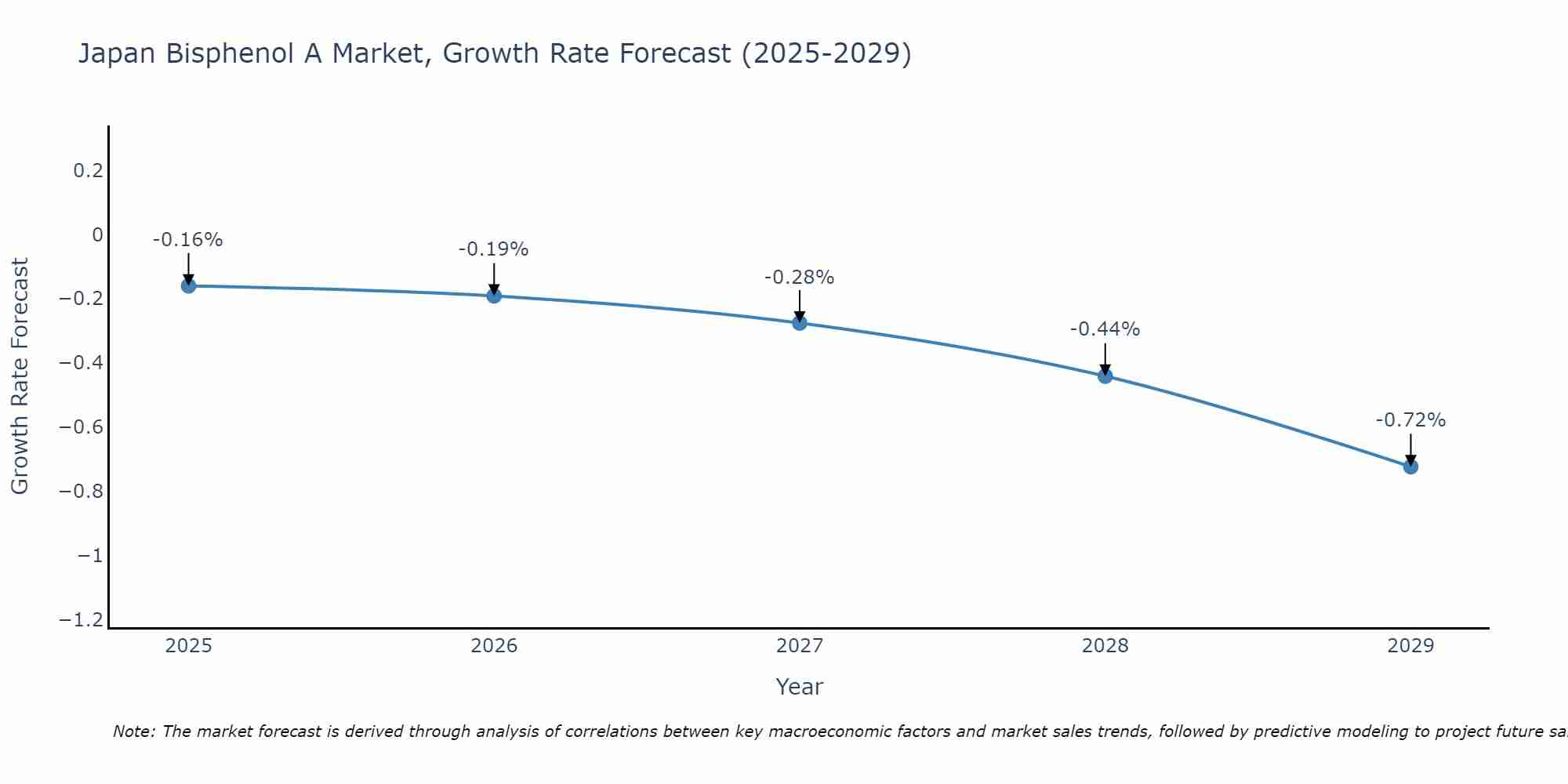
The Japan Bisphenol A Market could see a tapering of growth rates over 2025 to 2029. Although the growth rate starts strong at -0.16% in 2025, it steadily loses momentum, ending at -0.72% by 2029.
Japan Bisphenol A Market Overview
The Japan Bisphenol A market is characterized by steady growth due to the increasing demand from various industries such as automotive, electronics, and packaging. Bisphenol A is a key ingredient in the production of polycarbonate plastics and epoxy resins, which are widely used in these sectors. The market is also influenced by stringent regulations and growing awareness regarding the potential health risks associated with Bisphenol A exposure. Key players in the Japan Bisphenol A market include Mitsubishi Chemical Corporation, Mitsui Chemicals, and Idemitsu Kosan Co., Ltd. The market is expected to witness further growth driven by technological advancements in production processes and increasing applications in different end-use industries. However, concerns about environmental impact and shifting consumer preferences towards BPA-free products are also shaping the market dynamics.
Japan Bisphenol A Market Trends
In the Japan Bisphenol A market, there is a growing trend towards the use of BPA-free alternatives due to increasing concerns about the potential health risks associated with Bisphenol A. Manufacturers are focusing on developing and promoting products that are labeled as BPA-free to meet the demand from consumers looking for safer alternatives. Additionally, there is a shift towards more sustainable and eco-friendly options in the market, with companies exploring bio-based alternatives to traditional Bisphenol A. Regulatory changes and consumer awareness campaigns are also influencing the market trends, leading to a gradual phasing out of Bisphenol A in various industries. Overall, the Japan Bisphenol A market is experiencing a transition towards safer and more environmentally friendly alternatives in response to changing consumer preferences and regulatory pressures.
Japan Bisphenol A Market Challenges
In the Japan Bisphenol A market, challenges primarily revolve around increasing regulatory scrutiny and consumer concerns regarding the potential health risks associated with Bisphenol A exposure. The Japanese government has implemented stricter regulations on the use of Bisphenol A in certain products, leading to shifts in manufacturing processes and increased costs for companies. Additionally, heightened awareness among consumers about the possible adverse effects of Bisphenol A has resulted in a growing demand for BPA-free alternatives, putting pressure on manufacturers to innovate and develop safer substitutes. Navigating these regulatory changes while meeting consumer preferences for safer products poses a significant challenge for businesses operating in the Japan Bisphenol A market, requiring them to adapt quickly to evolving market dynamics and ensure compliance with stringent regulations.
Japan Bisphenol A Market Investment Opportunities
Investment opportunities in the Japan Bisphenol A (BPA) market include the growing demand for BPA as a key raw material in the production of polycarbonate plastics, epoxy resins, and other applications in various industries such as automotive, electronics, and packaging. With Japan being a leading producer and consumer of BPA globally, there is a stable market outlook for the product. Moreover, the increasing awareness around the health and environmental concerns associated with BPA has led to the development of BPA alternatives, creating opportunities for investment in research and development of new products. Additionally, the Japanese government`s focus on promoting sustainable practices and reducing the use of harmful chemicals could drive investment in eco-friendly BPA substitutes and technologies. Overall, the Japan BPA market offers potential for growth and innovation, making it an attractive investment opportunity for investors looking to capitalize on the country`s industrial and environmental trends.
Japan Bisphenol A Market Government Policy
The Japanese government has implemented strict regulations on Bisphenol A (BPA) in various products to protect consumer health. In 2010, Japan banned the use of BPA in baby bottles and implemented regulations to limit its presence in food contact materials. Furthermore, the Ministry of Health, Labour and Welfare regularly conducts monitoring and assessment of BPA levels in food products to ensure compliance with safety standards. The government continues to review and update regulations related to BPA based on scientific research and international standards to minimize exposure and potential health risks associated with this chemical. Overall, Japan`s policies aim to safeguard public health and promote the use of safer alternatives in the market.
Japan Bisphenol A Market Future Outlook
The future outlook for the Japan Bisphenol A market is expected to be moderate, with steady growth driven by increasing demand from key end-use industries such as automotive, electronics, and packaging. Despite concerns over the potential health and environmental risks associated with Bisphenol A, the market is likely to be sustained by ongoing research and development efforts to produce safer alternatives. Regulatory initiatives aimed at restricting the use of Bisphenol A in certain applications may pose some challenges, but opportunities exist for manufacturers to innovate and introduce BPA-free products to meet evolving consumer preferences. Overall, the Japan Bisphenol A market is anticipated to maintain a stable growth trajectory in the coming years, supported by a combination of industry regulations, technological advancements, and shifting consumer preferences.
Key Highlights of the Report:
- Japan Bisphenol A Market Outlook
- Market Size of Japan Bisphenol A Market, 2021
- Forecast of Japan Bisphenol A Market, 2027
- Historical Data and Forecast of Japan Bisphenol A Revenues & Volume for the Period 2018 - 2027
- Japan Bisphenol A Market Trend Evolution
- Japan Bisphenol A Market Drivers and Challenges
- Japan Bisphenol A Price Trends
- Japan Bisphenol A Porter's Five Forces
- Japan Bisphenol A Industry Life Cycle
- Historical Data and Forecast of Japan Bisphenol A Market Revenues & Volume By Application for the Period 2018 - 2027
- Historical Data and Forecast of Japan Bisphenol A Market Revenues & Volume By Polycarbonate Resin for the Period 2018 - 2027
- Historical Data and Forecast of Japan Bisphenol A Market Revenues & Volume By Epoxy Resin for the Period 2018 - 2027
- Historical Data and Forecast of Japan Bisphenol A Market Revenues & Volume By Unsaturated Polyester Resins for the Period 2018 - 2027
- Historical Data and Forecast of Japan Bisphenol A Market Revenues & Volume By Flame Retardants for the Period 2018 - 2027
- Historical Data and Forecast of Japan Bisphenol A Market Revenues & Volume By Others for the Period 2018 - 2027
- Historical Data and Forecast of Japan Bisphenol A Market Revenues & Volume By End-use for the Period 2018 - 2027
- Historical Data and Forecast of Japan Bisphenol A Market Revenues & Volume By Eye wear for the Period 2018 - 2027
- Historical Data and Forecast of Japan Bisphenol A Market Revenues & Volume By Automotive component for the Period 2018 - 2027
- Historical Data and Forecast of Japan Bisphenol A Market Revenues & Volume By Electronics for the Period 2018 - 2027
- Historical Data and Forecast of Japan Bisphenol A Market Revenues & Volume By Wind Energy Composites for the Period 2018 - 2027
- Historical Data and Forecast of Japan Bisphenol A Market Revenues & Volume By Paint and Coating for the Period 2018 - 2027
- Historical Data and Forecast of Japan Bisphenol A Market Revenues & Volume By Green House for the Period 2018 - 2027
- Historical Data and Forecast of Japan Bisphenol A Market Revenues & Volume By Others for the Period 2018 - 2027
- Japan Bisphenol A Import Export Trade Statistics
- Market Opportunity Assessment By Application
- Market Opportunity Assessment By End-use
- Japan Bisphenol A Top Companies Market Share
- Japan Bisphenol A Competitive Benchmarking By Technical and Operational Parameters
- Japan Bisphenol A Company Profiles
- Japan Bisphenol A Key Strategic Recommendations






































