Japan Botanical Extracts Market Size & Growth Rate
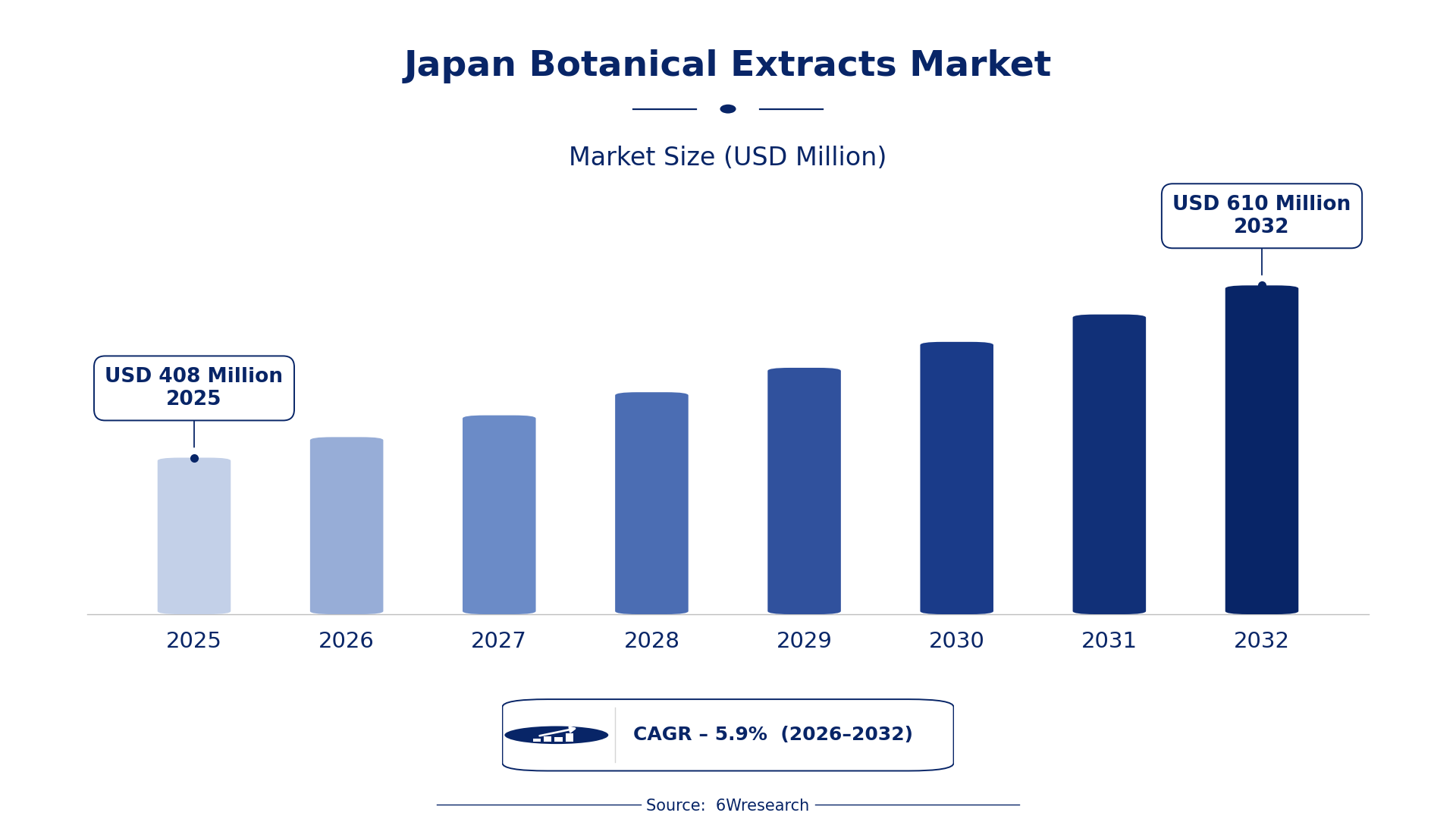
According to 6Wresearch internal database and industry insights, the Japan Botanical Extracts Market was valued at USD 408 Million in 2025 and is projected to reach USD 610 Million by 2032, growing at a CAGR of approximately 5.9% during 2026–2032.
Japan Botanical Extracts Market Highlights
| Report Metric | Details |
| Report Name | Japan Botanical Extracts Market (2026-2032) |
| Market Size 2025 | USD 408 Million |
| Market Size 2032 | USD 610 Million |
| Absolute Growth 2025–2032 | USD 202 Million |
| CAGR 2026–2032 | 5.9% |
| Peak Annual Growth | 7.2% in 2032 |
| Forecast Period | 2026–2032 |
| Historical Data | 2022–2025 |
| Base Year | 2025 |
| Leading Source, 2025 | Spices (50% share) |
| Leading Application, 2025 | Food Bakery & Confectionery (41% share) |
| Fastest-Growing Source | Herbs (8.3% CAGR) |
| Fastest-Growing Application | Sauces & Dressings (8.4% CAGR) |
| Growing Sector | Food and Beverage |
| Key End Users | Food manufacturers, beverage producers, cosmetic companies, herbal product suppliers |
Japan Botanical Extracts Market Year-wise Growth Rate and Key Drivers (2022–2032)
This graph illustrates the annual growth rates of the market from 2022 to 2032, highlighting a steady upward trajectory and projected market expansion over the forecast period.
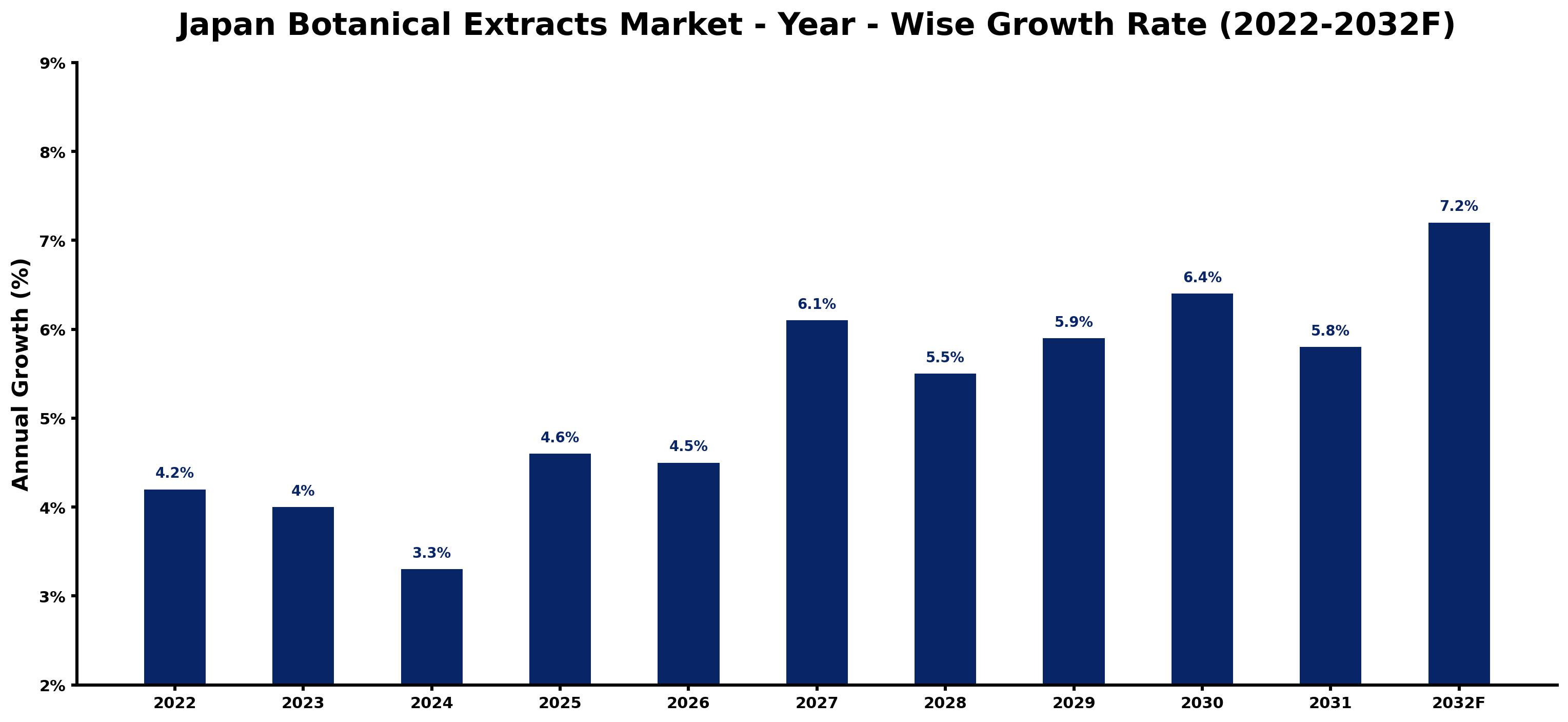
The table below sets out the estimated growth rate for each year and the main factor behind it.
| Year | Estimated Annual Growth (%) | Market Rationale |
| 2022 | 4.2 | The market exhibited steady growth, reflecting strong demand for food products. |
| 2023 | 4.0 | Growth slowed slightly as consumers adjusted to rising prices in the food sector. |
| 2024 | 3.3 | A further slowdown occurred as inflationary pressures continued to impact purchasing decisions. |
| 2025 | 4.6 | Demand accelerated again, driven by increased interest in health-focused food products. |
| 2026 | 4.5 | Growth is expected to moderate as market saturation begins to affect certain product categories. |
| 2027 | 6.1 | A resurgence in demand is projected as health trends gain traction among consumers. |
| 2028 | 5.5 | Growth is anticipated to slow again as competition intensifies within the botanical extracts sector. |
| 2029 | 5.9 | Demand is expected to pick up due to rising interest in herbal remedies and traditional medicine. |
| 2030 | 6.4 | Continued growth is projected to be supported by the increasing popularity of herbal tea consumption. |
| 2031 | 5.8 | Growth is expected to moderate slightly as the market adjusts to new consumer preferences. |
| 2032 | 7.2 | The market is projected to peak as health-focused products gain widespread acceptance. |
Note: Market size estimations and growth projections presented in this report are based on 6Wresearch's proprietary forecasting methodology, utilizing the latest available industry data, government publications, and primary research inputs.
Japan Botanical Extracts Market Synopsis
Botanical extracts are concentrated substances derived from plants, made through processes like steam distillation or solvent extraction. The Japan Botanical Extracts Market is growing as health consciousness rises and demand for natural ingredients increases. Government initiatives that promote organic farming and the growing popularity of herbal products are creating new opportunities in the sector. The market is set for continued expansion, particularly in food and beverage applications, as consumers pursue healthier alternatives.
Market Dynamics Impact Analysis (2026–2032)
| Factor | Type | Impact | Primary Segment Affected |
| Growing health consciousness among consumers | Driver | High | Food Bakery & Confectionery |
| Rising demand for natural ingredients in cosmetics | Driver | High | Herbs |
| Expansion of organic farming initiatives | Opportunity | High | Spices |
| Increasing popularity of herbal products in traditional medicine | Opportunity | High | Tea leaves |
| Regulatory compliance costs for producers | Restraint | Medium | Food Bakery & Confectionery |
| Limited supply of high-quality raw materials | Restraint | Medium | Herbs |
| Competition from synthetic alternatives | Challenge | High | Spices |
| Fluctuations in consumer preferences | Challenge | Medium | Beverages Alcoholic Beverages |
Evaluation of Drivers in Japan Botanical Extracts Market (2026–2032)
The main growth drivers and the segments they affect most are set out below.
| Drivers | Primary Segment Affected | Why It Matters (Evidence) |
| Increased investment in organic farming | Spices | This investment supports higher quality production, leading to greater demand from food manufacturers. |
| Rising health trends promoting natural ingredients | Herbs | These trends drive consumers to seek herbal extracts for their perceived health benefits. |
| Growing demand for herbal tea | Tea leaves | With annual consumption at about 2.5 million tons, this drives purchases from beverage producers. |
| Expansion of the food and beverage sector | Food Bakery & Confectionery | As the sector grows, demand for flavoring extracts increases. |
| Adoption of ISO 22000 standards | Sauces & Dressings | Compliance with these standards ensures product safety, increasing consumer trust and demand. |
Orders keep climbing as investment in organic farming rises, improving the quality of botanical extracts. The annual consumption of tea in Japan is about 2.5 million tons, which drives demand from beverage producers seeking authentic flavours. Health trends promote natural ingredients, leading consumers to seek herbal extracts for their health benefits. The expansion of the food and beverage sector increases demand for flavouring extracts, particularly in food bakery and confectionery applications. Compliance with ISO 22000 standards ensures product safety, boosting consumer trust and purchasing decisions.
Evaluation of Restraints in Japan Botanical Extracts Market
The following restraints limit how fast demand can grow.
| Market Restraint | Primary Segment Affected | Why It Matters (Evidence) |
| Regulatory compliance costs for producers | Food Bakery & Confectionery | Compliance with the Food Sanitation Act increases operational costs, impacting pricing strategies. |
| Limited supply of high-quality raw materials | Herbs | The scarcity of premium herbs constrains production capabilities, affecting supply to manufacturers. |
| Competition from synthetic alternatives | Spices | Synthetic options often provide lower-cost solutions, challenging the market share of natural extracts. |
| Fluctuations in consumer preferences | Beverages Alcoholic Beverages | Changing tastes can lead to unpredictable demand, complicating inventory management for producers. |
| High production costs associated with organic farming | Tea leaves | These costs can deter smaller producers from entering the market, limiting supply. |
Japan Botanical Extracts Market Challenges
Regulatory hurdles create the largest obstacle for producers of botanical extracts in Japan. Compliance with the Food Sanitation Act requires rigorous quality checks, consuming up to 15% of producers' budgets and delaying product launches for buyers. Skills shortages in traditional extraction techniques hinder production efficiency, causing delays that can extend lead times by three weeks for buyers. Intense competition from imported botanical extracts pressures local producers to lower prices, shrinking profit margins by as much as 20%. Buyers face rising costs as producers struggle to maintain quality while navigating these challenges.
Trends in the Japan Botanical Extracts Market
The following changes are redrawing the Japan Botanical Extracts Market.
- Shift in Consumer Preferences: Health-conscious consumers are increasingly opting for natural ingredients in food products, resulting in a rise in demand for botanical extracts. The herbal tea market, which is expected to grow steadily, reflects changing consumer habits.
- Emergence of Organic Farming Initiatives: The launch of government programs to promote organic botanical farming is reshaping production practices. In 2023, this initiative aims to improve sustainability and quality in the sector, influencing buyer choices.
- Rising Popularity of Herbal Products: The use of herbal extracts in traditional Japanese medicine is gaining traction, with over 10,000 registered herbal products available. This trend is driving demand in the pharmaceutical sector.
- Growth of the Food and Beverage Sector: The food and beverage sector is expanding, with increasing consumer interest in flavour-enhancing extracts. The market for sauces and dressings is projected to grow at a CAGR of 8.4%, reflecting this trend.
Investment Opportunities in the Japan Botanical Extracts Market
The openings below show where demand in the Japan Botanical Extracts Market is visible and how suppliers can enter.
- Food Manufacturers Seeking Natural Ingredients: Food manufacturers are increasingly looking for natural flavouring solutions, with the market valued at 300 billion yen. Collaborating with local suppliers can facilitate access to high-quality botanical extracts.
- Tokyo and Osaka as Major Industrial Hubs: Tokyo and Osaka are key regions for the production of botanical extracts, with significant investment opportunities. Establishing partnerships with local producers can improve market entry strategies.
- Joint Ventures in Organic Farming: With the government's push for organic farming, joint ventures with local farmers can help suppliers meet rising demand. The market is on a steady growth path, indicating a favourable investment environment.
- Consumer Demand for Herbal Remedies: The increasing popularity of herbal remedies presents a lucrative opportunity, as the herbal tea market is projected to grow steadily. Suppliers can tap into this demand by offering diverse product lines.
Government Initiatives in the Japan Botanical Extracts Market
The Food Sanitation Act amendment of 2018 requires food businesses to implement HACCP-based hygiene management, improving safety standards for botanical extracts. Compliance ensures that producers meet consumer safety expectations, building trust in the market.
The Ministry of Agriculture, Forestry and Fisheries oversees initiatives to promote organic farming, providing funding for sustainable agricultural practices. This support enables farmers to transition to organic methods, increasing the availability of high-quality botanical extracts.
Future Insight of the Japan Botanical Extracts Market
Advancements in extraction technologies will reshape demand for botanical extracts by 2032. Improved processes will enhance yield efficiency, allowing suppliers to cut production costs by 25%. The government's push for organic farming will diversify the product range, appealing to health-conscious consumers. New sustainability standards will encourage suppliers to create eco-friendly products, aligning with consumer preferences. As the herbal tea market expands, buyers will benefit from a broader selection of high-quality extracts that cater to emerging health trends.
Market Segmentation Analysis
Japan Botanical Extracts Market report covers a detailed analysis of the following market segments:
By Source – Spices Lead, Herbs Expected to Grow Fastest
According to Dhaval Chaurasia, Assistant Manager at 6Wresearch, Spices accounted for 50% of the market by source in 2025. Spices hold the largest share in Japan's botanical extracts market as they are fundamental to the nation's culinary practices, especially in regions like Tokyo and Osaka. Their indispensable role in enhancing the flavour of traditional dishes ensures a steady demand from both consumers and food manufacturers. Herbs are projected to grow fastest, at a CAGR of 8.3% during 2026–2032. Herbs are witnessing the fastest growth due to their expanding use in both culinary and health applications. The increasing popularity of herbal extracts in traditional Japanese medicine is a key factor driving this rapid increase in demand. Suppliers should focus on expanding their herb offerings to meet the growing interest in culinary and health applications.
By Application – Food Bakery & Confectionery Leads, Sauces & Dressings Expected to Grow Fastest
With 41% of application revenue in 2025, Food Bakery & Confectionery was the largest category. Food Bakery & Confectionery leads the market as these products are essential for flavour enhancement in a variety of baked goods. The high consumption rates of baked items in Japan significantly contribute to the demand for botanical extracts in this sector. The quickest growth will come from Sauces & Dressings, forecast to expand at a CAGR of 8.4% between 2026 and 2032. Sauces & Dressings are experiencing the fastest growth driven by a rising consumer interest in diverse flavour profiles. The trend towards gourmet cooking at home is a primary factor behind this segment's rapid expansion. Buyers should consider diversifying their botanical extract selections to enhance the flavour profiles of their sauces and dressings.
Key Attractiveness of the Report
- 10 Years of Market Numbers
- Historical Data Starting from 2022 to 2025
- Base Year 2025
- Forecast Data until 2032
- Key Performance Indicators Impacting the Market
- Major Upcoming Developments and Projects
Key Highlights of the Report:
- Japan Botanical Extracts Market Outlook
- Market Size of Japan Botanical Extracts Market, 2025
- Forecast of Japan Botanical Extracts Market, 2032
- Historical Data and Forecast of Japan Botanical Extracts Revenues & Volume for the Period 2022-2032
- Japan Botanical Extracts Market Trend Evolution
- Japan Botanical Extracts Market Drivers and Challenges
- Japan Botanical Extracts Price Trends
- Japan Botanical Extracts Porter's Five Forces
- Japan Botanical Extracts Industry Life Cycle
- Historical Data and Forecast of Japan Botanical Extracts Market Revenues & Volume By Source for the Period 2022-2032
- Historical Data and Forecast of Japan Botanical Extracts Market Revenues & Volume By Spices for the Period 2022-2032
- Historical Data and Forecast of Japan Botanical Extracts Market Revenues & Volume By Herbs for the Period 2022-2032
- Historical Data and Forecast of Japan Botanical Extracts Market Revenues & Volume By Flowers for the Period 2022-2032
- Historical Data and Forecast of Japan Botanical Extracts Market Revenues & Volume By Tea leaves for the Period 2022-2032
- Historical Data and Forecast of Japan Botanical Extracts Market Revenues & Volume By Application for the Period 2022-2032
- Historical Data and Forecast of Japan Botanical Extracts Market Revenues & Volume By Food Bakery & Confectionery for the Period 2022-2032
- Historical Data and Forecast of Japan Botanical Extracts Market Revenues & Volume By Sauces & Dressings for the Period 2022-2032
- Historical Data and Forecast of Japan Botanical Extracts Market Revenues & Volume By Beverages Alcoholic Beverages for the Period 2022-2032
- Historical Data and Forecast of Japan Botanical Extracts Market Revenues & Volume By Carbonated Soft Drinks for the Period 2022-2032
- Historical Data and Forecast of Japan Botanical Extracts Market Revenues & Volume By Ice Tea for the Period 2022-2032
- Japan Botanical Extracts Import Export Trade Statistics
- Market Opportunity Assessment By Source
- Market Opportunity Assessment By Application
- Japan Botanical Extracts Top Companies Market Share
- Japan Botanical Extracts Competitive Benchmarking By Technical and Operational Parameters
- Japan Botanical Extracts Company Profiles
- Japan Botanical Extracts Key Strategic Recommendations
Market Covered
Segments analysed in this report are listed below.
By Source
- Spices
- Herbs
- Flowers
- Tea leaves
By Application
- Food Bakery & Confectionery
- Sauces & Dressings
- Beverages Alcoholic Beverages
- Carbonated Soft Drinks
- Ice Tea






































