Japan Bottled Water Market Growth Rate
According to 6Wresearch internal database and industry insights, the Japan Bottled Water Market is projected to grow at a compound annual growth rate (CAGR) of 8% during the forecast period (2026–2032).
Japan Bottled Water Market Year-wise Growth Rate and Key Drivers
This graph highlights how the Japan Bottled Water Market has steadily grown over the past five years, supported by major growth factors.
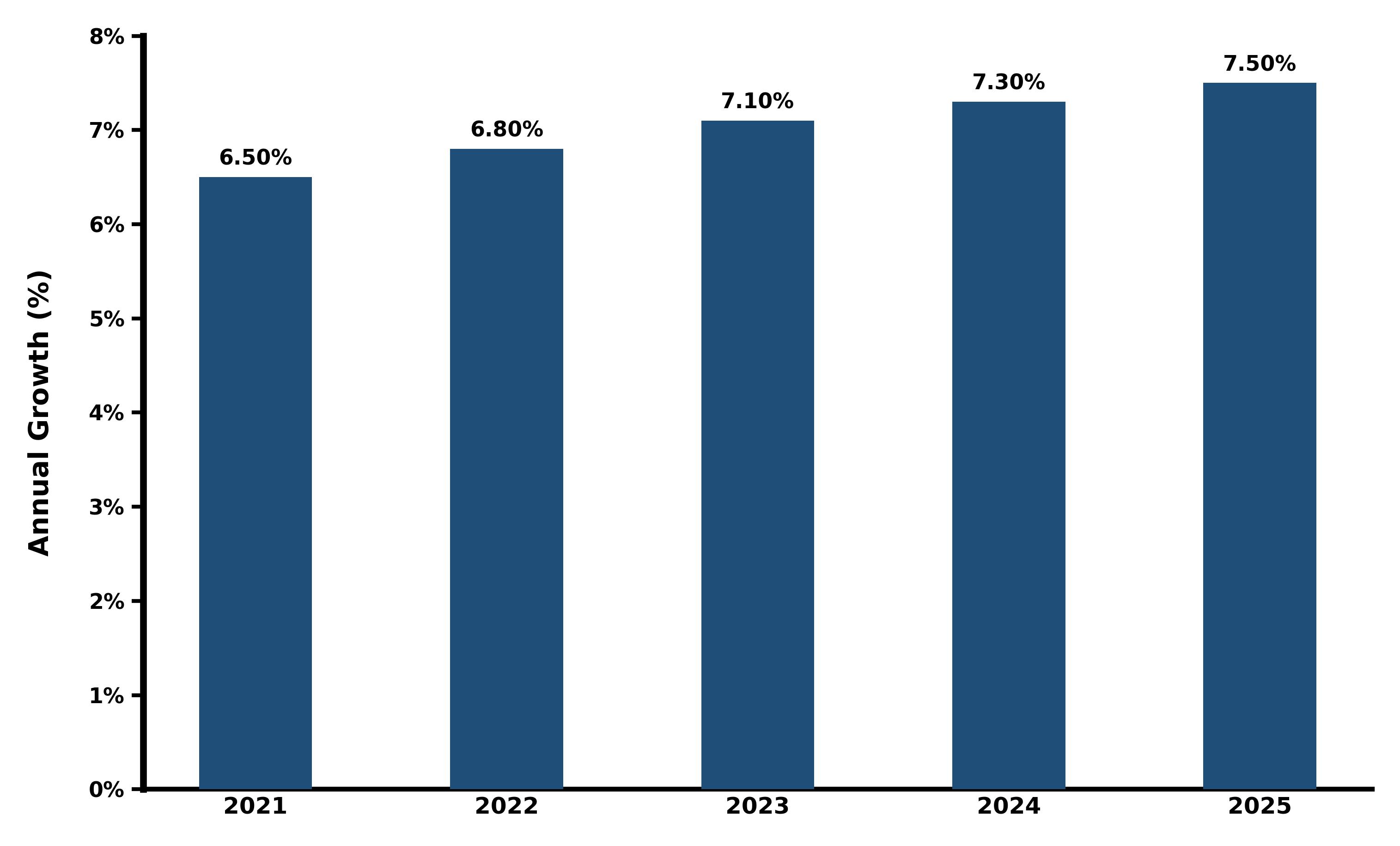
The table below presents the year‑wise growth rates along with the key drivers influencing the market
| Years | Estimated Annual Growth (%) | Growth Drivers |
| 2021 | 6.5% | Rising health awareness, preference for bottled water over sugary drinks. |
| 2022 | 6.8% | Increasing demand for functional water, especially in urban regions. |
| 2023 | 7.1% | Expansion of distribution networks in Tier 2 and Tier 3 cities. |
| 2024 | 7.3% | Government initiatives encouraging water purification and environmental issues. |
| 2025 | 7.5% | Continued growth in health-conscious consumer behavior and rising disposable income |
Topics Covered in the Japan Bottled Water Market Report
The Japan Bottled Water Market report thoroughly covers the market by quality, type, product, material, purchasing sources, pack size, and end-user packaging. The report provides a detailed analysis of ongoing market trends, opportunities, high-growth areas, and market drivers that will help stakeholders align strategies according to current and future market dynamics.
Japan Bottled Water Market Highlights
| Report Name | Japan Bottled Water Market |
| Forecast Period | 2026–2032 |
| CAGR | 8% |
| Growing Sector | Premium Water |
Japan Bottled Water Market Synopsis
The Japan Bottled Water Industry is experiencing steady growth, fueled by increasing health consciousness and growing urban areas. With better retail infrastructure, several cities are witnessing a surge in demand for premium and functional water products. Along with this, the government initiatives actively encourage the access to clean drinking water to everyone while funding for eco-friendly packaging solutions, all these factors influence market dynamics. The production of bottled water has surged due to growing number of consumers seeking convenient and hygienic products, across both urban and rural regions.
Evaluation of Growth Drivers in the Japan Bottled Water Market
Below are some prominent drivers and their influence on the market dynamics:
| Drivers | Primary Segments Affected | Why It Matters |
| Rising Health Awareness | Quality, Type, Product | Boosts demand for premium and functional water |
| Urbanization & Lifestyle Changes | Purchasing Sources, End-user Packaging | Expands retail and home delivery demand |
| Government Initiatives | Quality, Type | Improves clean water access and consumption |
| Innovation in Packaging & Sustainability | Material, End-user Packaging | Appeals to eco-conscious consumers |
| Growth of Organized Retail & E-commerce | Purchasing Sources | Enhances product availability and variety |
The Japan Bottled Water Market Size is projected to grow significantly, with a CAGR of 8% during the forecast period of 2026-2032. The market is driven by growing health-conscious consumers who require safe drinking water. Government initiatives focused on improving water supply systems and enforcing strict quality control are fostering growth. The expanding urbanization and rising disposable income, along with the development of retail and e-commerce businesses, are making bottled water products more accessible. Rising demand for high-quality, functional, and flavored water products is driving innovation and market growth across all sectors. Additionally, increasing environmental awareness is pushing companies toward more sustainable packaging solutions, thus proliferating Japan Bottled Water Market Growth.
Evaluation of Restraints in the Japan Bottled Water Market
Below are some prominent restraints and their influence on the market dynamics:
| Restraints | Primary Segments Affected | What This Means |
| Environmental Concerns over Plastic Use | Material, End-user Packaging | The use of eco-friendly alternatives is promoted instead of single-use plastic. |
| High Cost of Premium Water | Quality, Product | Restricts mass market penetration and limits broader consumer adoption. |
| Water Resource Management Issues | Type, Quality | The long-term supply stability is affected with sustainability water sourcing challenges. |
| Competition from Tap and Filtered Water | Purchasing Sources | Reduces bottled water consumption, especially in price-sensitive segments. |
| Regulatory Compliance for Packaging | Material, Product | Increases operational costs and forces investment in compliant solutions. |
Japan Bottled Water Market Challenges
The environmental issues regarding plastic waste form major difficulties for the Japan Bottled Water Market due to single-use PET bottle waste. Price-sensitive consumers show limited interest in premium and functional water products due to their high cost. The sustainable sourcing of water is hindered due to water scarcity issues. Affordable home filtration systems and accessible tap water services create competition which decreases bottled water sales. Stringent packaging regulations create higher operational expenses for manufacturers which results in negative effects on market development.
Japan Bottled Water Market Trends
Some major trends contributing to the Japan Bottled Water Market Growth are:
- Functional Water Demand Surge: The market is shifting from plain water to bottled waters fortified with vitamins, minerals, and electrolytes, catering to the growing wellness trend.
- Packaging Preference: Consumers show growing demands for environmentally friendly packaging solutions which include biodegradable plastic and glass bottles.
- Growth of Sparkling Water Segment: People now prefer sparkling water as it provides a healthier choice compared to sugary sodas.
- Health-Conscious Consumers: A large segment of consumers are switching to bottled water due to its better health advantages than sugary and carbonated drinks.
Investment Opportunities in the Japan Bottled Water Market
Here are some investment opportunities in the Japan Bottled Water Industry:
- Flavored Water Market Growth: The flavored water market will experience growth as investors see flavored water a healthier substitute for sugary beverages.
- Functional Water Innovations: The research and development of functional water which provides health advantages through immunity and energy-boosting features will create substantial market opportunities.
- Sustainable Packaging Solutions: Companies that develop biodegradable and eco-friendly packaging solutions will succeed in attracting customers who care about environmental sustainability.
- Expansion in Tier 2 and Tier 3 Cities: Bottled water brands can access untapped markets by establishing their operations in semi-urban and rural areas.
Top 5 Leading Players in the Japan Bottled Water Market
Below is the list of prominent companies leading the Japan Bottled Water Market
1. Nestlé Japan (Pure Life)
| Company Name | Nestlé Japan (Pure Life) |
|---|---|
| Established Year | 1971 |
| Headquarters | Tokyo, Japan |
| Official Website | Click Here |
Nestlé Pure Life is a prominent bottled water brand in Japan, offering purified water across various packaging sizes. The brand emphasizes clean and safe drinking water, while also promoting environmental sustainability through eco-friendly initiatives.
2. Danone Japan (Evian)
| Company Name | Danone Japan (Evian) |
|---|---|
| Established Year | 1991 |
| Headquarters | Tokyo, Japan |
| Official Website | - |
Danone Japan is a key player with its premium water brand, Evian. Known for its high-quality spring water, Danone focuses on sustainability efforts and innovative packaging to maintain its strong market presence in Japan.
3. Suntory Beverage & Food Ltd. (Suntory Natural Mineral Water)
| Company Name | Suntory Beverage & Food Ltd. (Suntory Natural Mineral Water) |
|---|---|
| Established Year | 1899 |
| Headquarters | Osaka, Japan |
| Official Website | Click Here |
Suntory is a well-established player in Japan’s bottled water market, offering a range of natural mineral water products. The company focuses on quality and sustainability, providing products that cater to health-conscious consumers.
4. Asahi Group Holdings (Asahi Soft Drinks)
| Company Name | Asahi Group Holdings (Asahi Soft Drinks) |
|---|---|
| Established Year | 1889 |
| Headquarters | Tokyo, Japan |
| Official Website | Click Here |
Asahi Group is a major player in Japan’s beverage market, offering bottled water products under the Asahi brand. The company is committed to sustainable practices and provides high-quality drinking water options for a broad consumer base.
5. Coca-Cola Japan (Minute Maid Water)
| Company Name | Coca-Cola Japan (Minute Maid Water) |
|---|---|
| Established Year | 1957 |
| Headquarters | Tokyo, Japan |
| Official Website | Click Here |
Coca-Cola Japan offers a variety of bottled water products, including Minute Maid Water. The company focuses on providing safe, purified water and has been working on sustainability initiatives in packaging.
Government Regulations in the Japan Bottled Water Market
According to Japanese government data, multiple strict regulations have been established to ensure safe and high-quality standards for bottled water. The regulations control water sourcing methods, the treatment system and packaging material requirements. The government supports sustainability through its Plastic Resource Recycling Promotion Project which helps reduce plastic waste and promotes environmentally friendly packaging methods. The regulations require companies to follow specific rules for maintaining their market position and consumer confidence.
Future Insights of the Japan Bottled Water Market
The Japan Bottled Water Market Share will experience continuous growth as consumers are becoming more health conscious and they prefer premium bottled water products. Another factor contribution to market growth is the expansion of e-commerce platforms and retail stores which continue to develop their operational capabilities. Bottled water usage will also increase as government maintains its dedication to providing clean water access and sustainable development. Furthermore, the market will develop in upcoming years with packaging innovations and changing consumer preference toward functional and flavored water products.
Market Segmentation Analysis
The report offers a comprehensive study of the following market segments and their leading categories:
Premium to Dominate the Market - By Quality
According to Rashika, Senior Research Analyst, 6Wresearch, Premium bottled water is the fastest-growing segment, driven by consumer preference for healthier and purer drinking options, particularly in urban markets. This trend is expected to continue as health awareness rises.
Mineral Water to Dominate the Market – By Type
Mineral water is expected to dominate, particularly in health-conscious urban markets, as it is preferred by consumers for its natural mineral content. It is seen as a healthier alternative.
Functional Water Bottle to Dominate the Market – By Product
The market for functional water products which contain electrolytes and vitamins is currently experiencing rapid growth as health-conscious consumers and fitness enthusiasts are showing increasing demand for these products.
Polyethylene Terephthalate (PET) to Dominate the Market – By Material
PET bottles will continue to dominate the market as they combine lightweight and durable features with cost-effective production for large-scale manufacturing. The most economical material choice remains PET as it is economical.
Online Retail Stores to Dominate the Market – By Purchasing Sources
Online retail stores are the fastest-growing source which leads the market as more consumers choose to shop online and they want to receive their purchases at home. E-commerce is changing consumer buying behavior.
501 ml - 1000 ml to Dominate the Market – By Pack Size
The 501 ml to 1000 ml pack size will dominate the market as it provides portable users with convenient access to their products. The size functions as the most suitable dimension for everyday requirements.
Plastic Bottle to Dominate the Market – By End-user Packaging
Plastic bottles remain the preferred packaging solution due to their convenience, lightweight nature, and cost-effectiveness for high-volume production. They remain a versatile option for brands.
Key Attractiveness of the Report
- 10 Years of Market Numbers
- Historical Data Starting from 2022 to 2025
- Base Year: 2025
- Forecast Data until 2032
- Key Performance Indicators Impacting the Market
- Major Upcoming Developments and Projects
Key Highlights of the Report:
- Japan Bottled Water Market Outlook
- Market Size of Japan Bottled Water Market, 2025
- Forecast of Japan Bottled Water Market, 2032
- Historical Data and Forecast of Japan Bottled Water Revenues & Volume for the Period 2022 - 2032
- Japan Bottled Water Market Trend Evolution
- Japan Bottled Water Market Drivers and Challenges
- Japan Bottled Water Price Trends
- Japan Bottled Water Porter's Five Forces
- Japan Bottled Water Industry Life Cycle
- Historical Data and Forecast of Japan Bottled Water Market Revenues & Volume By Quality for the Period 2022 - 2032
- Historical Data and Forecast of Japan Bottled Water Market Revenues & Volume By Premium for the Period 2022 - 2032
- Historical Data and Forecast of Japan Bottled Water Market Revenues & Volume By Non-Premium for the Period 2022 - 2032
- Historical Data and Forecast of Japan Bottled Water Market Revenues & Volume By Type for the Period 2022 - 2032
- Historical Data and Forecast of Japan Bottled Water Market Revenues & Volume By Still Water for the Period 2022 - 2032
- Historical Data and Forecast of Japan Bottled Water Market Revenues & Volume By Spring Water for the Period 2022 - 2032
- Historical Data and Forecast of Japan Bottled Water Market Revenues & Volume By Sparkling Water for the Period 2022 - 2032
- Historical Data and Forecast of Japan Bottled Water Market Revenues & Volume By Purified Water for the Period 2022 - 2032
- Historical Data and Forecast of Japan Bottled Water Market Revenues & Volume By Mineral Water for the Period 2022 - 2032
- Historical Data and Forecast of Japan Bottled Water Market Revenues & Volume By Product for the Period 2022 - 2032
- Historical Data and Forecast of Japan Bottled Water Market Revenues & Volume By Still Bottle Water for the Period 2022 - 2032
- Historical Data and Forecast of Japan Bottled Water Market Revenues & Volume By Packaged Drinking Water for the Period 2022 - 2032
- Historical Data and Forecast of Japan Bottled Water Market Revenues & Volume By Functional Water Bottle for the Period 2022 - 2032
- Historical Data and Forecast of Japan Bottled Water Market Revenues & Volume By Flavored Bottled Water for the Period 2022 - 2032
- Historical Data and Forecast of Japan Bottled Water Market Revenues & Volume By Distilled Bottled Water for the Period 2022 - 2032
- Historical Data and Forecast of Japan Bottled Water Market Revenues & Volume By arbonated Bottle Water for the Period 2022 - 2032
- Historical Data and Forecast of Japan Bottled Water Market Revenues & Volume By Material for the Period 2022 - 2032
- Historical Data and Forecast of Japan Bottled Water Market Revenues & Volume By Polyethylene Terephthalate (PET) for the Period 2022 - 2032
- Historical Data and Forecast of Japan Bottled Water Market Revenues & Volume By Glass for the Period 2022 - 2032
- Historical Data and Forecast of Japan Bottled Water Market Revenues & Volume By Purchasing Sources for the Period 2022 - 2032
- Historical Data and Forecast of Japan Bottled Water Market Revenues & Volume By Supermarket/Hypermarket for the Period 2022 - 2032
- Historical Data and Forecast of Japan Bottled Water Market Revenues & Volume By Online Retail Stores for the Period 2022 - 2032
- Historical Data and Forecast of Japan Bottled Water Market Revenues & Volume By Grocery Stores for the Period 2022 - 2032
- Historical Data and Forecast of Japan Bottled Water Market Revenues & Volume By Food Serving Places for the Period 2022 - 2032
- Historical Data and Forecast of Japan Bottled Water Market Revenues & Volume By E-retailers for the Period 2022 - 2032
- Historical Data and Forecast of Japan Bottled Water Market Revenues & Volume By Clubs for the Period 2022 - 2032
- Historical Data and Forecast of Japan Bottled Water Market Revenues & Volume By Home and Office Delivery for the Period 2022 - 2032
- Historical Data and Forecast of Japan Bottled Water Market Revenues & Volume By Others for the Period 2022 - 2032
- Historical Data and Forecast of Japan Bottled Water Market Revenues & Volume By Origin of Product for the Period 2022 - 2032
- Historical Data and Forecast of Japan Bottled Water Market Revenues & Volume By Imported for the Period 2022 - 2032
- Historical Data and Forecast of Japan Bottled Water Market Revenues & Volume By Domestic for the Period 2022 - 2032
- Historical Data and Forecast of Japan Bottled Water Market Revenues & Volume By Pack Size for the Period 2022 - 2032
- Historical Data and Forecast of Japan Bottled Water Market Revenues & Volume By 1501 ml and above for the Period 2022 - 2032
- Historical Data and Forecast of Japan Bottled Water Market Revenues & Volume By 1001 ml - 1500 ml for the Period 2022 - 2032
- Historical Data and Forecast of Japan Bottled Water Market Revenues & Volume By 501 ml - 1000 ml for the Period 2022 - 2032
- Historical Data and Forecast of Japan Bottled Water Market Revenues & Volume By 331 ml - 500ml for the Period 2022 - 2032
- Historical Data and Forecast of Japan Bottled Water Market Revenues & Volume By 330 ml for the Period 2022 - 2032
- Historical Data and Forecast of Japan Bottled Water Market Revenues & Volume By End-user Packaging for the Period 2022 - 2032
- Historical Data and Forecast of Japan Bottled Water Market Revenues & Volume By Plastic Bottle for the Period 2022 - 2032
- Historical Data and Forecast of Japan Bottled Water Market Revenues & Volume By Glass Bottle for the Period 2022 - 2032
- Historical Data and Forecast of Japan Bottled Water Market Revenues & Volume By Drum (Bulk) for the Period 2022 - 2032
- Historical Data and Forecast of Japan Bottled Water Market Revenues & Volume By Can for the Period 2022 - 2032
- Japan Bottled Water Import Export Trade Statistics
- Market Opportunity Assessment By Quality
- Market Opportunity Assessment By Type
- Market Opportunity Assessment By Product
- Market Opportunity Assessment By Material
- Market Opportunity Assessment By Purchasing Sources
- Market Opportunity Assessment By Origin of Product
- Market Opportunity Assessment By Pack Size
- Market Opportunity Assessment By End-user Packaging
- Japan Bottled Water Top Companies Market Share
- Japan Bottled Water Competitive Benchmarking By Technical and Operational Parameters
- Japan Bottled Water Company Profiles
- Japan Bottled Water Key Strategic Recommendations
Market Covered
The report subsequently covers the market by following segments and subsegments:
By Quality
- Premium
- Non-Premium
By Type
- Still Water
- Spring Water
- Sparkling Water
- Purified Water
- Mineral Water
By Product
- Still Bottle Water
- Packaged Drinking Water
- Functional Water Bottle
- Flavored Bottled Water
- Distilled Bottled Water
- Carbonated Bottle Water
By Material
- Polyethylene Terephthalate (PET)
- Glass
By Purchasing Sources
- Supermarket/Hypermarket
- Online Retail Stores
- Grocery Stores
- Food Serving Places
- E-retailers
- Clubs
- Home and Office Delivery
- Others
By Pack Size
- 1501 ml and above
- 1001 ml - 1500 ml
- 501 ml - 1000 ml
- 331 ml - 500 ml
- 330 ml
By End-user Packaging
- Plastic Bottle
- Glass Bottle
- Drum (Bulk)
- Can






































