Japan Canvas Market Size, Share & Growth Rate
The Japan Canvas Market was estimated at USD 98 Million in 2025 and is projected to reach USD 105 Million by 2032, growing at a CAGR of 1.0% from 2026 to 2032. This growth trajectory reflects a robust demand for high-quality canvas products driven by an increasing interest in sustainability and eco-conscious consumption. Factors such as a rising disposable income and a burgeoning DIY culture further fuel the market's expansion, making it a vibrant area for both investment and innovation.
Japan Canvas Market Year-wise Growth Rate and Key Drivers
This graph highlights how the Japan Canvas Market has steadily grown over the years, supported by major growth factors.
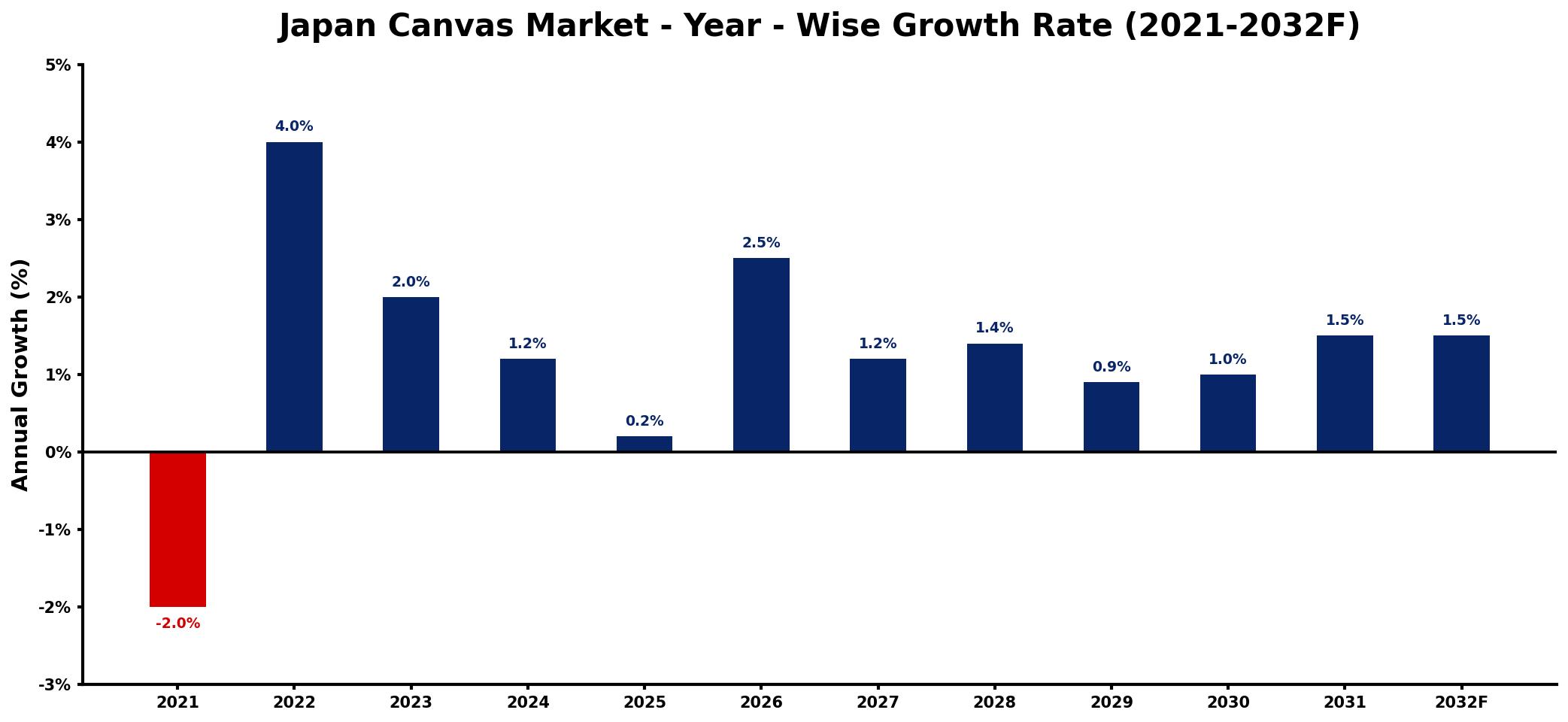
The table below presents the year‑wise growth rates along with the key drivers influencing the market
| Year | Growth Rate | Major Drivers |
| 2021 | -2.0% | decreased consumer spending on art |
| 2022 | 4.0% | emerging interest in home decor |
| 2023 | 2.0% | rise in online art sales |
| 2024 | 1.2% | expansion of art education programs |
| 2025 | 0.2% | increased investment in local artists |
| 2026 | 2.5% | growth in eco-friendly materials |
| 2027 | 1.2% | surge in DIY craft projects |
| 2028 | 1.4% | increase in social media influence |
| 2029 | 0.9% | strengthening international trade flows |
| 2030 | 1.0% | increased capital investment inflows |
| 2031 | 1.5% | enhanced product quality standards |
| 2032 | 1.5% | increased collaboration with designers |
Note: Market size estimations and growth projections presented in this report are based on 6Wresearch's proprietary forecasting methodology, utilizing the latest available industry data, government publications, and primary research inputs.
Japan Canvas Market Synopsis
Currently, the Japan Canvas Market is witnessing a notable shift as consumers increasingly opt for durable and versatile canvas products. This trend spans across several industries, including art, fashion, and home decor, reinforcing a cultural preference for craftsmanship and quality.
As sustainability becomes a cornerstone of purchasing decisions, Japanese consumers are gravitating towards canvas products crafted from organic or recycled materials. This surge in eco-consciousness, combined with an affinity for personalized and unique designs, is redefining market dynamics.
Japan Canvas Market Key Takeaways
- The market is experiencing steady growth, driven by the demand for sustainable and high-quality canvas products.
- Customization and personalization are key trends, with consumers favoring unique designs and prints.
- Intense competition persists, with both domestic and international manufacturers vying for market share.
- E-commerce platforms play a vital role in enhancing consumer access to a wide variety of canvas products.
- Government policies are increasingly supportive of the arts, promoting a conducive environment for canvas production.
Evaluation of Restraints in Japan Canvas Market
Despite its growth potential, the Japan Canvas Market faces several constraints that may hinder its progress. Intense competition among manufacturers, both domestic and international, creates pricing pressures that can impact profitability. Additionally, fluctuations in raw material costs, especially for cotton and synthetic fibers, pose challenges for maintaining stable production costs. The shift towards sustainable products means that companies must constantly innovate to meet changing consumer preferences, which can strain resources. Moreover, economic uncertainties can influence consumer spending patterns, making it critical for businesses to adapt swiftly to maintain their market positions.
Japan Canvas Market Trends
The landscape of the Japan Canvas Market is evolving, with sustainability emerging as a pivotal trend. Consumers are increasingly seeking canvas products that align with their eco-friendly values, favoring those made from organic cotton or recycled materials. Moreover, the customization movement is gaining momentum, as buyers desire canvas items that reflect their individuality and personal style.
Technological advancements are also shaping the market; innovations like digital printing and water-based coatings are enhancing the production of high-quality, durable canvas products. Meanwhile, e-commerce platforms are revolutionizing the shopping experience, allowing consumers to access a broader array of designs and materials conveniently.
Japan Canvas Market Opportunities
Investors have a wealth of opportunities within the Japan Canvas Market. The growing demand for premium, eco-friendly canvas products across art, fashion, and home decor sectors opens avenues for manufacturers specializing in sustainable practices. The rise of online marketplaces represents another significant investment opportunity, as digital platforms can enhance consumer engagement and broaden the reach of canvas products. Furthermore, tapping into niche markets that focus on unique and customized canvas offerings can provide an edge in a competitive landscape.
Government Initiatives in the Japan Canvas Market
The Japan Canvas Market is supported by government policies aimed at fostering the arts and cultural sectors. The Agency for Cultural Affairs plays a pivotal role in promoting artistic materials, including canvas, through grants and funding opportunities for creators and organizations. Regulations protecting intellectual property rights ensure fair competition, while initiatives encouraging the preservation of traditional art forms contribute positively to the canvas market. Collectively, these government efforts create an environment conducive to growth and innovation.
Future Insights of the Japan Canvas Market
Looking ahead to 2026-2032, the Japan Canvas Market is poised for sustained growth driven by evolving consumer preferences. With an increasing focus on sustainability, consumers will continue to seek out durable, eco-friendly canvas options. The burgeoning DIY culture and customization trend will also play critical roles in shaping market dynamics. Additionally, advancements in production technology are expected to enhance the quality and variety of canvas offerings, creating further opportunities for market participants to innovate and differentiate themselves.
Japan Canvas Market Latest Developments (2025 - 2026)
Recent developments in the Japan Canvas Market indicate a robust push towards sustainability, with several initiatives aimed at increasing the availability of eco-friendly canvas products. Concurrently, there has been a notable rise in online retailers focusing on customized canvas offerings, catering to the growing demand for personalized art and home decor solutions. Moreover, collaborations between traditional artists and modern technology companies are paving the way for innovative applications of canvas materials in various artistic expressions.
Japan Canvas Market - Key Attractiveness of the Report
- 10 Years of Market Numbers
- Historical Data Starting from 2022 to 2025
- Base Year: 2025
- Forecast Data until 2032
- Key Performance Indicators Impacting the Market
- Major Upcoming Developments and Projects
Key Highlights of the Report:
- Japan Canvas Market Outlook
- Market Size of Japan Canvas Market, 2025
- Forecast of Japan Canvas Market, 2032
- Historical Data and Forecast of Japan Canvas Revenues & Volume for the Period 2022-2032F
- Japan Canvas Market Trend Evolution
- Japan Canvas Market Drivers and Challenges
- Japan Canvas Price Trends
- Japan Canvas Porter's Five Forces
- Japan Canvas Industry Life Cycle
- Historical Data and Forecast of Japan Canvas Market Revenues & Volume By Types for the Period 2022-2032F
- Historical Data and Forecast of Japan Canvas Market Revenues & Volume By Plane Canvas for the Period 2022-2032F
- Historical Data and Forecast of Japan Canvas Market Revenues & Volume By Duck Canvas for the Period 2022-2032F
- Historical Data and Forecast of Japan Canvas Market Revenues & Volume By Application for the Period 2022-2032F
- Historical Data and Forecast of Japan Canvas Market Revenues & Volume By Tent for the Period 2022-2032F
- Historical Data and Forecast of Japan Canvas Market Revenues & Volume By Luggage Fabric for the Period 2022-2032F
- Historical Data and Forecast of Japan Canvas Market Revenues & Volume By Automotive Fabric for the Period 2022-2032F
- Historical Data and Forecast of Japan Canvas Market Revenues & Volume By Apparel for the Period 2022-2032F
- Historical Data and Forecast of Japan Canvas Market Revenues & Volume By Others for the Period 2022-2032F
- Japan Canvas Import Export Trade Statistics
- Market Opportunity Assessment By Types
- Market Opportunity Assessment By Application
- Japan Canvas Top Companies Market Share
- Japan Canvas Competitive Benchmarking By Technical and Operational Parameters
- Japan Canvas Company Profiles
- Japan Canvas Key Strategic Recommendations






































