Japan Cassava Market Size & Growth Rate
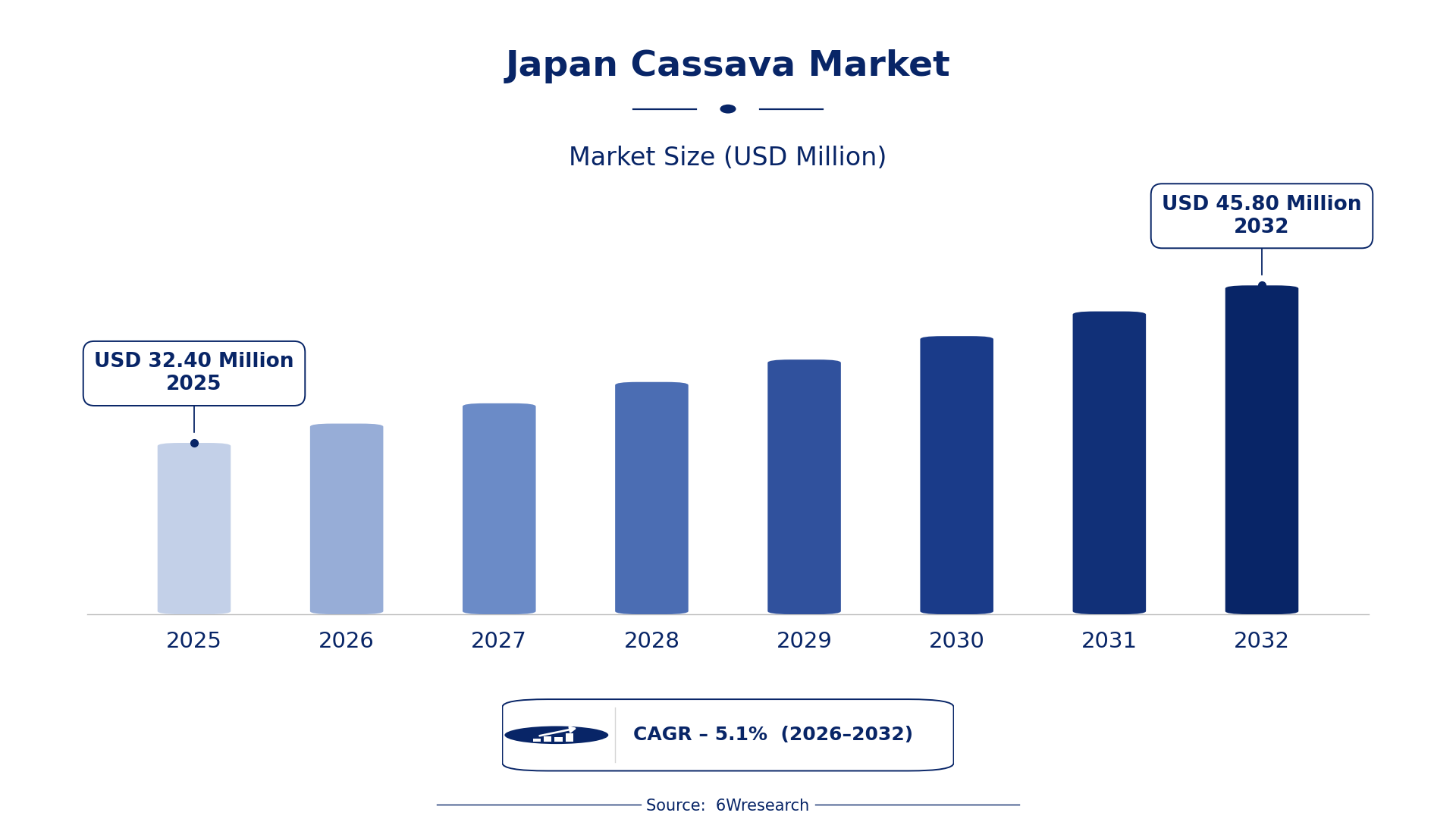
According to 6Wresearch internal database and industry insights, the Japan Cassava Market was valued at USD 32.40 Million in 2025 and is projected to reach USD 45.80 Million by 2032, growing at a CAGR of approximately 5.1% during 2026–2032.
Japan Cassava Market Highlights
| Report Metric | Details |
| Report Name | Japan Cassava Market (2026-2032) |
| Market Size 2025 | USD 32.40 Million |
| Market Size 2032 | USD 45.80 Million |
| Absolute Growth 2025–2032 | USD 13.40 Million |
| CAGR 2026–2032 | 5.1% |
| Peak Annual Growth | 5.8% in 2031 |
| Forecast Period | 2026–2032 |
| Historical Data | 2022–2025 |
| Base Year | 2025 |
| Leading Category, 2025 | Conventional (61% share) |
| Leading Form, 2025 | Solid (61% share) |
| Leading Application, 2025 | Food & Beverages (52% share) |
| Fastest-Growing Category | Organic (6.7% CAGR) |
| Fastest-Growing Form | Liquid (7.0% CAGR) |
| Fastest-Growing Application | Animal Feed (6.8% CAGR) |
| Growing Sector | Food & Beverages |
| Key End Users | Food manufacturers, livestock producers, snack producers, agricultural cooperatives |
Japan Cassava Market Year-wise Growth Rate and Key Drivers (2022–2032)
This graph illustrates the annual growth rates of the market from 2022 to 2032, highlighting a steady upward trajectory and projected market expansion over the forecast period.
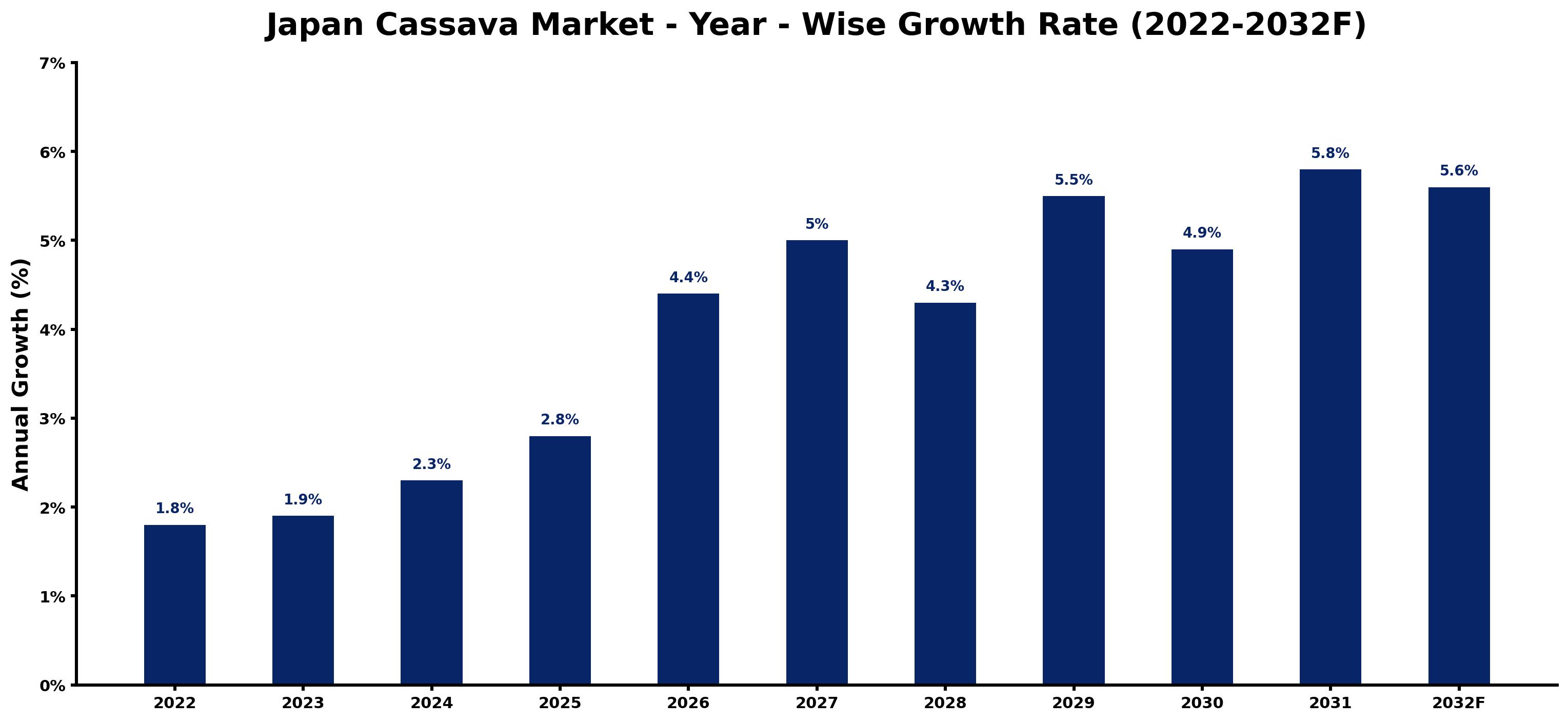
Each row of the following table gives one year's estimated growth and the event or demand shift that explains it.
| Year | Estimated Annual Growth (%) | Market Rationale |
| 2022 | 1.8 | The market experienced steady growth due to increasing consumer awareness of cassava's versatility. |
| 2023 | 1.9 | Growth was driven by rising demand for gluten-free options in food applications. |
| 2024 | 2.3 | The introduction of innovative cassava-based snacks contributed to faster growth this year. |
| 2025 | 2.8 | The market expanded as food manufacturers increased their reliance on cassava flour. |
| 2026 | 4.4 | Demand is expected to surge as the government promotes alternative crops like cassava. |
| 2027 | 5.0 | The rise in usage for animal feed will drive further growth in the cassava market. |
| 2028 | 4.3 | Growth is projected to slow slightly as the market adjusts to previous rapid increases. |
| 2029 | 5.5 | The market is expected to rebound with renewed interest in cassava-based beverages. |
| 2030 | 4.9 | A slight slowdown is anticipated as competition intensifies among cassava suppliers. |
| 2031 | 5.8 | The peak growth is projected to be supported by advancements in cassava processing techniques. |
| 2032 | 5.6 | Growth is expected to stabilise as the market matures and consumer preferences solidify. |
Note: Market size estimations and growth projections presented in this report are based on 6Wresearch's proprietary forecasting methodology, utilizing the latest available industry data, government publications, and primary research inputs.
Japan Cassava Market Synopsis
Cassava is a starchy root vegetable processed into flour and starch, primarily used in food products and animal feed. The Japan Cassava Market is expanding due to increasing consumer demand for gluten-free options and government initiatives promoting alternative crops. In 2023, a new program was launched to support cassava cultivation, while the average annual consumption of cassava products is approximately 200,000 tons, indicating a strong market for both domestic and imported cassava.
Market Dynamics Impact Analysis (2026–2032)
| Factor | Type | Impact | Primary Segment Affected |
| Increasing demand for gluten-free products drives cassava flour consumption. | Driver | High | Solid |
| Government initiatives promote alternative crops, boosting cassava cultivation. | Driver | High | Conventional |
| Growing popularity of tapioca pearls in beverages creates new market opportunities. | Opportunity | High | Food & Beverages |
| Rising animal feed requirements present a significant opportunity for cassava suppliers. | Opportunity | High | Animal Feed |
| Limited consumer awareness of cassava's benefits restrains market growth. | Restraint | Medium | Organic |
| Dependence on imports for cassava may affect supply stability. | Restraint | Medium | Conventional |
| High production costs for cassava farmers limit profitability. | Challenge | High | Conventional |
| Competition from other gluten-free alternatives poses a challenge. | Challenge | Medium | Food & Beverages |
Evaluation of Drivers in Japan Cassava Market (2026–2032)
The factors lifting demand, and the evidence behind each, are summarised below.
| Drivers | Primary Segment Affected | Why It Matters (Evidence) |
| Rising consumer preference for gluten-free products increases demand for cassava flour. | Solid | In 2022, gluten-free product sales surged, leading food manufacturers to source more cassava flour. |
| Government support for alternative crop initiatives boosts cassava cultivation. | Conventional | In 2023, the government launched a program aimed at increasing cassava production. |
| Growing popularity of tapioca pearls in beverages drives cassava starch demand. | Food & Beverages | The average annual consumption of cassava products in Japan is approximately 200,000 tons. |
| Increased livestock production raises demand for cassava in animal feed. | Animal Feed | Animal feed accounts for about 20% of cassava usage in Japan. |
| Expansion of cassava processing facilities increases market capacity. | Solid | The Japan Food Industry Association promotes the use of cassava in food products. |
The strongest pull on demand comes from rising consumer preference for gluten-free products, as sales surged in 2022, prompting food manufacturers to source more cassava flour. The growing popularity of tapioca pearls in beverages drives cassava starch demand, with annual consumption reaching approximately 200,000 tons. The expansion of cassava processing facilities increases market capacity, supported by local agricultural cooperatives improving production capabilities. Rising livestock production further increases the need for cassava in animal feed, which accounts for about 20% of total usage.
Evaluation of Restraints in Japan Cassava Market
Several factors work against faster growth; the main ones are summarised below.
| Market Restraint | Primary Segment Affected | Why It Matters (Evidence) |
| Limited consumer awareness of cassava's benefits restricts market growth. | Organic | Despite its advantages, consumer knowledge about cassava remains low, affecting sales. |
| Dependence on imports for cassava may affect supply stability. | Conventional | Japan imports cassava primarily from Southeast Asia, especially Thailand, which can lead to supply disruptions. |
| High production costs for cassava farmers limit profitability. | Conventional | Farmers face rising costs in cultivation and processing, impacting their profit margins. |
| Competition from other gluten-free alternatives poses a challenge. | Food & Beverages | The market for gluten-free products is crowded, making it difficult for cassava to stand out. |
| Regulatory compliance costs can burden cassava processors. | Solid | Compliance with food safety standards like ISO 22000 increases operational costs for processors. |
Japan Cassava Market Challenges
A shortage of skilled workers in cassava processing limits production capacity, causing delays for producers. Stringent regulations under the Food Sanitation Act impose compliance costs on suppliers, which can increase prices for buyers. Heavy reliance on imports from Southeast Asia creates supply chain risks, potentially leading to delays and higher costs for end users. Price fluctuations in cassava products disrupt purchasing strategies for buyers, resulting in stock shortages and uncertainty in the food sector.
Trends in the Japan Cassava Market
Several trends are reshaping the Japan Cassava Market; the most important are set out below.
- Shift from Conventional to Organic Cultivation: Since 2023, there has been a notable shift towards organic cassava cultivation, driven by consumer demand for healthier options. Approximately 6.7% CAGR is projected for organic cassava, indicating a growing market segment.
- Transition to Cassava-Based Snacks: The popularity of cassava-based snacks has surged, with sales increasing notably. This trend is evident in regions like Okinawa, where local producers are capitalising on consumer preferences.
- Emergence of Cassava in Animal Feed: In 2023, the use of cassava in animal feed formulations gained traction, with a projected CAGR of 6.8%. Livestock producers are increasingly incorporating cassava to meet nutritional needs.
- Prioritisation of Gluten-Free Products: The gluten-free market has prioritised cassava flour as a key ingredient, particularly in Japan's food sector. The average annual consumption of cassava products reflects this shift, reaching approximately 200,000 tons.
Investment Opportunities in the Japan Cassava Market
Several openings in the Japan Cassava Market merit attention from investors.
- Invest in Cassava Processing Facilities: With the average annual consumption of cassava products at around 200,000 tons, there is a pressing need for more processing facilities. Collaborating with local agricultural cooperatives can facilitate market entry.
- Supply Cassava for Animal Feed: As animal feed accounts for about 20% of cassava usage, there is a significant opportunity to supply this sector. Engaging with livestock producers in regions like Kumamoto can facilitate market penetration.
- Capitalize on Gluten-Free Trends: The growing demand for gluten-free products presents an opportunity to supply cassava flour. Targeting food manufacturers in urban areas can yield substantial returns, especially with rising health consciousness.
- Expand Organic Cassava Cultivation: The shift towards organic cassava cultivation, projected to grow at 6.7%, offers a timely investment opportunity. Partnering with local farmers can streamline entry into this emerging market.
Government Initiatives in the Japan Cassava Market
Regulations governing cassava production and processing in Japan are shaped by several key laws. The Food Recycling Law, enacted in 2000, mandates food businesses to reduce waste and recycle it into feed, fertiliser, and energy. The Food Sanitation Act amendment in 2018 introduced a system for evaluating synthetic resins, which has been in force since June 2020. These regulations ensure food safety and quality in cassava processing, ultimately benefiting consumers and producers alike.
Support for cassava farmers is provided through various initiatives. In 2023, a new subsidy program was introduced to improve productivity among cassava farmers, while the Japan Food Industry Association promotes the use of cassava in food products, ensuring compliance with food safety standards and encouraging market growth.
Future Insight of the Japan Cassava Market
Food sector buyers will benefit from improved product quality as ISO 22000 standards gain traction by 2032. A government subsidy program will boost cassava farmer productivity, leading to an increase in domestic production by 15%. Technological advancements in processing will improve efficiency, ensuring a steady supply of cassava flour for gluten-free products. Growing consumer demand for tapioca pearls will encourage suppliers to expand their product offerings, reinforcing cassava's importance in Japan's culinary landscape.
Market Segmentation Analysis
Japan Cassava Market report covers a detailed analysis of the following market segments:
By Category – Conventional Leads, Organic Expected to Grow Fastest
According to Sachin Kumar Rai, Senior Research Analyst at 6Wresearch, with 61% of category revenue in 2025, Conventional was the largest category. The conventional segment holds the largest share due to its extensive use in food products and animal feed, particularly in gluten-free applications. This segment benefits from a robust supply chain and strong consumer acceptance across regions in Japan. Organic is projected to grow fastest, at a CAGR of 6.7% during 2026–2032. The organic segment is growing rapidly as consumer preferences shift towards healthier options, with government support for alternative crops boosting its appeal. This trend is likely to continue as awareness of organic benefits increases among consumers. Suppliers should consider expanding their organic offerings to meet the rising demand for healthier food products.
By Form – Solid Leads, Liquid Expected to Grow Fastest
The largest form category in 2025 was Solid, at 61% of revenue. Solid forms dominate the market as they are primarily used in the production of flour and starch, which are essential ingredients in numerous food applications. The established processing methods for solid cassava products contribute to their widespread acceptance. Liquid is set to record the highest CAGR in this split, 7.0% over 2026–2032. Liquid forms are gaining traction due to their specific applications in food formulations, catering to niche markets. As manufacturers explore diverse uses for cassava, the demand for liquid forms is expected to rise. Suppliers may need to diversify their product offerings to include liquid forms to capture emerging market opportunities.
By Application – Food & Beverages Lead, Animal Feed Expected to Grow Fastest
Food & Beverages took 52% of application revenue in 2025, more than any other category. The food and beverages segment leads the market, primarily due to the high demand for cassava in popular items such as tapioca and various snacks. This application enjoys strong consumption patterns and well-established distribution channels throughout Japan. The quickest growth will come from Animal Feed, forecast to expand at a CAGR of 6.8% between 2026 and 2032. The animal feed segment is experiencing rapid growth as livestock producers look for cost-effective and sustainable feed alternatives, with cassava being a viable option. The increasing focus on sustainable agricultural practices is further driving this segment's expansion. Buyers in the animal feed sector should assess cassava's potential to enhance their feed formulations.
Key Attractiveness of the Report
- 10 Years of Market Numbers
- Historical Data Starting from 2022 to 2025
- Base Year 2025
- Forecast Data until 2032
- Key Performance Indicators Impacting the Market
- Major Upcoming Developments and Projects
Key Highlights of the Report:
- Japan Cassava Market Outlook
- Market Size of Japan Cassava Market, 2025
- Forecast of Japan Cassava Market, 2032
- Historical Data and Forecast of Japan Cassava Revenues & Volume for the Period 2022-2032
- Japan Cassava Market Trend Evolution
- Japan Cassava Market Drivers and Challenges
- Japan Cassava Price Trends
- Japan Cassava Porter's Five Forces
- Japan Cassava Industry Life Cycle
- Historical Data and Forecast of Japan Cassava Market Revenues & Volume By Category for the Period 2022-2032
- Historical Data and Forecast of Japan Cassava Market Revenues & Volume By Organic for the Period 2022-2032
- Historical Data and Forecast of Japan Cassava Market Revenues & Volume By Conventional for the Period 2022-2032
- Historical Data and Forecast of Japan Cassava Market Revenues & Volume By Form for the Period 2022-2032
- Historical Data and Forecast of Japan Cassava Market Revenues & Volume By Solid for the Period 2022-2032
- Historical Data and Forecast of Japan Cassava Market Revenues & Volume By Liquid for the Period 2022-2032
- Historical Data and Forecast of Japan Cassava Market Revenues & Volume By Application for the Period 2022-2032
- Historical Data and Forecast of Japan Cassava Market Revenues & Volume By Food & Beverages for the Period 2022-2032
- Historical Data and Forecast of Japan Cassava Market Revenues & Volume By Animal Feed for the Period 2022-2032
- Historical Data and Forecast of Japan Cassava Market Revenues & Volume By Others for the Period 2022-2032
- Japan Cassava Import Export Trade Statistics
- Market Opportunity Assessment By Category
- Market Opportunity Assessment By Form
- Market Opportunity Assessment By Application
- Japan Cassava Top Companies Market Share
- Japan Cassava Competitive Benchmarking By Technical and Operational Parameters
- Japan Cassava Company Profiles
- Japan Cassava Key Strategic Recommendations
Market Covered
The study includes the following segmentation.
By Category
- Organic
- Conventional
By Form
- Solid
- Liquid
By Application
- Food & Beverages
- Animal Feed
- Others































