Japan Ceramic Sanitary Ware Market Size & Growth Rate
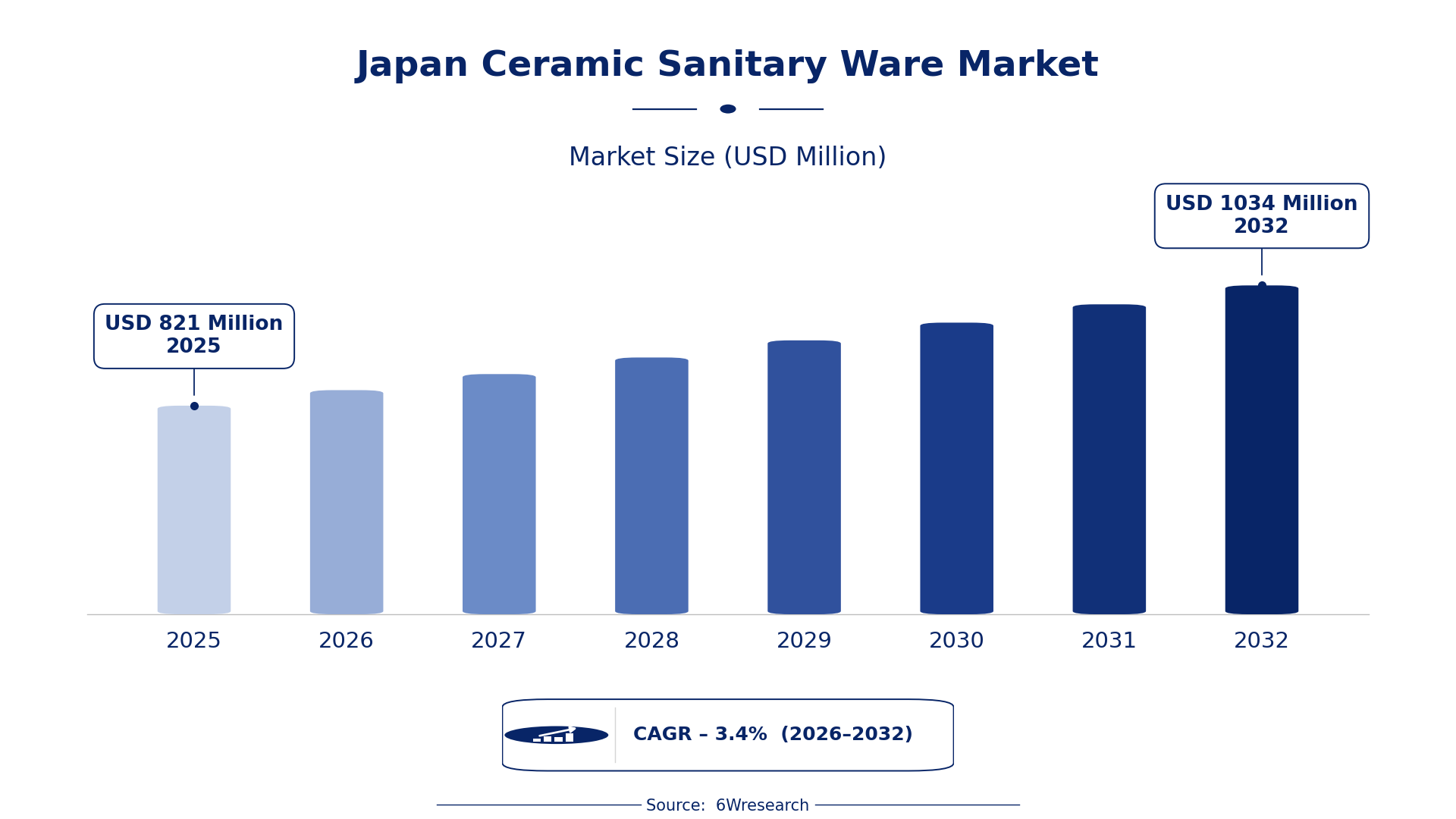
According to 6Wresearch internal database and industry insights, the Japan Ceramic Sanitary Ware Market was valued at USD 821 Million in 2025 and is projected to reach USD 1,034 Million by 2032, growing at a CAGR of approximately 3.4% during 2026–2032.
Japan Ceramic Sanitary Ware Market Highlights
| Report Metric | Details |
| Report Name | Japan Ceramic Sanitary Ware Market (2026-2032) |
| Market Size 2025 | USD 821 Million |
| Market Size 2032 | USD 1,034 Million |
| Absolute Growth 2025–2032 | USD 213 Million |
| CAGR 2026–2032 | 3.4% |
| Peak Annual Growth | 4.3% in 2028 |
| Forecast Period | 2026–2032 |
| Historical Data | 2022–2025 |
| Base Year | 2025 |
| Leading Type, 2025 | Toilet sinks/Water closets (69% share) |
| Leading Application, 2025 | Commercial (59% share) |
| Leading Technology, 2025 | Slip casting (49% share) |
| Fastest-Growing Type | Washbasins (4.7% CAGR) |
| Fastest-Growing Application | Residential (4.5% CAGR) |
| Fastest-Growing Technology | Pressure casting (4.8% CAGR) |
| Growing Sector | Residential |
| Key End Users | Construction firms, property developers, public facilities, homeowners |
Japan Ceramic Sanitary Ware Market Year-wise Growth Rate and Key Drivers (2022–2032)
This graph illustrates the annual growth rates of the market from 2022 to 2032, highlighting a steady upward trajectory and projected market expansion over the forecast period.
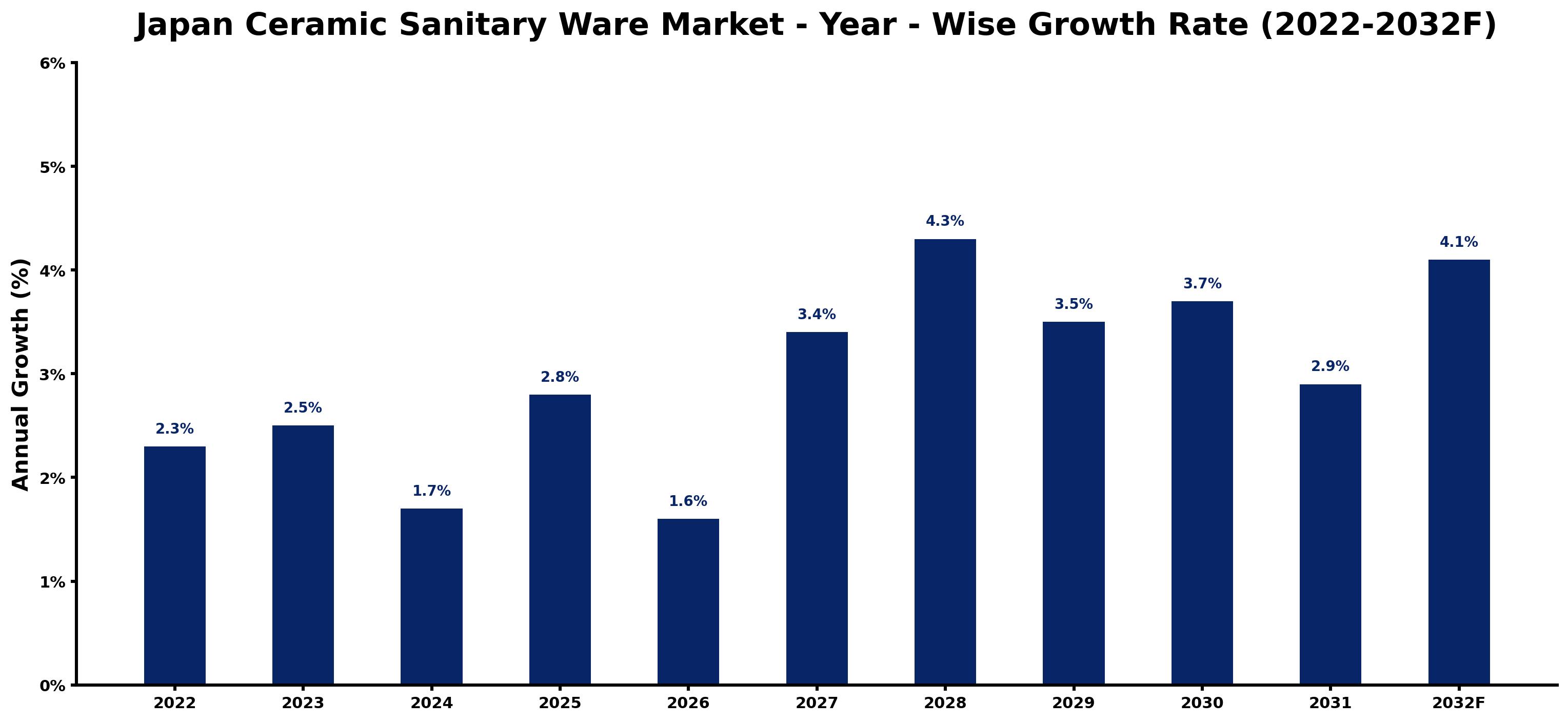
Each row of the following table gives one year's estimated growth and the event or demand shift that explains it.
| Year | Estimated Annual Growth (%) | Market Rationale |
| 2022 | 2.3 | The market experienced steady growth due to ongoing construction projects and stable demand. |
| 2023 | 2.5 | Demand increased as the construction sector expanded and residential projects gained momentum. |
| 2024 | 1.7 | Growth slowed as market saturation began to affect new residential developments. |
| 2025 | 2.8 | The market saw a resurgence in demand driven by urban development and infrastructure projects. |
| 2026 | 1.6 | Growth is expected to slow due to a temporary dip in construction activity and supply chain issues. |
| 2027 | 3.4 | Increased investments in eco-friendly building materials will boost market demand. |
| 2028 | 4.3 | The peak growth year will see a surge in demand from both residential and commercial sectors. |
| 2029 | 3.5 | Growth is projected to slow slightly as the market adjusts to previous high levels of demand. |
| 2030 | 3.7 | Demand will rise again as new eco-friendly initiatives are implemented in construction. |
| 2031 | 2.9 | Growth is expected to slow as the market stabilises after a period of rapid expansion. |
| 2032 | 4.1 | The market is projected to grow due to ongoing urbanisation and sustainability efforts. |
Note: Market size estimations and growth projections presented in this report are based on 6Wresearch's proprietary forecasting methodology, utilizing the latest available industry data, government publications, and primary research inputs.
Japan Ceramic Sanitary Ware Market Synopsis
Ceramic sanitary ware includes essential plumbing fixtures such as toilets, sinks, and washbasins, made from high-fired clay and durable materials. The Japan Ceramic Sanitary Ware Market is valued at approximately 200 billion yen, driven by residential demand and ongoing construction projects. The Tokyo metropolitan area leads in demand, while the 2023 programme promoting eco-friendly building materials further stimulates growth. With a large population influencing consumption patterns, the market is set for steady expansion.
Market Dynamics Impact Analysis (2026–2032)
| Factor | Type | Impact | Primary Segment Affected |
| Growing urbanisation and infrastructure projects | Driver | High | Residential |
| Increased focus on eco-friendly building materials | Driver | High | Commercial |
| Emerging demand for innovative designs in sanitary ware | Opportunity | Medium | Residential |
| Rising investments in public facilities and infrastructure | Opportunity | Medium | Commercial |
| Market saturation in urban areas | Restraint | High | Residential |
| Supply chain disruptions affecting production | Restraint | Medium | Commercial |
| High competition among manufacturers | Challenge | High | Residential |
| Fluctuating raw material prices impacting costs | Challenge | Medium | Commercial |
Evaluation of Drivers in Japan Ceramic Sanitary Ware Market (2026–2032)
Demand rests on the following drivers, each shown with the segment it touches most.
| Drivers | Primary Segment Affected | Why It Matters (Evidence) |
| Increased construction activity | Residential | The construction sector's growth, projected to expand by 2.5% annually, drives demand for sanitary ware, particularly in urban areas like Tokyo. |
| Focus on sustainability | Commercial | The push for eco-friendly materials, supported by government initiatives, encourages buyers to invest in sustainable sanitary ware. |
| Technological advancements in manufacturing | Residential | Innovations in slip casting and pressure casting improve product quality, prompting higher purchases from builders and homeowners. |
| Rising population and household formation | Residential | With a population of approximately 125 million, the increasing number of households fuels demand for sanitary fixtures. |
| Regulatory standards for quality and safety | Commercial | Compliance with JIS standards ensures safety and quality, motivating buyers to invest in certified sanitary ware. |
Buyers are adding capacity as construction activity increases, with public infrastructure projects projected to rise significantly. The population of approximately 125 million drives demand for residential sanitary ware, particularly in urban areas. Recent advancements in manufacturing methods, such as pressure casting, enhance product quality, leading to increased purchases. Compliance with JIS standards motivates commercial buyers to invest in high-quality sanitary ware, ensuring safety and reliability in public facilities.
Evaluation of Restraints in Japan Ceramic Sanitary Ware Market
The key brakes on demand, and where they bite hardest, are shown below.
| Market Restraint | Primary Segment Affected | Why It Matters (Evidence) |
| Market saturation in urban areas | Residential | As urban development peaks, the demand for new sanitary ware installations slows, affecting sales. |
| Supply chain disruptions | Commercial | Ongoing supply chain issues cause delays in production, impacting the availability of sanitary ware. |
| High competition among manufacturers | Residential | Intense competition drives prices down, impacting profit margins for manufacturers in the market. |
| Fluctuating raw material prices | Commercial | Rising costs of raw materials increase production expenses, affecting pricing for buyers. |
| Regulatory compliance costs | Residential | Manufacturers face increased costs to meet JIS standards, which may limit their pricing flexibility. |
Japan Ceramic Sanitary Ware Market Challenges
Rising raw material costs pose challenges for buyers, especially in the Tokyo metropolitan area, where project budgets can increase by up to 15%. Frequent supply chain disruptions delay critical components, extending production timelines by an average of four weeks for manufacturers. A shortage of skilled labour in the ceramic sanitary ware sector limits production capacity, causing producers to forfeit approximately 10% of potential sales. Intense competition from alternative plumbing fixtures pressures suppliers to reduce prices, potentially diminishing profit margins by 5% and restricting investments in quality improvements.
Trends in the Japan Ceramic Sanitary Ware Market
The trends below show where the Japan Ceramic Sanitary Ware Market is heading.
- Shift Towards Eco-Friendly Materials: Since 2023, there has been a notable shift towards eco-friendly building materials in Japan. The Ministry of Land, Infrastructure, Transport and Tourism's programme promotes sustainable practices, leading to a significant increase in demand for eco-friendly sanitary ware.
- Transition from Traditional to Modern Designs: Beginning in 2023, the Tokyo Architecture Festival showcased new designs in sanitary ware. This trend reflects changing consumer preferences, with a reported increase in demand for modern styles.
- Emergence of Smart Sanitary Ware: The introduction of smart sanitary ware products in 2023 has transformed consumer expectations. With a projected growth in this segment, buyers are increasingly seeking technology-integrated solutions.
- Growing Popularity of Washbasins: The demand for washbasins has surged, particularly in residential settings. As households average 1.5 bathrooms, the market for washbasins is expected to grow significantly.
Investment Opportunities in the Japan Ceramic Sanitary Ware Market
The opportunities below stand out in the Japan Ceramic Sanitary Ware Market for new entrants and existing suppliers.
- Investment in Eco-Friendly Products: With the government's target to reduce water usage by 20% by 2030, there is an opportunity to invest in eco-friendly sanitary ware. Commercial buyers are particularly interested in sustainable solutions.
- Expansion in Urban Areas: The Tokyo metropolitan area, with its high population density, presents a prime opportunity for manufacturers to supply ceramic sanitary ware. The ongoing urbanisation trend supports this investment.
- Collaboration with Local Builders: Partnering with local construction firms can facilitate entry into the market. This approach is particularly beneficial in regions experiencing rapid development, such as Osaka.
- Focus on Innovative Designs: With a growing consumer preference for modern designs, investing in unique sanitary ware can capture market share. The residential segment is actively seeking stylish products.
Government Initiatives in the Japan Ceramic Sanitary Ware Market
The GX Basic Policy, adopted in 2023, aims for JPY 150 trillion in public-private decarbonisation investment over the next decade. This policy promotes eco-friendly building materials, impacting ceramic sanitary ware producers by encouraging sustainable practices.
The Ministry of Environment oversees the Waste Management and Public Cleansing Act, ensuring that manufacturers comply with waste disposal regulations. This act, along with the Water Supply Act, sets standards that benefit buyers by ensuring the safety and quality of ceramic sanitary ware.
Future Insight of the Japan Ceramic Sanitary Ware Market
Innovations in water-efficient fixtures will reshape buyer preferences by 2032, aligning with the government's target to reduce water usage in buildings by 20% by 2030. Smart technologies will enhance water management, appealing to eco-conscious consumers. New designs showcased at the Tokyo 2023 Architecture Festival will elevate both functionality and aesthetics in ceramic sanitary ware. Growth in the construction sector will create ongoing demand for durable products, ensuring steady opportunities for suppliers.
Market Segmentation Analysis
Japan Ceramic Sanitary Ware Market report covers a detailed analysis of the following market segments:
By Type – Toilet sinks/Water closets Lead, Washbasins Expected to Grow Fastest
According to Shubham Deep, Research Manager at 6Wresearch, in 2025, Toilet sinks/Water closets led the type split with a 69% share. Toilet sinks and water closets dominate the market due to their essential role in sanitation across both residential and commercial settings. In urban regions like Tokyo, the high population density creates a pressing need for reliable sanitation solutions. The quickest growth will come from Washbasins, forecast to expand at a CAGR of 4.7% between 2026 and 2032. Washbasins are experiencing rapid growth, driven by the average household in Japan having 1.5 bathrooms, which boosts the demand for these fixtures. Additionally, ongoing construction projects aimed at modernising residential spaces contribute to this upward trend. Suppliers should prioritise production of washbasins to meet the rising consumer demand in the market.
By Application – Commercial Leads, Residential Expected to Grow Fastest
With 59% of application revenue in 2025, Commercial was the largest category. The commercial segment leads the market as it is extensively utilised in public facilities, offices, and businesses that require dependable sanitary solutions. This demand is particularly pronounced in urban centres where commercial activities are concentrated, ensuring consistent usage. Residential is projected to grow fastest, at a CAGR of 4.5% during 2026–2032. The residential application is growing quickly, propelled by an increasing focus on home renovations and new housing developments. As the population seeks to enhance living standards, the demand for modern sanitary ware in homes is rising significantly. Buyers in the residential sector should focus on investing in high-quality sanitary ware to improve their living environments.
By Technology – Slip casting Leads, Pressure casting Expected to Grow Fastest
The largest technology category in 2025 was Slip casting, at 49% of revenue. Slip casting dominates the market as it is the primary method for shaping ceramic products, providing consistent quality and design. This technique is widely adopted by manufacturers, solidifying its leading position in the industry. Over 2026–2032, Pressure casting is expected to post the fastest growth, at a CAGR of 4.8%. Pressure casting is experiencing rapid growth because it efficiently produces high-quality, dense ceramic items. As manufacturers aim to optimise production processes, this method is becoming increasingly favoured in the market. Suppliers must invest in pressure casting technologies to remain competitive and effectively meet market demands.
Key Attractiveness of the Report
- 10 Years of Market Numbers
- Historical Data Starting from 2022 to 2025
- Base Year 2025
- Forecast Data until 2032
- Key Performance Indicators Impacting the Market
- Major Upcoming Developments and Projects
Key Highlights of the Report:
- Japan Ceramic Sanitary Ware Market Outlook
- Market Size of Japan Ceramic Sanitary Ware Market, 2025
- Forecast of Japan Ceramic Sanitary Ware Market, 2032
- Historical Data and Forecast of Japan Ceramic Sanitary Ware Revenues & Volume for the Period 2022-2032
- Japan Ceramic Sanitary Ware Market Trend Evolution
- Japan Ceramic Sanitary Ware Market Drivers and Challenges
- Japan Ceramic Sanitary Ware Price Trends
- Japan Ceramic Sanitary Ware Porter's Five Forces
- Japan Ceramic Sanitary Ware Industry Life Cycle
- Historical Data and Forecast of Japan Ceramic Sanitary Ware Market Revenues & Volume By Type for the Period 2022-2032
- Historical Data and Forecast of Japan Ceramic Sanitary Ware Market Revenues & Volume By Toilet sinks/Water closets for the Period 2022-2032
- Historical Data and Forecast of Japan Ceramic Sanitary Ware Market Revenues & Volume By Washbasins for the Period 2022-2032
- Historical Data and Forecast of Japan Ceramic Sanitary Ware Market Revenues & Volume By Application for the Period 2022-2032
- Historical Data and Forecast of Japan Ceramic Sanitary Ware Market Revenues & Volume By Commercial for the Period 2022-2032
- Historical Data and Forecast of Japan Ceramic Sanitary Ware Market Revenues & Volume By Residential for the Period 2022-2032
- Historical Data and Forecast of Japan Ceramic Sanitary Ware Market Revenues & Volume By Technology for the Period 2022-2032
- Historical Data and Forecast of Japan Ceramic Sanitary Ware Market Revenues & Volume By Slip casting for the Period 2022-2032
- Historical Data and Forecast of Japan Ceramic Sanitary Ware Market Revenues & Volume By Pressure casting for the Period 2022-2032
- Historical Data and Forecast of Japan Ceramic Sanitary Ware Market Revenues & Volume By Tape casting for the Period 2022-2032
- Historical Data and Forecast of Japan Ceramic Sanitary Ware Market Revenues & Volume By Isostatic casting for the Period 2022-2032
- Japan Ceramic Sanitary Ware Import Export Trade Statistics
- Market Opportunity Assessment By Type
- Market Opportunity Assessment By Application
- Market Opportunity Assessment By Technology
- Japan Ceramic Sanitary Ware Top Companies Market Share
- Japan Ceramic Sanitary Ware Competitive Benchmarking By Technical and Operational Parameters
- Japan Ceramic Sanitary Ware Company Profiles
- Japan Ceramic Sanitary Ware Key Strategic Recommendations
Market Covered
This report examines the market across the segments below.
By Type
- Toilet sinks/Water closets
- Washbasins
By Application
- Commercial
- Residential
By Technology
- Slip casting
- Pressure casting
- Tape casting
- Isostatic casting































