Japan Connected TV Market Size & Growth Rate
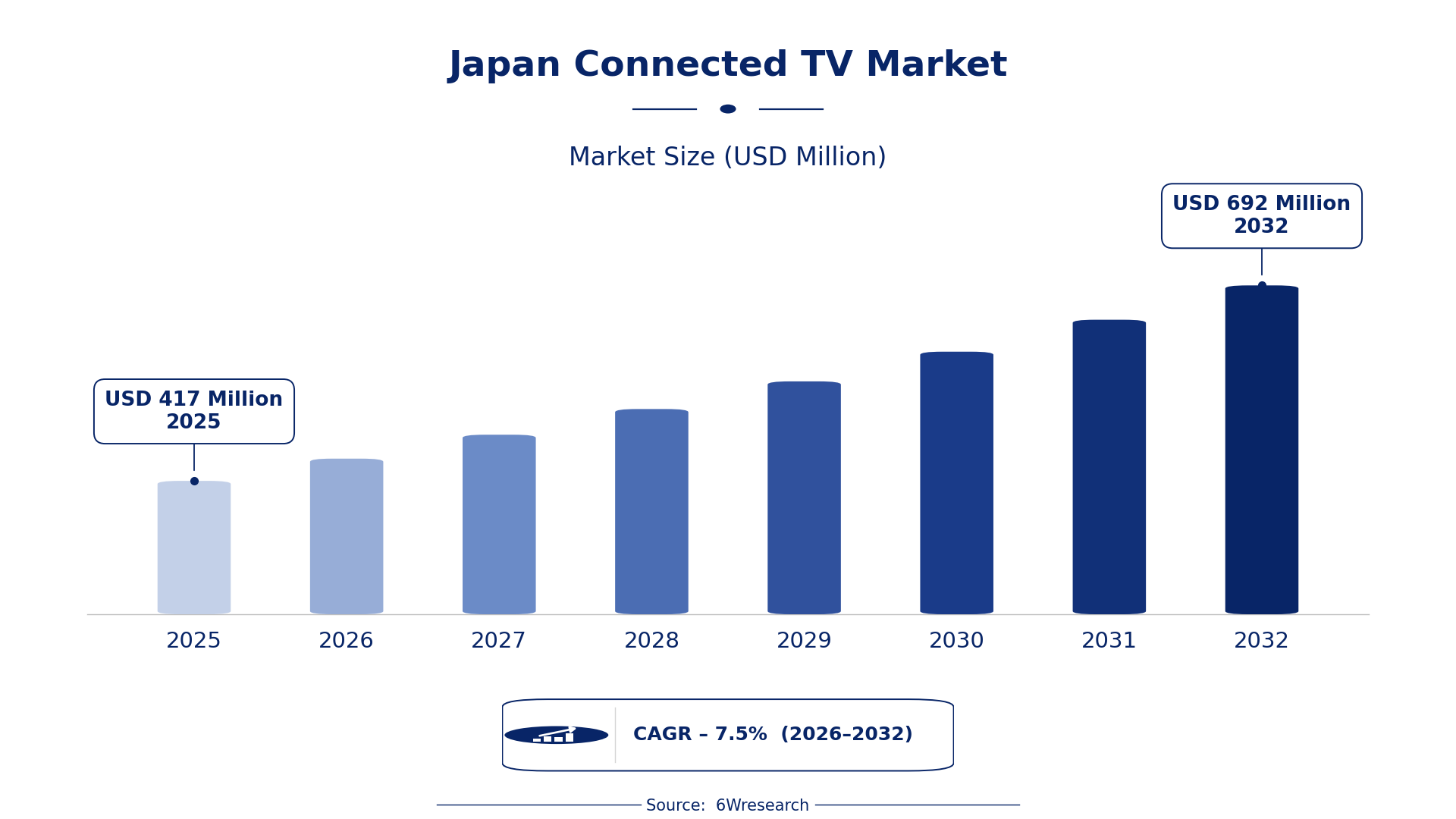
According to 6Wresearch internal database and industry insights, the Japan Connected TV Market was valued at USD 417 Million in 2025 and is projected to reach USD 692 Million by 2032, growing at a CAGR of approximately 7.5% during 2026–2032.
Japan Connected TV Market Highlights
| Report Metric | Details |
| Report Name | Japan Connected TV Market (2026-2032) |
| Market Size 2025 | USD 417 Million |
| Market Size 2032 | USD 692 Million |
| Absolute Growth 2025–2032 | USD 275 Million |
| CAGR 2026–2032 | 7.5% |
| Peak Annual Growth | 8.2% in 2028 |
| Forecast Period | 2026–2032 |
| Historical Data | 2022–2025 |
| Base Year | 2025 |
| Leading Screen Size, 2025 | Less than 30 inches (40% share) |
| Fastest-Growing Screen Size | 30 inches to 50 inches (9.5% CAGR) |
| Growing Sector | Consumer Electronics |
| Key End Users | Households, Entertainment Providers, Technology Integrators |
Japan Connected TV Market Year-wise Growth Rate and Key Drivers (2022–2032)
This graph illustrates the annual growth rates of the market from 2022 to 2032, highlighting a steady upward trajectory and projected market expansion over the forecast period.
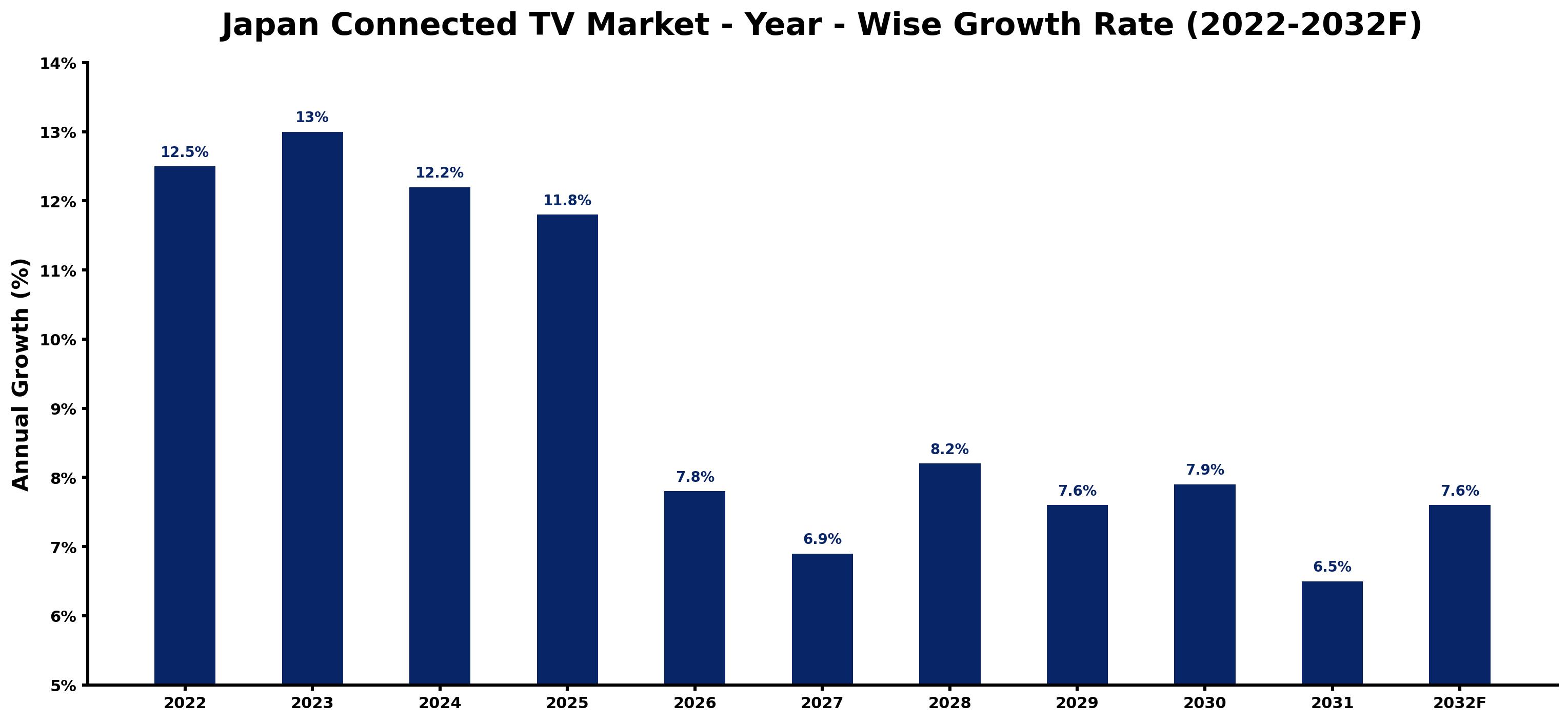
The following figures match every annual growth estimate with the main market development of that year, giving the reasoning behind each rise or slowdown.
| Year | Estimated Annual Growth (%) | Market Rationale |
| 2022 | 12.5 | The market saw strong consumer interest in smart technology and streaming services. |
| 2023 | 13.0 | Demand surged as households integrated connected TVs into their entertainment systems. |
| 2024 | 12.2 | Growth slowed as market saturation began to affect new purchases. |
| 2025 | 11.8 | Consumer spending remained steady, but growth continued to decelerate slightly. |
| 2026 | 7.8 | A further slowdown is expected as competition intensifies among manufacturers. |
| 2027 | 6.9 | Growth is projected to continue decelerating as consumers become more selective in purchases. |
| 2028 | 8.2 | Renewed interest in larger screen sizes and advanced features is expected to boost the market. |
| 2029 | 7.6 | Growth is projected to slow again as the market stabilises after the previous peak. |
| 2030 | 7.9 | Consumer interest in smart home integration is expected to drive renewed demand. |
| 2031 | 6.5 | Another slowdown will occur as economic factors influence buying behaviour. |
| 2032 | 7.6 | Demand is expected to rise again as new technologies emerge and attract buyers. |
Note: Market size estimations and growth projections presented in this report are based on 6Wresearch's proprietary forecasting methodology, utilizing the latest available industry data, government publications, and primary research inputs.
Japan Connected TV Market Synopsis
Connected TVs are advanced television sets that integrate internet connectivity, allowing users to stream content and access online services. The Japan Connected TV Market is expanding due to rising consumer spending on home entertainment, with over 10 million smart TV users in the country. In 2022, the average household owned 1.2 connected TVs, and Tokyo accounted for 25% of total sales, highlighting the urban demand for enhanced viewing experiences.
Market Dynamics Impact Analysis (2026–2032)
| Factor | Type | Impact | Primary Segment Affected |
| Rising consumer interest in home entertainment systems | Driver | High | 30 inches to 50 inches |
| Increasing adoption of 4K resolution TVs | Driver | High | 50 inches to 70 inches |
| Growing demand for larger screen sizes | Opportunity | High | Above 70 inches |
| Expansion of smart home technologies | Opportunity | Medium | 30 inches to 50 inches |
| Market saturation limiting new purchases | Restraint | Medium | Less than 30 inches |
| Intense competition among manufacturers | Restraint | High | 50 inches to 70 inches |
| Economic fluctuations affecting consumer spending | Challenge | High | 30 inches to 50 inches |
| Shifts in consumer preferences towards premium features | Challenge | Medium | Above 70 inches |
Evaluation of Drivers in Japan Connected TV Market (2026–2032)
The table below links each growth driver to the segment it affects and the evidence for it.
| Drivers | Primary Segment Affected | Why It Matters (Evidence) |
| Increased consumer spending on home entertainment | 30 inches to 50 inches | As households invest more in entertainment, they prefer larger screens for family viewing, driving sales. |
| High adoption rate of 4K resolution TVs | 50 inches to 70 inches | With over 60% of new sales being 4K, buyers seek better viewing experiences, boosting demand. |
| Growth in smart home technology integration | Above 70 inches | As smart homes become popular, larger connected TVs are increasingly in demand, attracting buyers. |
| Urban population density driving sales | 30 inches to 50 inches | Tokyo's 25% share of total sales indicates strong urban demand for family-oriented devices, increasing purchases. |
| Rising interest in streaming services | Less than 30 inches | Small connected TVs are gaining traction for personal viewing in limited spaces, appealing to urban consumers. |
What keeps demand rising is the increased consumer spending on home entertainment, with households investing in larger screens for family viewing. In 2023, over 10 million smart TV users in Japan indicate a strong trend towards connectivity. The adoption of 4K resolution TVs has surpassed 60% of new sales, improving the viewing experience for consumers. The integration of smart home technology drives interest in larger connected TVs, as consumers seek to upgrade their entertainment systems. Urban areas show a notable increase in demand, particularly in regions with high population density, reflecting changing consumer preferences.
Evaluation of Restraints in Japan Connected TV Market
Several factors work against faster growth; the main ones are summarised below.
| Market Restraint | Primary Segment Affected | Why It Matters (Evidence) |
| Market saturation limiting new purchases | Less than 30 inches | With many households already owning connected TVs, new purchases are declining due to limited demand. |
| Intense competition among manufacturers | 50 inches to 70 inches | As brands compete for market share, price wars can affect profitability and reduce margins. |
| Economic fluctuations affecting consumer spending | 30 inches to 50 inches | Economic uncertainty may lead consumers to delay purchases of new devices, impacting sales. |
| Shifts in consumer preferences towards premium features | Above 70 inches | As buyers seek advanced features, basic models may see reduced interest, limiting growth potential. |
| Limited use of smaller screens in personal settings | Less than 30 inches | The smaller segment remains less popular, restricting overall market growth and new sales. |
Japan Connected TV Market Challenges
In 2023, 10 million smart TV users in Japan face connectivity issues due to inadequate technology, which leads to buffering and dissatisfaction among viewers. Component shortages disrupt the supply chain, causing delays that force producers to postpone product launches, ultimately affecting retailers' sales. Rising costs of LCD and OLED components compel retailers to increase prices, which may alienate budget-conscious buyers. Fierce competition among brands results in aggressive pricing strategies, squeezing profit margins for suppliers and restricting their capacity to invest in product improvements.
Trends in the Japan Connected TV Market
The trends below show where the Japan Connected TV Market is heading.
- Shift towards Larger Screen Sizes: The trend towards larger screen sizes began in 2023, with the average screen size sold around 55 inches. This shift is supported by increased home entertainment spending, particularly in urban areas, leading to higher demand for immersive viewing experiences.
- Transition to Smart Home Integration: The Tokyo Metropolitan Government launched a program in 2023 to promote smart home technologies, encouraging households to adopt connected devices. This initiative has led to a rise in connected TV sales, with more households integrating these technologies.
- Emergence of 4K Resolution as Standard: As of 2023, over 60% of new TV sales in Japan are 4K resolution models. This trend reflects consumer preference for improved viewing quality, driving manufacturers to focus on higher resolution models.
- Growing Popularity of Streaming Services: The rise of streaming services has transformed viewing habits since 2022, with more households opting for connected TVs to access these platforms. This shift has influenced purchasing decisions, especially in urban markets.
Investment Opportunities in the Japan Connected TV Market
Below are the investment opportunities with the strongest case in the Japan Connected TV Market.
- Connected TVs for Smart Home Integration: With over 10 million smart TV users in Japan, there is a growing opportunity to supply connected TVs that integrate with smart home systems. Urban households are increasingly seeking these technologies to improve their living spaces.
- Larger Screen Sizes for Home Cinemas: The market for connected TVs above 70 inches is expanding, driven by consumer interest in immersive home cinema experiences. Manufacturers can target urban areas where demand for larger screens is rising.
- Investment in 4K Resolution TVs: As over 60% of new sales are 4K models, there is an opportunity to invest in high-quality 4K connected TVs. This trend is particularly strong among tech-savvy consumers in metropolitan regions.
- Smart TVs for Gaming: With the rise of gaming as a popular home activity, there is a demand for connected TVs that enhance gaming experiences. Targeting younger demographics in urban centres can drive sales effectively.
Government Initiatives in the Japan Connected TV Market
The Industrial Standardization Act, amended in 2019, governs product and test standards for connected TVs in Japan. This law ensures that manufacturers meet quality and interoperability requirements, which helps protect consumers and builds market confidence. The GX Basic Policy, adopted in 2023, focuses on substantial public-private investment to support the development of digital infrastructure.
The Consumer Affairs Agency oversees broadcasting standards, ensuring that connected TVs comply with regulations. This agency also promotes digital infrastructure development, which supports the growth of connected TV adoption across the country, benefiting both manufacturers and consumers.
Future Insight of the Japan Connected TV Market
By 2032, advancements in digital infrastructure will drive significant changes in the connected TV market, prompting suppliers to adopt cutting-edge technologies. The updated JIS standard will facilitate better device interoperability, enhancing user experience. As consumer spending on home entertainment rises, the average screen size sold is projected to exceed 60 inches. Initiatives from local governments to promote smart home technologies will further elevate demand for connected TVs, creating new opportunities for both buyers and suppliers.
Market Segmentation Analysis
Japan Connected TV Market report covers a detailed analysis of the following market segments:
By Screen Size – Less than 30 inches Lead, 30 inches to 50 inches Expected to Grow Fastest
According to Sumit Sagar, AM at 6Wresearch, the largest screen size category in 2025 was Less than 30 inches, at 40% of revenue. The less than 30 inches segment holds the largest share as it caters to individuals and couples living in compact urban apartments. Its appeal lies in affordability and convenience, making it a preferred choice for personal viewing in limited spaces. 30 inches to 50 inches are projected to grow fastest, at a CAGR of 9.5% during 2026–2032. The 30 inches to 50 inches segment is experiencing rapid growth due to a shift in consumer preferences towards larger screens for family-oriented viewing. This change is supported by increased spending on home entertainment, encouraging upgrades to bigger televisions. Suppliers should focus on expanding their mid-sized screen offerings to capitalise on the growing demand from households seeking enhanced viewing experiences.
Key Attractiveness of the Report
- 10 Years of Market Numbers
- Historical Data Starting from 2022 to 2025
- Base Year 2025
- Forecast Data until 2032
- Key Performance Indicators Impacting the Market
- Major Upcoming Developments and Projects
Key Highlights of the Report:
- Japan Connected TV Market Outlook
- Market Size of Japan Connected TV Market, 2025
- Forecast of Japan Connected TV Market, 2032
- Historical Data and Forecast of Japan Connected TV Revenues & Volume for the Period 2022-2032
- Japan Connected TV Market Trend Evolution
- Japan Connected TV Market Drivers and Challenges
- Japan Connected TV Price Trends
- Japan Connected TV Porter's Five Forces
- Japan Connected TV Industry Life Cycle
- Historical Data and Forecast of Japan Connected TV Market Revenues & Volume By Screen Size for the Period 2022-2032
- Historical Data and Forecast of Japan Connected TV Market Revenues & Volume By Less than 30 inches for the Period 2022-2032
- Historical Data and Forecast of Japan Connected TV Market Revenues & Volume By 30 inches to 50 inches for the Period 2022-2032
- Historical Data and Forecast of Japan Connected TV Market Revenues & Volume By 50 inches to 70 inches for the Period 2022-2032
- Historical Data and Forecast of Japan Connected TV Market Revenues & Volume By Above 70 inches for the Period 2022-2032
- Japan Connected TV Import Export Trade Statistics
- Market Opportunity Assessment By Screen Size
- Japan Connected TV Top Companies Market Share
- Japan Connected TV Competitive Benchmarking By Technical and Operational Parameters
- Japan Connected TV Company Profiles
- Japan Connected TV Key Strategic Recommendations
Market Covered
Coverage by segment is as follows.
By Screen Size
- Less than 30 inches
- 30 inches to 50 inches
- 50 inches to 70 inches
- Above 70 inches































