Japan Cross-border Import E-commerce Market Size & Growth Rate
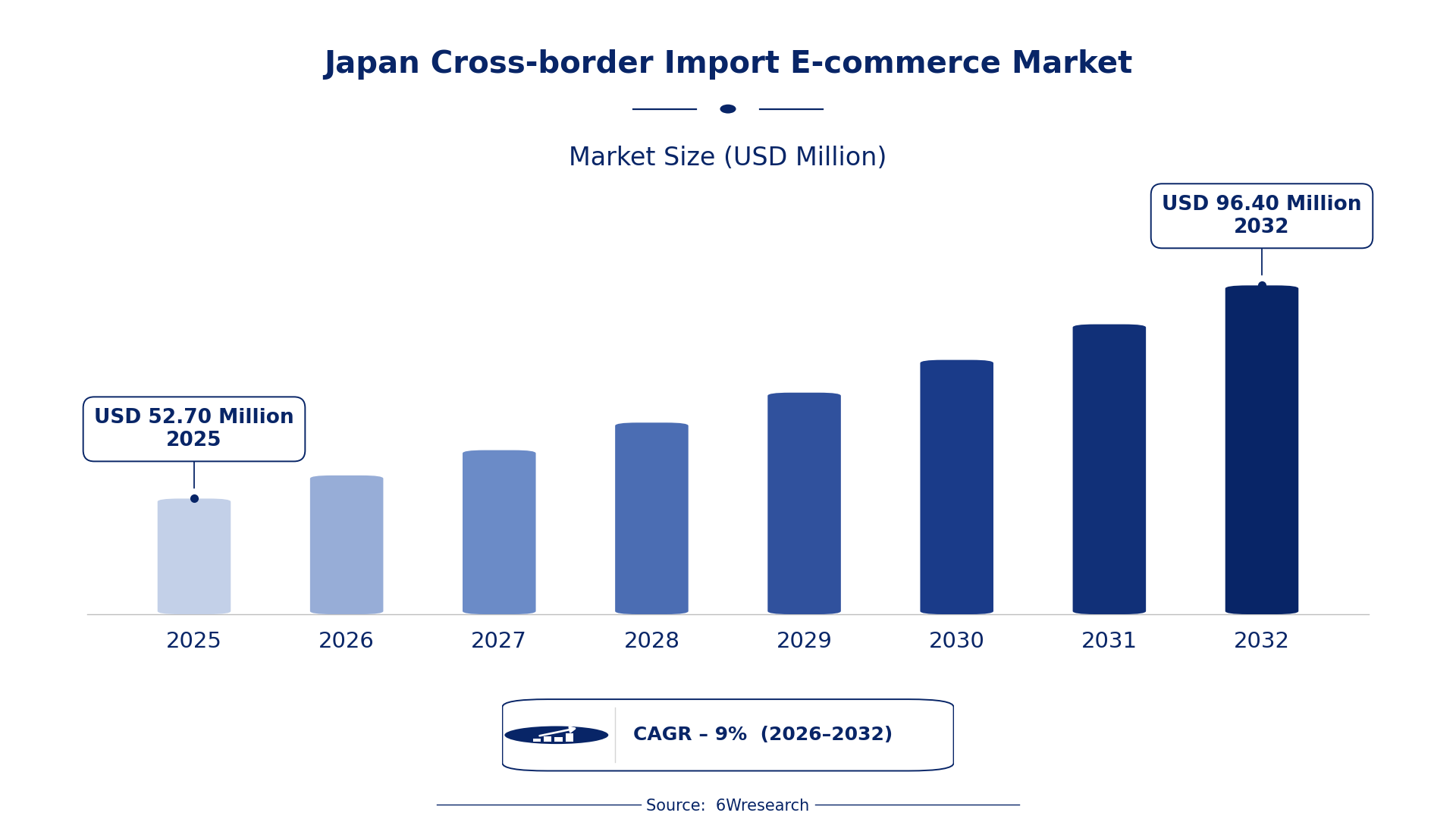
According to 6Wresearch internal database and industry insights, the Japan Cross-border Import E-commerce Market was valued at USD 52.70 Million in 2025 and is projected to reach USD 96.40 Million by 2032, growing at a CAGR of approximately 9% during 2026–2032.
Japan Cross-border Import E-commerce Market Highlights
| Report Metric | Details |
| Report Name | Japan Cross-border Import E-commerce Market (2026-2032) |
| Market Size 2025 | USD 52.70 Million |
| Market Size 2032 | USD 96.40 Million |
| Absolute Growth 2025–2032 | USD 43.70 Million |
| CAGR 2026–2032 | 9% |
| Peak Annual Growth | 10.6% in 2032 |
| Forecast Period | 2026–2032 |
| Historical Data | 2022–2025 |
| Base Year | 2025 |
| Leading Platform, 2025 | B2B (41% share) |
| Leading Merchant Size, 2025 | Large Enterprises (60% share) |
| Leading Application, 2025 | Food & Beverage (39% share) |
| Fastest-Growing Platform | B2C (13.3% CAGR) |
| Fastest-Growing Merchant Size | SME (11.4% CAGR) |
| Fastest-Growing Application | Personal Care (12.9% CAGR) |
| Growing Sector | Fashion |
| Key End Users | Consumers, SMEs, Large Enterprises, E-commerce platforms |
Japan Cross-border Import E-commerce Market Year-wise Growth Rate and Key Drivers (2022–2032)
This graph illustrates the annual growth rates of the market from 2022 to 2032, highlighting a steady upward trajectory and projected market expansion over the forecast period.
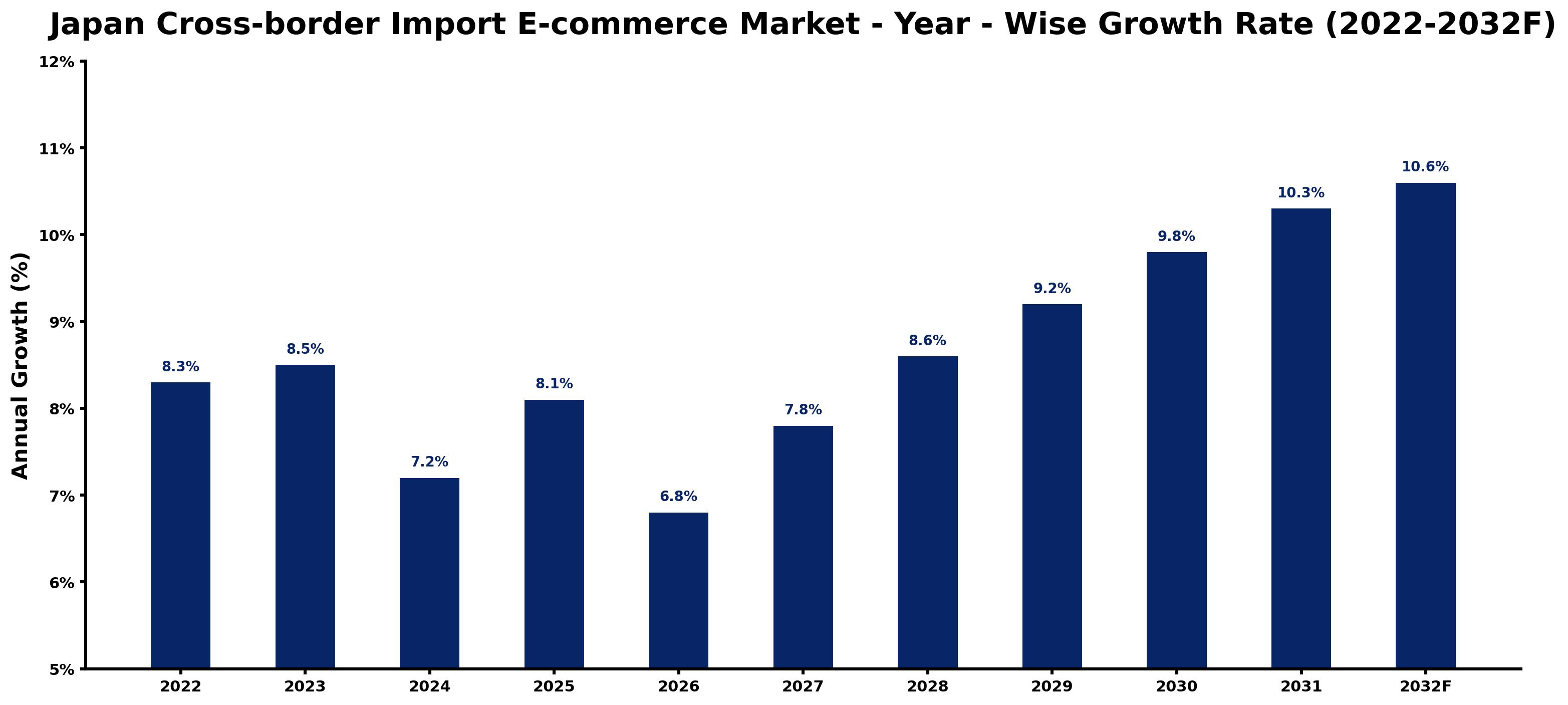
The yearly estimates that follow link every growth rate to its principal driver, so readers can see why the pace changed in each period.
| Year | Estimated Annual Growth (%) | Market Rationale |
| 2022 | 8.3 | The market showed steady growth, driven by increasing online shopping habits among consumers. |
| 2023 | 8.5 | Growth was supported by a rise in cross-border purchases of fashion and electronics. |
| 2024 | 7.2 | The market experienced a slowdown due to stricter import regulations impacting consumer choices. |
| 2025 | 8.1 | Demand increased as more consumers sought unique products from international sellers. |
| 2026 | 6.8 | Growth is expected to slow as competition intensifies among e-commerce platforms offering similar products. |
| 2027 | 7.8 | The market is projected to rebound as consumer interest in diverse product offerings grows stronger. |
| 2028 | 8.6 | Demand is expected to surge with the expansion of mobile commerce, attracting more online shoppers. |
| 2029 | 9.2 | Growth is projected to accelerate as digital trade capabilities improve, increasing consumer access. |
| 2030 | 9.8 | The market will continue to grow, driven by rising disposable incomes and consumer spending. |
| 2031 | 10.3 | Demand is expected to increase as more SMEs engage in cross-border e-commerce transactions. |
| 2032 | 10.6 | The market is projected to peak due to a rise in digital trade participation across sectors. |
Note: Market size estimations and growth projections presented in this report are based on 6Wresearch's proprietary forecasting methodology, utilizing the latest available industry data, government publications, and primary research inputs.
Japan Cross-border Import E-commerce Market Synopsis
Cross-border import e-commerce enables the online sale of goods from foreign merchants to Japanese consumers, providing access to unique products and competitive pricing. In Japan, the market is expanding due to over 100 million online shoppers and a growing interest in international fashion and electronics. The government's initiatives to boost digital trade capabilities and support for SMEs further drive this growth, targeting a 30% increase in digital trade participation by 2023.
Market Dynamics Impact Analysis (2026–2032)
| Factor | Type | Impact | Primary Segment Affected |
| Increasing online shopper base | Driver | High | B2C |
| Government support for SMEs | Driver | High | B2B |
| Growing interest in international fashion | Opportunity | High | Fashion |
| Expansion of mobile commerce | Opportunity | Medium | Electronics & Media |
| Strict import regulations | Restraint | High | Food & Beverage |
| High shipping costs for bulky items | Restraint | Medium | Furniture & Appliances |
| Competition from local e-commerce platforms | Challenge | High | B2C |
| Complex customs procedures | Challenge | Medium | B2B |
Evaluation of Drivers in Japan Cross-border Import E-commerce Market (2026–2032)
Demand rests on the following drivers, each shown with the segment it touches most.
| Drivers | Primary Segment Affected | Why It Matters (Evidence) |
| Rising disposable incomes | B2C | As disposable incomes increase, consumers are more willing to spend on cross-border purchases, particularly in fashion and electronics. |
| Government initiatives for SMEs | B2B | Support from the Japan External Trade Organization enables SMEs to engage more in cross-border e-commerce, boosting overall market demand. |
| High demand for unique products | Personal Care | Japanese consumers seek unique beauty products not available locally, driving higher cross-border purchases. |
| Growth of mobile commerce | Electronics & Media | With mobile commerce accounting for 30% of e-commerce sales, more consumers are purchasing electronics online. |
| Increased internet penetration | B2C | With over 100 million online shoppers, the growing internet user base fuels demand for cross-border e-commerce. |
Orders keep climbing as rising disposable incomes in Japan encourage consumers to spend more on cross-border purchases, particularly in electronics. The unique product offerings in the beauty sector attract Japanese shoppers, driving higher cross-border purchases. Mobile commerce, accounting for 30% of e-commerce sales, allows more consumers to buy online. The expanding internet user base further boosts demand, with over 125 million people connected, creating a larger market for international transactions.
Evaluation of Restraints in Japan Cross-border Import E-commerce Market
These restraints slow adoption and weigh on supplier margins.
| Market Restraint | Primary Segment Affected | Why It Matters (Evidence) |
| Strict import regulations | Food & Beverage | Japan's Food Sanitation Act imposes strict regulations on food imports, limiting consumer options. |
| High shipping costs for bulky items | Furniture & Appliances | Shipping costs deter consumers from purchasing larger items across borders, affecting overall sales. |
| Complex customs procedures | B2B | Businesses face delays and increased costs due to complicated customs processes for imports. |
| Intense competition from local platforms | B2C | Local e-commerce platforms offer similar products, making it challenging for cross-border sellers to compete. |
| Limited awareness of cross-border options | Personal Care | Consumers may not be fully aware of the variety of international beauty products available. |
Japan Cross-border Import E-commerce Market Challenges
High shipping costs impede cross-border e-commerce growth, with average fees reaching 5,000 yen per order, discouraging frequent purchases. Strict import regulations under the Food Sanitation Act complicate the process for suppliers, leading to delays in product availability and increasing compliance costs by up to 20%. Limited logistics infrastructure in rural areas affects supply chain efficiency, resulting in longer delivery times for consumers and potential sales losses. Intense competition from local retailers pressures prices, compelling producers to reduce margins and impacting their ability to invest in marketing and customer service.
Trends in the Japan Cross-border Import E-commerce Market
Below are the shifts with the largest effect on the Japan Cross-border Import E-commerce Market.
- Expansion of Digital Trade Initiatives: In 2023, the government launched a programme to boost digital trade capabilities, aiming for a 30% increase in participation. This initiative supports businesses looking to engage in cross-border e-commerce.
- Rise of Mobile Commerce: Mobile commerce now accounts for 30% of e-commerce sales, reflecting a shift in purchasing habits. This trend benefits suppliers who optimise their platforms for mobile users.
- Shift towards Unique Fashion Products: In 2023, increased consumer interest in unique fashion items led to a surge in cross-border purchases. This trend highlights the opportunity for international fashion brands to enter the Japanese market.
- Growing Demand for Electronics: The average Japanese consumer spends about 40,000 yen annually on cross-border electronics, indicating a strong preference for imported technology. This trend encourages suppliers to expand their offerings in this category.
Investment Opportunities in the Japan Cross-border Import E-commerce Market
The opportunities below stand out in the Japan Cross-border Import E-commerce Market for new entrants and existing suppliers.
- Timing for Fashion Brands: With a growing interest in international fashion, brands can invest in cross-border e-commerce to capture this demand, especially in urban areas like Tokyo, where fashion purchases are high.
- SMEs Seeking Cross-border Solutions: Small and medium enterprises are increasingly looking for cross-border solutions, particularly in regions with strong logistics networks, presenting opportunities for service providers.
- Digital Trade Enhancement: The government's target to boost digital trade participation by 30% creates a need for technology solutions that facilitate cross-border transactions, particularly for SMEs.
- Rising Demand for Personal Care Products: The increasing interest in international beauty products presents a significant opportunity for suppliers to enter the market, especially among younger consumers.
Government Initiatives in the Japan Cross-border Import E-commerce Market
The framework for cross-border import e-commerce is shaped by laws such as the Food Sanitation Act, which regulates food imports, and the Act on the Promotion of E-commerce and the Protection of Consumers. These laws ensure consumer safety and promote fair trade practices. Recent measures have focused on boosting digital trade capabilities, with the government aiming to increase participation by 30% by 2023.
In 2023, the government allocated funds to support e-commerce startups, facilitating their entry into the cross-border market. The Japan External Trade Organization provides resources and assistance to SMEs, helping them navigate the complexities of international trade.
Future Insight of the Japan Cross-border Import E-commerce Market
The 2023 initiative to enhance digital trade capabilities will streamline processes for suppliers, allowing them to reach Japanese consumers more effectively. By 2032, mobile commerce is projected to account for over 40% of e-commerce sales, further driving innovation in purchasing methods. The Tokyo E-commerce Expo will continue to showcase advancements in logistics and technology, enhancing service quality. With increased support for SMEs, consumers will benefit from a broader range of products and more competitive pricing.
Market Segmentation Analysis
Japan Cross-border Import E-commerce Market report covers a detailed analysis of the following market segments:
By Platform – B2B Leads, B2C Expected to Grow Fastest
According to Sumit Sagar, AM at 6Wresearch, in 2025, B2B led the platform split with a 41% share. B2B holds the largest share as businesses frequently import goods for resale, capitalising on the vast e-commerce market. For instance, many companies in Tokyo leverage cross-border platforms to source unique products that appeal to local consumers. B2C is set to record the highest CAGR in this split, 13.3% over 2026–2032. B2C is experiencing rapid growth due to an increasing number of consumers directly purchasing from overseas merchants. The convenience of online shopping and access to diverse products are key factors driving this trend. Suppliers should focus on enhancing B2C offerings to capture the growing consumer demand.
By Merchant Size – Large Enterprises Lead, SME Expected to Grow Fastest
Large Enterprises held 60% of the Japan Cross-border Import E-commerce Market by merchant size in 2025. Large Enterprises dominate the market as they utilise cross-border e-commerce for bulk imports, allowing them to meet high consumer demand efficiently. These companies benefit from established logistics networks and resources to navigate import regulations effectively. The quickest growth will come from SME, forecast to expand at a CAGR of 11.4% between 2026 and 2032. SMEs are growing quickly in this space as they increasingly engage in cross-border transactions to access unique products. The support from government initiatives aimed at enhancing digital trade capabilities is further propelling this growth. Suppliers must consider tailored strategies to support the unique needs of SMEs in cross-border e-commerce.
By Application – Food & Beverage Leads, Personal Care Expected to Grow Fastest
Food & Beverage accounted for 39% of the market by application in 2025. Food & Beverage leads the segment, albeit limited by strict regulations on food imports, which creates a niche market. Businesses focused on compliant food products often find success in catering to health-conscious consumers seeking international options. Over 2026–2032, Personal Care is expected to post the fastest growth, at a CAGR of 12.9%. Personal Care is the fastest-growing application due to the high demand for international beauty products among Japanese consumers. This trend is supported by the rising popularity of global beauty brands and online shopping convenience. Suppliers should prioritise personal care products to capitalise on the increasing consumer interest in international beauty offerings.
Key Attractiveness of the Report
- 10 Years of Market Numbers
- Historical Data Starting from 2022 to 2025
- Base Year 2025
- Forecast Data until 2032
- Key Performance Indicators Impacting the Market
- Major Upcoming Developments and Projects
Key Highlights of the Report:
- Japan Cross-border Import E-commerce Market Outlook
- Market Size of Japan Cross-border Import E-commerce Market, 2025
- Forecast of Japan Cross-border Import E-commerce Market, 2032
- Historical Data and Forecast of Japan Cross-border Import E-commerce Revenues & Volume for the Period 2022-2032
- Japan Cross-border Import E-commerce Market Trend Evolution
- Japan Cross-border Import E-commerce Market Drivers and Challenges
- Japan Cross-border Import E-commerce Price Trends
- Japan Cross-border Import E-commerce Porter's Five Forces
- Japan Cross-border Import E-commerce Industry Life Cycle
- Historical Data and Forecast of Japan Cross-border Import E-commerce Market Revenues & Volume By Platform for the Period 2022-2032
- Historical Data and Forecast of Japan Cross-border Import E-commerce Market Revenues & Volume By B2B for the Period 2022-2032
- Historical Data and Forecast of Japan Cross-border Import E-commerce Market Revenues & Volume By B2C for the Period 2022-2032
- Historical Data and Forecast of Japan Cross-border Import E-commerce Market Revenues & Volume By C2C for the Period 2022-2032
- Historical Data and Forecast of Japan Cross-border Import E-commerce Market Revenues & Volume By D2C for the Period 2022-2032
- Historical Data and Forecast of Japan Cross-border Import E-commerce Market Revenues & Volume By Merchant Size for the Period 2022-2032
- Historical Data and Forecast of Japan Cross-border Import E-commerce Market Revenues & Volume By Large Enterprises for the Period 2022-2032
- Historical Data and Forecast of Japan Cross-border Import E-commerce Market Revenues & Volume By SME for the Period 2022-2032
- Historical Data and Forecast of Japan Cross-border Import E-commerce Market Revenues & Volume By Application for the Period 2022-2032
- Historical Data and Forecast of Japan Cross-border Import E-commerce Market Revenues & Volume By Food & Beverage for the Period 2022-2032
- Historical Data and Forecast of Japan Cross-border Import E-commerce Market Revenues & Volume By Personal Care for the Period 2022-2032
- Historical Data and Forecast of Japan Cross-border Import E-commerce Market Revenues & Volume By Furniture & Appliances for the Period 2022-2032
- Historical Data and Forecast of Japan Cross-border Import E-commerce Market Revenues & Volume By Toys for the Period 2022-2032
- Historical Data and Forecast of Japan Cross-border Import E-commerce Market Revenues & Volume By Hobby & DIY for the Period 2022-2032
- Historical Data and Forecast of Japan Cross-border Import E-commerce Market Revenues & Volume By Electronics & Media for the Period 2022-2032
- Historical Data and Forecast of Japan Cross-border Import E-commerce Market Revenues & Volume By Fashion for the Period 2022-2032
- Historical Data and Forecast of Japan Cross-border Import E-commerce Market Revenues & Volume By Others for the Period 2022-2032
- Japan Cross-border Import E-commerce Import Export Trade Statistics
- Market Opportunity Assessment By Platform
- Market Opportunity Assessment By Merchant Size
- Market Opportunity Assessment By Application
- Japan Cross-border Import E-commerce Top Companies Market Share
- Japan Cross-border Import E-commerce Competitive Benchmarking By Technical and Operational Parameters
- Japan Cross-border Import E-commerce Company Profiles
- Japan Cross-border Import E-commerce Key Strategic Recommendations
Market Covered
The following segment groups are covered in the report.
By Platform
- B2B
- B2C
- C2C
- D2C
By Merchant Size
- Large Enterprises
- SME
By Application
- Food & Beverage
- Personal Care
- Furniture & Appliances
- Toys
- Hobby & DIY
- Electronics & Media
- Fashion
- Others































