Japan Dark Chocolate Market Size & Growth Rate
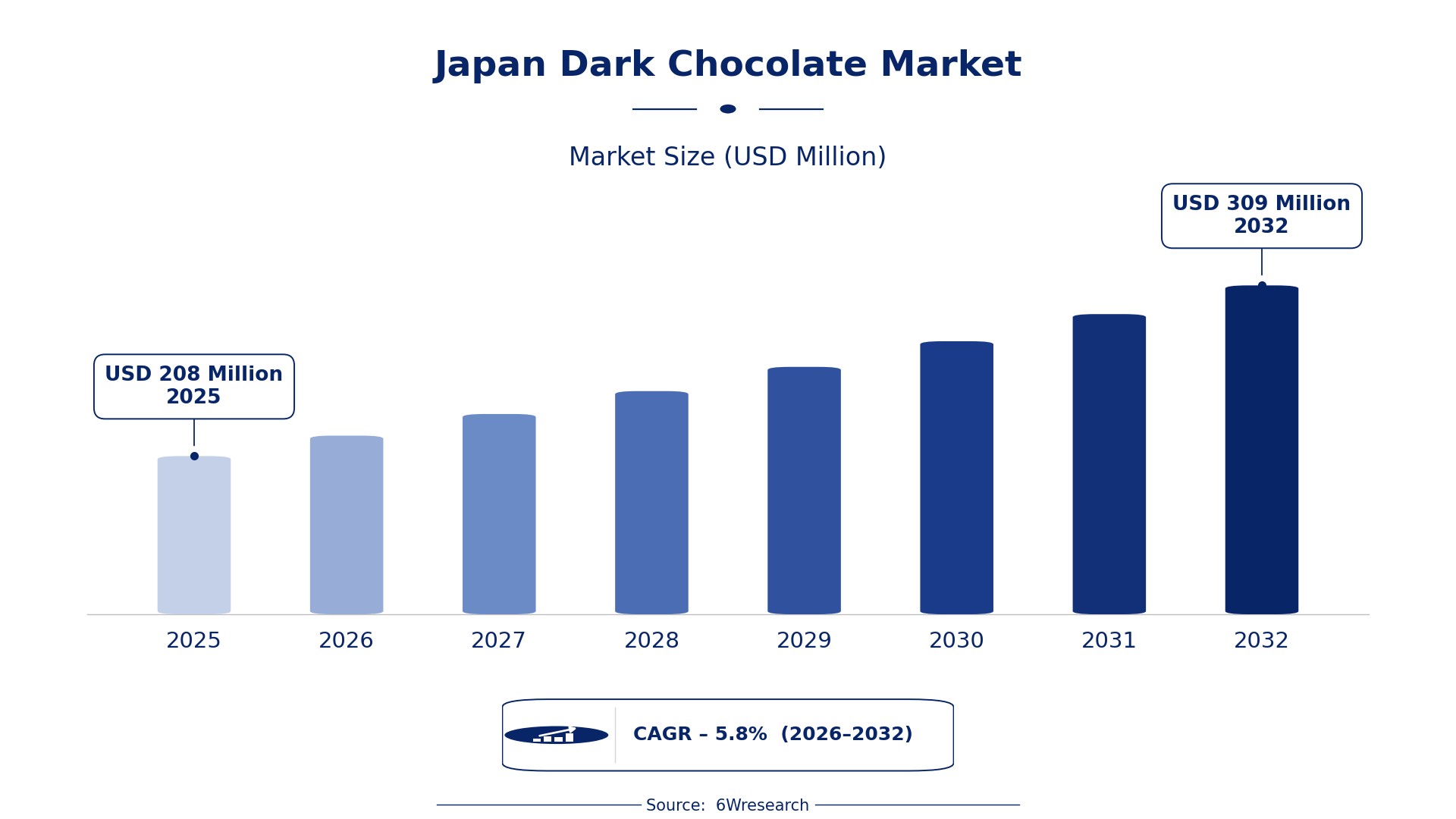
According to 6Wresearch internal database and industry insights, the Japan Dark Chocolate Market was valued at USD 208 Million in 2025 and is projected to reach USD 309 Million by 2032, growing at a CAGR of approximately 5.8% during 2026–2032.
Japan Dark Chocolate Market Highlights
| Report Metric | Details |
| Report Name | Japan Dark Chocolate Market (2026-2032) |
| Market Size 2025 | USD 208 Million |
| Market Size 2032 | USD 309 Million |
| Absolute Growth 2025–2032 | USD 101 Million |
| CAGR 2026–2032 | 5.8% |
| Peak Annual Growth | 6.4% in 2028 |
| Forecast Period | 2026–2032 |
| Historical Data | 2022–2025 |
| Base Year | 2025 |
| Leading Product, 2025 | Bitter Chocolate (45% share) |
| Leading Distribution Channel, 2025 | Online Sales (37% share) |
| Fastest-Growing Product | Pure Bitter Chocolate (8.7% CAGR) |
| Fastest-Growing Distribution Channel | Offline Sales (7.9% CAGR) |
| Growing Sector | Artisanal Chocolate |
| Key End Users | Specialty Shops, Luxury Hotels, Health-Conscious Consumers, Online Retailers |
Japan Dark Chocolate Market Year-wise Growth Rate and Key Drivers (2022–2032)
This graph illustrates the annual growth rates of the market from 2022 to 2032, highlighting a steady upward trajectory and projected market expansion over the forecast period.
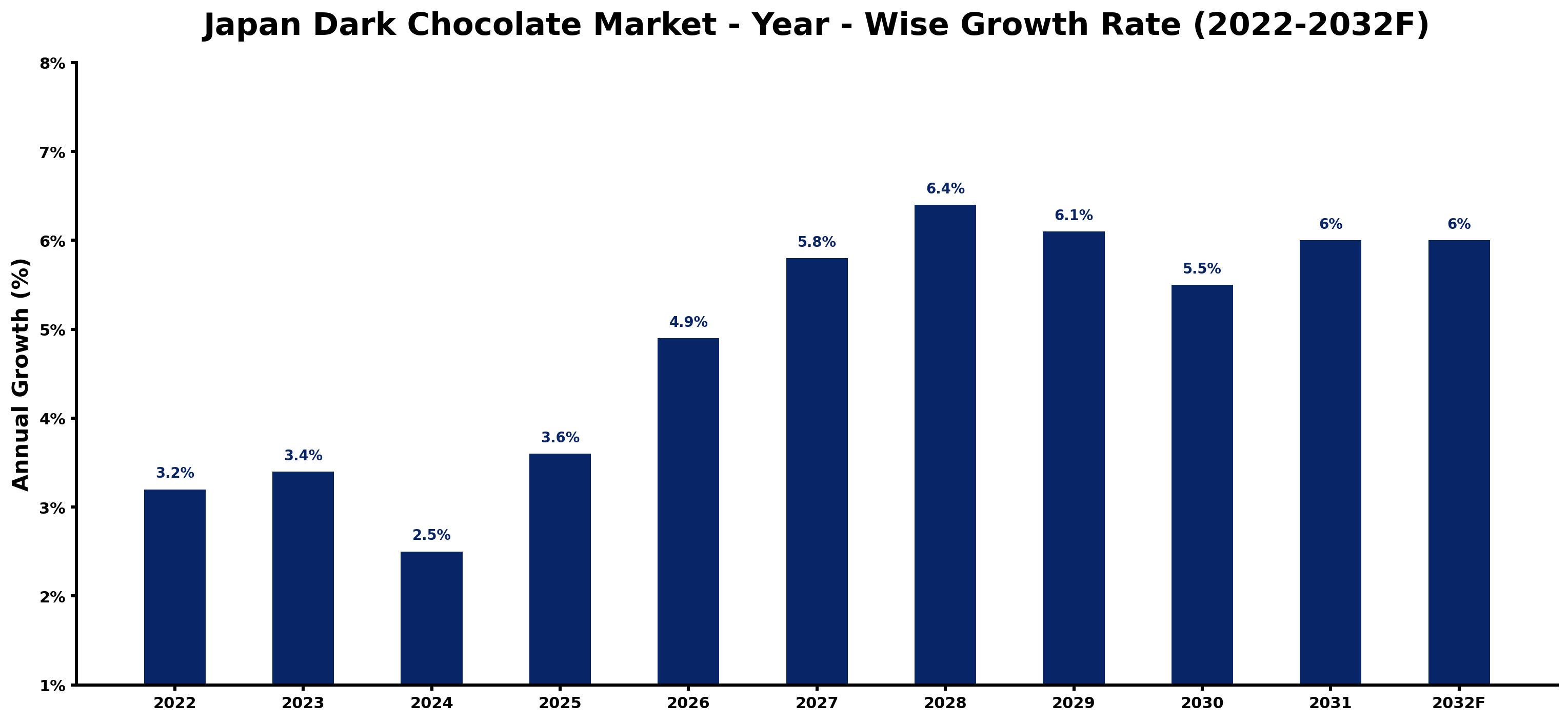
Annual growth estimates for each year appear below with the principal reason behind them, explaining the shifts that set the pace of the market.
| Year | Estimated Annual Growth (%) | Market Rationale |
| 2022 | 3.2 | The market experienced steady growth, driven by increasing consumer interest in premium chocolate products. |
| 2023 | 3.4 | Growth accelerated due to rising health consciousness and demand for high-quality dark chocolate. |
| 2024 | 2.5 | The market saw a slowdown as consumers adjusted spending habits amid economic uncertainties. |
| 2025 | 3.6 | Growth picked up again with the introduction of new artisanal chocolate brands in urban areas. |
| 2026 | 4.9 | The market is expected to gain momentum from expanding online retail channels and convenience shopping. |
| 2027 | 5.8 | Demand will rise as more consumers seek gourmet and organic chocolate options. |
| 2028 | 6.4 | The peak growth year will be driven by the popularity of dark chocolate in high-end desserts. |
| 2029 | 6.1 | Growth is projected to slow slightly as market saturation begins to set in. |
| 2030 | 5.5 | The market will continue to grow, albeit at a slower pace as competition intensifies. |
| 2031 | 6.0 | A resurgence in growth is anticipated as new product innovations attract consumers. |
| 2032 | 6.0 | The market is expected to maintain strong growth driven by sustained interest in health-oriented products. |
Note: Market size estimations and growth projections presented in this report are based on 6Wresearch's proprietary forecasting methodology, utilizing the latest available industry data, government publications, and primary research inputs.
Japan Dark Chocolate Market Synopsis
Dark chocolate, recognised for its rich cocoa content and versatile applications, is becoming increasingly popular in Japan, especially in upscale desserts and artisanal creations. The Japan Dark Chocolate Market is growing due to rising consumer interest in premium products, with Tokyo emerging as a central market hub. Factors such as the surge in online sales, a more health-conscious consumer base, and the impact of local cocoa farming initiatives are propelling this growth, creating a dynamic market environment.
Market Dynamics Impact Analysis (2026–2032)
| Factor | Type | Impact | Primary Segment Affected |
| Growing health consciousness among consumers | Driver | High | Organic Dark Chocolates |
| Increase in online retail channels | Driver | High | Online Sales |
| Rising demand for artisanal chocolate products | Opportunity | High | Trade Specialty Stores |
| Expansion of gourmet chocolate offerings in urban areas | Opportunity | High | Departmental Stores |
| Limited domestic cocoa production capacity | Restraint | Medium | Organic Dark Chocolates |
| High competition from imported chocolate brands | Restraint | Medium | Bitter Chocolate |
| Supply chain disruptions affecting ingredient availability | Challenge | High | Pure Bitter Chocolate |
| Fluctuating cocoa prices impacting production costs | Challenge | High | Semi-Sweet Chocolate |
Evaluation of Drivers in Japan Dark Chocolate Market (2026–2032)
Below are the drivers that matter most for revenue growth, with supporting evidence.
| Drivers | Primary Segment Affected | Why It Matters (Evidence) |
| Rising consumer interest in health benefits of dark chocolate | Organic Dark Chocolates | The average annual consumption of chocolate per person in Japan is around 2.5 kg, driving demand for healthier options. |
| Growth of e-commerce platforms for chocolate sales | Online Sales | The number of online chocolate retailers in Japan has grown by 30% since 2020, making it easier for consumers to purchase. |
| Increased focus on quality and artisanal production methods | Trade Specialty Stores | The annual Chocolate Festival in Tokyo showcases premium chocolate brands, boosting consumer interest in high-quality products. |
| Expansion of gourmet offerings in luxury hotels and restaurants | Bitter Chocolate | Dark chocolate is often used in high-end desserts, appealing to affluent consumers seeking premium experiences. |
| Support for local cocoa farmers through government programs | Organic Dark Chocolates | In 2023, the Ministry of Agriculture launched a program to support local cocoa farmers, improving domestic supply. |
Much of the new demand traces back to Tokyo's annual Chocolate Festival, which showcases premium chocolate brands and attracts thousands of visitors. The average annual consumption of chocolate per person in Japan is around 2.5 kg, leading buyers to seek healthier options. The number of online chocolate retailers has increased by 30% since 2020, making it easier for consumers to purchase their preferred products. Dark chocolate frequently features in high-end desserts at luxury hotels, appealing to affluent buyers.
Evaluation of Restraints in Japan Dark Chocolate Market
Below are the constraints most often cited by buyers and suppliers, with the segment each affects.
| Market Restraint | Primary Segment Affected | Why It Matters (Evidence) |
| Limited domestic cocoa production capacity | Organic Dark Chocolates | Japan imports cocoa beans primarily from Indonesia and Ghana, affecting local supply chains. |
| High competition from imported chocolate brands | Bitter Chocolate | Imported brands often dominate the market, making it challenging for local producers to compete effectively. |
| Supply chain disruptions affecting ingredient availability | Pure Bitter Chocolate | Global supply chain issues have led to ingredient shortages, impacting production schedules for local manufacturers. |
| Fluctuating cocoa prices impacting production costs | Semi-Sweet Chocolate | Volatile cocoa prices can lead to increased production costs, affecting profit margins for producers. |
| Consumer preference for organic over inorganic options | Inorganic Dark Chocolates | There is a growing trend towards organic products, limiting the market for inorganic dark chocolates. |
Japan Dark Chocolate Market Challenges
Japan's dark chocolate market is valued at approximately 200 billion yen, yet buyers encounter rising prices due to a 15% increase in organic dark chocolate demand. Producers face fierce competition from imported cocoa beans, primarily from Indonesia and Ghana, which raises their input costs and squeezes profit margins. Many producers stick to traditional methods, limiting their technology adoption, which increases production costs and delays product availability for buyers. Compliance with the JIS standard for chocolate quality imposes strict requirements that can slow down product launches for new entrants in the market.
Trends in the Japan Dark Chocolate Market
Below are the shifts with the largest effect on the Japan Dark Chocolate Market.
- Annual Chocolate Festival in Tokyo: The annual Chocolate Festival in Tokyo showcases premium chocolate brands and products, attracting thousands of visitors each year. This event underscores the growing consumer interest in high-quality dark chocolate, with attendance increasing by 20% in recent years.
- Shift towards Organic and Vegan Products: The trend for vegan and organic products is shaping dark chocolate sales, with organic dark chocolate sales rising by 15% in the last year. This shift mirrors changing consumer preferences towards healthier and ethically sourced options.
- Growth of Online Retail Channels: The number of online chocolate retailers in Japan has expanded significantly, with a 30% increase since 2020. This trend reflects a move towards convenience shopping, making dark chocolate more accessible to consumers.
- Emergence of Artisanal Chocolate Brands: Artisanal chocolate brands are gaining popularity in Japan, focusing on high-quality ingredients and distinctive flavours. This trend is transforming the market, with many consumers willing to pay a premium for gourmet products.
Investment Opportunities in the Japan Dark Chocolate Market
The openings below show where demand in the Japan Dark Chocolate Market is visible and how suppliers can enter.
- Health-Conscious Consumers: Health-conscious consumers are increasingly pursuing organic dark chocolate, with organic sales climbing by 15%. Investing in organic product lines can attract these buyers, particularly in urban areas with a high concentration of specialty shops.
- Expansion of Online Sales: The online chocolate retail market is expanding rapidly, with a 30% increase in online retailers since 2020. Suppliers can capitalise on this trend by partnering with e-commerce platforms to reach a broader audience.
- Artisanal Chocolate Production: The rise of artisanal chocolate brands offers an opportunity for investment in high-quality production facilities. Specialty shops in Tokyo are particularly well-positioned to take advantage of this trend, attracting discerning buyers.
- Support for Local Cocoa Farmers: Government programmes supporting local cocoa farmers can enhance supply chains and product quality. Collaborating with these initiatives can assist producers in securing high-quality ingredients and improving market positioning.
Government Initiatives in the Japan Dark Chocolate Market
The regulatory framework for dark chocolate in Japan is shaped by several laws, including the JIS standard for chocolate quality, which ensures that products meet specific quality benchmarks. The Japan Chocolate Association promotes quality standards for chocolate products, enhancing consumer trust and product integrity. Recent measures have focused on supporting local cocoa farmers, as seen in the 2023 initiative by the Ministry of Agriculture to improve domestic cocoa production.
In 2023, the Ministry of Agriculture launched a program to support local cocoa farmers, aiming to improve the quality and availability of cocoa in Japan. This program is administered by the Ministry of Agriculture, Forestry and Fisheries, which oversees various agricultural initiatives. This funding is vital for improving local cocoa production, with a target to increase domestic supply by 20% by 2025.
Future Insight of the Japan Dark Chocolate Market
Investment in local cocoa farming programmes will create a more stable sourcing environment for producers by 2032. Demand for high-quality dark chocolate will continue to grow as consumers increasingly seek premium products, particularly in luxury hotels and restaurants. The number of online chocolate retailers has expanded significantly, broadening access for consumers and enabling them to discover diverse offerings. Events like the annual Chocolate Festival in Tokyo will persist in promoting innovation and quality standards, driving market evolution.
Market Segmentation Analysis
Japan Dark Chocolate Market report covers a detailed analysis of the following market segments:
By Product – Bitter Chocolate Leads, Pure Bitter Chocolate Expected to Grow Fastest
According to Dhaval Chaurasia, Assistant Manager at 6Wresearch, Bitter Chocolate held 45% of the Japan Dark Chocolate Market by product in 2025. Bitter chocolate holds the largest share in Japan due to its widespread use in baking and confectionery, appealing to both amateur and professional cooks. Its popularity is evident in luxury hotels and restaurants where it is often featured in high-end desserts. Over 2026–2032, Pure Bitter Chocolate is expected to post the fastest growth, at a CAGR of 8.7%. Pure bitter chocolate is experiencing rapid growth as consumers increasingly seek gourmet options that emphasise premium quality. The annual Chocolate Festival in Tokyo exemplifies this trend, highlighting artisanal products that cater to discerning tastes. This suggests that suppliers should focus on providing high-quality bitter chocolate to meet the rising expectations of consumers and the hospitality sector.
By Distribution Channel – Online Sales Leads, Offline Sales Expected to Grow Fastest
The largest distribution channel category in 2025 was Online Sales, at 37% of revenue. Online sales dominate the distribution channel for dark chocolate in Japan, driven by the increasing trend for convenience shopping among consumers. The rise of online retailers has made it easier for customers to access a wider variety of products from the comfort of their homes. Offline Sales is projected to grow fastest, at a CAGR of 7.9% during 2026–2032. Offline sales are growing swiftly as traditional shopping preferences remain strong, particularly among consumers who value in-person experiences. This trend is underscored by the continued popularity of specialty stores in urban areas like Tokyo. Retailers must balance their online and offline strategies to cater to diverse consumer preferences and maximise market reach.
Key Attractiveness of the Report
- 10 Years of Market Numbers
- Historical Data Starting from 2022 to 2025
- Base Year 2025
- Forecast Data until 2032
- Key Performance Indicators Impacting the Market
- Major Upcoming Developments and Projects
Key Highlights of the Report:
- Japan Dark Chocolate Market Outlook
- Market Size of Japan Dark Chocolate Market, 2025
- Forecast of Japan Dark Chocolate Market, 2032
- Historical Data and Forecast of Japan Dark Chocolate Revenues & Volume for the Period 2022-2032
- Japan Dark Chocolate Market Trend Evolution
- Japan Dark Chocolate Market Drivers and Challenges
- Japan Dark Chocolate Price Trends
- Japan Dark Chocolate Porter's Five Forces
- Japan Dark Chocolate Industry Life Cycle
- Historical Data and Forecast of Japan Dark Chocolate Market Revenues & Volume By Product for the Period 2022-2032
- Historical Data and Forecast of Japan Dark Chocolate Market Revenues & Volume By Bitter Chocolate for the Period 2022-2032
- Historical Data and Forecast of Japan Dark Chocolate Market Revenues & Volume By Pure Bitter Chocolate for the Period 2022-2032
- Historical Data and Forecast of Japan Dark Chocolate Market Revenues & Volume By Semi-Sweet Chocolate for the Period 2022-2032
- Historical Data and Forecast of Japan Dark Chocolate Market Revenues & Volume By Organic Dark Chocolates for the Period 2022-2032
- Historical Data and Forecast of Japan Dark Chocolate Market Revenues & Volume By Inorganic Dark Chocolates for the Period 2022-2032
- Historical Data and Forecast of Japan Dark Chocolate Market Revenues & Volume By Distribution Channel for the Period 2022-2032
- Historical Data and Forecast of Japan Dark Chocolate Market Revenues & Volume By Online Sales for the Period 2022-2032
- Historical Data and Forecast of Japan Dark Chocolate Market Revenues & Volume By Offline Sales for the Period 2022-2032
- Historical Data and Forecast of Japan Dark Chocolate Market Revenues & Volume By Departmental Stores for the Period 2022-2032
- Historical Data and Forecast of Japan Dark Chocolate Market Revenues & Volume By Pharmaceutical Stores And Confectionary Stores for the Period 2022-2032
- Historical Data and Forecast of Japan Dark Chocolate Market Revenues & Volume By Trade Specialty Stores for the Period 2022-2032
- Japan Dark Chocolate Import Export Trade Statistics
- Market Opportunity Assessment By Product
- Market Opportunity Assessment By Distribution Channel
- Japan Dark Chocolate Top Companies Market Share
- Japan Dark Chocolate Competitive Benchmarking By Technical and Operational Parameters
- Japan Dark Chocolate Company Profiles
- Japan Dark Chocolate Key Strategic Recommendations
Market Covered
Coverage by segment is as follows.
By Product
- Bitter Chocolate
- Pure Bitter Chocolate
- Semi-Sweet Chocolate
- Organic Dark Chocolates
- Inorganic Dark Chocolates
By Distribution Channel
- Online Sales
- Offline Sales
- Departmental Stores
- Pharmaceutical Stores And Confectionary Stores
- Trade Specialty Stores































