Japan Digital Intelligence Platform Market Size & Growth Rate (2026-2032)
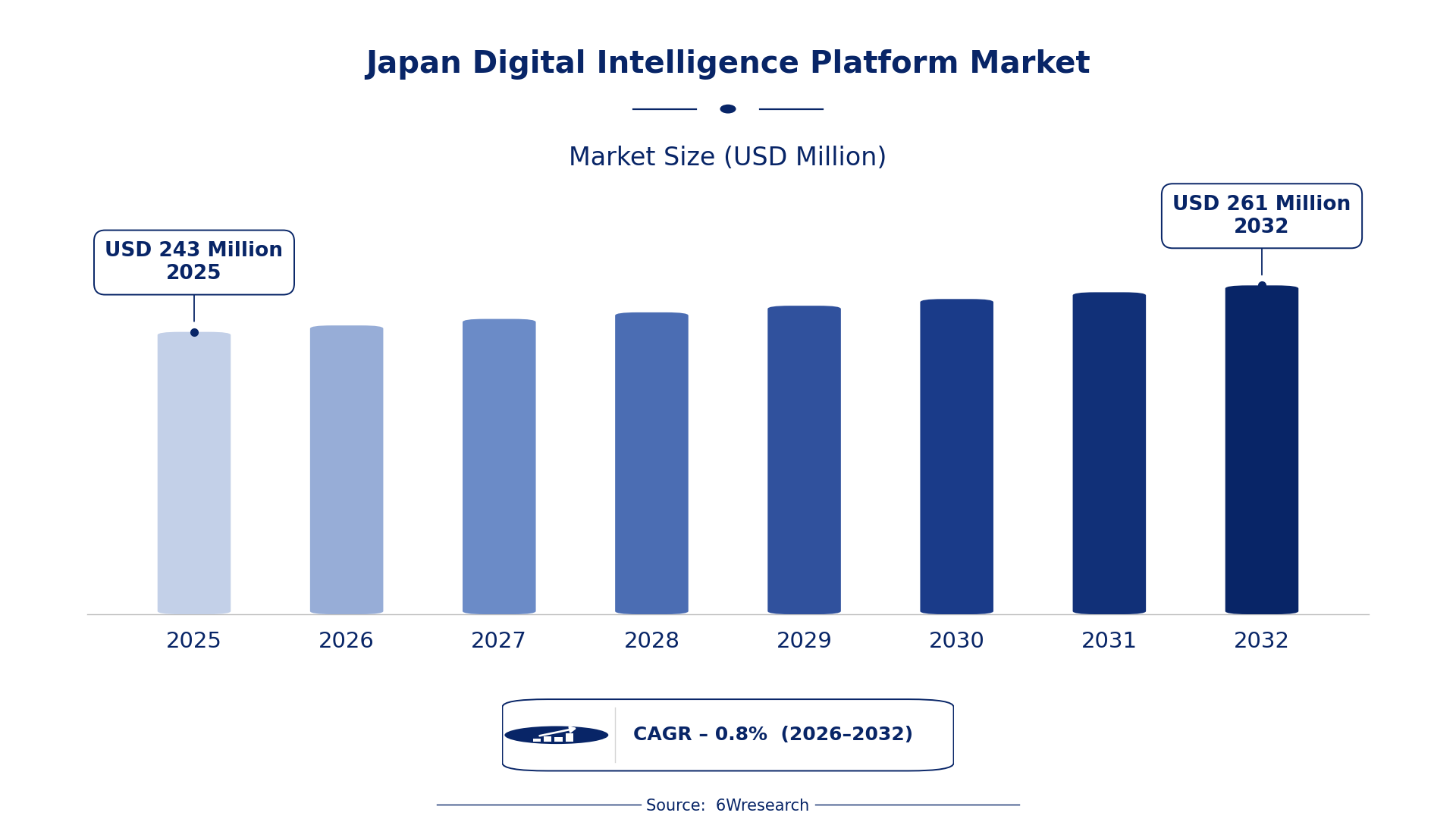
The Japan Digital Intelligence Platform Market was estimated at USD 243 Million in 2025 and is projected to reach USD 261 Million by 2032, growing at a CAGR of 0.8% from 2026 to 2032.
Japan Digital Intelligence Platform Market Synopsis
The Japan Digital Intelligence Platform Market has seen a surge in demand fueled by the growing integration of digital technologies across various sectors. Businesses are increasingly investing in advanced analytics and AI-driven solutions to unlock actionable insights from their data.
As organizations strive to enhance operational efficiencies and customer experiences, the market is set for further expansion. The focus is shifting towards real-time data processing and personalized solutions, indicating a strong trajectory for growth in the coming years.
Japan Digital Intelligence Platform Market Year-wise Growth Rate and Key Drivers
This graph illustrates the annual growth rates of the Japan Digital Intelligence Platform Market from 2021 to 2032, highlighting a steady upward trajectory and projected expansion over the forecast period.
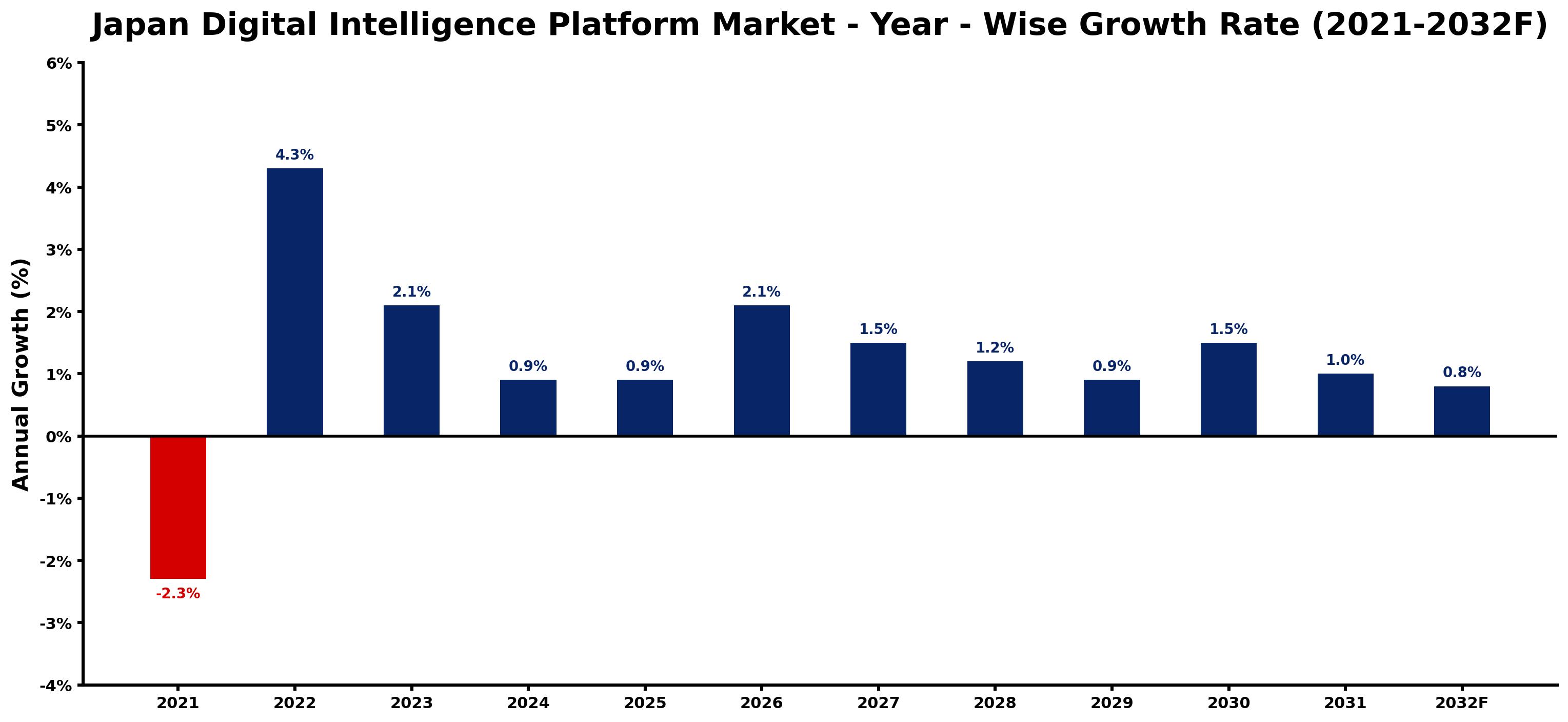
The table below presents the year‑wise growth rates along with the key drivers influencing the market
| Year | Growth Rate | Major Drivers |
| 2021 | -2.3% | Decreased investments due to Japan's declining workforce demographics. |
| 2022 | 4.3% | Government's Digital Agency promotes data utilization strategies. |
| 2023 | 2.1% | Increased demand for AI-driven insights in enterprises. |
| 2024 | 0.9% | Rising investment in cybersecurity measures by corporations. |
| 2025 | 0.9% | Continued growth in e-commerce platforms requiring analytics. |
| 2026 | 2.1% | Emergence of advanced cloud computing solutions in Japan. |
| 2027 | 1.5% | Growth of smart home devices drives data analytics usage. |
| 2028 | 1.2% | Local startups innovate digital solutions tailored for SMEs. |
| 2029 | 0.9% | Maturing digital payment systems enhance consumer data analysis. |
| 2030 | 1.5% | Adoption of IoT technologies fuels demand for analytics software. |
| 2031 | 1.0% | Government policies incentivize digital transformation initiatives. |
| 2032 | 0.8% | Increased focus on sustainability analytics by businesses. |
Note: Market size estimations and growth projections presented in this report are based on 6Wresearch's proprietary forecasting methodology, utilizing the latest available industry data, government publications, and primary research inputs.
Japan Digital Intelligence Platform Market Key Takeaways
Below are some of the specific key takeaways from the market, including:
- The increasing emphasis on AI and machine learning is reshaping data analytics practices across industries.
- Personalization and customization are driving the integration of advanced analytics tools within digital intelligence platforms.
- Cloud-based solutions are gaining traction due to their scalability and cost-effectiveness.
- Real-time data processing capabilities are becoming essential for quick and informed decision-making.
- Investment in cybersecurity solutions is rising as businesses prioritize data protection.
Evaluation of Restraints in Japan Digital Intelligence Platform Market
The Japan Digital Intelligence Platform Market faces several restraints that could impede its growth. Intense competition from established players creates pressure on pricing and innovation. on top of that, the rapid evolution of technology requires businesses to continuously adapt and upgrade their systems, which can be resource-intensive.
Cultural factors also play a role, as some organizations show a preference for traditional business practices, making them reluctant to embrace new technologies. Finally, data privacy regulations necessitate strict compliance measures, complicating the implementation of digital intelligence solutions.
Japan Digital Intelligence Platform Market Trends
Several trends are shaping the Japan Digital Intelligence Platform Market. A notable shift towards AI and machine learning is evident as companies seek to analyze vast datasets for actionable insights. Enhanced customer experience is a priority, leading to a greater adoption of platforms that offer real-time analytics and predictive capabilities.
The demand for cloud-based solutions continues to rise, driven by their flexibility and cost advantages. Additionally, businesses are increasingly focusing on integrating advanced analytics tools to provide tailored experiences, indicating a clear pivot towards data-centric strategies.
Japan Digital Intelligence Platform Market Opportunities
The market offers several promising investment opportunities as organizations accelerate their digital transformation efforts. Areas such as digital marketing platforms, customer relationship management systems, and business intelligence tools are ripe for investment. With a strong technological infrastructure in Japan, investors can capitalize on this momentum to foster growth across various sectors, including retail, finance, and healthcare.
Strategic partnerships and collaborations with local tech firms can enhance market penetration, while investment in cybersecurity solutions ensures robust protection of sensitive data, further strengthening the appeal of the market.
Government Initiatives in the Japan Digital Intelligence Platform Market
The Japanese government is actively shaping the Digital Intelligence Platform Market through various initiatives designed to foster innovation and digital transformation. With the "Society 5.0" vision, the government is integrating cutting-edge digital technologies to promote the adoption of digital intelligence solutions across industries.
- The "Digital Transformation Acceleration Program" was launched recently to support businesses in digitizing their operations and services.
- The "Connected Industries" initiative is currently underway, focusing on enhancing digital connectivity in manufacturing processes.
- A regulatory framework mandating increased transparency in data management is expected to be introduced in 2026.
- Future plans include a comprehensive digital infrastructure upgrade initiative aimed at expanding connectivity across urban and rural areas by 2028.
Future Insights of the Japan Digital Intelligence Platform Market
The Japan Digital Intelligence Platform Market is set to grow significantly in the coming years, driven by the continuous adoption of AI, machine learning, and big data analytics. As businesses increasingly recognize the value of data-driven insights, the demand for platforms providing real-time analytics and personalized experiences will surge.
Innovation will be key, with major players focusing on tailoring solutions to meet the unique demands of Japanese enterprises across various sectors. The ongoing commitment to digital transformation will further propel market expansion, leading to exciting developments in technology and application.
Japan Digital Intelligence Platform Market Latest Developments
In the past year, the Japan Digital Intelligence Platform Market has experienced a flurry of activity, with businesses actively pursuing digital solutions to enhance their operational capabilities. There has been a marked uptick in the development and deployment of innovative platforms designed to address specific industry needs.
- A major technology vendor launched a new analytics platform in early 2025, aimed at providing real-time insights for the retail sector.
- An ongoing collaboration between local firms is focused on developing AI-powered solutions for the healthcare industry, which began in mid-2025.
- A planned rollout of a cloud-based digital intelligence solution for financial services is expected to begin in Q3 2026.
- Recently completed initiatives have improved data visualization tools for manufacturing companies, enhancing their operational efficiencies.
Japan Digital Intelligence Platform Market - Key Attractiveness of the Report
- 10 Years of Market Numbers
- Historical Data Starting from 2022 to 2025
- Base Year: 2025
- Forecast Data until 2032
- Key Performance Indicators Impacting the Market
- Major Upcoming Developments and Projects
Key Highlights of the Report:
- Japan Digital Intelligence Platform Market Outlook
- Market Size of Japan Digital Intelligence Platform Market, 2025
- Forecast of Japan Digital Intelligence Platform Market, 2032
- Historical Data and Forecast of Japan Digital Intelligence Platform Revenues & Volume for the Period 2022-2032F
- Japan Digital Intelligence Platform Market Trend Evolution
- Japan Digital Intelligence Platform Market Drivers and Challenges
- Japan Digital Intelligence Platform Price Trends
- Japan Digital Intelligence Platform Porter's Five Forces
- Japan Digital Intelligence Platform Industry Life Cycle
- Historical Data and Forecast of Japan Digital Intelligence Platform Market Revenues & Volume By Component for the Period 2022-2032F
- Historical Data and Forecast of Japan Digital Intelligence Platform Market Revenues & Volume By Analytics for the Period 2022-2032F
- Historical Data and Forecast of Japan Digital Intelligence Platform Market Revenues & Volume By Data Management for the Period 2022-2032F
- Historical Data and Forecast of Japan Digital Intelligence Platform Market Revenues & Volume By Engagement Optimization for the Period 2022-2032F
- Historical Data and Forecast of Japan Digital Intelligence Platform Market Revenues & Volume By Vertical for the Period 2022-2032F
- Historical Data and Forecast of Japan Digital Intelligence Platform Market Revenues & Volume By Banking, Financial Services & Insurance (BFSI) for the Period 2022-2032F
- Historical Data and Forecast of Japan Digital Intelligence Platform Market Revenues & Volume By Retail & E-commerce for the Period 2022-2032F
- Historical Data and Forecast of Japan Digital Intelligence Platform Market Revenues & Volume By Telecommunication & IT for the Period 2022-2032F
- Historical Data and Forecast of Japan Digital Intelligence Platform Market Revenues & Volume By Media & Entertainment for the Period 2022-2032F
- Historical Data and Forecast of Japan Digital Intelligence Platform Market Revenues & Volume By Travel & Hospitality for the Period 2022-2032F
- Historical Data and Forecast of Japan Digital Intelligence Platform Market Revenues & Volume By Public Sector for the Period 2022-2032F
- Historical Data and Forecast of Japan Digital Intelligence Platform Market Revenues & Volume By Healthcare for the Period 2022-2032F
- Historical Data and Forecast of Japan Digital Intelligence Platform Market Revenues & Volume By Others for the Period 2022-2032F
- Historical Data and Forecast of Japan Digital Intelligence Platform Market Revenues & Volume By Touchpoint for the Period 2022-2032F
- Historical Data and Forecast of Japan Digital Intelligence Platform Market Revenues & Volume By Company Website for the Period 2022-2032F
- Historical Data and Forecast of Japan Digital Intelligence Platform Market Revenues & Volume By Mobile for the Period 2022-2032F
- Historical Data and Forecast of Japan Digital Intelligence Platform Market Revenues & Volume By E-mail for the Period 2022-2032F
- Historical Data and Forecast of Japan Digital Intelligence Platform Market Revenues & Volume By Social Media for the Period 2022-2032F
- Historical Data and Forecast of Japan Digital Intelligence Platform Market Revenues & Volume By Web for the Period 2022-2032F
- Historical Data and Forecast of Japan Digital Intelligence Platform Market Revenues & Volume By Kiosks & POS for the Period 2022-2032F
- Historical Data and Forecast of Japan Digital Intelligence Platform Market Revenues & Volume By Others for the Period 2022-2032F
- Historical Data and Forecast of Japan Digital Intelligence Platform Market Revenues & Volume By Organization Size for the Period 2022-2032F
- Historical Data and Forecast of Japan Digital Intelligence Platform Market Revenues & Volume By Large Enterprises for the Period 2022-2032F
- Historical Data and Forecast of Japan Digital Intelligence Platform Market Revenues & Volume By Small & Medium Enterprises (SMEs) for the Period 2022-2032F
- Japan Digital Intelligence Platform Import Export Trade Statistics
- Market Opportunity Assessment By Component
- Market Opportunity Assessment By Vertical
- Market Opportunity Assessment By Touchpoint
- Market Opportunity Assessment By Organization Size
- Japan Digital Intelligence Platform Top Companies Market Share
- Japan Digital Intelligence Platform Competitive Benchmarking By Technical and Operational Parameters
- Japan Digital Intelligence Platform Company Profiles
- Japan Digital Intelligence Platform Key Strategic Recommendations






































