Japan EdTech and Smart Classrooms Market Size & Growth Rate (2026-2032)
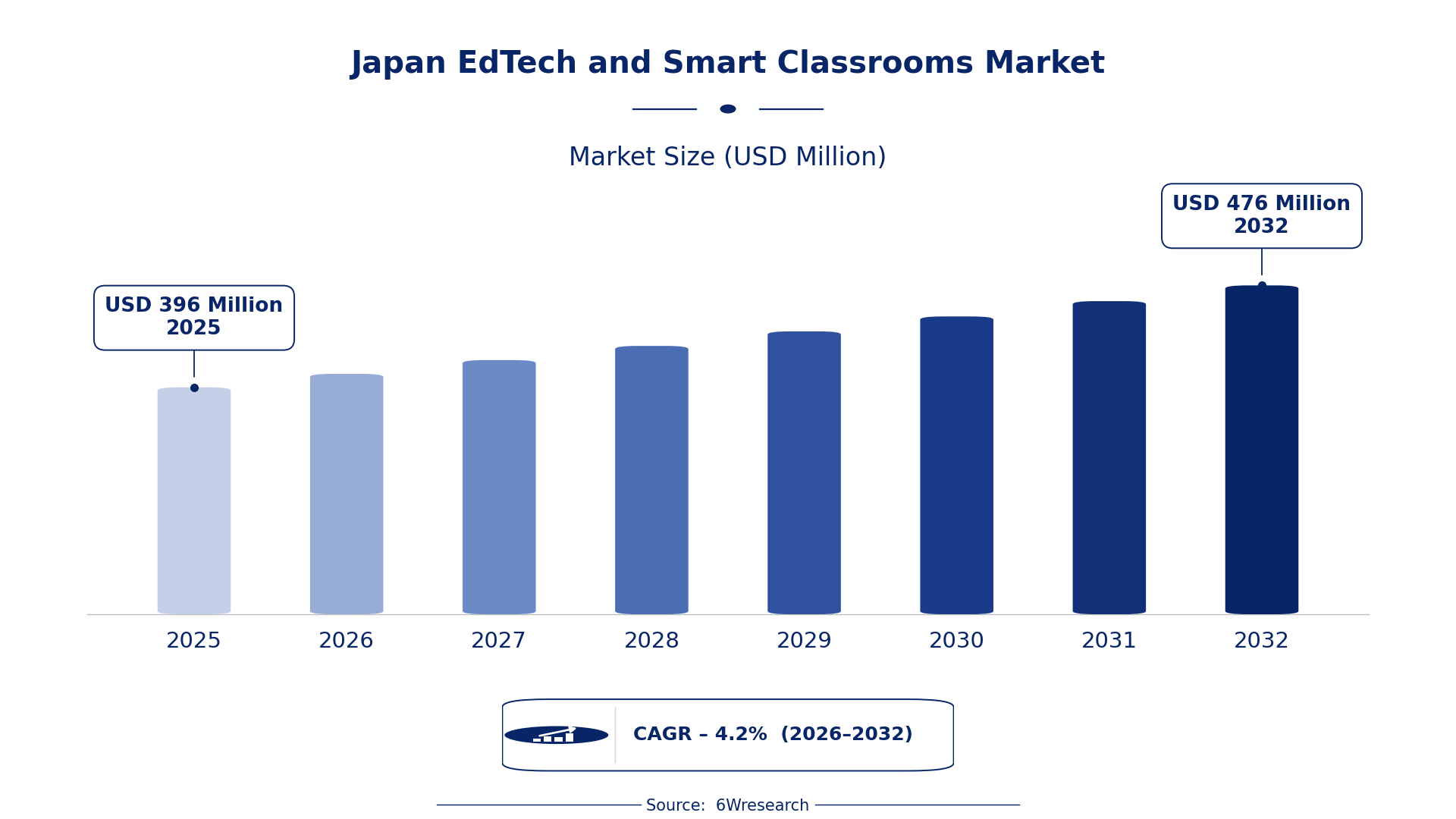
The Japan EdTech and Smart Classrooms Market was estimated at USD 396 Million in 2025 and is projected to reach USD 476 Million by 2032, growing at a CAGR of 4.2% from 2026 to 2032.
Japan EdTech and Smart Classrooms Market Synopsis
The Japan EdTech and Smart Classrooms market is witnessing a transformative phase, characterized by increasing investments in digital learning solutions. Schools and educational institutions are rapidly adopting advanced technologies to facilitate personalized and interactive learning experiences, reflecting a shift in educational paradigms.
As the demand for innovative educational technologies surges, the market is becoming a focal point for both local and international players. With the government's support in integrating technology into the education system, stakeholders are optimistic about the future potential of this sector.
Japan EdTech and Smart Classrooms Market Year-wise Growth Rate and Key Drivers
This graph illustrates the annual growth rates of the Japan EdTech and Smart Classrooms Market from 2021 to 2032, highlighting a steady upward trajectory and projected expansion over the forecast period.
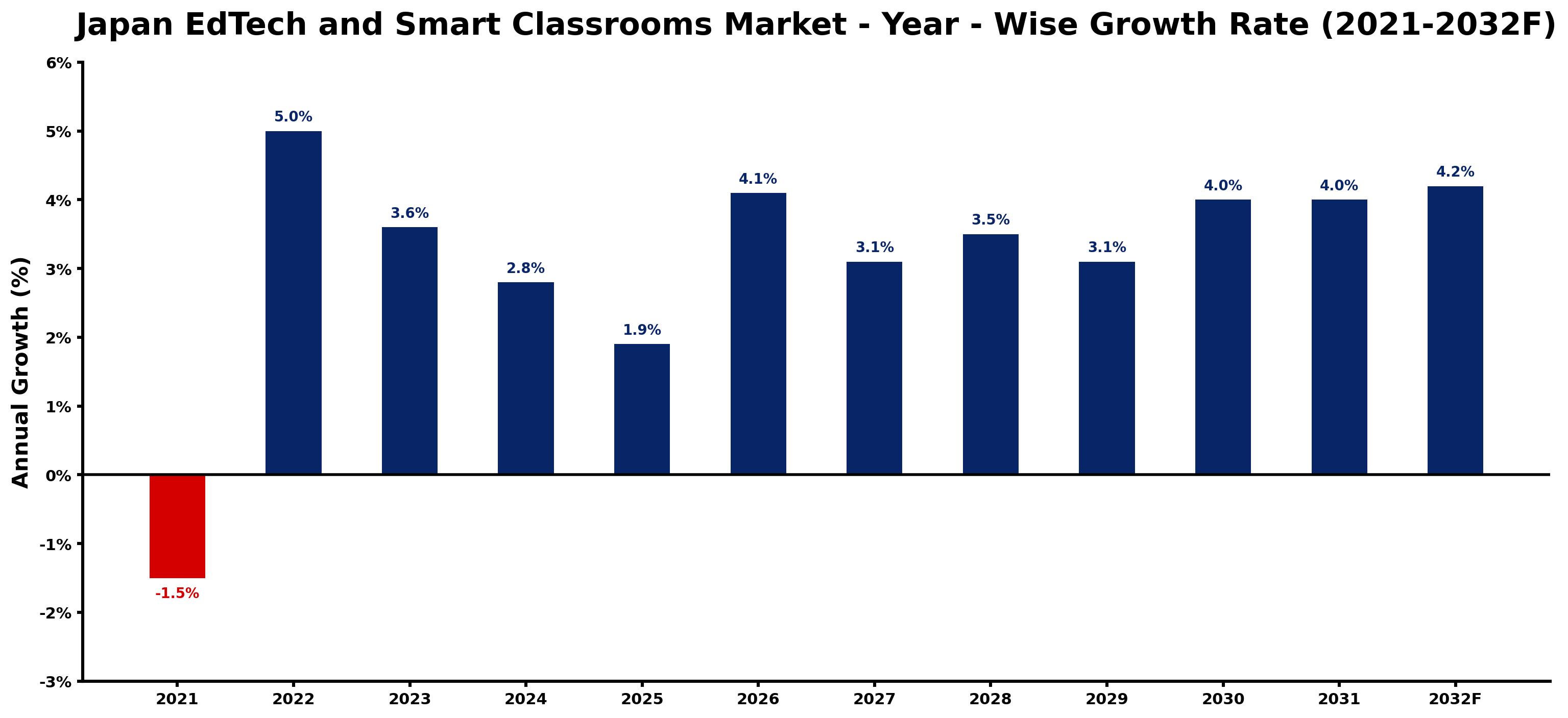
The table below presents the year‑wise growth rates along with the key drivers influencing the market
| Year | Growth Rate | Major Drivers |
| 2021 | -1.5% | Delayed adoption of digital tools in Japanese classrooms. |
| 2022 | 5.0% | MEXT's Digital Education Promotion Policy supports smart classroom adoption. |
| 2023 | 3.6% | Increasing digital literacy initiatives among Japanese educators. |
| 2024 | 2.8% | Rising investments in AI-driven educational technologies. |
| 2025 | 1.9% | Government subsidies for tech integration in universities. |
| 2026 | 4.1% | Growing collaboration between universities and EdTech startups. |
| 2027 | 3.1% | Demand for personalized learning tools among students rising. |
| 2028 | 3.5% | Enhanced focus on STEM education in school curricula. |
| 2029 | 3.1% | Surge in the use of interactive learning platforms. |
| 2030 | 4.0% | National strategy emphasizing advanced digital infrastructure in schools. |
| 2031 | 4.0% | Increased parental interest in tech-enabled learning environments. |
| 2032 | 4.2% | Focus on reducing classroom sizes leveraging smart technologies. |
Note: Market size estimations and growth projections presented in this report are based on 6Wresearch's proprietary forecasting methodology, utilizing the latest available industry data, government publications, and primary research inputs.
Japan EdTech and Smart Classrooms Market Key Takeaways
Below are some of the specific key takeaways from the market, including:
- Growing investment in AI-powered learning tools and virtual classrooms.
- Government initiatives are driving technology integration in education.
- Rising demand for personalized and adaptive learning solutions.
- Challenges remain regarding infrastructure and teacher training.
- Future growth is anticipated due to ongoing digital transformation efforts.
Evaluation of Restraints in Japan EdTech and Smart Classrooms Market
The Japan EdTech and Smart Classrooms market faces several hurdles. Traditional teaching methods often resist the adoption of new technologies, slowing down progress. Limited IT infrastructure in many schools hampers the effective implementation of advanced EdTech solutions. Additionally, concerns surrounding data privacy and security continue to raise red flags among educators and parents alike.
The lack of standardized regulations for EdTech integration leads to varying degrees of effectiveness in technology use across educational institutions. High costs associated with advanced tools and the necessity for specialized training further complicate the landscape, necessitating a collaborative approach among stakeholders to address these issues.
Japan EdTech and Smart Classrooms Market Trends
The market is experiencing a surge in the adoption of online learning platforms, catalyzed by the COVID-19 pandemic. Schools are increasingly utilizing virtual classrooms and interactive whiteboards to enhance student engagement. on top of that, a growing emphasis on personalized learning is driving investments in AI-driven educational applications.
on top of that, there is a noticeable trend towards incorporating augmented and virtual reality tools to create immersive learning environments. These advancements are reshaping the educational experience, making it more interactive and tailored to individual student needs.
Japan EdTech and Smart Classrooms Market Opportunities
Investment opportunities abound in the Japan EdTech and Smart Classrooms market, particularly in sectors like e-learning platforms and smart classroom technologies. With the government's push for digital education, companies that offer innovative solutions for personalized learning experiences are well-positioned for growth.
Additionally, partnerships with educational institutions can lead to fruitful collaboration and expansion avenues. As the demand for interactive educational content rises, there is ample scope for new entrants to capture market share by developing tailored solutions.
Government Initiatives in the Japan EdTech and Smart Classrooms Market
The Japanese government is actively shaping the EdTech and Smart Classrooms market through various initiatives aimed at enhancing educational technology integration. With a focus on digital literacy and innovation, these policies are designed to support the educational sector in adapting to modern technological demands.
- A recently completed initiative involved the allocation of funds to schools for procuring digital devices and software to support remote learning.
- A current ongoing project aims to promote the "Future School" concept, which focuses on innovative teaching methods and technology integration.
- Upcoming plans include a national digital infrastructure upgrade program intended to enhance internet access in schools by 2027.
- The government is developing a regulatory framework to ensure data privacy and security for educational technology solutions.
- Current initiatives also emphasize collaboration between educational institutions and tech companies to foster innovation in teaching methodologies.
Future Insights of the Japan EdTech and Smart Classrooms Market
Looking ahead to 2026-2032, the Japan EdTech and Smart Classrooms market is expected to flourish. The continued rise in digital learning adoption, coupled with government backing, will create a fertile environment for growth. Innovations in AI and AR/VR applications are likely to redefine educational experiences, making them more engaging and effective.
As hybrid learning models gain traction, the demand for smart classroom technologies will escalate. With a strong focus on enhancing learning outcomes and student engagement, the market holds significant promise for investors and stakeholders in the coming years.
Japan EdTech and Smart Classrooms Market Latest Developments
Recent activities in the Japan EdTech and Smart Classrooms market reveal a dynamic environment characterized by innovation and investment. In the past year, numerous initiatives have been launched to enhance digital learning and classroom experiences, reflecting the sector's commitment to progress.
- A major technology vendor announced the rollout of a new AI-driven educational platform that began in early 2025 and is set to be completed by late 2025.
- An initiative launched in Q3 2025 focuses on integrating virtual reality tools in classrooms to foster immersive learning experiences.
- A partnership between educational institutions and tech startups was formed in mid-2025, aimed at developing interactive learning content.
- Upcoming projects include a planned expansion of online tutoring services anticipated to begin in early 2026.
- A new government-funded program is underway to improve digital infrastructure in rural schools, expected to be completed by late 2026.
Japan EdTech and Smart Classrooms Market - Key Attractiveness of the Report
- 10 Years of Market Numbers
- Historical Data Starting from 2022 to 2025
- Base Year: 2025
- Forecast Data until 2032
- Key Performance Indicators Impacting the Market
- Major Upcoming Developments and Projects
Key Highlights of the Report:
- Japan EdTech and Smart Classrooms Market Outlook
- Market Size of Japan EdTech and Smart Classrooms Market, 2025
- Forecast of Japan EdTech and Smart Classrooms Market, 2032
- Historical Data and Forecast of Japan EdTech and Smart Classrooms Revenues & Volume for the Period 2022-2032F
- Japan EdTech and Smart Classrooms Market Trend Evolution
- Japan EdTech and Smart Classrooms Market Drivers and Challenges
- Japan EdTech and Smart Classrooms Price Trends
- Japan EdTech and Smart Classrooms Porter's Five Forces
- Japan EdTech and Smart Classrooms Industry Life Cycle
- Historical Data and Forecast of Japan EdTech and Smart Classrooms Market Revenues & Volume By Hardware for the Period 2022-2032F
- Historical Data and Forecast of Japan EdTech and Smart Classrooms Market Revenues & Volume By Interactive Displays for the Period 2022-2032F
- Historical Data and Forecast of Japan EdTech and Smart Classrooms Market Revenues & Volume By Interactive Projectors for the Period 2022-2032F
- Historical Data and Forecast of Japan EdTech and Smart Classrooms Market Revenues & Volume By Education System Solution for the Period 2022-2032F
- Historical Data and Forecast of Japan EdTech and Smart Classrooms Market Revenues & Volume By Learning Management System for the Period 2022-2032F
- Historical Data and Forecast of Japan EdTech and Smart Classrooms Market Revenues & Volume By Student Information and Administration System for the Period 2022-2032F
- Historical Data and Forecast of Japan EdTech and Smart Classrooms Market Revenues & Volume By Student Collaboration System for the Period 2022-2032F
- Historical Data and Forecast of Japan EdTech and Smart Classrooms Market Revenues & Volume By Student Response System for the Period 2022-2032F
- Historical Data and Forecast of Japan EdTech and Smart Classrooms Market Revenues & Volume By Learning and Gamification for the Period 2022-2032F
- Historical Data and Forecast of Japan EdTech and Smart Classrooms Market Revenues & Volume By Test Preparation for the Period 2022-2032F
- Historical Data and Forecast of Japan EdTech and Smart Classrooms Market Revenues & Volume By Classroom Management System for the Period 2022-2032F
- Historical Data and Forecast of Japan EdTech and Smart Classrooms Market Revenues & Volume By Document Management System for the Period 2022-2032F
- Historical Data and Forecast of Japan EdTech and Smart Classrooms Market Revenues & Volume By Deployment Type for the Period 2022-2032F
- Historical Data and Forecast of Japan EdTech and Smart Classrooms Market Revenues & Volume By Cloud for the Period 2022-2032F
- Historical Data and Forecast of Japan EdTech and Smart Classrooms Market Revenues & Volume By On-Premises for the Period 2022-2032F
- Historical Data and Forecast of Japan EdTech and Smart Classrooms Market Revenues & Volume By End User for the Period 2022-2032F
- Historical Data and Forecast of Japan EdTech and Smart Classrooms Market Revenues & Volume By K-12 for the Period 2022-2032F
- Historical Data and Forecast of Japan EdTech and Smart Classrooms Market Revenues & Volume By Higher Education for the Period 2022-2032F
- Japan EdTech and Smart Classrooms Import Export Trade Statistics
- Market Opportunity Assessment By Hardware
- Market Opportunity Assessment By Education System Solution
- Market Opportunity Assessment By Deployment Type
- Market Opportunity Assessment By End User
- Japan EdTech and Smart Classrooms Top Companies Market Share
- Japan EdTech and Smart Classrooms Competitive Benchmarking By Technical and Operational Parameters
- Japan EdTech and Smart Classrooms Company Profiles
- Japan EdTech and Smart Classrooms Key Strategic Recommendations






































