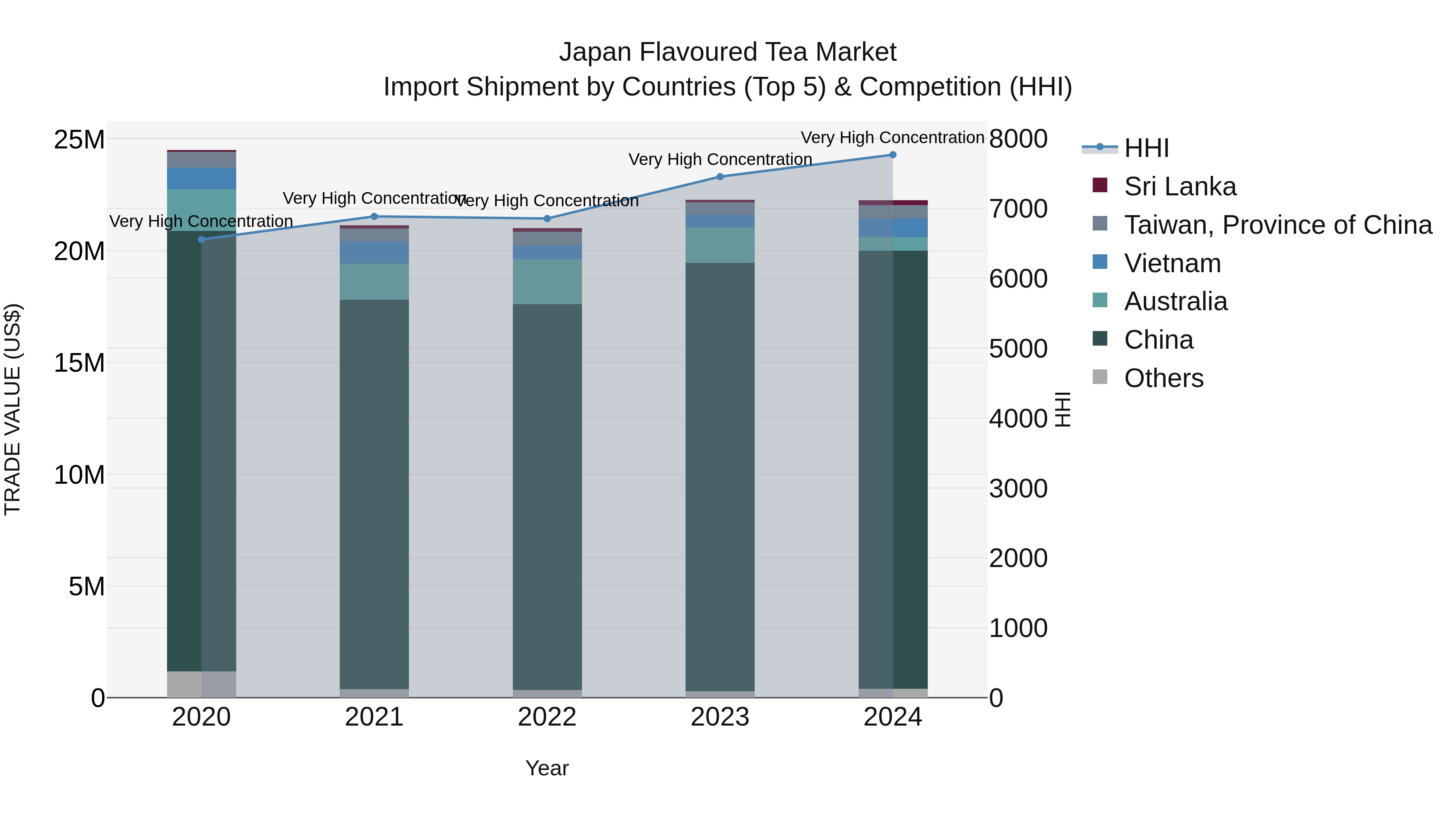
Japan Flavoured Tea Market Import Shipment by Countries (Top 5) & Competition (HHI)
Despite a declining CAGR from 2020-24, Japan continues to see significant import shipments of flavored tea, with top exporters being China, Vietnam, Australia, Taiwan, and Sri Lanka. The high Herfindahl-Hirschman Index (HHI) concentration in 2024 indicates a competitive market. However, the slight negative growth rate from 2023-24 suggests a potential slowdown in the industry. It will be interesting to see how these trends evolve and impact the flavored tea market in Japan in the coming years.
Key Highlights of the Report:
- Japan Flavoured Tea Market Outlook
- Market Size of Japan Flavoured Tea Market, 2024
- Forecast of Japan Flavoured Tea Market, 2031
- Historical Data and Forecast of Japan Flavoured Tea Revenues & Volume for the Period 2021- 2031
- Japan Flavoured Tea Market Trend Evolution
- Japan Flavoured Tea Market Drivers and Challenges
- Japan Flavoured Tea Price Trends
- Japan Flavoured Tea Porter's Five Forces
- Japan Flavoured Tea Industry Life Cycle
- Historical Data and Forecast of Japan Flavoured Tea Market Revenues & Volume By Type for the Period 2021- 2031
- Historical Data and Forecast of Japan Flavoured Tea Market Revenues & Volume By Loose Leaf Tea for the Period 2021- 2031
- Historical Data and Forecast of Japan Flavoured Tea Market Revenues & Volume By CTC Tea for the Period 2021- 2031
- Historical Data and Forecast of Japan Flavoured Tea Market Revenues & Volume By Flavour for the Period 2021- 2031
- Historical Data and Forecast of Japan Flavoured Tea Market Revenues & Volume By Fruits for the Period 2021- 2031
- Historical Data and Forecast of Japan Flavoured Tea Market Revenues & Volume By Flower for the Period 2021- 2031
- Historical Data and Forecast of Japan Flavoured Tea Market Revenues & Volume By Herbs and Spices for the Period 2021- 2031
- Historical Data and Forecast of Japan Flavoured Tea Market Revenues & Volume By Packaging format for the Period 2021- 2031
- Historical Data and Forecast of Japan Flavoured Tea Market Revenues & Volume By Packed for the Period 2021- 2031
- Historical Data and Forecast of Japan Flavoured Tea Market Revenues & Volume By Loose for the Period 2021- 2031
- Historical Data and Forecast of Japan Flavoured Tea Market Revenues & Volume By Product Type for the Period 2021- 2031
- Historical Data and Forecast of Japan Flavoured Tea Market Revenues & Volume By Black Tea for the Period 2021- 2031
- Historical Data and Forecast of Japan Flavoured Tea Market Revenues & Volume By Green Tea for the Period 2021- 2031
- Historical Data and Forecast of Japan Flavoured Tea Market Revenues & Volume By Herbal Tea for the Period 2021- 2031
- Historical Data and Forecast of Japan Flavoured Tea Market Revenues & Volume By Oolong Tea for the Period 2021- 2031
- Historical Data and Forecast of Japan Flavoured Tea Market Revenues & Volume By Distribution Channel for the Period 2021- 2031
- Historical Data and Forecast of Japan Flavoured Tea Market Revenues & Volume By Online and Offline for the Period 2021- 2031
- Historical Data and Forecast of Japan Flavoured Tea Market Revenues & Volume By Supermarkets/Hypermarkets for the Period 2021- 2031
- Japan Flavoured Tea Import Export Trade Statistics
- Market Opportunity Assessment By Type
- Market Opportunity Assessment By Flavour
- Market Opportunity Assessment By Packaging format
- Market Opportunity Assessment By Product Type
- Market Opportunity Assessment By Distribution Channel
- Japan Flavoured Tea Top Companies Market Share
- Japan Flavoured Tea Competitive Benchmarking By Technical and Operational Parameters
- Japan Flavoured Tea Company Profiles
- Japan Flavoured Tea Key Strategic Recommendations






































