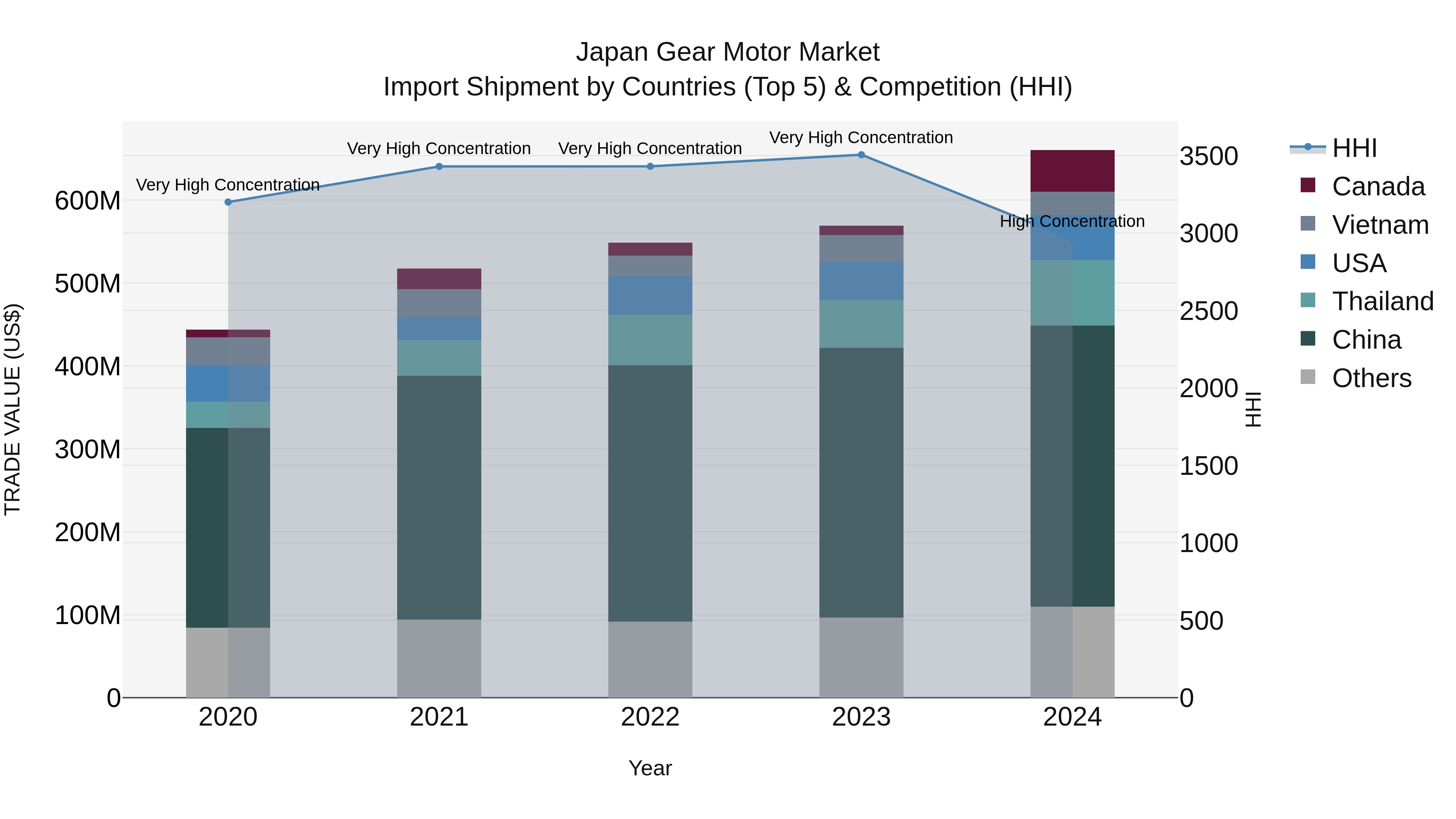
Japan Gear Motor Market Import Shipment by Countries (Top 5) & Competition (HHI)
Japan's gear motor import shipments in 2024 continue to be dominated by key exporters such as China, Thailand, USA, Canada, and Taiwan. The market shows a high concentration level, with a noticeable increase from 2023 to 2024. The impressive compound annual growth rate (CAGR) of 10.44% from 2020 to 2024 indicates a steady expansion in the market. Moreover, the growth rate spike of 16.05% from 2023 to 2024 suggests a rapid acceleration in import volumes, reflecting a robust demand for gear motors in Japan.
Japan Gear Motor Market Overview
The Japan gear motor market is a thriving industry driven by the country`s strong manufacturing sector and technological advancements. With a focus on precision engineering and high-quality products, Japanese gear motor manufacturers are known for their reliability and efficiency. The market is segmented across various industries such as automotive, robotics, electronics, and industrial machinery, catering to a wide range of applications. Companies in Japan are investing in research and development to enhance product capabilities, including energy efficiency and compact designs. With a growing emphasis on automation and smart manufacturing, the demand for gear motors in Japan is expected to continue to rise. Overall, the Japan gear motor market presents significant opportunities for growth and innovation.
Japan Gear Motor Market Trends
In Japan, the gear motor market is experiencing several notable trends. One key trend is the increasing adoption of energy-efficient gear motors in various industries to reduce carbon emissions and operating costs. Manufacturers are focusing on developing gear motors with higher efficiency ratings and compact designs to meet the growing demand for sustainable solutions. Another trend is the rising demand for gear motors in the automotive sector, driven by the shift towards electric and hybrid vehicles. Additionally, the integration of advanced technologies such as IoT and automation in gear motor systems is gaining traction, enabling remote monitoring and predictive maintenance capabilities. Overall, the Japan gear motor market is witnessing a shift towards eco-friendly solutions, increased automation, and technological advancements to meet evolving industry requirements.
Japan Gear Motor Market Challenges
The Japan gear motor market faces several challenges, including intense competition from both domestic and international manufacturers, leading to price pressures and margin constraints. Additionally, the market is experiencing a shift towards environmentally friendly and energy-efficient solutions, requiring gear motor manufacturers to invest in research and development to meet these changing customer preferences. Another challenge is the need for continuous innovation to keep up with technological advancements, such as the integration of IoT capabilities and smart features in gear motors. Moreover, the aging workforce in Japan poses a potential challenge in terms of skills gap and succession planning within the industry. Overall, navigating these challenges while maintaining product quality and competitiveness is crucial for sustained growth in the Japan gear motor market.
Japan Gear Motor Market Investment Opportunities
The Japan gear motor market offers promising investment opportunities due to the country`s strong manufacturing sector and technological advancements. With increasing automation in industries such as automotive, electronics, and robotics, the demand for gear motors is expected to rise significantly. Investing in companies that manufacture high-quality gear motors or provide innovative solutions for automation processes could yield favorable returns. Additionally, the focus on energy efficiency and sustainability in Japan presents opportunities for investments in gear motors that are designed to reduce energy consumption and carbon emissions. Overall, the Japan gear motor market is poised for growth, making it an attractive prospect for investors looking to capitalize on the country`s industrial development and technological progress.
Japan Gear Motor Market Government Policy
The Japanese government has implemented policies to promote energy efficiency and sustainability in the gear motor market. The Energy Efficiency Standards for Motors and Appliances aim to reduce energy consumption by setting minimum efficiency requirements for gear motors. Additionally, the Japanese government provides subsidies and incentives for companies to adopt energy-efficient gear motors, encouraging the use of eco-friendly and high-performance products. These policies not only support the growth of the gear motor market but also contribute to the country`s overall goals of reducing carbon emissions and promoting a greener economy.
Japan Gear Motor Market Future Outlook
The Japan gear motor market is expected to exhibit steady growth in the upcoming years, driven by factors such as increasing industrial automation, robotics, and automotive production. With a strong focus on technological advancements and innovation, Japanese manufacturers are likely to introduce more energy-efficient and compact gear motor solutions to meet the evolving demands of various industries. Additionally, the growing adoption of electric vehicles in Japan is anticipated to create new opportunities for gear motor manufacturers, particularly in the automotive sector. Overall, the market is poised for expansion, supported by the country`s robust manufacturing sector and continuous efforts to enhance operational efficiency and productivity across industries.
Key Highlights of the Report:
- Japan Gear Motor Market Outlook
- Market Size of Japan Gear Motor Market,2024
- Forecast of Japan Gear Motor Market, 2031
- Historical Data and Forecast of Japan Gear Motor Revenues & Volume for the Period 2021-2031
- Japan Gear Motor Market Trend Evolution
- Japan Gear Motor Market Drivers and Challenges
- Japan Gear Motor Price Trends
- Japan Gear Motor Porter's Five Forces
- Japan Gear Motor Industry Life Cycle
- Historical Data and Forecast of Japan Gear Motor Market Revenues & Volume By Type for the Period 2021-2031
- Historical Data and Forecast of Japan Gear Motor Market Revenues & Volume By Helical Gear Motor for the Period 2021-2031
- Historical Data and Forecast of Japan Gear Motor Market Revenues & Volume By Planetary Gear Motor for the Period 2021-2031
- Historical Data and Forecast of Japan Gear Motor Market Revenues & Volume By Helical-Bevel Gear Motor for the Period 2021-2031
- Historical Data and Forecast of Japan Gear Motor Market Revenues & Volume By Worm Gear Motor for the Period 2021-2031
- Historical Data and Forecast of Japan Gear Motor Market Revenues & Volume By Others for the Period 2021 - 2029
- Historical Data and Forecast of Japan Gear Motor Market Revenues & Volume By Power for the Period 2021-2031
- Historical Data and Forecast of Japan Gear Motor Market Revenues & Volume By Up to 7.5 kW for the Period 2021-2031
- Historical Data and Forecast of Japan Gear Motor Market Revenues & Volume By 7.5 kW to 75 kW for the Period 2021-2031
- Historical Data and Forecast of Japan Gear Motor Market Revenues & Volume By Above 7.5 kW for the Period 2021-2031
- Historical Data and Forecast of Japan Gear Motor Market Revenues & Volume By Torque for the Period 2021-2031
- Historical Data and Forecast of Japan Gear Motor Market Revenues & Volume By Up to 10,000 Nm for the Period 2021-2031
- Historical Data and Forecast of Japan Gear Motor Market Revenues & Volume By Above 10,000 Nm for the Period 2021-2031
- Historical Data and Forecast of Japan Gear Motor Market Revenues & Volume By End use for the Period 2021-2031
- Historical Data and Forecast of Japan Gear Motor Market Revenues & Volume By Industrial Machinery for the Period 2021-2031
- Historical Data and Forecast of Japan Gear Motor Market Revenues & Volume By Automotive for the Period 2021-2031
- Historical Data and Forecast of Japan Gear Motor Market Revenues & Volume By Aerospace & Defense for the Period 2021-2031
- Historical Data and Forecast of Japan Gear Motor Market Revenues & Volume By Consumer Electronics for the Period 2021-2031
- Historical Data and Forecast of Japan Gear Motor Market Revenues & Volume By Agriculture for the Period 2021 - 2029
- Historical Data and Forecast of Japan Gear Motor Market Revenues & Volume By Energy & Power for the Period 2021 - 2029
- Historical Data and Forecast of Japan Gear Motor Market Revenues & Volume By Marine for the Period 2021 - 2029
- Historical Data and Forecast of Japan Gear Motor Market Revenues & Volume By Others for the Period 2021 - 2029
- Japan Gear Motor Import Export Trade Statistics
- Market Opportunity Assessment By Type
- Market Opportunity Assessment By Power
- Market Opportunity Assessment By Torque
- Market Opportunity Assessment By End use
- Japan Gear Motor Top Companies Market Share
- Japan Gear Motor Competitive Benchmarking By Technical and Operational Parameters
- Japan Gear Motor Company Profiles
- Japan Gear Motor Key Strategic Recommendations






































