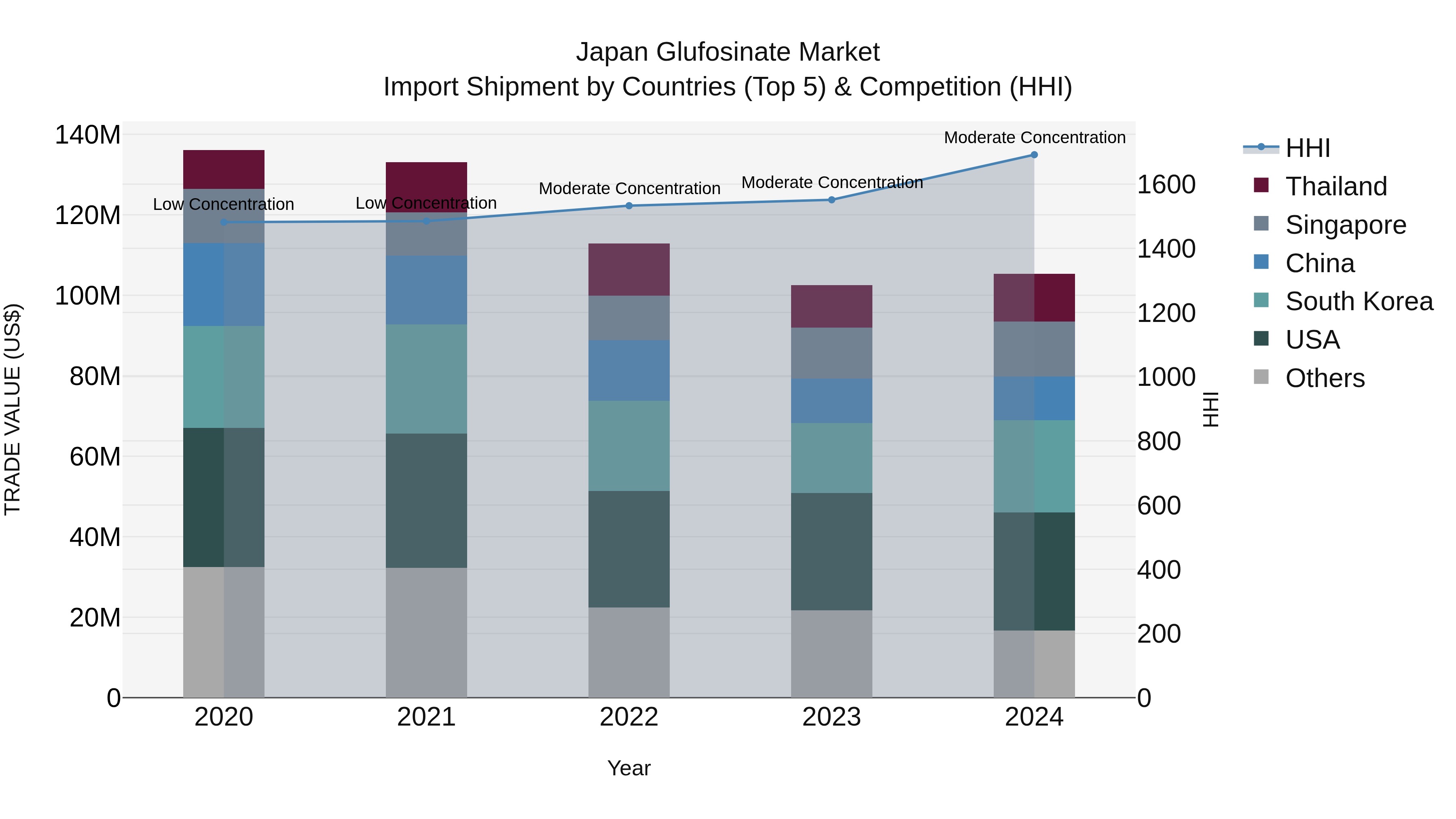
Japan Glufosinate Market Import Shipment by Countries (Top 5) & Competition (HHI)
Japan's glufosinate import shipments in 2024 saw steady contributions from top exporting countries including the USA, South Korea, Singapore, Thailand, and China. Despite a moderate concentration level in the market, the compound annual growth rate (CAGR) for 2020-2024 experienced a decline of -6.19%. However, there was a slight improvement in the growth rate from 2023 to 2024, with a positive 2.77% increase. These trends indicate a stable market with potential for further developments and collaborations among key players in the industry.
Japan Glufosinate Market Synopsis
The Japan Glufosinate market is witnessing steady growth driven by the increasing adoption of herbicides in agriculture to improve crop yield. Glufosinate, a broad-spectrum herbicide, is favored for its effectiveness against a wide range of weeds, making it a popular choice among farmers. The market is also benefiting from the rising demand for genetically modified (GM) crops that are engineered to be resistant to glufosinate, further driving its usage. Technological advancements in farming practices and the government`s support for sustainable agriculture practices are expected to fuel further growth in the Japan Glufosinate market. Key players in the market include Bayer CropScience, BASF SE, and Nufarm Limited, among others, who are focusing on product innovation and strategic partnerships to strengthen their market presence.
Japan Glufosinate Market Trends
The Japan Glufosinate market is witnessing a steady growth trajectory due to increasing demand for crop protection products in the agriculture sector. The trend towards sustainable farming practices and the adoption of genetically modified crops resistant to Glufosinate herbicides are driving market growth. Additionally, stringent regulations on pesticide usage are creating opportunities for bio-based alternatives in the market. The rising awareness about the environmental impact of chemical pesticides is also boosting the demand for Glufosinate as a more eco-friendly option. With Japan`s strong focus on technology and innovation in agriculture, there is a growing opportunity for companies to introduce advanced formulations and precision application techniques in the Glufosinate market to cater to the evolving needs of Japanese farmers.
Japan Glufosinate Market Challenges
In the Japan Glufosinate market, several challenges are faced, including increasing regulatory scrutiny on pesticide usage, competition from alternative herbicides, and rising concerns over environmental impact. Regulatory changes and restrictions on pesticide usage in Japan can impact the availability and usage of Glufosinate-based products, leading to market uncertainty. Additionally, the availability of alternative herbicides and the preference for more sustainable and environmentally friendly agricultural practices pose a challenge to the growth of Glufosinate in the market. To address these challenges, companies operating in the Japan Glufosinate market need to focus on innovation, product differentiation, and sustainable practices to stay competitive and meet the changing demands of consumers and regulatory authorities.
Japan Glufosinate Market Investment Opportunities
The Japan Glufosinate market is primarily driven by the increasing demand for herbicides in the agriculture sector to combat weed resistance and ensure higher crop productivity. The growing adoption of genetically modified (GM) crops that are engineered to be resistant to glufosinate herbicides is also fueling market growth. Additionally, stringent regulations on chemical usage and a shift towards sustainable farming practices are driving the demand for environmentally friendly herbicides like glufosinate. The rising awareness among farmers about the benefits of glufosinate in terms of efficacy, cost-effectiveness, and ease of application is further contributing to market expansion. Overall, factors such as increasing agricultural activities, technological advancements in crop protection products, and the need for higher crop yields are driving the growth of the Japan Glufosinate market.
Japan Glufosinate Market Government Polices
The Japanese government has strict regulations in place for the use of glufosinate, a popular herbicide. The Ministry of Agriculture, Forestry and Fisheries (MAFF) oversees the registration and approval process for glufosinate products, ensuring they meet safety and efficacy standards. Additionally, the Ministry of Health, Labour and Welfare (MHLW) sets maximum residue limits for glufosinate in food crops to safeguard public health. The government also promotes sustainable agricultural practices and encourages farmers to adopt alternative weed control methods to reduce dependence on chemical pesticides like glufosinate. Overall, the regulatory framework in Japan emphasizes the safe and responsible use of glufosinate to protect both consumers and the environment.
Japan Glufosinate Market Future Outlook
The Japan Glufosinate market is projected to experience steady growth in the coming years, driven by increasing demand for effective herbicides to support the country`s agricultural sector. Factors such as the need for sustainable weed control solutions and advancements in biotechnology are expected to fuel the market expansion. Additionally, the government`s initiatives to promote precision agriculture practices and the adoption of genetically modified crops are anticipated to further boost the demand for Glufosinate in Japan. Market players are likely to focus on product innovations, strategic partnerships, and marketing initiatives to capitalize on the growing market opportunities. Overall, the Japan Glufosinate market is poised for growth, with a positive outlook in the foreseeable future.
Key Highlights of the Report:
- Japan Glufosinate Market Outlook
- Market Size of Japan Glufosinate Market, 2024
- Forecast of Japan Glufosinate Market, 2031
- Historical Data and Forecast of Japan Glufosinate Revenues & Volume for the Period 2021 - 2031
- Japan Glufosinate Market Trend Evolution
- Japan Glufosinate Market Drivers and Challenges
- Japan Glufosinate Price Trends
- Japan Glufosinate Porter's Five Forces
- Japan Glufosinate Industry Life Cycle
- Historical Data and Forecast of Japan Glufosinate Market Revenues & Volume By Crop Type for the Period 2021 - 2031
- Historical Data and Forecast of Japan Glufosinate Market Revenues & Volume By Genetically Modified Crops for the Period 2021 - 2031
- Historical Data and Forecast of Japan Glufosinate Market Revenues & Volume By Conventional Crops for the Period 2021 - 2031
- Historical Data and Forecast of Japan Glufosinate Market Revenues & Volume By Form for the Period 2021 - 2031
- Historical Data and Forecast of Japan Glufosinate Market Revenues & Volume By Liquid Formulation for the Period 2021 - 2031
- Historical Data and Forecast of Japan Glufosinate Market Revenues & Volume By Dry Formulation for the Period 2021 - 2031
- Historical Data and Forecast of Japan Glufosinate Market Revenues & Volume By Application for the Period 2021 - 2031
- Historical Data and Forecast of Japan Glufosinate Market Revenues & Volume By Agricultural for the Period 2021 - 2031
- Historical Data and Forecast of Japan Glufosinate Market Revenues & Volume By Non Agricultural for the Period 2021 - 2031
- Japan Glufosinate Import Export Trade Statistics
- Market Opportunity Assessment By Crop Type
- Market Opportunity Assessment By Form
- Market Opportunity Assessment By Application
- Japan Glufosinate Top Companies Market Share
- Japan Glufosinate Competitive Benchmarking By Technical and Operational Parameters
- Japan Glufosinate Company Profiles
- Japan Glufosinate Key Strategic Recommendations






































