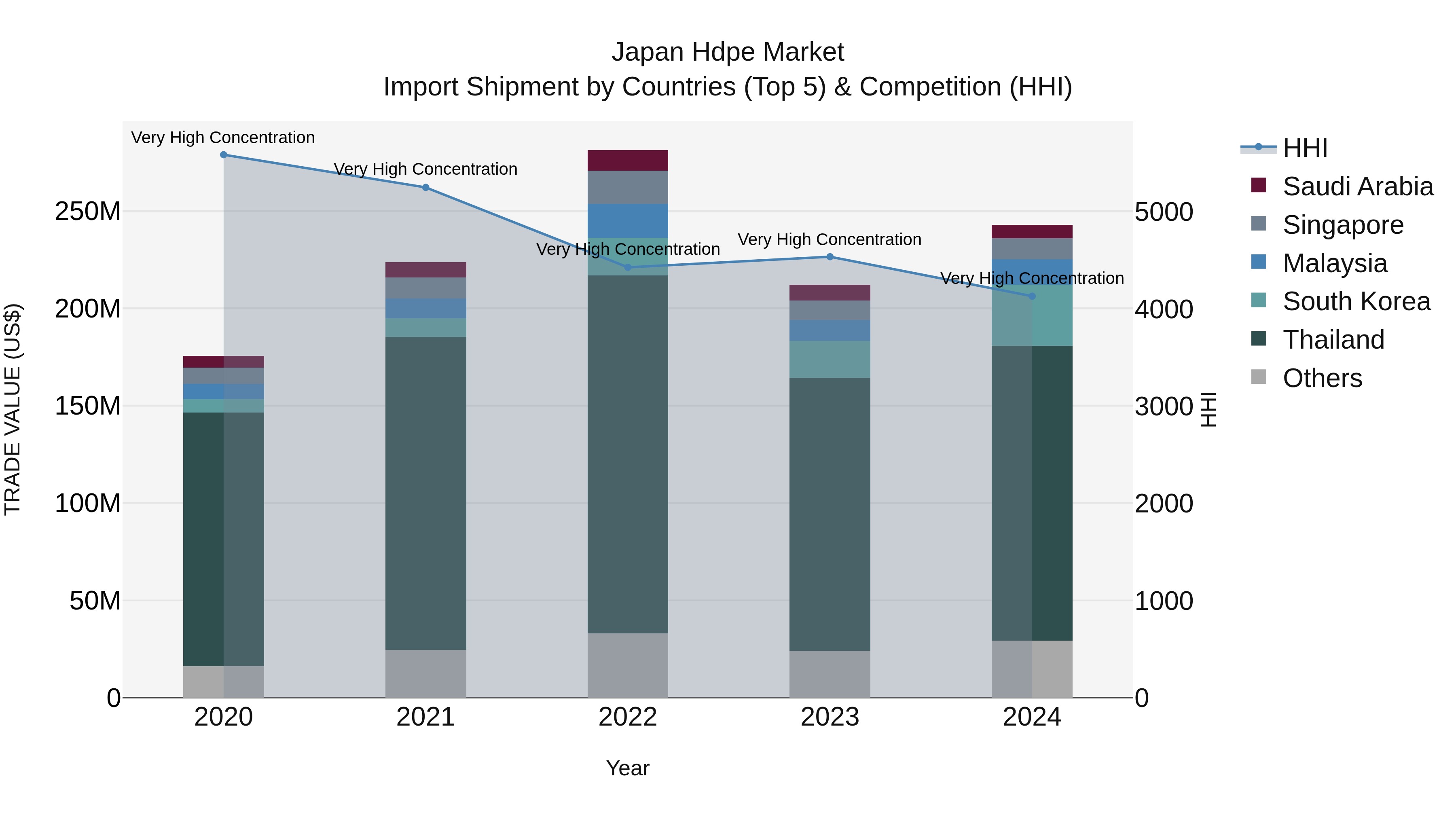
Japan Hdpe Market Import Shipment by Countries (Top 5) & Competition (HHI)
In 2024, Japan's HDPE import market continued to thrive with significant contributions from top exporters including Thailand, South Korea, Malaysia, Singapore, and Qatar. The high Herfindahl-Hirschman Index (HHI) indicates a concentrated market, highlighting the dominance of key players. With a commendable Compound Annual Growth Rate (CAGR) of 8.46% from 2020 to 2024, the industry shows a strong performance. The impressive growth rate of 14.5% from 2023 to 2024 suggests a promising outlook for the HDPE import market in Japan, reflecting robust demand and strategic trade relationships with key exporting nations.
Japan Hdpe Market Overview
The Japan HDPE (High-Density Polyethylene) market is experiencing steady growth driven by factors such as increasing demand from packaging, construction, and automotive industries. HDPE is widely used in Japan for packaging materials due to its excellent strength, durability, and chemical resistance properties. The construction sector also contributes significantly to the demand for HDPE in applications such as pipes, fittings, and geomembranes. The automotive industry uses HDPE for various components, including fuel tanks and bumpers. The market is characterized by intense competition among key players like Mitsui Chemicals, Inc., and INEOS Group Holdings S.A. Innovations in product development, sustainability initiatives, and strategic partnerships are key strategies adopted by companies to maintain their market position in Japan`s HDPE market.
Japan Hdpe Market Trends
The Japan HDPE market is experiencing several key trends. One prominent trend is the increasing demand for HDPE in packaging applications, driven by the growth of e-commerce and the need for sustainable packaging solutions. Another trend is the rising focus on recycling and sustainability, leading to a shift towards using recycled HDPE materials in various industries. Additionally, technological advancements in HDPE production processes are helping to improve the overall quality and performance of HDPE products in Japan. The market is also witnessing a trend towards lightweight and durable HDPE products in sectors such as construction and automotive. Overall, these trends are shaping the Japan HDPE market towards a more sustainable and innovative future.
Japan Hdpe Market Challenges
In the Japan HDPE market, some of the key challenges faced include intense competition from other plastic types like polypropylene and polyethylene, fluctuating raw material prices, and environmental concerns related to plastic waste. Additionally, the market is witnessing increasing regulations and policies aimed at reducing plastic usage and promoting sustainability, which can impact the demand for HDPE products. Furthermore, the COVID-19 pandemic has disrupted supply chains and affected overall market dynamics. Companies operating in the Japan HDPE market need to navigate these challenges by focusing on innovation, sustainability, and cost-efficiency to stay competitive and meet changing consumer preferences and regulatory requirements.
Japan Hdpe Market Investment Opportunities
In the Japan HDPE market, there are several investment opportunities worth considering. With the increasing demand for HDPE (high-density polyethylene) in various industries such as packaging, construction, and automotive, investing in HDPE production facilities or distribution channels could be lucrative. Additionally, the push towards sustainability and environmental regulations in Japan has created a growing market for recycled HDPE products, offering opportunities for investment in recycling technologies and facilities. Furthermore, the ongoing research and development in the HDPE sector for innovative applications and enhanced properties present avenues for investment in technology companies or partnerships. Overall, the Japan HDPE market`s growth trajectory and evolving landscape make it an attractive space for strategic investments with the potential for long-term returns.
Japan Hdpe Market Government Policy
The Japanese government has implemented various policies to regulate and support the High-Density Polyethylene (HDPE) market. These policies include waste management regulations to promote recycling and reduce plastic waste, as well as initiatives to incentivize the use of eco-friendly materials such as HDPE in packaging and manufacturing. Additionally, the government has introduced subsidies and grants to support research and development in the HDPE sector, aiming to enhance the competitiveness of Japanese HDPE manufacturers in the global market. Furthermore, there are strict quality standards and certification requirements in place to ensure the safety and reliability of HDPE products in Japan, fostering consumer trust and confidence in the market.
Japan Hdpe Market Future Outlook
The future outlook for the Japan HDPE (High-Density Polyethylene) market appears positive, with steady growth projected over the coming years. Factors driving this growth include increasing demand from industries such as packaging, construction, and automotive due to the material`s lightweight, durable, and versatile properties. Additionally, the emphasis on sustainability and recyclability is expected to drive the adoption of HDPE as a preferred material choice. Technological advancements in manufacturing processes and the development of innovative applications for HDPE are also likely to contribute to market expansion. However, challenges such as fluctuating raw material prices and environmental concerns regarding plastic waste management may impact the market to some extent. Overall, the Japan HDPE market is poised for growth, driven by increasing demand and technological advancements.
Key Highlights of the Report:
- Japan HDPE Market Outlook
- Market Size of Japan HDPE Market,2024
- Forecast of Japan HDPE Market, 2031
- Historical Data and Forecast of Japan HDPE Revenues & Volume for the Period 2021-2031
- Japan HDPE Market Trend Evolution
- Japan HDPE Market Drivers and Challenges
- Japan HDPE Price Trends
- Japan HDPE Porter's Five Forces
- Japan HDPE Industry Life Cycle
- Historical Data and Forecast of Japan HDPE Market Revenues & Volume By Type for the Period 2021-2031
- Historical Data and Forecast of Japan HDPE Market Revenues & Volume By PE80 Pipe for the Period 2021-2031
- Historical Data and Forecast of Japan HDPE Market Revenues & Volume By PE100 Pipe for the Period 2021-2031
- Historical Data and Forecast of Japan HDPE Market Revenues & Volume By Sales Channel for the Period 2021-2031
- Historical Data and Forecast of Japan HDPE Market Revenues & Volume By Direct Sales for the Period 2021-2031
- Historical Data and Forecast of Japan HDPE Market Revenues & Volume By Distribution Sales for the Period 2021-2031
- Historical Data and Forecast of Japan HDPE Market Revenues & Volume By Application for the Period 2021-2031
- Historical Data and Forecast of Japan HDPE Market Revenues & Volume By Water Supply for the Period 2021-2031
- Historical Data and Forecast of Japan HDPE Market Revenues & Volume By Oil and Gas for the Period 2021-2031
- Historical Data and Forecast of Japan HDPE Market Revenues & Volume By Sewage Systems for the Period 2021-2031
- Historical Data and Forecast of Japan HDPE Market Revenues & Volume By Agricultural Applications for the Period 2021-2031
- Japan HDPE Import Export Trade Statistics
- Market Opportunity Assessment By Type
- Market Opportunity Assessment By Sales Channel
- Market Opportunity Assessment By Application
- Japan HDPE Top Companies Market Share
- Japan HDPE Competitive Benchmarking By Technical and Operational Parameters
- Japan HDPE Company Profiles
- Japan HDPE Key Strategic Recommendations






































