Japan Inulin Market Size & Growth Rate
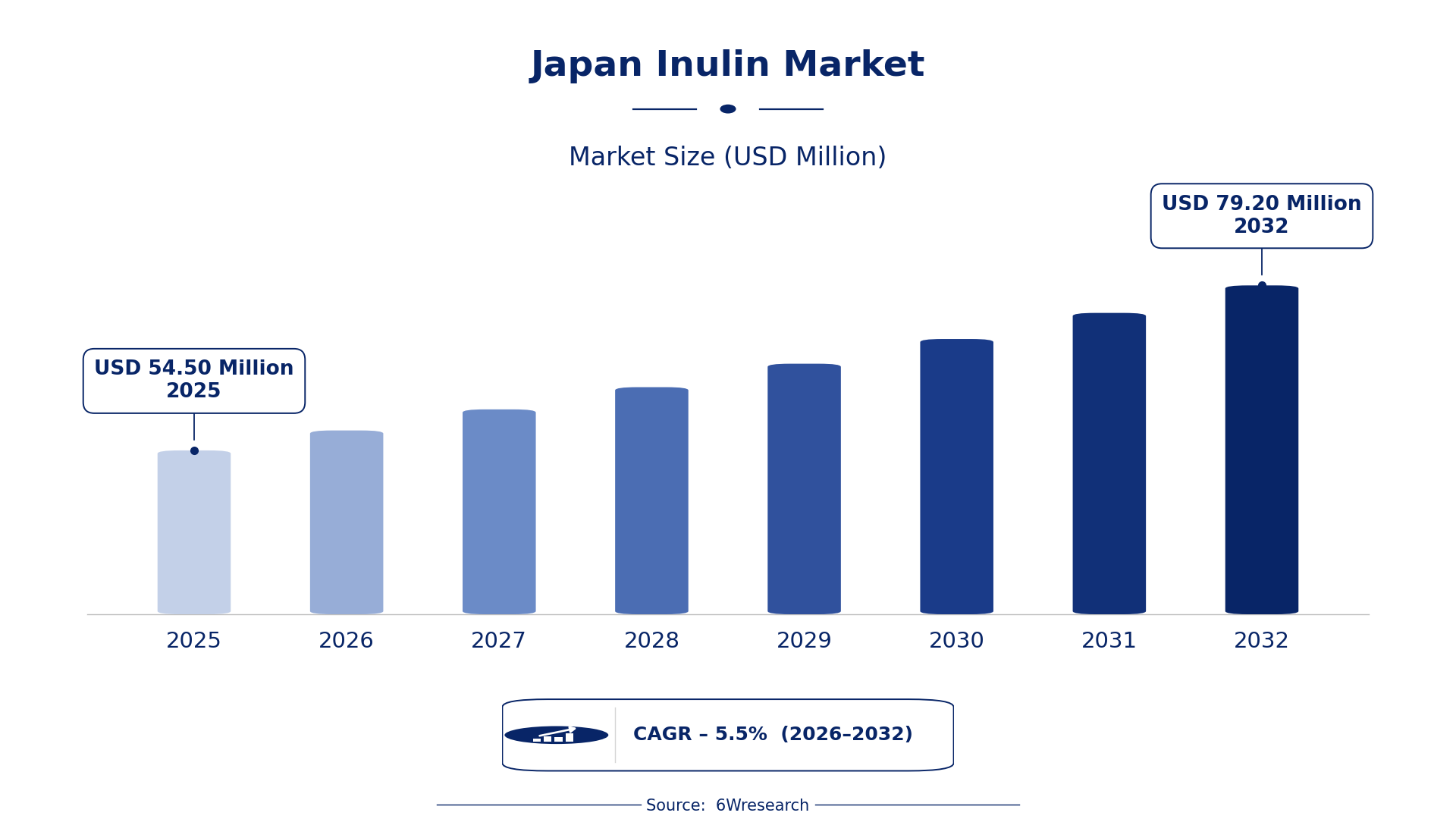
According to 6Wresearch internal database and industry insights, the Japan Inulin Market was valued at USD 54.50 Million in 2025 and is projected to reach USD 79.20 Million by 2032, growing at a CAGR of approximately 5.5% during 2026–2032.
Japan Inulin Market Highlights
| Report Metric | Details |
| Report Name | Japan Inulin Market (2026-2032) |
| Market Size 2025 | USD 54.50 Million |
| Market Size 2032 | USD 79.20 Million |
| Absolute Growth 2025–2032 | USD 24.70 Million |
| CAGR 2026–2032 | 5.5% |
| Peak Annual Growth | 6.3% in 2028 |
| Forecast Period | 2026–2032 |
| Historical Data | 2022–2025 |
| Base Year | 2025 |
| Leading Form, 2025 | Powder (62% share) |
| Leading Nature, 2025 | Organic (57% share) |
| Leading Source, 2025 | Chicory (52% share) |
| Leading Application, 2025 | Food & Beverages (41% share) |
| Fastest-Growing Form | Liquid (7.4% CAGR) |
| Fastest-Growing Source | Agave (7.6% CAGR) |
| Fastest-Growing Application | Dietary Supplements (7.9% CAGR) |
| Growing Sector | Dietary Supplements |
| Key End Users | Food manufacturers, dietary supplement producers, health-conscious consumers, organic product retailers |
Japan Inulin Market Year-wise Growth Rate and Key Drivers (2022–2032)
This graph illustrates the annual growth rates of the market from 2022 to 2032, highlighting a steady upward trajectory and projected market expansion over the forecast period.
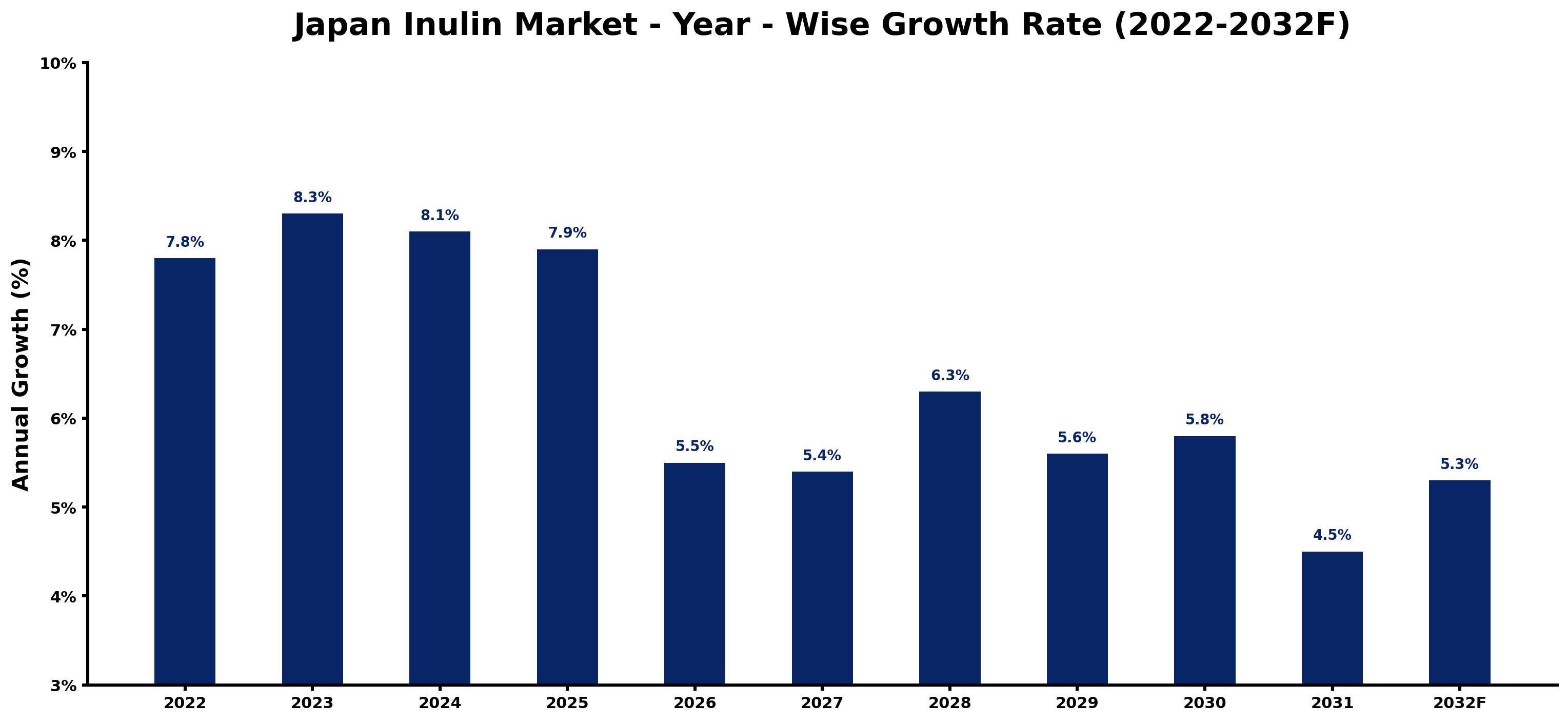
Annual growth estimates for each year appear below with the principal reason behind them, explaining the shifts that set the pace of the market.
| Year | Estimated Annual Growth (%) | Market Rationale |
| 2022 | 7.8 | The market exhibited solid growth due to rising health consciousness among consumers. |
| 2023 | 8.3 | Demand surged as the dietary supplement market reached a valuation of approximately 1.2 trillion yen. |
| 2024 | 8.1 | Growth slowed as consumer preferences began to stabilise after rapid increases. |
| 2025 | 7.9 | Demand continued to grow, but at a slower pace as market saturation approached. |
| 2026 | 5.5 | The market is projected to experience a slowdown as competition intensifies among suppliers. |
| 2027 | 5.4 | Growth is expected to decelerate slightly, reflecting a more mature market. |
| 2028 | 6.3 | The market is anticipated to rebound with renewed interest in dietary fibers and health products. |
| 2029 | 5.6 | Growth is expected to slow again as consumers become more selective in their purchases. |
| 2030 | 5.8 | Demand is projected to increase as health campaigns promote dietary fiber intake. |
| 2031 | 4.5 | The market will see a slowdown as growth rates normalise after peaks. |
| 2032 | 5.3 | Demand is anticipated to rise steadily as health awareness continues to grow. |
Note: Market size estimations and growth projections presented in this report are based on 6Wresearch's proprietary forecasting methodology, utilizing the latest available industry data, government publications, and primary research inputs.
Japan Inulin Market Synopsis
Inulin is a soluble dietary fiber derived from chicory and agave, primarily serving as a prebiotic, fat replacer, and sweetener in food products. The Japan Inulin Market is growing due to health-conscious consumers and the expanding dietary supplement sector, valued at approximately 1.2 trillion yen in 2022. The government's health campaign promoting dietary fibers and increasing awareness of health benefits further drives demand for inulin across various applications, especially in food and beverages. This trend presents a notable opportunity for suppliers to address the rising consumer interest in health-oriented products.
Market Dynamics Impact Analysis (2026–2032)
| Factor | Type | Impact | Primary Segment Affected |
| Health campaigns promoting dietary fibers are expanding consumer awareness. | Driver | High | Food & Beverages |
| The dietary supplement market's growth is driving demand for functional ingredients. | Driver | High | Dietary Supplements |
| The organic inulin segment is gaining traction due to rising health awareness. | Opportunity | High | Organic |
| Growing demand for low-calorie food products presents new market potential. | Opportunity | Medium | Food & Beverages |
| Limited awareness of inulin's benefits may hinder market expansion. | Restraint | Medium | Dietary Supplements |
| Competition from alternative fibers could limit inulin's market share. | Restraint | Medium | Food & Beverages |
| Rising production costs can affect pricing strategies for suppliers. | Challenge | High | Organic |
| Compliance with food safety regulations can increase operational complexity. | Challenge | Medium | Conventional |
Evaluation of Drivers in Japan Inulin Market (2026–2032)
These are the developments adding the most demand over the forecast period.
| Drivers | Primary Segment Affected | Why It Matters (Evidence) |
| The increasing focus on health and wellness drives demand for dietary fibers. | Dietary Supplements | The Japanese dietary supplement market was valued at approximately 1.2 trillion yen in 2022, resulting in higher purchases of inulin. |
| Growing consumer preference for low-calorie products boosts inulin use. | Food & Beverages | Chicory inulin is often used in low-calorie food products across Japan, driving its demand. |
| The rise in organic product consumption is pushing organic inulin sales. | Organic | Organic inulin held a 57% market share in 2025, reflecting consumer trends towards organic products. |
| Health campaigns promote dietary fiber intake, increasing inulin demand. | Food & Beverages | These campaigns encourage consumers to seek out products containing inulin for health benefits. |
| The popularity of prebiotic ingredients is expanding in food formulations. | Food & Beverages | Inulin is recognised under JIS standards, solidifying its credibility in food applications. |
Volumes grow on the back of the increasing focus on health and wellness, with the dietary supplement market valued at approximately 1.2 trillion yen in 2022. The consumer preference for low-calorie products drives inulin use, as chicory inulin is often incorporated into low-calorie food products across Japan. Health campaigns promote dietary fiber intake, encouraging consumers to seek products containing inulin. The popularity of prebiotic ingredients in food formulations further boosts demand, as inulin is recognised under JIS standards, solidifying its position in various applications. This trend indicates a growing market for suppliers to explore new opportunities in health-oriented food products.
Evaluation of Restraints in Japan Inulin Market
The main factors holding the market back are set out below.
| Market Restraint | Primary Segment Affected | Why It Matters (Evidence) |
| Limited awareness of inulin's health benefits may restrict consumer adoption. | Dietary Supplements | Despite the growing market, many consumers remain unaware of inulin's advantages, resulting in lower demand. |
| Competition from alternative dietary fibers can impact inulin's market share. | Food & Beverages | As new fibers gain popularity, inulin may face challenges in maintaining its market presence. |
| Rising production costs can affect pricing strategies for suppliers. | Organic | Increased costs in sourcing organic materials may lead to higher prices for consumers. |
| Compliance with stringent food safety regulations can complicate production processes. | Conventional | Producers must navigate complex regulations, which can increase operational costs and time. |
| Market saturation in certain segments may limit growth opportunities. | Food & Beverages | As the market matures, finding new growth avenues becomes increasingly challenging. |
Japan Inulin Market Challenges
Producers in Hokkaido face competition from cheaper imported dietary fibers, which pressures them to reduce prices and diminishes profit margins. Buyers in the Tokyo region encounter sourcing difficulties for high-quality inulin, leading to delays in launching health-focused food products. The rising demand for organic inulin may result in a 15% price increase for manufacturers, complicating pricing strategies for buyers. Limited skills in processing and quality control for inulin extraction restrict producers' ability to meet market standards, causing postponed product launches for buyers seeking effective food solutions.
Trends in the Japan Inulin Market
The following changes are redrawing the Japan Inulin Market.
- Shift towards Organic Products: Health-conscious consumers are increasingly choosing organic inulin, reflecting a broader trend in dietary preferences. Organic inulin is expected to capture a 57% market share by 2025, indicating a notable shift in consumer behaviour.
- Growing Demand for Low-Calorie Foods: The demand for low-calorie food products is on the rise, with inulin being a popular ingredient. Inulin is frequently used in low-calorie food products across Japan, underscoring its relevance in this trend.
- Increased Focus on Dietary Fibers: The Japanese government initiated a health campaign in 2023 to promote dietary fiber intake, including inulin. This campaign aims to address the average daily fiber intake, which falls below recommended levels.
- Expansion of Functional Food Ingredients: There is a growing trend towards incorporating functional food ingredients in products. Inulin is classified as a functional food ingredient by the Japan Health Food Association, highlighting its importance in food formulations.
Investment Opportunities in the Japan Inulin Market
Investors looking at the Japan Inulin Market should consider the following areas.
- Gap in Dietary Fiber Awareness: With the average daily fiber intake in Japan below recommended levels, there is a notable opportunity for inulin suppliers. Targeting health-conscious consumers in urban areas like Tokyo can drive sales.
- Timing for Health Campaigns: The recent health campaign launched in 2023 creates a timely opportunity for inulin producers. Focusing on partnerships with dietary supplement manufacturers can improve market penetration.
- Supply of Organic Inulin: The growing preference for organic products presents a prime opportunity for organic inulin suppliers. Engaging with health food stores and organic product retailers can facilitate market entry.
- Expansion into Functional Foods: The increasing demand for functional food ingredients opens avenues for inulin suppliers. Collaborating with food manufacturers to develop new products can capture this growing market segment.
Government Initiatives in the Japan Inulin Market
The Food Sanitation Act amendment in 2018 introduced a positive list system for food additives, ensuring safety and compliance measures for producers. This law mandates that all food additives, including inulin, must be evaluated and approved before use, ensuring higher safety standards in food products. The amendment enhances the previous framework by providing clearer guidelines for producers, fostering a safer food environment for consumers.
In 2023, the Japanese government launched a health campaign focusing on dietary fibers, supported by the Ministry of Health, Labour and Welfare. This campaign aims to increase public awareness and promote the consumption of dietary fibers, including inulin, as part of a healthier diet. The initiative is expected to reach millions of consumers, significantly impacting their dietary choices.
Future Insight of the Japan Inulin Market
Advancements in extraction technology will improve the quality and yield of inulin by 2032, enabling suppliers to meet rising consumer demand. A national health campaign will likely boost dietary fiber consumption by 20%, prompting buyers to seek more inulin-rich products. New JIS standards will enhance quality control in food items, benefiting both suppliers and consumers. As the market for organic inulin expands, suppliers will be encouraged to adopt sustainable farming practices to remain competitive.
Market Segmentation Analysis
Japan Inulin Market report covers a detailed analysis of the following market segments:
By Form – Powder Leads, Liquid Expected to Grow Fastest
According to Shubham Deep, Research Manager at 6Wresearch, in 2025, Powder led the form split with a 62% share. Powder inulin holds the largest share due to its widespread use in food and dietary supplements, appealing to health-conscious consumers. For instance, it is commonly incorporated into low-calorie food products across Japan, making it a preferred choice among manufacturers. The quickest growth will come from Liquid, forecast to expand at a CAGR of 7.4% between 2026 and 2032. Liquid inulin is experiencing rapid growth as manufacturers seek to diversify product offerings, particularly in beverages. The increasing trend towards functional drinks that incorporate dietary fibers is driving this segment's expansion. Suppliers should consider diversifying their product lines to include liquid inulin to capture emerging market opportunities.
By Nature – Organic Leads and Records the Fastest Growth
Organic took 57% of nature revenue in 2025, more than any other category. Organic inulin leads the market as it aligns with the growing consumer preference for health-conscious and natural products. This trend is particularly visible in the rising demand for organic inulin in various food applications across Japan. Organic is also forecast to expand faster than any other category, at a CAGR of 7.1% over 2026–2032. The organic segment is also the fastest-growing due to increased health awareness among consumers and a notable shift towards natural ingredients in food products. This momentum suggests that the organic segment will continue to expand rapidly as consumer preferences evolve. Suppliers need to prioritise organic certifications and effective marketing strategies to cater to the increasing consumer demand for organic inulin.
By Source – Chicory Leads, Agave Expected to Grow Fastest
With 52% of source revenue in 2025, Chicory was the largest category. Chicory is the main source of inulin in Japan, enjoying a dominant market share due to its extensive cultivation in regions like Hokkaido. Its established use in a variety of food products solidifies its leading position in the market. Agave is set to record the highest CAGR in this split, 7.6% over 2026–2032. Agave is witnessing rapid growth as consumers increasingly seek alternative sources of inulin, particularly for health-oriented products. This shift is evidenced by the rising popularity of agave in niche markets, indicating a broader acceptance among health-conscious consumers. Suppliers should explore opportunities to diversify their offerings by including agave inulin to meet the changing preferences of consumers.
By Application – Food & Beverages Lead, Dietary Supplements Expected to Grow Fastest
Food & Beverages held 41% of the Japan Inulin Market by application in 2025. The food and beverage sector represents the largest application for inulin, primarily because of its effectiveness in improving texture and health benefits across various products. This segment's strength is reinforced by the growing consumer inclination towards healthier food choices in Japan. Dietary Supplements are projected to grow fastest, at a CAGR of 7.9% during 2026–2032. Dietary supplements are the fastest-growing application for inulin, driven by the increasing health and wellness trend where consumers actively seek products that offer health advantages. The dietary supplement market's valuation of approximately 1.2 trillion yen in 2022 underscores the significant potential for growth in this area. Suppliers should tailor their product development and marketing strategies to align with the dietary supplement sector's rapid expansion.
Key Attractiveness of the Report
- 10 Years of Market Numbers
- Historical Data Starting from 2022 to 2025
- Base Year 2025
- Forecast Data until 2032
- Key Performance Indicators Impacting the Market
- Major Upcoming Developments and Projects
Key Highlights of the Report:
- Japan Inulin Market Outlook
- Market Size of Japan Inulin Market, 2025
- Forecast of Japan Inulin Market, 2032
- Historical Data and Forecast of Japan Inulin Revenues & Volume for the Period 2022-2032
- Japan Inulin Market Trend Evolution
- Japan Inulin Market Drivers and Challenges
- Japan Inulin Price Trends
- Japan Inulin Porter's Five Forces
- Japan Inulin Industry Life Cycle
- Historical Data and Forecast of Japan Inulin Market Revenues & Volume By Form for the Period 2022-2032
- Historical Data and Forecast of Japan Inulin Market Revenues & Volume By Powder for the Period 2022-2032
- Historical Data and Forecast of Japan Inulin Market Revenues & Volume By Liquid for the Period 2022-2032
- Historical Data and Forecast of Japan Inulin Market Revenues & Volume By Nature for the Period 2022-2032
- Historical Data and Forecast of Japan Inulin Market Revenues & Volume By Organic for the Period 2022-2032
- Historical Data and Forecast of Japan Inulin Market Revenues & Volume By Conventional for the Period 2022-2032
- Historical Data and Forecast of Japan Inulin Market Revenues & Volume By Source for the Period 2022-2032
- Historical Data and Forecast of Japan Inulin Market Revenues & Volume By Agave for the Period 2022-2032
- Historical Data and Forecast of Japan Inulin Market Revenues & Volume By Chicory for the Period 2022-2032
- Historical Data and Forecast of Japan Inulin Market Revenues & Volume By Jerusalem Artichoke for the Period 2022-2032
- Historical Data and Forecast of Japan Inulin Market Revenues & Volume By Others for the Period 2022-2032
- Historical Data and Forecast of Japan Inulin Market Revenues & Volume By Application for the Period 2022-2032
- Historical Data and Forecast of Japan Inulin Market Revenues & Volume By Food & Beverages for the Period 2022-2032
- Historical Data and Forecast of Japan Inulin Market Revenues & Volume By Dietary Supplements for the Period 2022-2032
- Historical Data and Forecast of Japan Inulin Market Revenues & Volume By Pharmaceuticals for the Period 2022-2032
- Historical Data and Forecast of Japan Inulin Market Revenues & Volume By Animal Feed for the Period 2022-2032
- Japan Inulin Import Export Trade Statistics
- Market Opportunity Assessment By Form
- Market Opportunity Assessment By Nature
- Market Opportunity Assessment By Source
- Market Opportunity Assessment By Application
- Japan Inulin Top Companies Market Share
- Japan Inulin Competitive Benchmarking By Technical and Operational Parameters
- Japan Inulin Company Profiles
- Japan Inulin Key Strategic Recommendations
Market Covered
Coverage by segment is as follows.
By Form
- Powder
- Liquid
By Nature
- Organic
- Conventional
By Source
- Agave
- Chicory
- Jerusalem Artichoke
- Others
By Application
- Food & Beverages
- Dietary Supplements
- Pharmaceuticals
- Animal Feed































